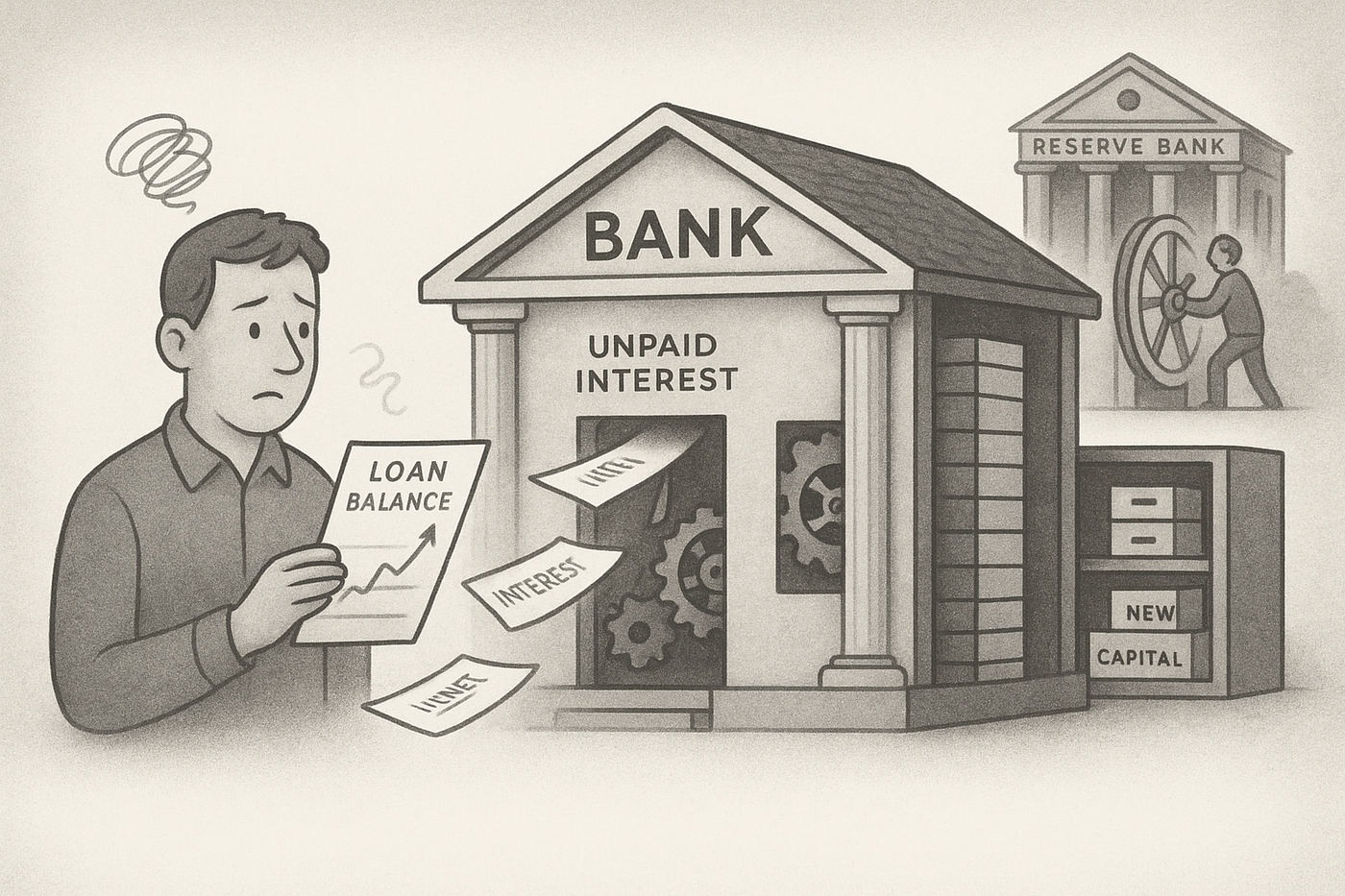
Cellular Economics: A Living System That Balances Itself
A living-systems approach to ownership, finance and shared value
Cellular Economics: A Living System That Balances Itself
A living-systems approach to ownership, finance and shared value

Modern economics often treats the economy as a machine. Money is injected, demand is stimulated, interest rates are adjusted, markets are corrected, governments pull levers, and banks allocate capital. The language is mechanical, and the picture behind it is usually a machine controlled from the top.
But economies do not behave like simple machines. They behave like living systems. They are made of many parts, each part depends on other parts, and the flows between the parts matter as much as the parts themselves. Food, energy, housing, care, transport, knowledge, money and trust all move through the system. When the flows are healthy, people live better. When the flows are blocked, extracted or concentrated, the system becomes unhealthy.
This is where Cellular Economics begins. It does not say that the economy is literally a living organism. It says that living cells provide a better design metaphor than machines do. A living cell has a boundary. It takes in nutrients, uses energy, communicates, repairs itself, removes waste, and regulates what comes in and what goes out. It does not survive by allowing one part of the cell to extract everything from the rest. It survives because flows are balanced within a boundary.
A healthy economy should also be built from bounded, communicating, self-maintaining parts. Each part should have a purpose, observe what is happening within itself, and adjust before damage becomes too great. Each part should keep value circulating among the people who create, use and sustain it. In Cellular Economics, these parts are social enterprises.
A Cellular Social Enterprise is a living cell in the economy. It is not simply a charity, a cooperative or a company with good intentions. It is an organisation designed to provide a real good or service, own or finance the assets needed to provide it, and share the value created with the people who use, work in, fund and maintain the enterprise. It has a purpose, a boundary, assets, users, workers, investors, income, maintenance obligations, governance rules, and a way of deciding how gains and losses are shared.
This is what makes it different from much of the present economy. In the wider economy, money flows everywhere, and it becomes difficult to see what is happening. Profits may be made in one place and extracted in another. Debt may be created in one system and serviced by another. Asset values may rise for owners while costs rise for users. When something goes wrong, it is often hard to see who benefited, who paid, and who carried the loss.
A Cellular Social Enterprise makes those flows visible. It lets us see the real asset, the real service, the financial claims around it, the people who use it, the people who maintain it, and the people who receive the benefit. Once we can see those flows, we can ask whether the enterprise is balanced or slowly extracting value from the people it was meant to serve.
The biological comparison
A living cell is not just a bag of liquid and solids. It is a bounded communicating system. It moves nutrients and waste through fluids, but it also sends information via chemical signals, electrical gradients, direct contact, pressure, and feedback. What makes it alive is not a single transport method, but the coordination of all these flows within a boundary.
An economic cell works in a similar way. The social enterprise is the boundary; the asset is the body; payments are the nutrient flow; Fair Points are the ownership signal; governance is the nervous system; maintenance is the repair system; and depreciation and replacement are part of the life cycle. Profit-sharing and loss-sharing are feedback mechanisms that indicate whether the enterprise is healthy or if something is being hidden.
The point is not that economics should crudely copy biology. The point is that life depends on regulated flows inside boundaries. An economy also needs regulated flows within its boundaries. If too much value is extracted from the cell, the cell weakens. If payments are treated only as private profit, the asset may still exist, but the community becomes poorer. If debt grows faster than the asset’s useful life, the system becomes unstable. If users keep paying but never gain a share in the asset they support, the economic system becomes one-sided.
Cellular Economics asks whether we can design economic cells so that the people who maintain and use assets gradually receive the value they help create. That is why ownership matters, why profit-sharing matters, why losses must be visible, and why Fair Points matter. They are not decorative ideas. They are the signalling and circulation system of the economic cell.
How Cellular Economics differs from ordinary capitalism
In ordinary capitalism, capital represents ownership of assets, where owners of those assets compete with other owners of similar assets to secure the highest price from users of the assets' output. Renters pay landlords, borrowers pay banks, consumers pay corporations, passengers pay transport operators, and residents pay utilities. The people who pay for an asset over time often do not end up owning it. They may fund it many times over, but the ownership and profits remain elsewhere.
This creates a structural split between use and ownership. Those who use assets make the payments, while those who own assets receive the gains. The result is that money flows from people who need goods and services to those who already hold claims over assets. Over time, this concentrates wealth, especially when capital gains, rent, interest and profit are allowed to accumulate without a balancing transfer back to users.
Cellular Economics keeps enterprise, investment and payment, but changes the circulation rules. It says that when people pay for an asset, part of that payment should go toward maintaining the asset, and the rest should transfer value to the people who use and support it. Investors can still receive a fair return. Workers can still be paid. Enterprises can still make a surplus. But ownership does not remain permanently separated from use.
This is not anti-enterprise. It is a different kind of enterprise. It is a social enterprise model in which profit has a purpose. Profit is not treated as a private extraction from the community. It is treated as a signal that the enterprise is producing value, and that value should be shared according to the rules of the cell. Where users create the income stream, users should progressively receive a share of the asset value.
How Cellular Economics differs from socialism
Cellular Economics is also distinct from socialism, at least in the traditional sense of state ownership. It does not say that the state should own everything, that the central government should plan all production, or that one large public authority should decide what every community needs. It keeps ownership closer to the people who use and maintain the asset.
A housing social enterprise should be governed by the people connected to that housing. An energy social enterprise should be governed by the people connected to that energy system. A care social enterprise should be governed by the people who receive, provide and support care. The structure is local, practical and experimental.
The government still has an important role. The government can authorise money creation, set rules, help create fair starting conditions, support experiments, and measure public benefit. But the government does not have to carry all the debt or own all the assets. Cellular Economics, therefore, sits between private capitalism and state socialism. It says that assets should be held in social enterprises where users, workers, investors and the wider community can all have defined roles. The point is not to abolish markets. The point is to design markets so that ownership moves with use and value circulates instead of being extracted.
How Cellular Economics differs from cooperatives
Cooperatives are one of the closest existing models. They already show that enterprises can be owned and governed by members. They already have democratic principles and keep values closer to users, workers or producers. Cellular Economics builds on this tradition, but adds a more precise economic mechanism.
In a normal cooperative, membership and ownership may be relatively fixed. People join, buy shares, and receive benefits, but the cooperative may lack a dynamic mechanism for transferring asset value over time from outside investors to users. It may not have a rule saying that if you keep paying for the asset, you gradually gain a share in it. It may not have a regular mechanism requiring investors to sell part of their holdings, so ownership keeps shifting toward users.
Fair Points Markets are designed to do this. Fair Points are not shares. Shares can vary in value. They can be bought by someone with no connection to the enterprise. A share can rise in price due to scarcity, speculation, or market power. It can give permanent claims to people who no longer contribute to the system. Fair Points have a fixed value of $1, which equals 1 share. Returns come when an asset's value increases by adding more Fair Points, not by changing the value of a Point.
Fair Points are different because they are designed to record participation in the life of the enterprise. A person may receive points by investing money, using the service, working in the enterprise, or maintaining, improving or protecting the asset. The idea is not that everyone receives the same. The idea is that the accounting recognises real contribution.
Fair Points also allow ownership to move. This is the crucial change. In a conventional market, ownership often becomes fixed. The owner owns the asset, and the user pays for access. In a Fair Points Market, ownership can gradually shift to the people who use, pay for, and maintain the asset. Investors can still be rewarded for helping make the asset possible and should receive a fair return, but their claim need not remain permanent. Over time, users can earn points through their regular payments. Ownership circulates instead of becoming stuck.
This is how the enterprise begins to balance itself. It does not rely only on goodwill. It relies on rules that make the value move in the right direction.
Profit is a signal, not the purpose.
A social enterprise has to balance more than its budget. A conventional business usually asks whether income exceeds costs. If it does, the business says it has made a profit. If it does not, the business reports a loss. That is useful information, but it is not enough.
A business can make a profit while under-maintaining its assets, underpaying its workers, overcharging its users, damaging the environment, or transferring too much value to passive owners. In that case, the profit is not a sign that the system is healthy. It may simply be a sign that some costs have been passed on to someone else.
A Cellular Social Enterprise asks a wider set of questions. Is the enterprise maintaining the real assets it depends on? Are users paying a fair amount? Are workers being paid fairly? Are investors being rewarded fairly? Is enough value being kept inside the enterprise to repair, improve and replace assets? Is ownership moving toward the people who use and sustain the system? Are losses visible, or are they being hidden?
Profit is not the enemy. Profit indicates that an enterprise has earned more income than it has spent during a period. That can be useful. It may show that people value what the enterprise provides, that the enterprise has used resources efficiently, or that there is a surplus that can be used for maintenance, reserves, growth or rewards.
The problem is not profit itself. The problem is what happens to profit after it is created. In a conventional company, profit usually belongs to the owners of capital. The users may have paid the profit. The workers may have helped create it. The community may have supplied the roads, rules, trust, education and public infrastructure that made it possible. But the profit is usually treated as belonging to shareholders.
Cellular Economics changes that assumption. In a Cellular Social Enterprise, profit is not automatically treated as a private gain for capital. It is treated as a signal that value has been created inside a shared system. The next question is not simply, “ Who owns the shares? The next question is, who contributed to this value, and how should it now circulate?
Some of the surplus may go to investors because they helped make the asset possible. Some may go to the workers because their labour helped create the value. Some may go to users because their payments generated the surplus. Some may go to maintenance because the asset must be kept in good condition. Some may go to reserves because future shocks must be absorbed. Some may go to the wider community because the enterprise exists inside a public and ecological system.
This is where Fair Points Markets become important. They provide the accounting system for sharing value based on contribution, use, maintenance, funding and need. They allow the enterprise to ask not just whether it made a profit, but whether that profit is being shared in a way that keeps the system balanced.
Losses must also be visible.
If gains are shared, losses must be visible as well. Otherwise, the system is not honest. A social enterprise cannot simply distribute the good news while hiding the bad. If users, workers, investors and communities are to share in value, then they also need to see where value is being lost.
If an asset is poorly maintained, that is a loss. If the enterprise undercharges and cannot replace equipment, that is a loss. If users overuse a shared resource, that is a loss. If investors demand too much and make the service unaffordable, that is a loss. If management makes poor decisions, that is a loss. If environmental damage is pushed off the balance sheet, it is still a loss, even if the financial statements look healthy.
In the conventional economy, many losses are hidden. They are pushed onto renters, workers, governments, future generations or the environment. A business can appear profitable because it has not paid the full cost of what it uses. A financial asset can appear valuable because someone else is carrying the risk. A service can look cheap because unpaid people, public systems or ecological systems are absorbing the real cost.
A Cellular Social Enterprise should not work like that. Its purpose is to make gains and losses visible inside the enterprise. If the enterprise performs well, value is shared. If it performs poorly, the loss is also visible and must be addressed. This gives everyone an interest in maintenance, good management, fair pricing, and the avoidance of extraction. A system that shares only gains becomes a gift to the powerful. A system that makes both gains and losses visible becomes a more stable economy.
Why smaller units can balance better
A living economy does not balance itself because someone at the top understands everything. It balances itself when each part can see what is happening, respond to it, and adjust before the problem becomes too large.
Large systems often hide failure. A national housing market can remain unaffordable for decades while still appearing profitable to banks, landlords and existing owners. A water system can carry debt for generations while users simply pay higher bills. A transport system can be judged mainly by financial returns while ignoring congestion, health, access and public benefit. A care system can reduce costs by reducing care.
The larger the system, the easier it is for one group to gain while another group pays. Costs can be shifted across time, across institutions, across communities and onto the environment. People may know that something is wrong, but they cannot easily see the cause of the problem.
A cellular system reduces that problem by creating smaller, clearer units. Each social enterprise has its own purpose and its own accounts. The people involved can see more clearly what is happening. They can ask whether the enterprise is maintaining its assets, whether payments are fair, whether ownership is moving, and whether value is leaking out.
This does not mean every enterprise must be tiny. A housing enterprise may contain many houses. A water enterprise may be large. A transport enterprise may involve many routes, vehicles and stations. But the principle is that the financial and ownership flows should be visible in relation to the real service being provided. The cell, or social enterprise, is therefore a unit of visibility. It lets us see whether money is serving the asset, or whether the asset has become a servant of finance.
Feedback, inflation and wealth
A self-balancing social enterprise needs feedback. Feedback means the enterprise must be able to see the consequences of its own actions. If maintenance is delayed, the cost must become visible. If prices are too high, users must be able to see why. If investors are receiving too much, the effect on affordability must be visible. If users are paying enough to build ownership, that must also be visible.
This feedback loop is what allows the enterprise to adjust. In the current economy, feedback is often distorted. Prices rise, but we may not know whether the rise comes from real scarcity, financial speculation, debt costs, monopoly power, poor planning or hidden extraction. Wages may stagnate while asset prices rise. Governments may subsidise services, but the benefit may leak out through land prices, private profits or debt servicing.
A Cellular Social Enterprise tries to shorten the feedback loop. It asks practical questions. How much income came in? How much was needed for the operation? How much was needed for maintenance? How much went to investors? How much transferred ownership to users? How much was retained for future replacement? How much leaked out of the system without improving the asset or the service?
Once those questions are asked regularly, the enterprise can learn. If the enterprise is under-maintaining assets, it can increase the maintenance share. If users are not building ownership quickly enough, the Fair Points rules can be adjusted. If investors are not being rewarded enough to provide capital, investor returns can be adjusted. If too much value is leaving the enterprise, the structure can be changed. This is not central planning. It is local learning.
This also changes how we think about inflation. Inflation is usually discussed as if the whole economy had a single temperature. If prices rise, central banks increase interest rates. This is meant to slow spending across the whole economy. Sometimes that may be necessary, but it is a very blunt instrument.
The economy does not overheat evenly. Housing costs may rise while wages remain stagnant. Energy prices may rise due to infrastructure failures. Food prices may rise because of climate shocks. Construction costs may rise due to material shortages. Asset prices may rise because too much credit is flowing into existing assets rather than new production.
A cellular economy gives us a more precise way to think. If each social enterprise connects money, assets, payments and ownership, then price pressure can be seen where it actually occurs. A housing enterprise can see whether costs are rising due to maintenance, land, debt, investor returns, materials, insurance, or administration. An energy enterprise can determine whether costs are rising due to equipment, grid fees, maintenance, storage, or financing. A care enterprise can see whether costs are rising due to wages, buildings, compliance, equipment, or profit extraction.
Different causes need different responses. If prices are rising because assets are under-maintained, the answer is maintenance. If they are rising because ownership is too concentrated, the answer is to transfer ownership. If they are rising because debt servicing is too high, the answer is cheaper financing. If they are rising because resources are genuinely scarce, the answer is investment, substitution, conservation or rationing. A single interest-rate lever cannot see these differences. A cellular system can.
The central difference: money does not generate money
The biggest difference is how money is treated. In the financial economy, money is often treated as if it naturally generates more money. If someone lends money, they expect more money back. If someone owns an asset, they expect its price to rise. If someone invests, they expect returns that may not be tied to their own contribution to the real economy.
Cellular Economics starts from a different principle. Money is not alive. Money does not build houses, care for people, grow food, repair ecosystems or generate electricity. People do that. Organisations do that. Land, materials, knowledge, trust and labour do that. Money is a claim, a signal and a coordinating tool. It should help real assets and real services come into existence. It should not become a permanent extraction device.
This is why Cellular Economics is concerned with debt, interest, rent and speculative capital gains. The problem is not that people are paid for contributing. The problem is when payment becomes detached from contribution, and claims over future income keep growing faster than the real assets and services that support life.
A living cell cannot survive if one internal process expands without limit and consumes the rest of the cell. We call it a cancer. An economy has the same problem. Finance should serve the real economy, not grow as a separate system making claims on it.
Cellular Economics, therefore, asks finance to return to purpose. Money should help create and maintain assets. Payments should reduce obligations. Value should circulate to those who use and support the assets. Profit should be shared where it is created. Losses should also be shared, rather than pushed onto the weakest participants.
Where Cellular Economics fits
Cellular Economics belongs in the family of living-systems economics, ecological economics, regenerative economics, cooperative economics and social enterprise design. It draws something from each of them, but it is not identical to any of them.
From biology, it takes the idea of bounded, communicating, self-maintaining systems. Ecological economics holds that the economy must serve real life and operate within material limits. From regenerative economics, the idea is that healthy systems circulate value, repair themselves, and build resilience. From cooperatives, it takes democratic ownership and member benefits. From a social enterprise perspective, it takes purpose, trading activity, and retained or shared surplus. In agent-based modelling, the idea is that complex outcomes emerge from local rules.
But Cellular Economics adds a specific claim. The basic economic unit should be a social enterprise that holds real assets and uses Fair Points to move value toward the people who use, maintain and pay for those assets.
That is the distinctive contribution. It is not just a metaphor. It is a design principle.
A practical test
The test of Cellular Economics is not whether the metaphor is elegant. The test is whether the structure works. A housing social enterprise, for example, can be judged by whether it reduces the cost of living compared with a mortgage or rent system, whether it transfers ownership to occupants over time, whether it still gives investors a fair return, whether it maintains the houses properly, whether it reduces the amount of money lost to interest, speculation and unnecessary transaction costs, whether it makes the community more stable, whether it allows government to support housing without carrying more debt, and whether it keeps value circulating locally.
These are practical questions. They can be measured. That is why Cellular Economics should not be judged as a grand ideology. It should be judged as an experimental economic design. If the rules work in one cell, they can be refined and applied elsewhere. If they fail, the rules can be changed. The economy becomes a learning system rather than a fixed structure defended by theory.
The larger purpose
The present economy often rewards ownership more than contribution. It allows people who already own assets to gain greater control over the income of those who need it. It treats money as if it could grow on its own. It treats debt as normal, even when debt grows faster than the real economy. It separates users from ownership and then wonders why inequality grows.
Cellular Economics starts somewhere else. It says the economy should be built on real assets, real services, and real relationships. It says that money should help those assets come into existence, not become a permanent burden on them. It says that people who use and pay for assets should gradually share in their value. It says that enterprises can be profitable without being extractive. It says that ownership should move, not freeze.
This is what living cells teach us. Life is not created by endless accumulation in one place. Life is created by regulated flows, maintained boundaries, communication, repair and balance. An economy should do the same.
Cellular Economics is therefore a bridge between biology and economics. It takes the living-systems insight seriously, but it does not stop at analogy. It proposes a practical structure: social enterprises, real assets, Fair Points Markets, shared profits, shared losses, and the gradual transfer of value to the people who sustain the system.
If you are a leader, policymaker, or innovator seeking to make economies more balanced and resilient, consider piloting a single element of Cellular Economics in your context. Begin with one small experiment: create a social enterprise around a real asset, introduce visible flows for value sharing, or trial Fair Points as an ownership mechanism. By experimenting on a manageable scale, you can help test, learn, and refine these principles in practice. Your willingness to explore can lay the groundwork for a healthier economic system that learns and repairs itself from within.
That is how social enterprises balance themselves. They make the real economy visible. They make finance accountable. They make ownership move. And when ownership shifts toward the people who depend on the asset, the economy begins to repair itself from within.
메타데이터
- post_id
- 793ecb4af9ce
- slug
- cellular-economics-a-living-system-that-balances-itself-793ecb4af9ce
- url
- https://medium.com/@kevin-34708/cellular-economics-a-living-system-that-balances-itself-793ecb4af9ce
- canonical_url
- https://medium.com/@kevin-34708/cellular-economics-a-living-system-that-balances-itself-793ecb4af9ce
- author_url
- https://medium.com/@kevin-34708
- status
- ok
- fetched_at
- 2026-08-09 00:55:21