Generative AI vs Agentic AI: Understanding the Next Shift
It’s not about whether to use AI. That decision has already been made. It’s about something more uncomfortable: why, despite significant AI…
Generative AI vs Agentic AI: Understanding the Next Shift
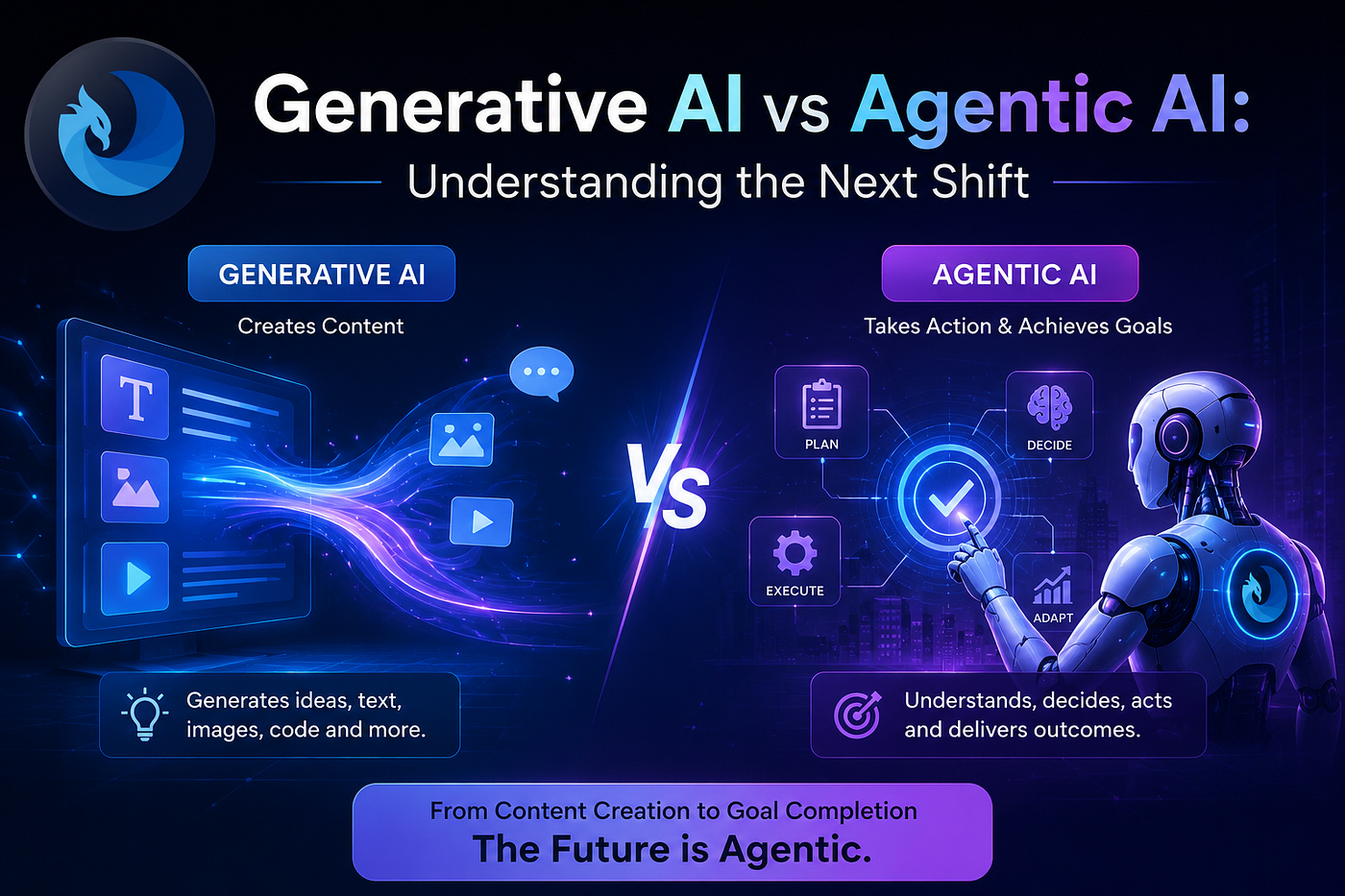
It’s not about whether to use AI. That decision has already been made. It’s about something more uncomfortable: why, despite significant AI investment, the actual work still feels the same. Teams are faster at drafting. Slower at deciding. Better at generating. Still stuck executing. The answer isn’t more prompting. It’s a different kind of AI entirely.
**Generative AI and Agentic AI **are not competing products. There are two different philosophies about what AI should do, and understanding the difference between them may be the most important strategic conversation your organization has this year.
The central question isn’t “which AI should we use?” It’s “do we want AI that creates, or AI that acts?”
The First Wave: What Generative AI Changed?
The moment everything shifted
When large language models became publicly accessible in 2022, they didn’t just impress people. They permanently reset expectations about what technology could do without an engineer in the room.
For the first time, a non-technical leader could describe a problem in plain English and get a genuinely useful output within seconds.
Where businesses felt it immediately
Marketing and Content
- Campaign briefs that took days were drafted in hours
- A/B copy variants generated at scale without agency dependency
- SEO content was produced faster than editorial teams could review it
Software Development
- Junior developers shipping code with senior-level support
- Debugging cycles cut from hours to minutes
- Documentation the task everyone avoided is finally getting done
Customer Support
- Response templates built from historical ticket data
- Knowledge bases are summarized and made searchable
- First-draft replies generated before agents even opened the ticket
Knowledge Work
- Legal teams drafting contracts and NDAs faster
- Finance teams summarizing reports without manual analysis
- HR is generating job descriptions, offer letters, and onboarding materials on demand
The core mechanic
Generative AI operates on a simple loop:
Human prompt → AI output → Human review → Human action
Every cycle begins and ends with a human. The AI produces. The human decides. The AI waits. That loop created enormous value. It also created a ceiling.
The Limitations Businesses Are Starting to Notice
The Productivity Paradox
Here’s what most honest post-implementation reviews are finding: Generative AI sped up creation but didn’t reduce coordination. A marketing team using AI tools still needs a project manager to assign work, track revisions, chase approvals, and make sure the campaign actually ships on time. The content gets written faster. The process around it hasn’t changed.
The three gaps Generative AI cannot close
- Execution gap: AI drafts the plan. Humans still have to run it.
- Memory gap: Each prompt starts fresh. AI has no awareness of what happened before.
- Judgement gap: AI generates options. Humans still have to choose and act.
What Is Agentic AI?
A different starting point
Generative AI asks: “What should I produce?”
Agentic AI asks: “What needs to happen and how do I make it happen?”
Agentic AI refers to systems capable of autonomous goal pursuit. Instead of responding to a single prompt, an agentic system receives a goal, plans the steps required to achieve it, executes those steps using available tools, monitors its own progress, and adjusts when something doesn’t go as expected.
The core capabilities that separate it
- Goal comprehension: Understanding what success looks like, not just what was asked
- Multi-step planning: Breaking a goal into an ordered sequence of actions
- Tool use: Accessing APIs, databases, calendars, CRMs, and external systems autonomously
- Decision-making: Choosing between options without human input at each step
- Self-monitoring: Checking whether actions are producing the right results
- Adaptation: Changing course when outputs don’t match expectations
The same scenario, handled differently
The prompt: “Handle this customer support escalation.”
Generative AI response: Drafts a professional reply. Stops. Waits for a human to send it, log it, and decide next steps.
Agentic AI response:
- Reads the ticket and classifies the issue type
- Searches the knowledge base for relevant resolution history
- Checks the customer’s account status and purchase history in the CRM
- Drafts a response calibrated to the customer’s tier and issue severity
- Sends the reply
- Logs the interaction and updates the ticket status
- Creates a follow-up task for 48 hours out
- Escalates to a human agent only if the customer responds with unresolved frustration
The human set the goal. The agent completed the workflow.
Generative AI vs Agentic AI: The Core Differences
At first glance, Generative AI and Agentic AI may seem similar because both rely on advanced AI models. The difference becomes clear when you look at what each system is designed to accomplish.
Purpose
Generative AI is built to create. It responds to prompts by producing text, code, images, reports, summaries, and other forms of content.
Agentic AI is built to achieve outcomes. Rather than simply generating information, it works toward a defined objective and takes actions required to complete it.
How They Get Started
Generative AI typically waits for a user prompt. It responds when asked and stops when the response is delivered.
Agentic AI starts with a goal, trigger, or business event. Once activated, it can plan multiple steps and continue working until the objective is completed.
What They Deliver
The output of Generative AI is usually content such as written responses, software code, images, presentations, or data summaries.
The output of Agentic AI is completed work. This may include updating systems, executing workflows, scheduling tasks, sending notifications, processing transactions, or coordinating multiple applications.
Decision-Making Capabilities
Generative AI can suggest options and provide recommendations, but it does not make decisions on its own.
Agentic AI can evaluate available options, choose the most appropriate course of action based on predefined rules or objectives, and move forward without requiring constant human direction.
Task Completion
Once Generative AI creates the requested output, its role ends.
Agentic AI continues operating across multiple steps. It monitors progress, adjusts actions when conditions change, and keeps working until the target outcome is reached.
Memory and Context
Most Generative AI systems focus on the current interaction and are limited in how they retain information across activities.
Agentic AI maintains context throughout a process and can use persistent memory to track tasks, previous decisions, workflow status, and business objectives over time.
Use of External Tools
Generative AI primarily generates responses and may have limited interaction with external systems.
Agentic AI actively connects with APIs, databases, enterprise software, business applications, and digital tools to gather information and execute actions.
Ownership of Workflows
Generative AI assists people within a workflow.
Agentic AI can own portions of the workflow itself, managing tasks from initiation through completion while keeping humans informed when necessary.
Human Involvement
Generative AI requires user participation throughout the process. Every major step generally needs a new instruction.
Agentic AI still requires human oversight, but mainly for setting goals, defining boundaries, approving sensitive actions, and handling exceptions.
Business Scalability
Generative AI helps organizations scale content creation, communication, documentation, research, and knowledge sharing.
Agentic AI helps organizations scale operations, decision execution, process management, customer service workflows, and business automation.
Enterprise Applications
Organizations commonly use Generative AI for content generation, customer communications, software development assistance, reporting, and summarization.
Agentic AI is increasingly being deployed for workflow automation, IT operations, supply chain coordination, HR processes, customer support orchestration, finance operations, and cross-functional business execution.
Real Business Examples
Customer Service
Generative AI does: Drafts response templates. Suggests tone adjustments. Summarizes long ticket threads.
Agentic AI does: Reads the incoming ticket → pulls customer history → identifies issue category → resolves if within defined parameters → escalates with full context if not → logs resolution → triggers satisfaction survey → flags repeat issues to the product team.
The difference: One creates a draft. The other closes the ticket.
Human Resources
Generative AI does: Writes job descriptions. Draft interview questions. Creates offer letter templates.
Agentic AI does: Posts the role across platforms → screens incoming applications against defined criteria → ranks candidates → schedules shortlisted interviews → sends calendar invites → follows up on no-responses → generates interview prep briefs for the hiring manager.
The difference: One writes the job description. The other fills the pipeline.
Finance and Compliance
Generative AI does: Summarizes financial reports. Explains variances. Draft audit narratives.
Agentic AI does: Continuously monitors transaction flows → flags statistical anomalies → cross-references against compliance rules → initiates investigation workflows → notifies the right stakeholders → logs all actions with timestamps for the audit trail.
The difference: One explains what happened. The other responds to it in real time.
Operations and Supply Chain
Generative AI does: Generates procurement recommendations. Summarizes supplier performance data. Draft operational SOPs.
Agentic AI does: Monitors inventory levels → identifies reorder triggers → compares supplier pricing and lead times → places orders within approved parameters → updates the ERP → notifies procurement managers of exceptions only.
The difference: One provides a recommendation. The other executes the decision.
Why Agentic AI Is Becoming the Next Enterprise Priority
The business drivers behind the shift
Three compounding pressures are pushing organizations beyond Generative AI faster than most roadmaps anticipated.
Productivity has been unlocked but efficiency hasn’t
Most enterprises have now captured the low-hanging fruit of AI-assisted creation. The next layer of value isn’t faster drafts. It’s fewer handoffs, shorter cycle times, and processes that don’t stall waiting for human action.
Decision volume is outpacing human capacity
Modern organizations make thousands of micro-decisions daily, routing, prioritization, escalation, allocation. Many of these don’t require human judgment. They require consistent, fast, rules-based execution. Agentic AI is built for exactly this.
Labor models are under structural pressure
Headcount isn’t scaling with operational complexity. The question isn’t whether to automate it’s what level of automation is now possible. Agentic AI raises that ceiling significantly.
What leaders actually want from AI
Most AI tools today focus on creating content. Business leaders are focused on something bigger: results.
- Not just faster content creation, but faster business outcomes.
- Not just AI-generated recommendations, but executed decisions.
- Not just better drafts, but completed workflows.
- Not just AI-assisted tasks, but AI-driven processes.
This is where the shift from Generative AI to Agentic AI begins. The goal is no longer producing information. The goal is getting work done.
Will Agentic AI Replace Generative AI?
Short answer: No. They need each other.
Agentic AI doesn’t eliminate Generative AI; it uses it. Most agentic systems rely on generative models to handle the language-heavy parts of a workflow: drafting communications, interpreting unstructured data, generating summaries, and creating reports.
How they divide the work
GENERATIVE AI handles:
→ Creating content
→ Interpreting language
→ Drafting communications
→ Generating knowledge artifacts
AGENTIC AI handles:
→ Planning the workflow
→ Deciding what to do next
→ Executing across systems
→ Monitoring and adapting
→ Coordinating between tools and agents
The combined architecture
[Business Goal]
↓
[Agentic Layer] — Plans, decides, orchestrates, monitors
↓
[Generative Layer] — Creates, drafts, interprets, and communicates
↓
[Business Systems] — CRMs, ERPs, databases, APIs, communication tools
↓
[Outcome] — Completed workflow, updated records, measurable result
Think of Generative AI as the language brain and Agentic AI as the operating system running around it.
Conclusion
The question businesses were asking two years ago was: “How do we use AI to create things faster?”
The question that matters now is: “How do we build AI systems that can run parts of our business?”
Generative AI changed what was possible for individuals. Agentic AI is about to change what’s possible for organizations. The businesses that understand the difference between generative AI and agentic AI today won’t just adopt the next wave of technology. They’ll shape what it looks like in their industry.
At **Liquid Technologies**, we help organizations design, develop, and deploy intelligent AI solutions that connect data, automate operations, and drive measurable business outcomes.
Explore what Agentic AI can do for your organization before the next shift becomes the new standard.
메타데이터
- post_id
- 7955d2a4e748
- slug
- generative-ai-vs-agentic-ai-understanding-the-next-shift-7955d2a4e748
- url
- https://medium.com/@liquidtechnologie/generative-ai-vs-agentic-ai-understanding-the-next-shift-7955d2a4e748
- canonical_url
- https://medium.com/@liquidtechnologie/generative-ai-vs-agentic-ai-understanding-the-next-shift-7955d2a4e748
- author_url
- https://medium.com/@liquidtechnologie
- status
- ok
- fetched_at
- 2026-07-11 07:33:00