What is a SpudCell?
Disclosure: I wrote this article and used AI as a “professional editor” to refine and shorten overly long or complicated sentences.
What is a SpudCell?
Image generated with the assistance of AI.
Disclosure: I wrote this article and used AI as a “professional editor” to refine and shorten overly long or complicated sentences.
.
I recently came across multiple headlines that scientists had built a living cell from scratch. Or maybe not a living cell, but a life-like cell. This synthetic cell is called a SpudCell, and it could be one of those breakthroughs that build the foundation for something bigger. Whether it does remains to be seen. Either way, SpudCells represent the first cell-like system, built from scratch, that completes a full life cycle, even though they are not alive.
Sounds interesting. Sounds confusing. Keep reading, as this article will explain what a SpudCell actually is, how it works, and how it stacks up against a real living cell.
As always in this series, the explanation is intentionally simplified. The underlying science is considerably more complex, but the core ideas can be grasped without all of the details.
All you need to remember is this: DNA stores instructions. Cells copy those instructions into a temporary message called mRNA. Ribosomes then read that message and build proteins. Proteins do many different jobs. Enzymes are a special kind of protein: they make chemical reactions happen, or happen fast enough, inside the cell.
And one more thing: at the time of writing, the SpudCell work has been released as a **preprint**, which means the scientific paper has been shared publicly before it has been accepted by a peer-reviewed journal. That does not mean the work is wrong, but the usual quality-control step is still pending.
.
Building a Synthetic Cell
Maybe you remember that about 15 years ago, scientists chemically synthesized the entire genome of a bacterium (Mycoplasma mycoides) and transplanted that synthetic genome into a recipient cell of a different species (Mycoplasma capricolum) whose own DNA had been removed. The recipient cell accepted the synthetic genome and followed the instructions provided in it. The scientists made a synthetic genome, but they used an existing, living cell to run it. The organism was nicknamed “Synthia.”
For SpudCell, Kate Adamala and her team at the University of Minnesota made the synthetic genome and built the cell-like container around it, from non-living parts. SpudCells are nothing like the cells in our body, but they could represent a foundation for someday building cells like ours from scratch.
As I mentioned, scientists can already make a complete genome synthetically, and that’s exactly what the team did for SpudCells, which have a genome that is about a tenth the size of the bacterial genome made for “Synthia.” The genome of SpudCells is also made of so-called plasmids, which are circular, closed rings of double-stranded DNA.
Next came the cell membrane. Think of it as a “wall” that creates a cell-like inner compartment clearly divided from the surroundings. The scientists used phospholipids, the same molecules that make up our own cell membranes.
Phospholipids are molecules (“building blocks”) shaped a little like a tuning fork: a short single stem at one end (picture it as a rounded knob) splitting into two long prongs that run side by side. But it isn’t rigid at all. The knob is the “head,” and the two prongs are the “tails,” and the head and tails behave in opposite ways around water (See Figure below).
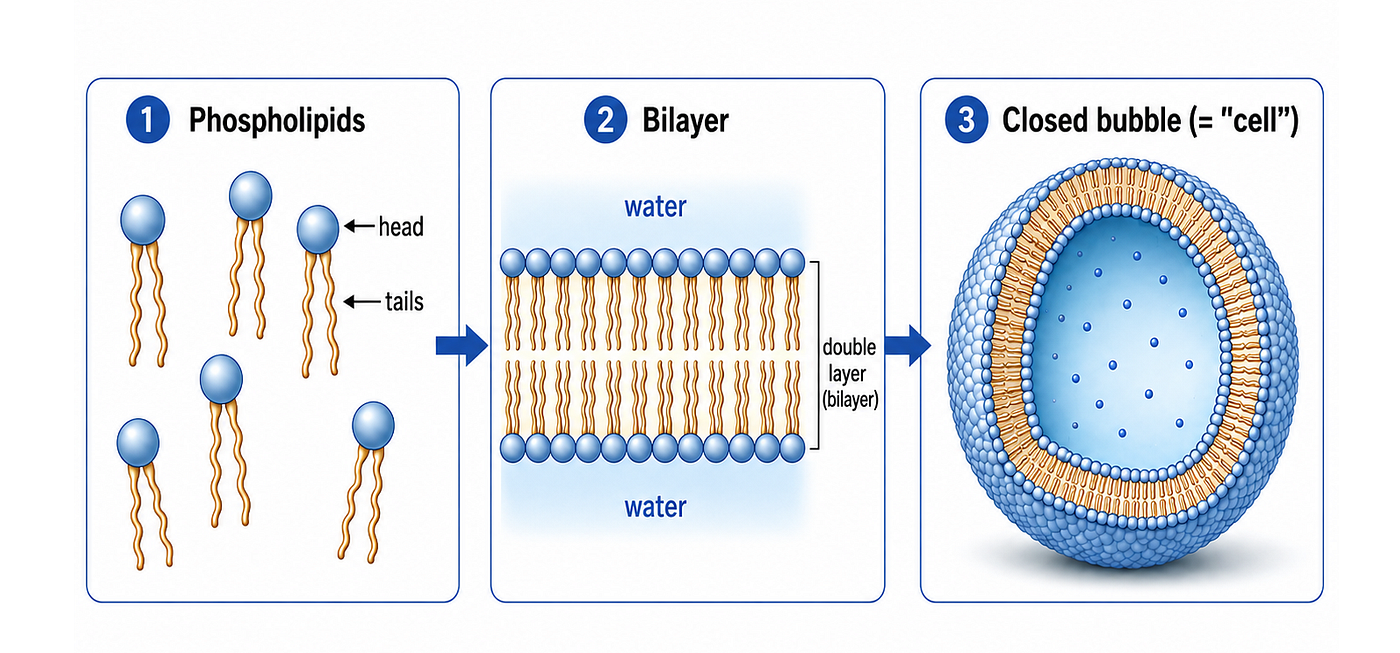
Image generated with the assistance of AI.
The two tails are chemically similar to oil. If you’ve ever poured oil into water, you know it pulls away into droplets, and the tails, being oil-like, are pushed away from water the same way. The head is the opposite: it carries a small electric charge, and water is drawn to charges.
So: head pulled toward water, tails pushed away from it. This design makes phospholipids arrange themselves automatically into a bilayer (= a double layer). One sheet has its heads facing outward, the other has its heads facing inward, and the water-avoiding tails from both sheets meet in the middle, hidden from water in the interior of the bilayer.
A flat sheet bilayer still has a problem at its edges, where tails are left exposed to water. This is why the bilayer forms into a closed bubble, which has no exposed edges at all. That sealed bubble is the cell-like compartment.
Now, I do want to mention that SpudCells also have cholesterol integrated into their cell membrane. Cholesterol helps the membrane stay stable and cope with the stresses of being fed, grown, and divided. As it happens, our own membranes contain it too.
The genome, and everything else the SpudCell needs to function, are trapped inside by chance. Literally. The phospholipids are added to a water solution that also contains the other ingredients. As phospholipid bubbles form, some of them randomly trap those ingredients inside. This is a bit like the lipid particles in mRNA vaccines, which also carry genetic instructions inside.
SpudCells trap not only the genome inside the bubble, but also the tools and raw materials needed to use that genome. These include protein-making machinery, a DNA-copying enzyme (Phi29 polymerase), protein building blocks (amino acids), energy molecules, and small helper molecules called tRNAs. The exact names matter to scientists, but the main idea is simple: the bubble has to contain both instructions and tools.
And this is also where the “synthetic cell” becomes a hybrid. The genome and membrane are built from non-living parts, but some of the working tools inside the SpudCell originally came from living cells. For example, the ribosomes were taken from E. coli bacteria. So SpudCells are built from scratch in an important sense, but they still borrow some of the machinery that natural cells already know how to make.
Let’s pause here, because that’s already a lot of information to process. Maybe time to get a drink, or at least stretch your legs and arms.
.
How do SpudCells Eat, Grow, and Multiply?
Welcome back. Now that we have established how SpudCells are made, let’s look at how they work.
Eating and Growing
For a SpudCell to grow, it needs to take up “food” from the surroundings. The researchers supplied that food as “feeder” droplets. These droplets have the same kind of phospholipid bilayer membrane and contain the needed ingredients, but not the genome.
For a SpudCell to “eat” feeder droplets, scientists gave it the genetic instructions for making a membrane protein called α-hemolysin, which inserts itself into the membrane. The key is that α-hemolysin displays a so-called tag on the outside of the cell. Think of this as a docking handle on the surface. Feeder droplets carry the matching partner, so the two membranes can dock and fuse.
Fusion does two things at once. It delivers the contents of the feeder droplet into the SpudCell, and it adds the feeder droplet’s membrane to the SpudCell’s membrane. In other words, the SpudCell receives fresh supplies and grows larger.
Copying the Genome
SpudCells copy their DNA using a DNA-copying enzyme called Phi29 polymerase, which comes from a bacterial virus (phage) called Phi29. This enzyme continuously duplicates the genome.
Dividing and Multiplying
SpudCells need to be “told” from the outside when to divide. This uses the same membrane protein, α-hemolysin, that is also used for feeding. Here, however, α-hemolysin exposes a different tag on the outside surface of the cell. This tag allows a very bulky protein called streptavidin, which researchers add to the surrounding solution, to bind to the cell. As more streptavidin binds, the surface becomes more crowded. This crowding eventually pinches the cell into a peanut-like structure, and the pinched neck gets thinner and thinner until it snaps, dividing the cell into two.
Alternatively, SpudCells can be pushed through a layer of pores smaller than the cells themselves, which also forces them to snap and divide.
I need to mention that this division is not precisely controlled. The contents of the mother cell are shared out at random. That means a daughter cell may miss one or more plasmids and end up incomplete and unable to function (remember, the SpudCell genome is split across multiple plasmids, somewhat like our genome is split across multiple chromosomes). In fact, only about 30% of daughter cells ended up with the full set.
Nevertheless, the scientists demonstrated at least 5 successful cycles of feeding, copying the genome, and dividing, resulting in 5 generations of SpudCells.
.
Why Build It At All?
By now you might reasonably ask why anyone would build something so limited.
The answer is that a SpudCell is not meant to be impressive on its own. It is a starting point, what the team calls a “chassis,” borrowing from car manufacturing. Because every ingredient is known, the whole system is fully defined, and that is exactly what makes it something researchers can deliberately build on, unlike a natural cell, which comes with billions of years of tangled complexity we still only partly understand. The scientists even kept the genome as separate, swappable pieces of DNA, so new genes can be added or changed one at a time. Piece by piece, future SpudCells could gain more abilities and more control over their own behavior, without anyone having to redesign the whole system at once. That is the real reason to build it: it turns making a cell from one impossible leap into a series of manageable steps.
It also opens a longer-term possibility: programming biology as deliberately as we write software, to build cells that manufacture medicines, grow new materials, or run chemistry that industry does wastefully today.
One reassuring note before we move on: the authors point out that a SpudCell can only divide if a bulky protein and a special linker are added by hand. Since these are not found out in nature, there is no realistic way for it to keep reproducing outside the lab.
.
.
For the interested reader: How does a SpudCell compare to one of our cells?
It is tempting to line a SpudCell up against one of our own cells, but the two are barely in the same league. The point here is not to compare them as equals. It is to show how rudimentary a SpudCell still is. Again and again, it leans on luck or plain physics where a living cell relies on precise, self-built machinery.
Membrane. In a human cell, this is a busy, active barrier: the bilayer is packed with proteins that act as pumps, channels, receptors, and sensors, and the cell builds and grows it under genetic control. A SpudCell is built from the same phospholipid bilayer and cholesterol as ours, but it is almost bare. It carries essentially one protein (for feeding) and none of the pumps, channels, receptors, or sensors, and it self-assembles rather than being actively built.
Internal structure. A human cell has an internal protein scaffold, the cytoskeleton, that gives it its shape, holds its contents in place, and powers movement and division. A SpudCell has nothing of the kind. It is essentially a bag of solution, with no scaffold and no internal organization.
Genome. A human cell keeps its genome as organized chromosomes, packaged and maintained as one coordinated set. A SpudCell’s genome is a handful of small, separate DNA rings (plasmids) floating loose, with nothing holding the set together.
Making its own parts and food. A human cell manufactures its own ribosomes, enzymes, food, and energy from raw materials, and uses active pumps to pull in what it needs. A SpudCell makes almost none of this. It must be hand-fed with feeder droplets, it borrows its ribosomes and enzymes from E. coli, and small molecules simply drift in passively.
Dividing. In a human cell, division is controlled and precise: the genome is split evenly, and each daughter cell reliably ends up with a complete set of everything it needs. A SpudCell’s division is uncontrolled. The bubble splits wherever crowding (or a squeeze through a filter) makes it give way, and the contents are shared out at random, so many daughters end up missing pieces.
.
If you’d like to keep reading:
Subscribe to my newsletter on **Substack** (free, email delivery)
If you’d like to follow my work professionally (and read articles there as well):
Connect with me on **LinkedIn**
If you find this writing useful and want to support independent science communication:
You can support my work on **Patreon** (optional)
메타데이터
- post_id
- 795f4cc75ceb
- slug
- what-is-a-spudcell-795f4cc75ceb
- url
- https://medium.com/@scienceworthknowing/what-is-a-spudcell-795f4cc75ceb
- canonical_url
- https://medium.com/@scienceworthknowing/what-is-a-spudcell-795f4cc75ceb
- author_url
- https://medium.com/@scienceworthknowing
- status
- ok
- fetched_at
- 2026-07-13 13:37:38