How to Invest in Tokenized Treasuries: Step-by-Step Guide (2026)
The convergence of traditional finance and blockchain has given rise to one of the fastest-growing sectors in digital assets — Tokenized US…
How to Invest in Tokenized Treasuries: Step-by-Step Guide (2026)
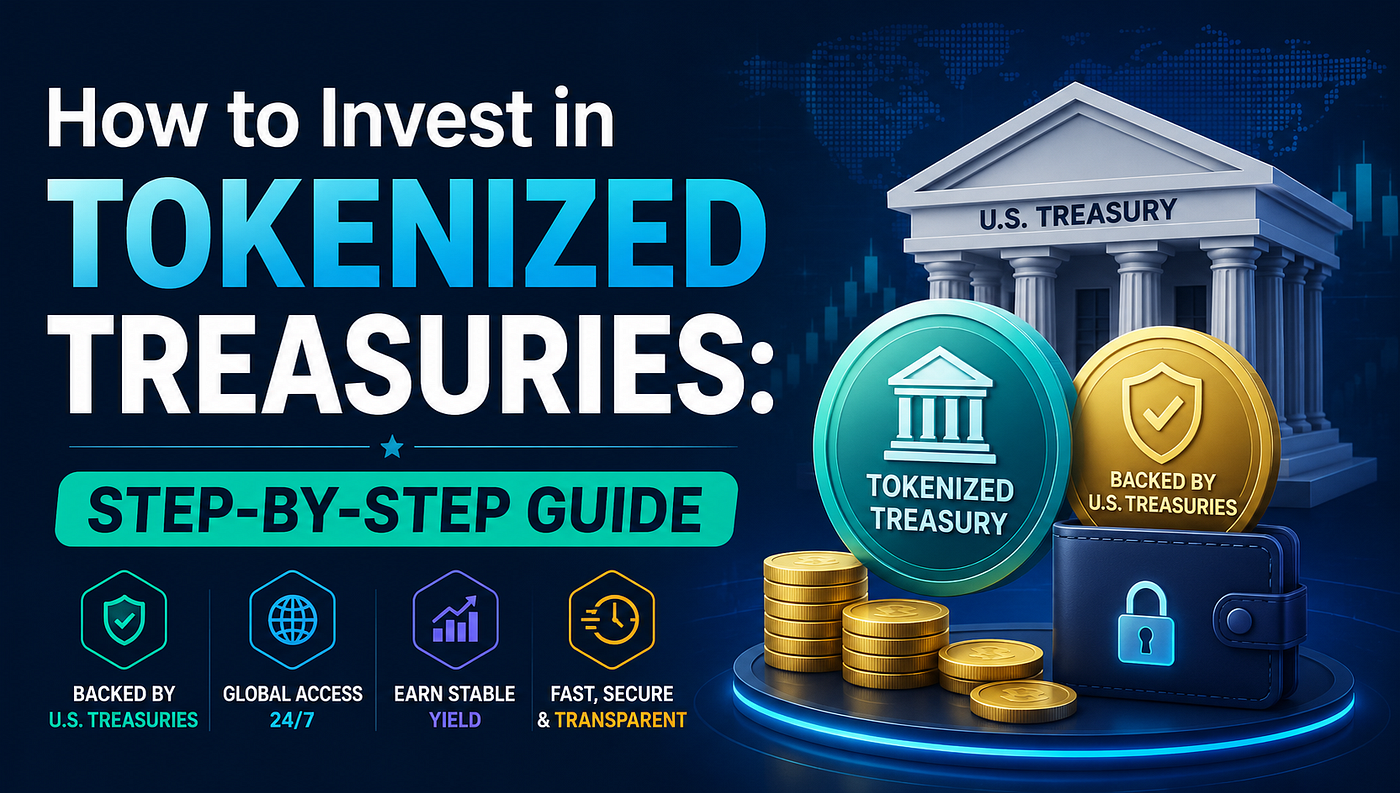
The convergence of traditional finance and blockchain has given rise to one of the fastest-growing sectors in digital assets — Tokenized US Treasuries. Instead of purchasing government securities through banks or brokerage firms, investors can now hold blockchain-based tokens backed by real U.S. Treasury bills while enjoying faster settlement, improved transparency, and 24/7 accessibility.
The market has evolved dramatically over the last two years. Large financial institutions such as BlackRock, Franklin Templeton, Ondo Finance, and WisdomTree have entered the sector, validating tokenized government securities as a legitimate institutional asset class. Recent industry reports estimate that tokenized Treasury assets now represent well over $10 billion in on-chain assets, making them the largest category within the Real World Asset (RWA) ecosystem. Market analysts expect this figure to continue growing as more institutions tokenize fixed-income products and integrate them into blockchain-based financial systems.
Whether you’re a crypto investor seeking stable yield or a business exploring digital asset opportunities, understanding How to Invest in Tokenized Treasuries is becoming increasingly important. This guide explains everything — from how these assets work to where they are traded, their risks, and how they compare with traditional bonds and stablecoins.
What Are Tokenized Treasuries?
Tokenized Treasuries are blockchain-based digital tokens representing ownership or beneficial interest in real U.S. Treasury bills, Treasury notes, or government money market funds. Instead of holding paper securities through conventional financial intermediaries, investors own blockchain tokens backed by regulated custodians that maintain the underlying Treasury assets.
Think of tokenization as placing traditional government securities inside a secure digital wrapper. Every token corresponds to actual Treasury holdings managed by licensed financial institutions. Blockchain technology simply improves how ownership is recorded, transferred, and settled.
Unlike speculative cryptocurrencies, tokenized Treasury products derive their value from one of the world’s safest financial assets — the U.S. government. Since short-term Treasury bills generate interest, these digital tokens also provide investors with passive income while maintaining relatively low volatility.
This innovation addresses several inefficiencies found in traditional finance. Conventional Treasury investments often involve limited trading hours, intermediaries, settlement delays, and geographic restrictions. Tokenization removes many of these barriers by enabling near-instant settlement, transparent ownership records, and programmable financial products that integrate seamlessly with decentralized finance (DeFi).
The concept has attracted both institutional and retail attention because it combines the reliability of government debt with the efficiency of blockchain infrastructure. Investors can access yield-bearing assets without sacrificing the flexibility offered by digital wallets and blockchain ecosystems.
How Tokenized Treasury Assets Work
The process behind tokenized Treasuries is surprisingly straightforward despite the sophisticated technology involved.
An asset manager purchases actual U.S. Treasury securities through regulated financial channels. These securities remain securely held by licensed custodians. A blockchain platform then issues digital tokens representing ownership or economic rights tied to those assets.
When investors purchase these tokens, they essentially own blockchain representations of Treasury-backed investments. Interest generated by the underlying securities is distributed periodically through different mechanisms depending on the issuer. Some platforms increase token value automatically, while others distribute yield separately.
Smart contracts automate ownership transfers, record transactions permanently, and simplify settlement. Because these records exist on public blockchains, transparency improves significantly compared to traditional back-office financial systems.
Several major products — including BlackRock’s BUIDL, Franklin Templeton’s BENJI, Ondo Finance’s OUSG and USDY, and Superstate’s USTB — have demonstrated that blockchain can modernize fixed-income investing without changing the underlying security itself. Institutional participation continues expanding as tokenized government securities become increasingly integrated into treasury management, collateral systems, and DeFi lending markets.
Why Tokenized Treasuries Are Growing So Fast in 2026
Few blockchain sectors have experienced growth comparable to tokenized government securities. While many crypto narratives fluctuate with market cycles, real-world assets continue attracting institutional capital because they solve genuine financial infrastructure challenges.
Industry data indicates that the tokenized Treasury market has surpassed $10 billion in on-chain assets, with BlackRock, Franklin Templeton, Ondo Finance, Circle, and other institutions leading adoption. Treasury-backed products now account for the largest share of the broader RWA ecosystem, reflecting growing demand for low-risk, yield-generating blockchain assets.
Several factors explain this momentum.
Higher global interest rates have made Treasury yields attractive again. Investors holding idle stablecoins can earn government-backed returns without exiting blockchain ecosystems. At the same time, institutional investors increasingly require compliant digital collateral that works across multiple blockchain networks.
Technology has also matured significantly. Modern tokenized Treasury platforms operate across Ethereum, Polygon, Solana, Aptos, Avalanche, Stellar, and other blockchain ecosystems, making these assets accessible to a wider audience.
Regulatory clarity has improved as established asset managers partner with regulated custodians and licensed transfer agents. Instead of relying solely on crypto-native companies, investors now access products managed by globally recognized financial institutions.
Perhaps the biggest driver is utility. Unlike traditional Treasury funds that remain isolated within conventional banking systems, tokenized Treasuries can be integrated into lending protocols, treasury management platforms, cross-border payments, and institutional collateral networks. This programmable functionality creates additional value beyond simple yield generation, positioning tokenized government securities as foundational infrastructure for the next generation of financial markets.
Benefits of Investing in Tokenized Treasuries
The rapid growth of Tokenized US Treasuries is not simply driven by blockchain enthusiasm. Investors are increasingly viewing these assets as a practical alternative for earning stable returns while maintaining the flexibility of digital finance. By combining government-backed securities with blockchain infrastructure, tokenized treasuries address many of the inefficiencies associated with traditional fixed-income investments.
One of the biggest advantages is accessibility. Traditional Treasury investments often require brokerage accounts, banking relationships, and adherence to market trading hours. Tokenized assets remove many of these barriers by allowing eligible investors to purchase and manage Treasury-backed tokens using compatible digital wallets. Settlement times are also significantly shorter, with many transactions completing within minutes instead of waiting one or two business days.
Another major benefit is improved transparency. Every token transaction is recorded on a blockchain, making ownership transfers verifiable and reducing reliance on multiple intermediaries. Investors gain greater visibility into asset movements while institutions benefit from simplified reconciliation processes.
Liquidity is another compelling factor. While the underlying Treasury securities remain traditional financial instruments, tokenization allows them to be transferred digitally between approved participants. This creates opportunities for faster portfolio management and opens the door for future secondary market innovations.
Tokenized Treasuries also integrate seamlessly with decentralized finance (DeFi). Instead of leaving idle capital in non-yield-bearing stablecoins, investors can hold Treasury-backed tokens that generate returns while potentially being used as collateral in compliant lending or liquidity protocols. This additional utility is one of the reasons institutions increasingly consider tokenized government securities as productive on-chain assets rather than passive investments.
Perhaps the greatest advantage is the balance between security and innovation. Investors gain exposure to one of the world’s safest asset classes while benefiting from blockchain features such as programmable ownership, faster settlement, and global accessibility.
How to Invest in Tokenized Treasuries
Understanding How to Invest in Tokenized Treasuries becomes much easier when the process is broken into manageable steps. Although each platform has its own onboarding requirements, the overall investment journey remains largely similar across the industry.
Step 1: Choose a Regulated Platform
The first decision is selecting a reputable issuer or investment platform. Since these products represent regulated financial assets rather than ordinary cryptocurrencies, investors should prioritize platforms that partner with licensed custodians and comply with securities regulations.
When evaluating a provider, consider factors such as:
- Regulatory compliance
- Assets under management
- Custodian reputation
- Supported jurisdictions
- Historical performance
- Blockchain networks supported
- Fee structure
- Redemption policies
Established providers generally offer greater investor confidence because they maintain transparent reporting, audited reserves, and institutional-grade custody solutions.
Step 2: Complete Identity Verification (KYC)
Unlike decentralized cryptocurrencies, most tokenized Treasury products require Know Your Customer (KYC) and Anti-Money Laundering (AML) verification.
Investors typically submit:
- Government-issued identification
- Proof of residence
- Tax information (where applicable)
- Investor suitability documentation
Although this onboarding process takes longer than opening a crypto wallet, it ensures regulatory compliance and protects both investors and asset issuers.
Step 3: Fund Your Account or Wallet
After approval, investors deposit funds into the platform.
Depending on the issuer, funding options may include:
- USD bank transfers
- Stablecoins like USDC
- Wire transfers
- Institutional custody accounts
Some platforms operate entirely within traditional finance, while others bridge conventional banking with blockchain infrastructure. The available funding methods depend largely on the jurisdiction and regulatory framework.
Step 4: Purchase Treasury Tokens
Once your account is funded, purchasing tokenized Treasury assets is similar to buying any other digital investment.
The platform issues blockchain tokens representing your ownership or beneficial interest in the underlying Treasury portfolio. Depending on the issuer, these tokens may appreciate in value as interest accrues or distribute yield at predefined intervals.
Before purchasing, investors should carefully review:
- Minimum investment amount
- Annual management fees
- Expected yield
- Redemption frequency
- Lock-up requirements
- Supported blockchain networks
Understanding these details helps align the investment with your financial goals and liquidity needs.
Step 5: Monitor Performance and Redeem When Needed
After purchasing the tokens, investors can monitor portfolio performance directly through the platform or compatible blockchain wallets.
Key metrics to track include:
- Current token value
- Yield earned
- Net asset value (NAV)
- Interest distributions
- Portfolio composition
Most platforms also provide redemption options, allowing investors to convert their holdings back into fiat currency or eligible digital assets according to the issuer’s redemption schedule.
Where Tokenized Treasuries Are Traded
One of the most frequently asked questions is Where Tokenized Treasuries Are Traded.
Unlike cryptocurrencies that trade on hundreds of public exchanges, tokenized Treasury products primarily operate through regulated issuance platforms and approved secondary marketplaces. This controlled distribution helps maintain compliance with securities regulations while protecting investors.
Several well-known asset managers and fintech companies now offer tokenized Treasury products, including BlackRock, Franklin Templeton, Ondo Finance, WisdomTree, Superstate, and other regulated financial institutions.
Most trading activity currently occurs through:
- Issuer-operated investment portals
- Institutional digital asset platforms
- Licensed broker-dealers
- Qualified custody providers
- Selected blockchain-based marketplaces supporting compliant token transfers
As regulations evolve, industry experts expect secondary markets for tokenized government securities to become more active, improving liquidity and making these products accessible to a broader global investor base.
Tokenized Treasuries vs Traditional Bonds vs Stablecoins
Choosing the right asset depends on your investment objectives. While all three options play valuable roles in portfolio management, they serve different purposes.

For investors seeking predictable income while remaining active within blockchain ecosystems, tokenized Treasuries often represent a compelling middle ground between conventional bonds and stablecoins.
Stablecoins primarily function as digital cash, whereas tokenized Treasury products allow idle capital to generate government-backed returns. Traditional bonds remain valuable for long-term portfolio diversification but generally lack the flexibility, programmability, and accessibility offered by blockchain-based assets.
Risks to Understand Before Investing in RWA
Although tokenized Treasuries are considered among the safest blockchain-based investments, investors should still understand the Risks to Understand Before Investing in RWAs before allocating capital.
Regulatory uncertainty remains one of the most significant considerations. Digital asset regulations continue evolving across jurisdictions, and future policy changes could affect product availability, investor eligibility, or trading mechanisms.
Technology risk also exists. Blockchain infrastructure is highly secure but not immune to vulnerabilities. Smart contract bugs, operational failures, or cybersecurity incidents may impact platform functionality even when the underlying Treasury assets remain secure.
Liquidity risk should not be overlooked. While tokenization improves transferability, redemption policies differ among issuers. Investors may not always have immediate access to their capital, particularly during periods of market stress.
Counterparty risk is another important factor. Investors rely on issuers, custodians, fund administrators, and transfer agents to manage the underlying assets correctly. Choosing reputable providers with transparent governance significantly reduces this risk.
Finally, interest rate risk still applies. Rising interest rates can reduce the market value of Treasury securities, particularly longer-duration instruments. Although short-term Treasury products are generally less sensitive to rate changes, investors should understand how duration affects returns.
Successful investing begins with proper due diligence. Reviewing offering documents, understanding custody arrangements, evaluating regulatory compliance, and assessing redemption policies are essential before making any investment decision.
Conclusion
The evolution of **Tokenized US Treasuries** marks a significant shift in how fixed-income assets are accessed, managed, and traded. By combining the stability of U.S. government securities with the efficiency of blockchain technology, tokenized treasuries offer investors a modern alternative to traditional bond investing. Faster settlement, improved transparency, programmable ownership, and the potential for integration with digital financial ecosystems make these assets increasingly attractive to both retail and institutional participants.
For investors, the key to success lies in understanding the complete investment process rather than chasing market trends. Selecting a regulated platform, completing the required compliance checks, evaluating custody arrangements, and reviewing redemption policies are all essential steps before committing capital. While tokenization introduces new efficiencies, it does not eliminate the need for sound investment research and risk management.
As regulatory frameworks continue to mature and institutional adoption accelerates, tokenized government securities are expected to become a foundational component of the broader **Real World Asset (RWA)** ecosystem. Financial institutions, fintech companies, and asset managers are already expanding their offerings, signaling that blockchain-based treasury products are moving from an emerging innovation to mainstream financial infrastructure.
Businesses exploring this rapidly growing sector can also capitalize on the opportunity by launching compliant investment platforms. If you’re planning to **Build a Tokenized Treasury Platform Like Franklin Templeton**, partnering with an experienced Tokenized Treasuries platform development company can help you create a secure, regulation-ready solution with smart contract automation, digital asset custody integration, investor onboarding, compliance modules, and multi-chain support for institutional-grade operations.
메타데이터
- post_id
- 79648d69de06
- slug
- how-to-invest-in-tokenized-treasuries-step-by-step-guide-2026-79648d69de06
- url
- https://mobileappcircular.com/how-to-invest-in-tokenized-treasuries-step-by-step-guide-2026-79648d69de06
- canonical_url
- https://mobileappcircular.com/how-to-invest-in-tokenized-treasuries-step-by-step-guide-2026-79648d69de06
- author_url
- https://medium.com/@Rathi.rajdeep
- status
- ok
- fetched_at
- 2026-07-09 05:53:33