I have spent six years building infrastructure for things the world treats as inaccessible.
On developer education, real-world assets, a UN-linked land registry, and the insight that led to Kulawise — Otobong Peter
I have spent six years building infrastructure for things the world treats as inaccessible. Health is next.
On developer education, real-world assets, a UN-linked land registry, and the insight that led to Kulawise — Otobong Peter
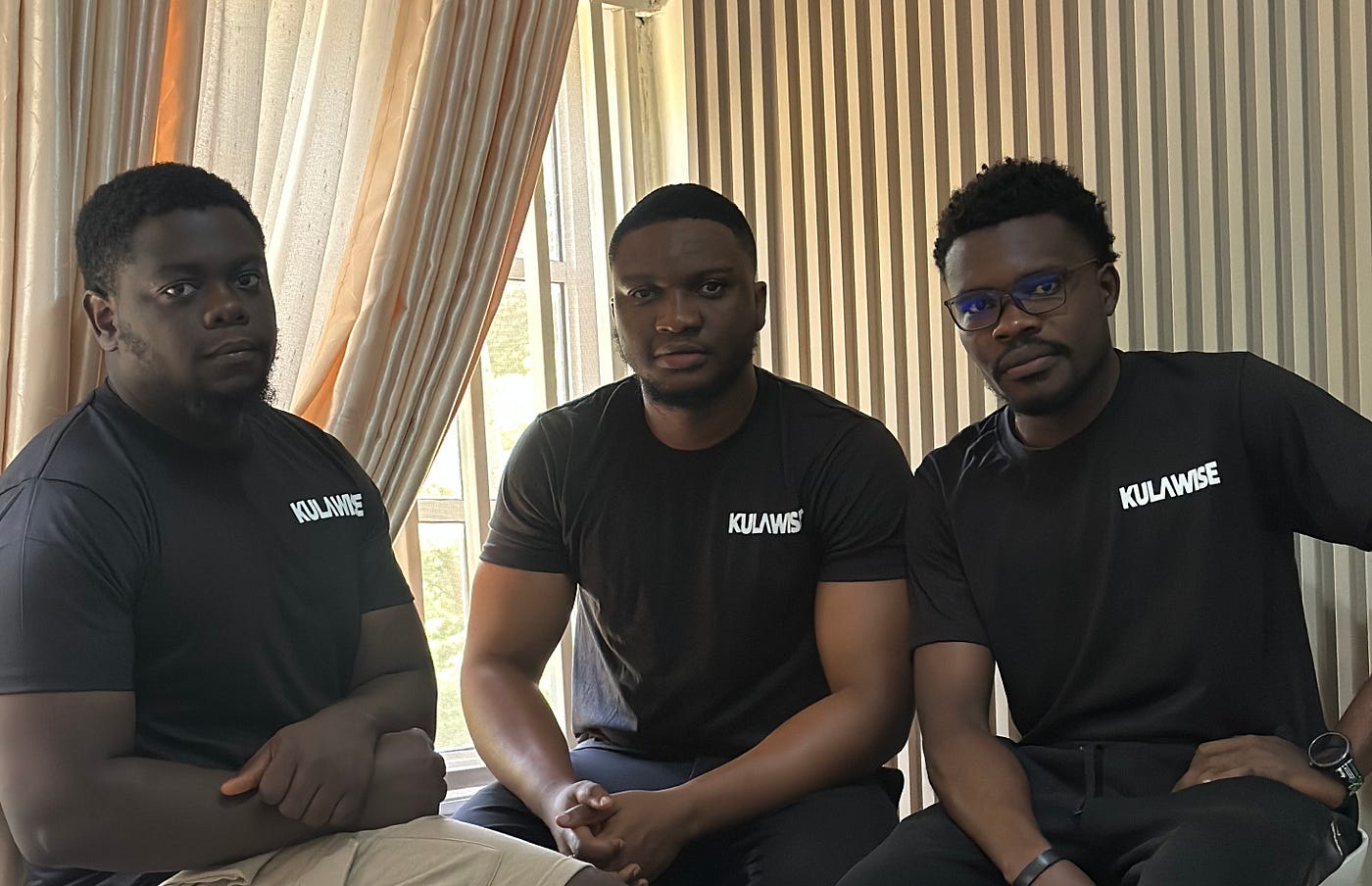
Otobong Peter (middle), Eyimofe to my right and Wisdom to my Left
My name is Otobong Peter. There is a version of this story where I say I always wanted to build in health. That would be punchy but far from the truth. But the honest version is more interesting: I have spent my career chasing a single problem under different names. The problem is that value exists, in people, in land, in bodies and in habits, but the rails that would let that value circulate do not exist yet. I keep showing up at those gaps and building.
It started in developer education. As a Google Developer Students Club lead, selected from thousands of applicants across Sub-Saharan Africa while in the final year of my electrical & electronics engineering bachelor's in 2020, I had the immense opportunity to connect with other talent across the African continent and help students on my campus get started in tech.
Later on, I co-founded ABCD Technologies, where we trained over 500 engineers, ran mentorship programmes, connected talent to opportunities, and raised $37,500 from Cardano’s Project Catalyst Fund VI to sustain what we were building. The lesson I took from that period was not about code. It was about access. Talent was everywhere. The pipeline was not.
Talent was everywhere. The pipeline was not.
When we wound down in 2023, I joined LTO Network, now called Stichting EQTY, based in Amsterdam, 6 months later. They were building real-world asset rails, and I found myself working on the GoLand Registry, a project originally built in partnership with the United Nations to formalise land ownership in conflict and post-conflict economies. First in Afghanistan (you can read more here), then repurposed for Burkina Faso. The mission was simple to state and brutally hard to execute: formalise ownership so that people could participate in economies that had previously locked them out. To make a real-world asset infrastructure viable technically, you have to solve problems around identity, credential verification using VCs, security and trust. LTO had cracked most of these, but like I like to say, each day was always day one in also understanding that beyond the technology, user experience mattered even more.
I also worked with an amazing team where we built LTO’s wallet infrastructure, designing systems for private on-chain asset and message sharing through the ownables technology, and I worked deeply on systems where tokenomics and gamification were first-class engineering concerns. When LTO shut down its Layer 1 in 2025, I collaborated directly with engineering lead Arnold Daniels to migrate the entire platform particularly the ownables technology, to Base L2 and then we developed bridges to allow users to move their tokens, no margin for error. The kind of migration that teaches you something about pressure.
The insight
By then, I had a clear model in my head. The hardest infrastructure problems are the ones where the asset is real, the population is large, and the existing rails are broken or simply absent. Land in Burkina Faso. Developer talent in Port Harcourt. Health in Lagos.
Then a close friend had a health scare. And the next broken rail became obvious.
Health financing in Africa is an episodic, backwards-looking system. Insurers price risk from electronic health records or just a patient’s age in most cases. But EHR data is fragmented, uninteroperable, and only ever captures what has already gone wrong. You cannot build a proactive health infrastructure on a system designed to record episodes after they happen. The data arrives too late, and the picture it paints is always incomplete.
You cannot build proactive health infrastructure on a system designed to record episodes after they happen.
The real signal is behavioural. Mobile devices, used consistently, reveal habits and routines that can predict health episodes before they occur. Observe behaviour long enough and closely enough, and you approach something close to an 80% chance of anticipating an episode before it becomes a claim. That is not a marginal improvement on the status quo. That is a different model entirely. It is the difference between pricing risk reactively and underwriting it intelligently.
But building with mobile as the entry point introduces a new constraint that fintech does not face in the same way. Health behaviour has high churn. People start, then they stop. Habits do not stick without structure, without accountability, without the feeling that something is at stake. Which means the infrastructure cannot simply be rails. From day one, it has to drive daily active behaviour. Not as a feature layer on top of the product, but as the architecture itself.
What we are building
That is Kulawise. Users track health metrics through wearables and their mobile devices. That data flows into Circles, communities built and run by wellness professionals: personal trainers, nutritionists, coaches, and gyms. These professionals bring their own audiences. Kulawise gives them the infrastructure to manage members, run paid communities, and earn from the transformation they create. An AI layer personalises meal recommendations and habit scoring for each member. A wallet handles payments and rewards. Gamification through challenges and Circle leaderboards is what converts a monthly user into a daily one. We earn a percentage off Circle transactions, plus subscriptions from users on the platform. As behavioural data accumulates at scale, the third revenue layer opens: partnerships with health insurers and HMOs who currently have no reliable way to price risk before it becomes a claim, and insurers would gladly offer members discounted premiums if they could guarantee that active Kulawise users file fewer claims. We’re starting as the B2B toll road today, and we’ll evolve into the underwriting intelligence layer tomorrow.
During the years I was building at LTO, I was also completing my MSc in Software Engineering, with research focused on applied AI and machine learning, critical skills which I have found helpful as we build kulawise’s health system. I have also spent time understanding the space properly: speaking to health professionals, insurance providers, wellness coaches, and nutritionists. The problem was not hidden. It was hiding in plain sight, behind a category error. Everyone in African healthtech was starting from the EHR or out-of-wallet payment for micro-insurance. We are starting from the phone in someone’s hand, the noticeable health goals they care about and the habits they would love to build.
I did not stumble into this. Developer education taught me that access is a system problem. The GoLand Registry taught me that infrastructure, when it works, unlocks participation at scale. LTO’s wallet systems taught me that incentives and behaviour are as much engineering concerns as databases and APIs. Kulawise is where those things converge. It is the only problem I could have ended up building.
메타데이터
- post_id
- 796efb38008e
- slug
- i-have-spent-six-years-building-infrastructure-for-things-the-world-treats-as-inaccessible-796efb38008e
- url
- https://medium.com/@otobongpeter/i-have-spent-six-years-building-infrastructure-for-things-the-world-treats-as-inaccessible-796efb38008e
- canonical_url
- https://medium.com/@otobongpeter/i-have-spent-six-years-building-infrastructure-for-things-the-world-treats-as-inaccessible-796efb38008e
- author_url
- https://medium.com/@otobongpeter
- status
- ok
- fetched_at
- 2026-06-12 18:14:10