The Instrumental Once Banned from American Radio
A tune so badass, it didn’t need words to raise a ruckus!
The Instrumental Once Banned from American Radio
A tune so badass, it didn’t need words to raise a ruckus!
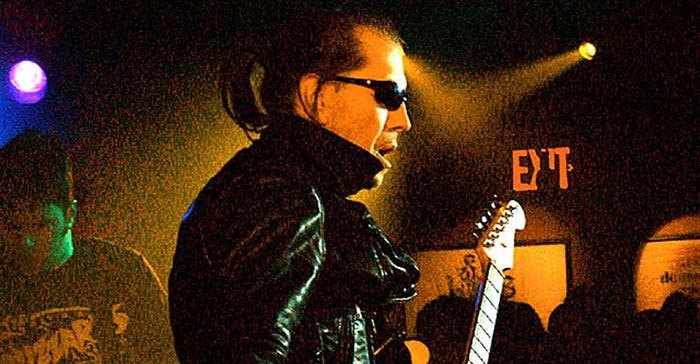
Still a badass; Link Wray on stage in New York, 2003 (photo by Anthony Pepitone via Wikimedia Commons)
*“Let’s see Pat Boone cover this motherf***r!” -Link Wray
In the 1950s, white American parents were fighting a scourge no one had seen coming, and its name was rock-and-roll. You wouldn’t think dance music could threaten the very fabric of society, but so it was.
And the thing is, as much as we like to poke fun at them today, and whatever else you may want to say about them, those old white folks were dead right. Yes, rock and roll allowed kids to form their own culture that cut their parents out of the picture. Yes, it encouraged “race mixing.” Yes, its pervasive sexual innuendo got the teens all hot and bothered. Yes, it promoted drinking and smoking and getting high. All of it was true.
And that was back when rock was little more than boogie woogie played on guitars by guys in suits. Like this:
[embed]
Granted, rockers like Little Richard were getting a whole lot earthier with the lyrics in the juke joints and honky-tonks, but they cleaned it up for radio and the sock hop circuit. Meanwhile, fireside-caridgan artists like Pat Boone had their managers scouring the landscape for new material they could “cover,” which in those days meant putting out their own version before the original could gain an audience, dooming many a worthy band to obscurity and an early demise.
But one night in December of ’57, at a teen dance party in Fredricksburg, Virginia, rock took an unexpected sharp turn onto a much rougher road where the likes of Boone dared not follow. And there would be no looking back.
The man at the wheel was Link Wray:
“The Diamonds had a number one song called ‘The Stroll.’ A disc jockey got up on the stage and said, ‘Link, give me a stroll.’ I said, ‘I don’t know a stroll.’ My brother Doug said, ‘l know the beat to a stroll,’ so he started playing a real hard beat. So I started playing [and] my brother Ray took the microphone that you sing through and he put it into the speakers of my amplifier. Back in those days nobody miked amplifiers, so it was really pulsating through this small speaker. It was rattling and distortion was coming out of the speakers. There were about 5,000 kids in the audience that all rushed to the stage, hollerin’ and screaming during this wild instrumental I was playing. It was really amazing. l just made it up on the spot.” -Link Wray
[embed]Link Wray in 1974, a decade and a half after the original release of “Rumble”
That “disc jockey,” a fellow named Milt Grant, knew a hit when he heard one, so he paid $57 to cut a one-track demo in exchange for writing credits. Trouble was, they couldn’t replicate the distortion from the original performance in the studio. So Wray grabbed a pen that was lying around and before anyone could stop him stabbed holes in the tweeters, a technique The Kinks would later replicate on “You Really Got Me.” A microphone was shoved through a fist-hole someone had knocked into the standup bass during a bar fight.
Initially entitled “Oddball,” the tune was tossed out by Capitol and Decca, but found a more receptive ear at Cadence, where Archie Bleyer personally hated it but thought maybe this weird new thing had potential with younger listeners. So he took it home and let his stepdaughter and her friends listen to it. They proceeded to go nuts, playing it repeatedly, and then he knew he had gold in his hands. He also renamed it “Rumble,” although there are competing accounts about whether his stepdaughter or Cadence artist Phil Everly was the first to call it that.
Released in April of ’58, “Rumble” spread like wildfire among young audiences, both black and white. Its menacing aura, cross-racial popularity, and provocative title — which Dick Clark would famously refuse to pronounce on air — got it banned in major radio markets like New York, Boston, and Chicago for fear of fueling juvenile delinquency. But no matter, it flew off record store shelves and wore the needles off of jukeboxes from coast to coast, eventually hitting #11 on the charts despite the censors.
“I wanted to play country music, black music, bottleneck music — I wanted to play it all.” -Link Wray
Born in rural North Carolina, raised during the Great Depression as the son of a white street preacher and his Shawnee wife, Wray was exposed from a tender age to grass roots music of all sorts and to racial bigotry, including attacks on his family by the KKK which eventually ran them out of the state. He and his brothers had seen firsthand how black guitarists used microphones on their instruments to make themselves heard over the other players, producing a “dirty” sound that got the crowd moving.
Having survived poverty, the Klan, the Korean war, and the removal of a lung after a bout with tuberculosis, Wray took shit from exactly nobody. Before recording “Rumble” he’d played in chickenwire joints, where the band was protected from the audience by a wire net to prevent projectiles and fights from spilling over onto the stage. “You can be wild, but not evil” he once remarked. “There’s an evil, and there’s wild. And I was wild.”
That wildness inspired younger guitarists like Jimmy Page and Pete Townshend to play loud, hard, and distorted, and led directly to all the genres of hard rock we have today. As for the original, Link Wray was played off this earthly stage in 2005. Fare thee well, old soul. God only knows what rock would be without you.
메타데이터
- post_id
- 79964ee5a723
- slug
- the-instrumental-once-banned-from-american-radio-79964ee5a723
- url
- https://medium.com/thinkpiece-magazine/the-instrumental-once-banned-from-american-radio-79964ee5a723
- canonical_url
- https://medium.com/thinkpiece-magazine/the-instrumental-once-banned-from-american-radio-79964ee5a723
- author_url
- https://medium.com/@ptzenki
- status
- ok
- fetched_at
- 2026-06-09 15:37:30