Micro LLMs — The Quietly Powerful AI Revolution That Enterprises Are Betting On in 2026
Everyone is chasing bigger models. The smartest teams are going smaller. Here is why that decision is changing everything.
Micro LLMs — The Quietly Powerful AI Revolution That Enterprises Are Betting On in 2026
Everyone is chasing bigger models. The smartest teams are going smaller. Here is why that decision is changing everything.
The Assumption That’s Costing Enterprises Millions
When most people think about AI in enterprise software — they imagine the giants.
GPT-4. Claude. Gemini. Llama. Hundreds of billions of parameters. Massive GPU clusters. Cloud bills that make finance teams sweat.
The assumption is straightforward:
Bigger model = Better AI = Better business outcomes.
It sounds logical. It is often wrong.
Because here is what nobody tells you when you’re building AI into a real product at enterprise scale:
You don’t always need a model that can write poetry, solve differential equations, and debate philosophy.
Sometimes you need a model that can classify a support ticket in 12 milliseconds. Sometimes you need a model that runs on a device with no internet connection. Sometimes you need a model that processes 10 million customer records overnight without destroying your infrastructure budget. Sometimes you need a model that keeps sensitive data entirely within your own walls.
For all of those use cases —
Micro LLMs are not just good enough.
They are the correct engineering decision.
What Is a Micro LLM?
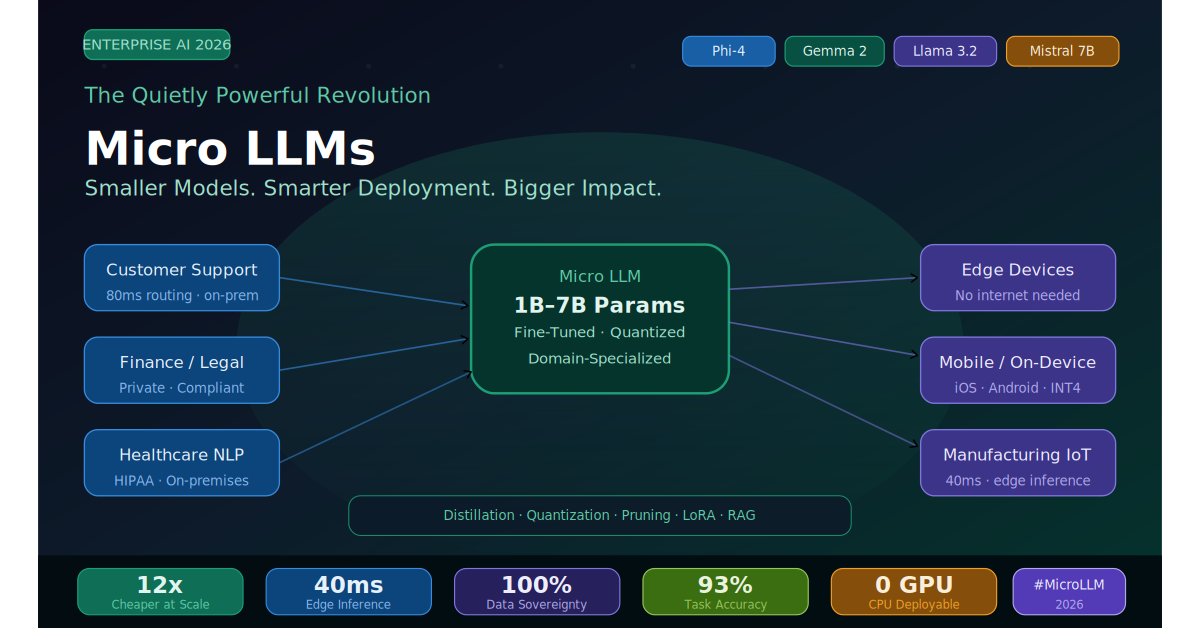
A Micro LLM — also called a Small Language Model (SLM) — is a large language model that has been deliberately designed, trained, or compressed to operate with significantly fewer parameters than frontier models while preserving strong performance on specific, well-defined tasks.
There is no universally agreed parameter cutoff. But the working definition in 2026:
Frontier LLMs   → 70B–1T+ parameters  (GPT-4, Claude, Gemini)
Mid-size LLMs   → 7B–70B parameters   (Llama 3, Mistral, Mixtral)
Micro LLMs      → 100M–7B parameters  (Phi-3, Gemma 2B, TinyLlama,
                                        Qwen, MobileLLM, SmolLM)
But parameter count alone doesn’t define a micro LLM.
What defines it is the engineering philosophy behind it:
→ Built for specific tasks rather than general intelligence → Optimized for inference speed over raw capability → Designed to run on constrained hardware — edge devices, mobile, embedded systems → Fine-tuned on domain-specific data for high accuracy in narrow contexts → Deployable on-premises for data sovereignty and compliance
A micro LLM is not a dumbed-down version of a big model.
It is a precision instrument — built for a specific job, doing that job exceptionally well, at a fraction of the cost and compute.
How Micro LLMs Actually Work
To understand micro LLMs, you need to understand how they are built — because the engineering techniques are what make them genuinely powerful.
Technique 1 — Pre-training on Curated, High-Quality Data
Frontier models are pre-trained on essentially everything on the internet.
Micro LLMs take a different approach.
Instead of training on vast quantities of general data — they are trained on carefully curated, high-quality datasets that are deeply relevant to the intended domain.
Microsoft’s Phi series demonstrated this principle dramatically.
Phi-1 — a 1.3B parameter model — matched or outperformed models 10× its size on coding benchmarks. The reason was not a better architecture. It was better training data — specifically curated high-quality code and technical explanations.
Frontier Model Training Philosophy:
More data + more parameters = more general capability
Micro LLM Training Philosophy:
Better data + focused parameters = higher domain accuracyThe insight: quality of training data beats quantity — especially for narrow, well-defined tasks.
Technique 2 — Knowledge Distillation
This is one of the most powerful techniques in the micro LLM toolkit.
Distillation works like this:
Step 1 → Train a large "teacher" model (e.g. 70B parameters)
Step 2 → Use the teacher model to generate training data
         and soft probability distributions (not just labels)
Step 3 → Train a small "student" model on this rich
         teacher-generated training signal
Step 4 → Student learns not just correct answers
         but the teacher's reasoning patterns
Step 5 → Student achieves 85-95% of teacher performance
         at 5-10% of the compute cost
The student model learns how the teacher thinks — not just what it outputs.
This is why distilled micro LLMs consistently outperform models of similar size trained from scratch.
Real example: DistilBERT is a distilled version of BERT that runs 60% faster, uses 40% less memory, and retains 97% of BERT’s language understanding performance.
Technique 3 — Quantization
Full precision neural networks store each parameter as a 32-bit floating point number (FP32).
Quantization reduces this precision:
FP32 Quantization:
Each parameter = 32 bits
7B parameter model = ~28GB memory
INT8 Quantization:
Each parameter = 8 bits
7B parameter model = ~7GB memory (4× smaller)INT4 Quantization:
Each parameter = 4 bits
7B parameter model = ~3.5GB memory (8× smaller)With minimal accuracy loss for most inference tasks.Quantization means a model that previously required an expensive GPU can now run on a consumer laptop, a mobile device, or an edge computing node.
This is the technique that makes on-device AI practical.
Technique 4 — Pruning
Neural networks typically have many redundant connections — weights that contribute very little to the model’s output.
Pruning identifies and removes these low-value connections:
Before pruning:
Dense neural network → 1B connections → Full accuracy
After pruning:
Sparse neural network → 700M connections → 98% of accuracy
30% smaller, 30% fasterStructured pruning removes entire neurons or attention heads. Unstructured pruning removes individual weights. Both make the model smaller and faster with minimal performance impact on well-defined tasks.
Technique 5 — Fine-Tuning on Domain Data
Even after compression — micro LLMs are then fine-tuned on domain-specific data to specialize their knowledge.
Base Micro LLM (general language understanding)
        ↓
Fine-tune on: medical records + clinical notes
        ↓
Medical Micro LLM (expert performance on clinical NLP)
Base Micro LLM (general language understanding)
↓
Fine-tune on: legal contracts + case law
↓
Legal Micro LLM (expert performance on contract analysis)Base Micro LLM (general language understanding)
↓
Fine-tune on: customer support transcripts + product docs
↓
Support Micro LLM (expert performance on ticket routing)Fine-tuning is what transforms a general micro LLM into a domain expert that outperforms much larger general models on specific tasks.
Technique 6 — RLHF and Alignment at Scale
Even small models can be aligned using Reinforcement Learning from Human Feedback (RLHF) — teaching the model to produce outputs that match human preferences and enterprise guidelines.
Combined with Constitutional AI techniques — micro LLMs can be made safer, more consistent, and more aligned with specific enterprise communication standards than unaligned larger models.
The Complete Architecture of a Micro LLM System
Here is how a production micro LLM deployment looks at enterprise scale:
┌──────────────────────────────────────────────────────────────┐
│                    DATA SOURCES                              │
│  Documents · APIs · Databases · User Input · Sensor Data     │
└─────────────────────────┬────────────────────────────────────┘
                          │
┌─────────────────────────▼────────────────────────────────────┐
│                 PREPROCESSING LAYER                          │
│   Tokenization → Chunking → Embedding → Vector Store         │
│   (RAG Pipeline for knowledge-augmented inference)           │
└─────────────────────────┬────────────────────────────────────┘
                          │
┌─────────────────────────▼────────────────────────────────────┐
│              MICRO LLM INFERENCE ENGINE                      │
│                                                              │
│  ┌─────────────────┐    ┌─────────────────┐                  │
│  │  Domain-Specific│    │  Quantized      │                  │
│  │  Fine-tuned     │    │  INT4/INT8      │                  │
│  │  Weights        │    │  Model          │                  │
│  └────────┬────────┘    └────────┬────────┘                  │
│           └────────────┬─────────┘                           │
│                        │                                     │
│           ┌────────────▼────────────┐                        │
│           │   Inference Runtime     │                        │
│           │  ONNX · llama.cpp       │                        │
│           │  TensorRT · CoreML      │                        │
│           └────────────┬────────────┘                        │
└────────────────────────┼─────────────────────────────────────┘
                         │
┌────────────────────────▼─────────────────────────────────────┐
│              DEPLOYMENT TARGETS                              │
│                                                              │
│  ┌──────────┐  ┌──────────┐  ┌──────────┐  ┌─────────────┐  │
│  │  Cloud   │  │  On-Prem │  │   Edge   │  │   Mobile    │  │
│  │ (private)│  │ Servers  │  │  Devices │  │   Apps      │  │
│  └──────────┘  └──────────┘  └──────────┘  └─────────────┘  │
└──────────────────────────────────────────────────────────────┘
                         │
┌────────────────────────▼─────────────────────────────────────┐
│              APPLICATION LAYER                               │
│   Enterprise Apps · APIs · Dashboards · Workflows            │
└──────────────────────────────────────────────────────────────┘
The Role of RAG (Retrieval-Augmented Generation)
One of the most powerful patterns for enterprise micro LLMs is RAG.
Instead of trying to fit all enterprise knowledge into the model’s parameters — RAG keeps knowledge external and retrieves it dynamically at inference time:
User Query: "What is our refund policy for enterprise contracts?"Step 1 → Query is embedded into a vector
Step 2 → Vector search finds relevant policy documents
Step 3 → Retrieved context is injected into the prompt
Step 4 → Micro LLM generates answer grounded in actual documents
Step 5 → Response includes source references for auditabilityResult: Accurate, current, auditable answers
Without retraining the model on every policy updateRAG makes micro LLMs dramatically more capable for enterprise knowledge tasks without increasing model size.
The Leading Micro LLMs in 2026
The micro LLM landscape has exploded. Here are the models enterprises are actually deploying:
Microsoft Phi-3 and Phi-4 Family
Parameters: 3.8B — 14B Standout capability: Reasoning and coding performance massively disproportionate to size Best for: Code generation, document analysis, reasoning tasks Can run on: Laptop CPU, mobile devices (Phi-3 Mini) Enterprise adoption: Azure AI, Microsoft 365 Copilot backend features
Google Gemma 2
Parameters: 2B — 27B Standout capability: Strong multilingual performance, open weights Best for: Classification, summarization, multilingual enterprise apps Can run on: Consumer GPUs, edge servers Enterprise adoption: Google Cloud Vertex AI, on-device Android AI
Meta Llama 3.2 (Small Variants)
Parameters: 1B — 3B Standout capability: Open source, commercially licensable, strong instruction following Best for: On-device inference, privacy-sensitive enterprise tasks Can run on: Mobile devices, Raspberry Pi class hardware Enterprise adoption: Self-hosted enterprise deployments globally
Mistral 7B and Mixtral
Parameters: 7B (dense), 46.7B (sparse MoE — activates only 12.9B per token) Standout capability: Mixture of Experts architecture — big model capability at small model cost Best for: Complex reasoning, multilingual tasks, code Enterprise adoption: European enterprises prioritizing data sovereignty
Apple MLX Models
Parameters: 1B — 8B Standout capability: Optimized specifically for Apple Silicon — runs natively on Mac, iPhone, iPad Best for: On-device privacy-first enterprise apps, iOS/macOS integration Enterprise adoption: Enterprises in Apple ecosystem deploying on-device AI
Qwen 2.5 (Alibaba)
Parameters: 0.5B — 72B Standout capability: Outstanding Chinese and multilingual performance Best for: Asian market enterprise deployments, multilingual customer service Enterprise adoption: Dominant in Asia-Pacific enterprise AI
SmolLM (Hugging Face)
Parameters: 135M — 1.7B Standout capability: Genuinely tiny — runs on microcontrollers and ultra-low-power devices Best for: IoT, embedded systems, edge AI at extreme scale Enterprise adoption: Industrial IoT, smart manufacturing, retail edge AI
Enterprise Use Cases — Where Micro LLMs Are Winning
Use Case 1 — Intelligent Customer Support at Scale
The problem: A telecom company handles 2 million support tickets per month. Routing tickets manually to the right team takes 6–8 minutes per ticket. That is 200,000+ hours of manual routing work per month.
The Micro LLM solution:
Customer submits ticket
        ↓
Micro LLM (fine-tuned on 3 years of support data)
        ↓
Classifies: Category · Priority · Department · Sentiment
        ↓
Routes automatically in 80ms
        ↓
Generates suggested response for agent review
        ↓
Agent edits and sends in 90 seconds instead of 8 minutes
Results: → 94% routing accuracy (vs 78% rule-based system) → 85% reduction in routing time → Runs on 4 CPU-only servers — no GPU required → Processes 10,000 tickets per hour at peak → Full data sovereignty — zero tickets leave the enterprise network
Why not a frontier model? A frontier model via API would cost 40–60× more per ticket. At 2 million tickets per month — that difference funds an engineering team.
Use Case 2 — On-Device AI for Field Workers
The problem: A construction company has 800 field inspectors working across remote sites with no reliable internet connectivity. They need AI assistance for safety compliance checks, defect classification, and report generation — in the field, in real time.
The Micro LLM solution:
Inspector photographs a structural element
        ↓
On-device vision model classifies defect type
        ↓
Micro LLM (2B parameters, INT4 quantized, runs on tablet)
        ↓
Generates compliance check report
References relevant safety codes
Suggests remediation actions
        ↓
Inspector reviews and signs off
        ↓
Report syncs to HQ when connectivity returns
Results: → Full AI capability with zero internet dependency → Runs on standard rugged Android tablets → Report generation time: 4 minutes → 45 seconds → Compliance accuracy improved by 31% → Zero sensitive site data ever transmitted to cloud
Why not a frontier model? No internet. No API. No choice. Micro LLM is the only architecture that works.
Use Case 3 — Real-Time Financial Document Processing
The problem: A private equity firm processes 3,000–5,000 financial documents per week — term sheets, investment memos, cap tables, due diligence reports. Manual review takes senior analysts 45–90 minutes per document.
The Micro LLM solution:
Document uploaded (PDF, DOCX, Excel)
        ↓
OCR + chunking pipeline
        ↓
Vector embedding → private vector database
        ↓
Micro LLM (fine-tuned on financial documents)
        ↓
Extracts: Key terms · Valuation · Risk factors
          Covenants · Comparison to portfolio norms
        ↓
Generates structured summary + risk flags
        ↓
Analyst reviews summary (8 minutes) not full doc (90 minutes)
Results: → 89% reduction in initial document review time → Risk flag accuracy: 91% — better than junior analyst baseline → Deployed entirely on private cloud — no financial data leaves firm → Processes 500 documents per hour at peak → Full audit trail for regulatory compliance
Why not a frontier model? Financial documents contain material non-public information. Using a third-party API would create regulatory and confidentiality exposure the firm cannot accept. On-premises micro LLM is the only compliant architecture.
Use Case 4 — Multilingual Real-Time Customer Communication
The problem: A global e-commerce platform serves customers in 47 countries. Real-time chat support in 15+ languages with human-quality responses. Latency must be under 200ms for a good user experience.
The Micro LLM solution:
Customer message arrives (any of 15 languages)
        ↓
Language detection micro model (50ms)
        ↓
Intent classification micro model (30ms)
        ↓
Response generation micro LLM
  → fine-tuned on product catalog + policy docs
  → generates culturally appropriate response
  → in customer's native language
  → with brand voice consistency
Total latency: 140ms
        ↓
Response delivered to customer
Results: → 140ms average response latency (API frontier model: 2,000–8,000ms) → Supports 15 languages at native quality → Handles 50,000 concurrent conversations → 78% of conversations resolved without human escalation → Infrastructure cost: 1/12th of equivalent frontier model API spend
Why not a frontier model? Latency. A frontier model API cannot consistently respond in under 200ms. Users notice. Users leave. Speed is a product requirement — not a preference.
Use Case 5 — Healthcare Clinical NLP
The problem: A hospital network processes 40,000 clinical notes per month. Extracting structured data (diagnoses, medications, procedures) for billing, research, and quality reporting requires clinical expertise. Manual extraction takes trained coders 20–30 minutes per note.
The Micro LLM solution:
Clinical note enters secure processing pipeline
        ↓
Micro LLM (fine-tuned on de-identified clinical data)
  → Extracts ICD-10 diagnosis codes
  → Identifies medication names, dosages, interactions
  → Flags procedures for billing classification
  → Detects risk indicators for readmission prediction
        ↓
Structured output → EHR system
Human coder reviews and approves
        ↓
Audit log maintained for compliance
Results: → Coding time: 25 minutes → 4 minutes per note → Code accuracy: 93% (human baseline: 89%) → HIPAA compliance maintained — all processing on-premises → $2.4M annual savings in clinical coding costs → Identified 340 missed diagnoses in first 3 months
Why not a frontier model? HIPAA requires strict controls over where patient data is processed. Sending clinical notes to a third-party cloud API is not a compliant architecture. The micro LLM runs inside the hospital’s own secure infrastructure.
Use Case 6 — Smart Manufacturing Quality Control
The problem: An automotive parts manufacturer runs 24/7 production. Quality inspection is done by human inspectors working in shifts. Defect detection rate: 94%. Miss rate: 6%. One missed defect can cause a recall.
The Micro LLM solution:
Sensor data + camera feed from production line
        ↓
Vision micro model → defect detection
        ↓
Micro LLM → analyzes defect pattern + production parameters
  → Classifies defect type
  → Identifies probable root cause
  → Recommends immediate corrective action
  → Predicts whether defect will recur based on patterns
        ↓
Alert sent to line supervisor
Production paused or adjusted in real time
        ↓
All inference runs on edge hardware at the line
Latency: 40ms — faster than any human inspector
Results: → Defect detection rate: 94% → 99.2% → False positive rate: 0.3% → Prevented 3 potential recall events in first year → Runs on NVIDIA Jetson edge devices — no cloud dependency → ROI achieved in 4 months
Micro LLMs vs Frontier LLMs — When to Use Which
This is the decision framework every enterprise architect needs:
Choose Micro LLM when:
  ✦ Task is well-defined and narrow
  ✦ Latency < 500ms is required
  ✦ Data cannot leave your infrastructure
  ✦ Volume is high (millions of inferences/day)
  ✦ Edge or on-device deployment needed
  ✦ Cost efficiency is a core requirement
  ✦ Compliance mandates data sovereignty
  ✦ Offline capability is needed
Choose Frontier LLM when:
✦ Task requires broad general knowledge
✦ Complex multi-step reasoning needed
✦ Creative or open-ended generation
✦ Task diversity is unpredictable
✦ Prototype or low-volume use case
✦ Latency tolerance > 2 seconds
✦ Data sensitivity is manageableBest Pattern — Hybrid Architecture:
✦ Micro LLM handles 80–90% of volume
(fast, cheap, on-premises)
✦ Frontier LLM handles 10–20% of complex cases
(escalated, routed from micro LLM)
✦ Result: frontier-level quality at micro-level costThe Enterprise Implementation Roadmap
For organizations looking to deploy micro LLMs seriously — here is the proven path:
Phase 1 — Identify and Validate (Weeks 1–4)
→ Audit your workflows for AI automation candidates
→ Prioritize by: volume × time saved × data sensitivity
→ Select 1 pilot use case with clear success metrics
→ Define: accuracy threshold, latency requirement, data boundaries
→ Choose base model (Phi-3, Gemma, Llama) based on task type
Phase 2 — Data and Fine-Tuning (Weeks 5–10)
→ Collect and clean domain-specific training data
   Minimum: 1,000–10,000 labeled examples
   Better: 50,000–500,000 examples
→ Apply instruction tuning format
→ Fine-tune base model on your data
→ Evaluate on held-out test set
→ Iterate until accuracy threshold met
→ Apply quantization for deployment efficiency
Phase 3 — Infrastructure and Deployment (Weeks 11–14)
→ Select inference runtime:
   CPU deployment → llama.cpp, ONNX Runtime
   GPU deployment → TensorRT, vLLM
   Mobile/edge → CoreML, TensorFlow Lite
→ Build API wrapper around model
→ Set up monitoring: latency, accuracy drift, error rates
→ Configure logging for compliance and audit
→ Load test to validate throughput requirements
→ Deploy to staging → production rollout
Phase 4 — Optimize and Scale (Ongoing)
→ Monitor accuracy drift → retrain quarterly
→ Collect production edge cases → add to training data
→ Expand to additional use cases
→ Build internal fine-tuning capability
→ Develop enterprise model registry
→ Standardize deployment pipeline across teams
The Economics That Make This Undeniable
Let me put real numbers on the micro LLM advantage:
Scenario: 1 million API calls per month
Frontier LLM API (GPT-4 class):
  Input: 500 tokens avg × 1M calls  = 500M tokens
  Output: 200 tokens avg × 1M calls = 200M tokens
  Cost: ~$15–30 per 1M tokens
  Monthly total: $10,500–$21,000
  Annual: $126,000–$252,000
Self-hosted Micro LLM (7B, quantized):
Hardware: 2× A10G GPUs = ~$2,400/month cloud
Or: On-premises server amortized = ~$800/month
Throughput: Easily handles 1M calls/month
Monthly total: $800–$2,400
Annual: $9,600–$28,800Annual savings: $97,000–$223,000
At 10M calls/month → $1M–$2.2M annual savings
At 100M calls/month → $10M–$22M annual savingsAt enterprise volume — the economics of micro LLMs don’t just pencil out.
They fundamentally change what AI-powered products can cost to operate.
What Micro LLMs Mean for the Future of AI in Enterprises
The narrative in 2023 was: AI means OpenAI. AI means the cloud. AI means paying per token forever.
The reality in 2026 is more nuanced and more interesting.
The enterprise AI market is bifurcating:
Tier 1 — Frontier models for tasks requiring broad general intelligence, complex reasoning, and creative generation.
Tier 2 — Micro LLMs for high-volume, well-defined, latency-sensitive, compliance-constrained, or edge-deployed tasks.
The enterprises winning with AI in 2026 are not the ones using the biggest models everywhere.
They are the ones who understand which tier belongs where — and architect their AI systems accordingly.
The future is not one model to rule them all.
The future is a portfolio of precisely chosen, expertly deployed, domain-specialized micro LLMs — orchestrated intelligently alongside frontier models where frontier models genuinely earn their cost.
Final Thoughts
Micro LLMs represent something important about how mature technology markets evolve.
In the beginning — everyone reaches for the most powerful tool available. Power feels like safety. Bigger feels like better.
Then the market matures. Engineers start asking harder questions. Do we actually need all of this capability? What is this capability costing us? What are we giving up for this convenience?
And the answer — again and again across every generation of enterprise technology — is that precision beats power for production workloads.
The right tool for the right job. The right model for the right task.
Micro LLMs are not the underdog story of AI.
They are the maturity story.
The signal that enterprise AI has moved from experimentation to engineering.
From “what can AI do?” to “what should AI do here, specifically, efficiently, safely, and at scale?”
That is the question micro LLMs were built to answer.
And in 2026 — the enterprises that are asking it are the ones pulling ahead.
Found this valuable? Follow me for more deep-dives into enterprise AI, machine learning engineering, and how intelligent architecture drives business outcomes.
♻️ Repost to help your network understand why smaller AI models are making a massive impact.
💬 Is your enterprise running micro LLMs in production? What use case? Drop it in the comments — I read every one.
MicroLLM #SmallLanguageModels #EnterprisAI #MachineLearning #GenerativeAI #LLM #AIArchitecture #OnDeviceAI #EdgeAI #PrivateAI #DataSovereignty #AIEngineering #MLOps #NaturalLanguageProcessing #TechLeadership #CloudAI #AIInfrastructure #Phi3 #Gemma #Llama #OpenSourceAI #AIStrategy #DigitalTransformation #Innovation2026 #BuildInPublic #LinkedInTech #EnterpriseArchitecture
A message from our Founder
Hey, Sunil here. I wanted to take a moment to thank you for reading until the end and for being a part of this community. Did you know that our team run these publications as a volunteer effort to over 3.5m monthly readers? We don’t receive any funding, we do this to support the community.
If you want to show some love, please take a moment to follow me on LinkedIn, TikTok, Instagram. You can also subscribe to our weekly newsletter. And before you go, don’t forget to clap and follow the writer️!
메타데이터
- post_id
- 799d1ce535c2
- slug
- micro-llms-the-quietly-powerful-ai-revolution-that-enterprises-are-betting-on-in-2026-799d1ce535c2
- url
- https://ai.plainenglish.io/micro-llms-the-quietly-powerful-ai-revolution-that-enterprises-are-betting-on-in-2026-799d1ce535c2
- canonical_url
- https://ai.plainenglish.io/micro-llms-the-quietly-powerful-ai-revolution-that-enterprises-are-betting-on-in-2026-799d1ce535c2
- author_url
- https://medium.com/@imtushaarr
- status
- ok
- fetched_at
- 2026-06-26 03:39:16