Famine looms as so little fertiliser passes the Strait of Hormuz
How can countries help find a solution?
Famine looms as so little fertiliser passes the Strait of Hormuz
How can countries help find a solution?
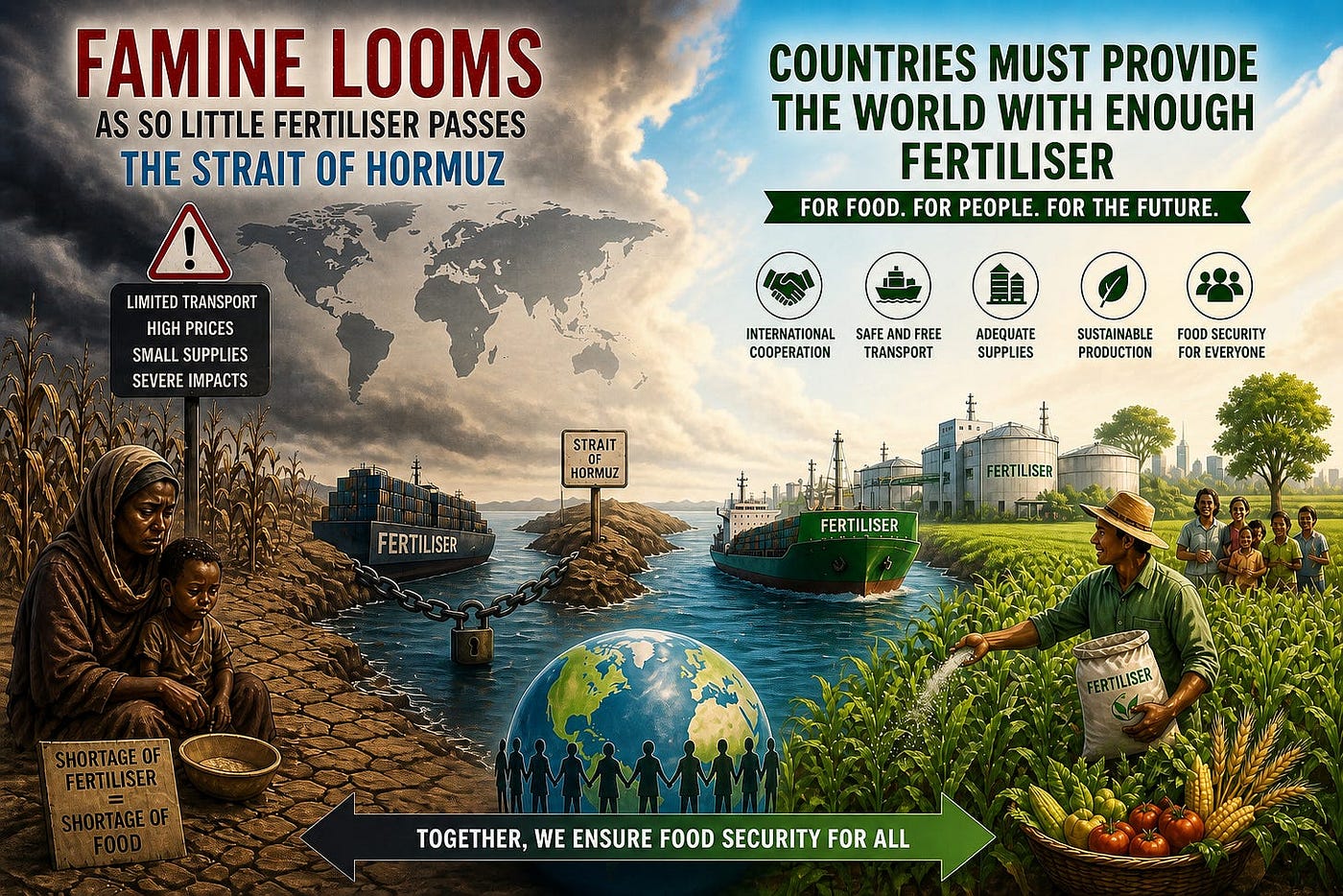
In better times, thirty per cent of the world’s fertiliser production passed through the Strait of Hormuz.
For the well-known reason, the flow has now dried up.
This is leading to price increases, just like with fuels.
The UN is now warning of a food crisis, as arable farming can hardly manage without fertiliser anywhere in the world.
European farmers will be able to cope with the higher costs, but their counterparts in poorer countries certainly will not.
They are forced to cut back on fertiliser use.
As a result, their harvests are decreasing.
This could have disastrous consequences.
The background to this is plant breeding, which over the past hundred years has been carried out and directed primarily by institutions from Europe and North America.
In the process, not only were native crops targeted, but also those in the colonies.
Right down to the present day.
One result of this is, for example, the wonder rice developed at the International Rice Research Institute https://www.irri.org/.
Its stalks bear far more rice grains than traditional varieties, but the new variety required more fertiliser than traditional varieties and was more susceptible to diseases and pests.
This required farmers to make an additional investment in crop protection products.
There are many more improved crops for which this story could be told.
Nevertheless, without scientifically developed varieties, it would not be possible to feed the world’s dramatically growing population.
Organic farming is essential, but given the current state of technology, it can only serve as a complement.
Thanks to the breeding of so many crops, global food production has increased dramatically.
This was also necessary to feed the rapidly growing world population.
However, the dependence on fertilisers and crop protection products makes all of this very vulnerable.
This is once again becoming clear.
If farmers in poor countries are not provided with sufficient, affordable fertilisers and crop protection products, their harvests will suffer.
Many European countries still have their own fertiliser industry, as do many other European countries.
This industry is under pressure due to the nitrogen problem and rising gas prices.
However, they also have another source of fertilisers: agriculture, with some countries relying on it much more than others.
It is quite possible to convert the manure, which farmers are currently not allowed to spread, into dry fertilisers that could, in principle, be exported all over the world.
This won’t happen overnight, but it could make a structural contribution to a system in which fertiliser remains affordable worldwide and dependence on straits such as the Strait of Hormuz decreases.
This is a matter of urgency.
It should be given top priority at Ministries of Agriculture, in the fertiliser industry, and across the entire agricultural sector
메타데이터
- post_id
- 799ed165a8d3
- slug
- famine-looms-as-so-little-fertiliser-passes-the-strait-of-hormuz-799ed165a8d3
- url
- https://medium.com/@hanvanderhorst_22163/famine-looms-as-so-little-fertiliser-passes-the-strait-of-hormuz-799ed165a8d3
- canonical_url
- https://medium.com/@hanvanderhorst_22163/famine-looms-as-so-little-fertiliser-passes-the-strait-of-hormuz-799ed165a8d3
- author_url
- https://medium.com/@hanvanderhorst_22163
- status
- ok
- fetched_at
- 2026-07-10 15:20:15