The Generative History of Consciousness and Language
The Emergent Structure and Integrative Dynamics of Spacetime, Body, Instinct, Emotion, and Thought
The Generative History of Consciousness and Language
The Emergent Structure and Integrative Dynamics of Spacetime, Body, Instinct, Emotion, and Thought
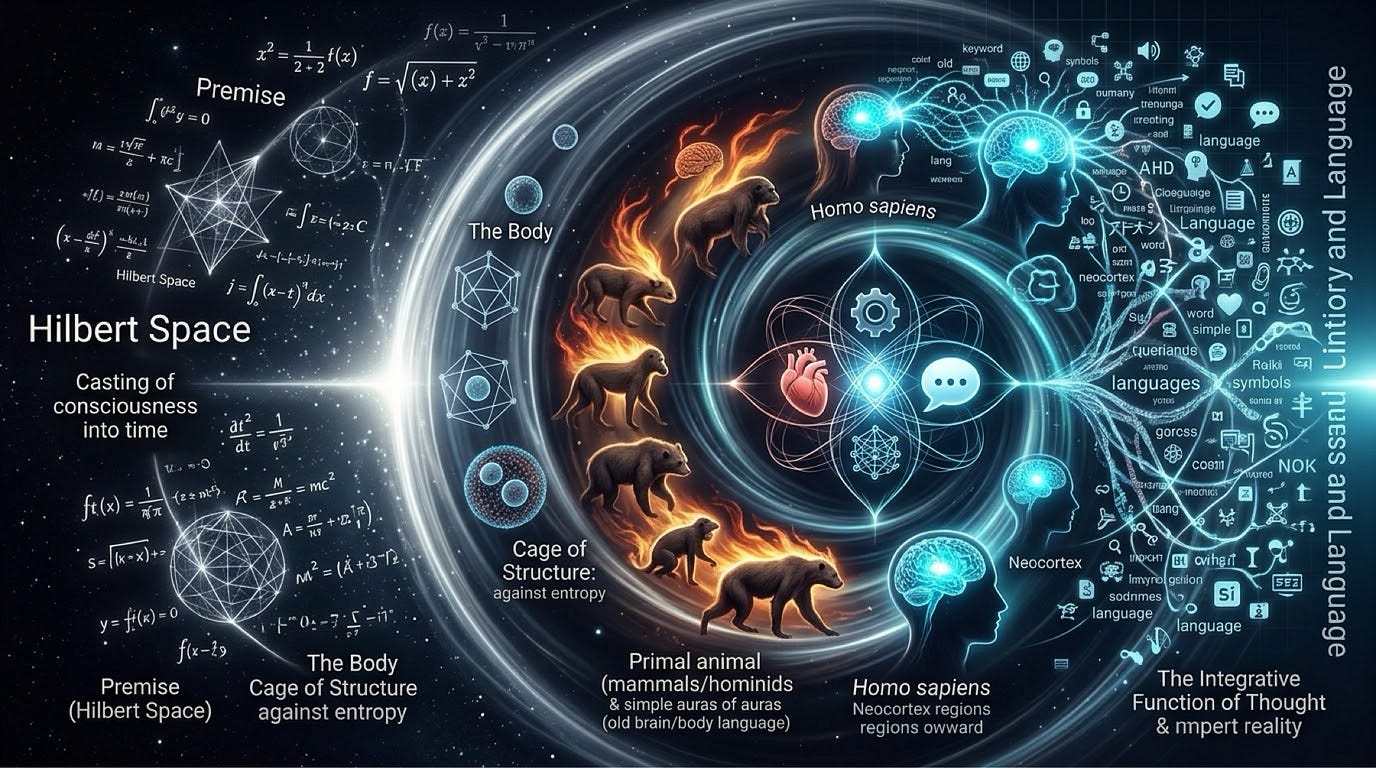
① The Premise of Consciousness / The Universe (State Space) [Outside of Time]
First, as a premise, we begin from a realm outside of time (prior to temporal differentiation). Here, consciousness is chaotic and undifferentiated from the universe (State Space / von Neumann’s Hilbert Space). (It could be called the foundational reality itself, but this paper does not assume their strict identity.)
In this realm, mathematical structure exists as the common language, and there is yet no time axis or directionality.
② The Casting of Consciousness into the Time Axis → The Emergence of Directionality
Next, the casting of consciousness into the time axis causes the emergence of directionality. The occurrence of time gives birth to 「orientation,」 「flow,」 and 「before and after」 within consciousness.
The 「directionality」 generated here is not a pre-set 「purpose,」 but strictly a byproduct of the temporal structure. (This is observed as the behavior of consciousness within the time axis.)
③ The Body (Existence / Life): The 「Cage of Structure」 Against Entropy
Consciousness, now possessing this directionality, confronts the body (existence / life) – namely, the 「cage of structure」 that resists entropy.
The moment consciousness is cast into the 「flow」 of the time axis, it begins to collapse due to the increase of entropy. To resist this and attempt 「self-replication,」 a physical 「boundary (membrane)」 and 「energy metabolism」 – in short, a body – become indispensable.
(According to Schrödinger’s definition, life is a system that prevents its own decay by feeding on 「negative entropy [order]」 from the environment.)
④ The Animal Stage: The Old Brain + Body Language (Non-verbal Affective Transmission)
Following this is the transition to the animal stage. The foundation here is the old brain + body language (non-verbal affective transmission).
What first became structured was the old brain (instinct). At this stage, affective states remain in a crude state (basic levels of joy, anger, sorrow, and pleasure), and language is processed as physical reactions themselves or as images. While directionality exists, the subject has almost no ability to select or control it (there is no symbolic concept of time).
⑤ The Birth of the Genus Homo: The Critical Importance of Relationality as Social Animals
Then we reach the birth of the genus Homo. This is a phase where the importance of relationality with others advances exponentially as social animals.
With the alignment of conditions – the human species (genus Homo) + brain expansion + premature birth (approx. 1.8 million years ago~) – social relationality becomes decisive as a survival strategy. Consequently, the capacity for relationality through affective synchronization was strengthened. Furthermore, long-term cooperation with specific individuals (the formation and maintenance of pair-bonds) becomes more advantageous for survival.
⑥-1 The Human Stage (Approx. 200,000 Years Ago~): The Birth of Language and the Differentiation / Symbolic Articulation of Emotion
Furthermore, in the human stage (approx. 200,000 years ago~), the birth of language, alongside the differentiation and symbolic articulation of emotion, occurs.
Through this differentiation and symbolic articulation, what was previously a state physically 「felt」 becomes 「nameable」 through language. Because this attribution of meaning becomes possible, the subject becomes able to interpret and manipulate directionality (acquiring the concept of time [the ability to abstract mathematical structure, space, and the time axis]).
⑥-2 The Positioning of Thought
What becomes critical here is the positioning of thought. Thought is the most recently born function; it is a function to integrate, stabilize, and maintain the preceding stages of mathematical structure, body (instinct), and emotion. That is, it operates as a regulatory apparatus to maintain relationality with the world (including others) and the universe.
Note: 「Thought」 here is not logical rationality itself, nor is it meant to deny or suppress instinct and emotion.
→ It is an integrative function to allow them to coexist within the same individual.
However, when logical rationality (mathematical structure, efficiency, consistency) is foregrounded, the priority of emotion (relationality through affective synchronization) may appear relatively lower (= this is merely a difference in the mode of relationality with the world (in the context of neurotypical development)).
⑦ Individual Differences
Finally, we touch upon individual differences. Because the intensity, ratio, and ways of connecting instinct, emotion, and thought vary from person to person, there are individual differences in their output.
★ Supplement 1
While what is generally referred to as 「thought」 often points to logic (Logos) detached from instinct and emotion, 「thought」 in this model is defined as an integrative function. It does not deny the preceding layers – 「mathematical truth,」 「body (instinct/animality),」 and 「emotion (synchronization with others)」 – but integrates them while they are still alive, stabilizes them, and maintains the connection with the world.
★ Supplement 2
Traditional Western dualism makes an extreme division of 「Head (Reason) vs. The Beast (Everything Else)」, treating both instinct and emotion collectively as 「beasts to be controlled.」 However, 「instinct,」 which keeps the individual alive, and 「emotion,」 which connects with others, are entirely different driving forces with different evolutionary processes and purposes.
★ Supplement 3
In the animal stage (the old brain), beings were desperate for survival and lacked both the capacity and the cognitive apparatus to attune to abstract mathematical truth beyond immediate survival demands. In the human stage (the birth of thought), the acquisition of a highly sophisticated integrative cognitive apparatus called the neocortex likely allowed humanity, for the first time, to attune to the realm of abstract mathematical truth existing as a pre-temporal structure, and to abstract and manipulate it.
★ Supplement 4
In this paper, there is no pre-set purpose or progress (Darwinian directionality) in 「existence (life)」 or 「evolution.」 Out of the infinitely branching possibilities (waves of probability), only the routes (physical systems) that coincidentally resisted entropy and maintained their 「structures of self」 survived, and we merely call them 「life」 after the fact (this is both a thermodynamic survivorship bias and an ex post facto observer selection effect).
Conclusion: The Core Purpose of This Model
The core purpose of presenting this generative history is to deconstruct traditional dualism from a perspective that fully accepts “observer bias.”
Historically, human thought has often fallen into two extremes: classical dualism, which worships reason (thought) and seeks to suppress instinct and emotion (the beast); or nihilistic reductionism, which dismisses human emotion and purpose as mere biological illusions within a meaningless, entropic universe.
This model rejects both. While it acknowledges the cold, objective truth that there is no pre-set purpose in the foundational universe (outside of time), it simultaneously affirms that the moment we are cast into the time axis as observers, the ”bias” of finding directionality, the “instinct” for survival and self-replication, and the “heat” of affective synchronization (emotion) become structural necessities for existence.
메타데이터
- post_id
- 79ae99b2b3e3
- slug
- the-generative-history-of-consciousness-and-language-79ae99b2b3e3
- url
- https://medium.com/@yuko501212/the-generative-history-of-consciousness-and-language-79ae99b2b3e3
- canonical_url
- https://medium.com/@yuko501212/the-generative-history-of-consciousness-and-language-79ae99b2b3e3
- author_url
- https://medium.com/@yuko501212
- status
- ok
- fetched_at
- 2026-06-09 15:37:30