The Architecture of Compromise
The 81-year-old Benjamin Franklin, at the last session of the Constitutional Convention on September 17, 1787, handed his speech to James…
The Architecture of Compromise
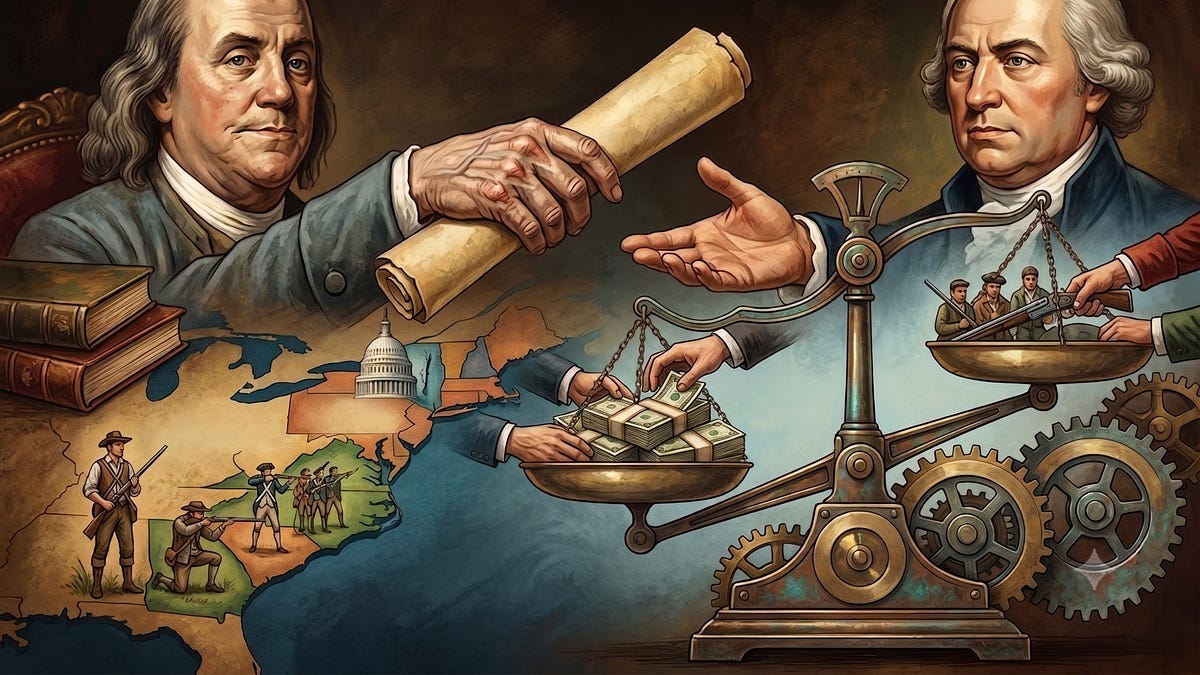
The 81-year-old Benjamin Franklin, at the last session of the Constitutional Convention on September 17, 1787, handed his speech to James Wilson and, because he himself was weak and ill, asked Wilson to read it on his behalf. Franklin expressed his support for the Constitution as follows:
“I consent, Sir, to this Constitution because I expect no better, and because I am not sure, that it is not the best.”
But this is not the only time that advocates of the Constitution, before its ratification, acknowledged its imperfection. The Founding Father, James Madison, also admitted in Federalist Paper №37 that this document was written by humans, and therefore is not free from error; and Alexander Hamilton stated in Federalist Paper №85 that the document “is the best that the present views and circumstances of the country will permit.”
This rhetoric is usually cited as a reason to show why the US was built the way it is; that is the notion that the US Constitution was written based on the idea that what was achieved is not perfect, and consequently, there is a humility and an anti-dogmatism in the spirit of the Constitution, in the ethos of the people, and the Founding Fathers. This idea is undeniable. Indeed, such a thing can be found numerous times throughout US history. However, in my opinion, there is something more fundamental that brought this about, and it traces back to the structure of power in the US; the US was not founded merely on an idea, but rather a unique structure of power made this possible.
Following independence, the United States was composed of 13 Independent states, where decisions among them required a supermajority of at least 9 out of 13 votes, and in certain cases, every state even held veto power. This meant that although some states, like Virginia, possessed great wealth and population, poorer states still had a significant impact on the processes. Furthermore, since no equipped army was at the disposal of Congress, each state maintained its own militia, and gun ownership was widespread among free men, creating a sort of check and balance in power.
In fact, the power structure was such that no group or state possessed enough power to destroy another and impose its will upon it without cost, or even at a low cost. This was not limited to relations between states, but also encompassed the relations between the inhabitants of each state and its politicians.
For example, if we look at an event like the Pennamite-Yankee Wars , we will see that along with extensive struggles, many casualties, and three periods of war, both sides of the conflict possessed significant power to influence the will of the other.
Pennsylvania, through the Trenton Decree of 1782, held the legal backing of Congress, which it viewed as an opportunity to wipe out the Yankees completely, but this resulted in the Battle of Locust Ridge, which inflicted heavy losses on both sides. Although General Armstrong of Pennsylvania ultimately achieved a military victory through immense violence, this was not a policy accepted by the state’s citizens. Ultimately, local pressures shaped events, leading to great infamy for Armstrong, and Pennsylvania magistrate Alexander Patterson was officially withdrawn from the region.
All of these conflicts, including the Pennamite-Yankee Wars and Shays’s Rebellion, never caused the union among the states to dissolve. Of course, this does not mean that such a danger never necessarily threatened them, but rather that the interests of many powerful groups and individuals did not align with such an outcome, and the more desirable solution for them was always to resolve such disputes with the least possible tension.
Charles Beard’s book, *An Economic Interpretation of the Constitution of the United States *, can give us good insight into this matter.
During the American Revolutionary War, the Continental Congress could not tax, so it paid soldiers’ wages by IOUs that it gave directly to people. However, these IOUs were deemed worthless by individuals, resulting in them being sold at a very low price. Beard states in his book:
“The common selling price in good markets before the movement for the Constitution got under way ranged from one-sixth to one-tenth its face value; and some of it sold as low as twenty to one.”
The result was that the distribution of these IOUs became more concentrated. Financial elites and speculators bought up these war bonds from desperate citizens for pennies on the dollar.
This concentration of debt created a profound political mechanism. If a state like Virginia or New York decided to completely ignore Congress, break the Articles of Confederation, and go its own way as an independent nation, the Continental Congress would dissolve. If Congress dissolved, the national debt would be erased and legally dead.
For the financial elites, a total collapse of the Confederation meant their massive investments in war bonds would instantly become worthless paper. Therefore, the wealthiest and most influential men in every single state had a direct and selfish financial interest in ensuring that:
- The Articles of Confederation remained legally intact.
- States didn’t push things so far that the union fractured.
- The erosion of Congress’s credibility was prevented until a stronger centralized government could finally be established.
All of this combined meant that the complex game of founding the US possessed a sort of Nash Equilibrium, which was that everyone strived for a compromise to establish a more powerful central government. This does not mean that a powerful central government had no opponents; obviously, the Anti-Federalists, most famously the Founding Father George Mason, were against it, to the extent that they did not even accept the U.S. Constitution. But the result of all political actions was such that different groups negotiated with one another, attempted to make political trade-offs, and everyone surrendered a portion of their demands to bring others along, because such an outcome was, in any case, better for the majority than entering a tense environment of perpetual military conflicts and debt crises.
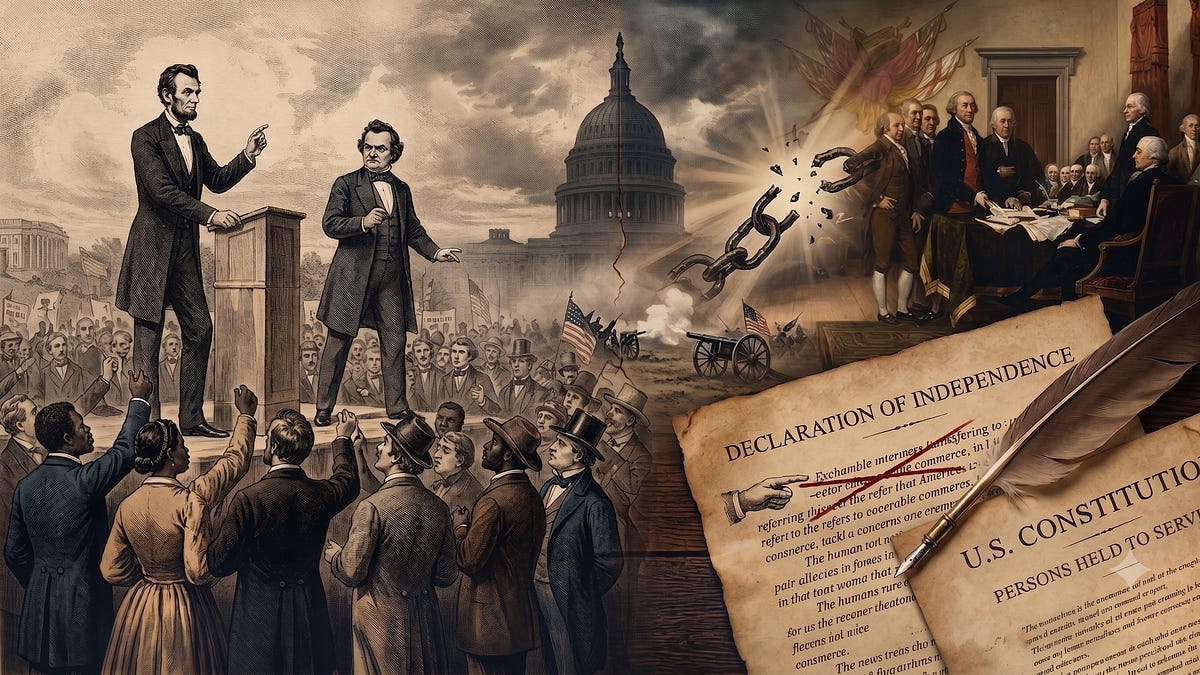
Obviously, this does not mean they managed to reach an agreement on all important issues or had considered everything. A significant part of the Anti-Federalists’ criticisms was for this very reason. For instance, slavery was an issue that had been a point of contention since the Declaration of Independence; it was resolved neither at that time nor during the drafting of the Constitution, and it is evident from historical trends that this issue was continually postponed into the future until the Civil War finally brought it to a resolution. (I wrote a detailed account of this topic in the essay “ A Century of Postponement” ). However, what is obvious is that the power structure in the United States was always such that it effectively and significantly aided the formation of liberal institutions in this country.
Originally published at https://theimplex.substack.com.
메타데이터
- post_id
- 79b2e082768d
- slug
- the-architecture-of-compromise-79b2e082768d
- url
- https://medium.com/@theimplex/the-architecture-of-compromise-79b2e082768d
- canonical_url
- https://medium.com/@theimplex/the-architecture-of-compromise-79b2e082768d
- author_url
- https://medium.com/@theimplex
- status
- ok
- fetched_at
- 2026-07-26 17:39:23