Sermon: The Oreo Gospels
The Middle Matters
ADVENT | INAUGURATION | FULFILLMENT
Sermon: The Oreo Gospels
The Middle Matters
A sermon given at St. Andrew’s Episcopal Church, Madison, CT, on December 14, 2025, on 3 Advent, year A.¹

The middle matters | Photo by Ron Steed
So you take your Oreo in the fingers of both hands and, with a gentle twist, separate the top from the bottom to reveal the creamy middle. If you’re good, it all sits there on one cookie. Then, you scrape that dollop of sweetness with your teeth and eat the cookies, dipped in milk, as an afterthought. Are there any of you who have never done that? So good. The middle matters.
Misunderstanding….
If you are even a half-hearted listener of my sermons, you have noted one very consistent takeaway: that those around Jesus, even his closest confidants both then and now, didn’t and don’t understand what he was up to. Everybody, including myself perhaps, seems to come at him with an agenda, an expectation that shapes the way Jesus is seen. The trouble with all these agendas is that they are not Jesus’ agenda. And consequently, people are surprised and disappointed at Jesus. Not least among them, John the Baptist.
For John, the axe is lying at the root of the tree, and at any moment, the coming Messiah is going to start cutting down the unfruitful ones and burning the debris with unquenchable fire! (Matt 3:1–12). When Jesus doesn’t pick up that axe or the winnowing fork, and even invites tax collectors into discipleship, John can’t help but wonder whether he had picked the wrong guy. “Are you the one who is to come, or are we to wait for another?”

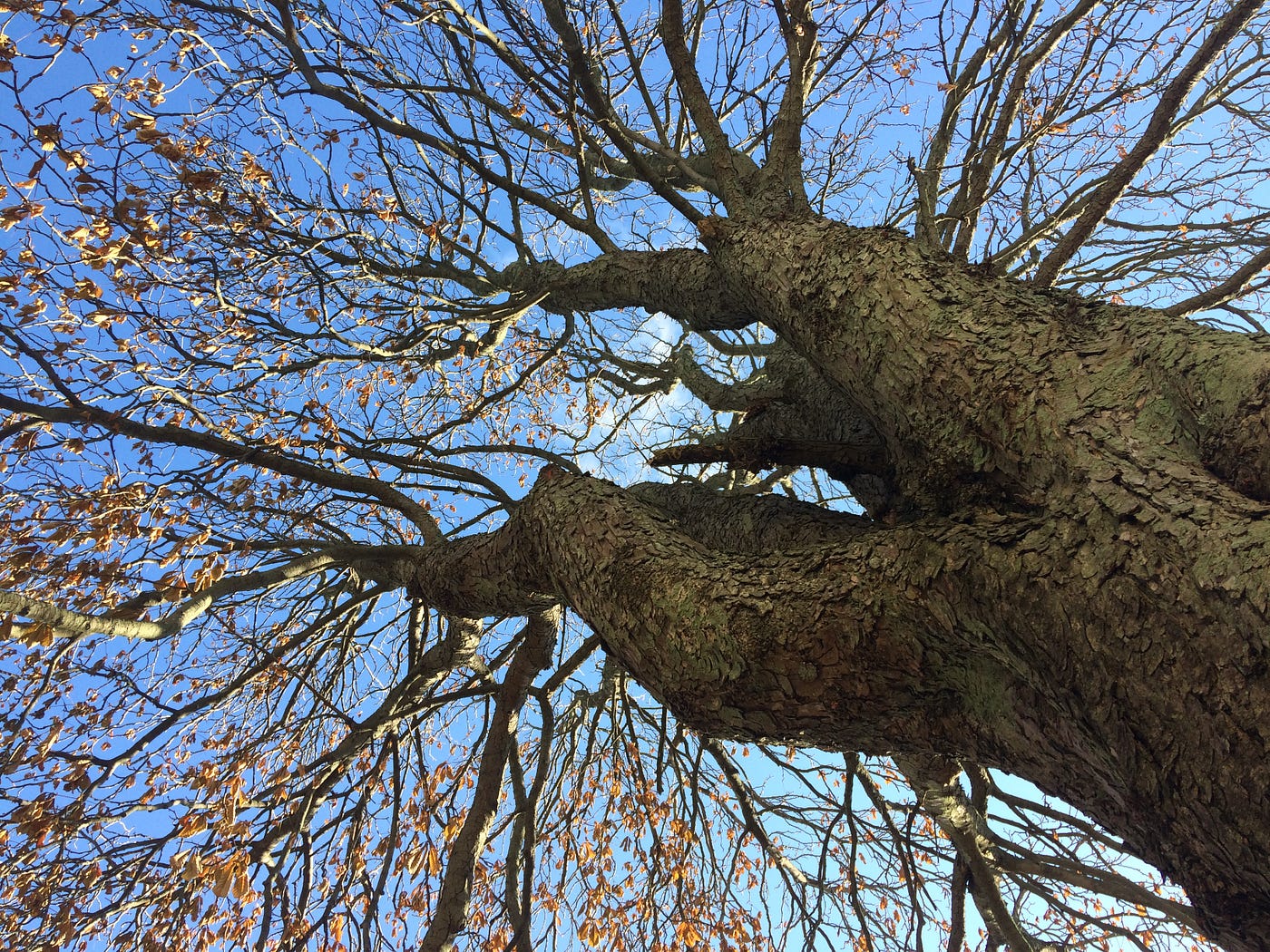
No axe at the root of the tree for Jesus | Photo by Ron Steed in Morris, CT
Some are certain that Jesus has come to raise an army and conquer the Romans. Others like John, perhaps, expect Jesus to render judgment on Jews like Herod Antipas, the Romans’ King of Judea, or the likes of the Sadducees and other ruling elites who are driving the people to ruin and starvation. “You brood of vipers! Who warned you to flee from the wrath to come? You’re gonna get yours when the Messiah gets here; you’ve got it coming!”
You don’t have to listen to the news in America for very long to hear similar themes being thrown out there by people who wrap themselves in the cross of Christ. And I have to be careful too; I’m wrapped in the very same thing!
The left out middle…
And here, I want to make a point. When I am done talking, we’re going to stand up and say the Nicene Creed. There’s a point when it says that Jesus “…became incarnate from the Virgin Mary, and was made man. For our sake, he was crucified under Pontius Pilate….” The creed leaves out his whole life! All the parts in the middle between when he was born and when he died! It’s like they had an Oreo cookie at the Council of Nicea (325 A.D.), ate the cream, and handed us the outside cookies!
It’s in the gospels of Matthew, Mark, Luke, and John where we find that creamy filling, the story about what Jesus was up to. And it is THAT story I want to focus on, because Jesus hints at it very strongly in today’s gospel. And by the way, I say the creeds, too. It’s just that they leave out any mention of some vital things. The creeds are not a complete statement of Christian faith without the gospels.

God becoming King , Act 1 | Photo By Ron Steed of Madonna del Parto by Piero della Francesco (c1460)
The story that the four gospels tell is how God became King of the Earth, in and through Jesus the Messiah.² It’s the story about how God’s Kingdom was inaugurated on Earth, so that God’s will would be done on Earth as it is in heaven. Something profound in history happened through Jesus’ life and ministry so that now God is king, not Caesar, Herod Antipas, the Emperor of France, the King of England, or the President of the United States.
That God would become King was always the fulfillment of Jewish scripture and the hope of its people. It’s just that what God’s will on Earth might look like differed significantly from what people imagined. Rather than armies or burning chaff, God’s Kingdom means, at least in part, the Isaiah 35 agenda: “the blind receive their sight, the lame walk, the lepers are cleansed, the deaf hear, the dead are raised, and the poor have good news brought to them.” All the things that Jesus himself was doing.

The poor have good news brought to them | Photo by Ron Steed, painting by Arturo Luciani in Montalcino, Tuscany
That right there, Jesus is saying that God’s Kingdom on Earth acts in ways unlike any other earthly kingdom. It’s not that Jesus was proposing some crazy hard-to-fathom moral teaching — which he was — it was also that Jesus was saying, out loud, “I am doing what God said God would personally do.” Equating himself with God, and moreover, as a King, caused people heartburn; enough heartburn for them to crucify Jesus. And it still does.
Many modern people do not want to accept a God who acts in the world the way Jesus acted. They would rather that God stay distant and detached on some faraway galaxy. They want to keep Jesus as an “important moral teacher” rather than understand that Jesus was saying something far more profound, “I am doing what the Creator God said God would do.”
The backstory
This is an important point. Isaiah 35 is the backstory of today’s gospel, and it is not just a moral teaching. It speaks about what good things God plans to do for Israel. Jesus says that the time has come for this to happen, and he, Jesus, is the one doing it. This should REALLY give the hearer a pause. I think it gave John the Baptist a pause. Isn’t this what God said GOD would do? Yes… Yes, it is.
And this is one of the reasons that early Christians, very quickly after Jesus’ life on Earth, made the connection that Jesus was, in some way divine, and began to worship him. Jesus rarely made this direct and explicit claim for himself in the gospels (remember it is Thomas who exclaims, “My Lord and my God!”). What Jesus DID claim was that he was the Messiah, which doesn’t mean you have to be divine. AND, what Jesus was doing was all the things that Jewish scripture said God would do. It would take another 300 years for the Nicene Creed to put together words that were “good enough” to describe all of this.

A different king of Messiah | Photo by Ron Steed at Holy Cross Monastery in West Park, NY
This is just one of many ways in which the gospels lean on the Hebrew Testament as the backstory for what Jesus is doing, what God is doing. It is not that the gospels are a new beginning, as though we need to forget the story of Israel and start over. Rather, it is the fulfillment of the story. It is where the Hebrew narrative was pointing all along.
And more. This matters because the People of Israel were chosen not to rule the world as the Romans did, but to be the people through whom God would save the world. The whole world is caught up in the story of Israel. Our own times and nation are also woven into Israel's salvation story. Even the modern State of Israel and the people of Gaza, God help them all, are caught up in the salvation story of their ancient ancestors.
What do we do now?
Now, it may not feel to us today that God is as completely in control of things as we might hope the King of the World would be. How is that?
I think part of the answer is that God’s Kingdom was launched by Jesus and is not yet fulfilled. And, I think part of the fulfillment depends on us as disciples to do some things. It takes our active participation, with the assistance of the Holy Spirit, for God’s will to be done on Earth as it is in heaven. Part of what we long for in Advent is the fulfillment of that Kingdom. As we look forward to celebrating the birth of Jesus at Christmas, we also look for Jesus' return to make God’s Kingdom whole and complete. We hope it happens this afternoon; it might not happen for another million years. In fact, 20,000 years from now, people might look on us as early Christians who were still trying to figure out what Jesus was up to!

Can we raise those who are dead to housing? | Photo by Ron Steed in New London, CT
In the meantime, what do we do? Well, one thing we can do is what Jesus did in the middle of his ministry. We practice being the Isaiah 35 people; ones who help the blind receive their sight, the lame walk, the lepers cleansed, the deaf to hear, the dead to be raised (maybe the ones who are dead to health… dead to housing… dead to human connection), and we bring good news to the poor.
“Wait a minute,” you might say, “isn’t this just following the teachings of one of history’s great moral teachers?”
Yes, it is that, and it is also way more than that. These are the things God said God would do, and it turns out that he is doing those things through Jesus and those who follow Jesus. And, he has given us God’s Spirit to help us in the doing. In doing these Isaiah 35 things, we proclaim that the Creator God of Israel has performed an act of new creation in and through his son Jesus the Messiah of Israel, the one who is himself, God in human form, and the one we worship as God.

We are caught in the middle | Photo by Ron Steed in Tuscany
We are a people today who are caught in the middle — caught in that sometimes sweet, delicious, Oreo place, between the inauguration of the Kingdom and its fulfillment. We are also caught, delightfully, in the middle of the mystery of the Trinity: Father, Son, and Holy Spirit. We are in the middle of things, and the middle matters.
So, go twist open a few Oreos. If you’re really good, you’ll split the cream between the cookies, so each gets half, and you can share one with another. In that sharing, you proclaim the inauguration of God’s Kingdom, our hope for its fulfillment, and our wisdom that Jesus the Messiah is the God of Israel in human form. And blessed is anyone who takes no offense at you!
¹ Taken from : Isaiah 35:1–10 (NRSV)
The wilderness and the dry land shall be glad, the desert shall rejoice and blossom; like the crocus it shall blossom abundantly, and rejoice with joy and singing. The glory of Lebanon shall be given to it, the majesty of Carmel and Sharon. They shall see the glory of the Lord, the majesty of our God. Strengthen the weak hands, and make firm the feeble knees. Say to those who are of a fearful heart, “Be strong, do not fear! Here is your God. He will come with vengeance, with terrible recompense. He will come and save you.” Then the eyes of the blind shall be opened, and the ears of the deaf unstopped; then the lame shall leap like a deer, and the tongue of the speechless sing for joy. For waters shall break forth in the wilderness, and streams in the desert; the burning sand shall become a pool, and the thirsty ground springs of water; the haunt of jackals shall become a swamp, the grass shall become reeds and rushes. A highway shall be there, and it shall be called the Holy Way; the unclean shall not travel on it, but it shall be for God’s people; no traveler, not even fools, shall go astray. No lion shall be there, nor shall any ravenous beast come up on it; they shall not be found there, but the redeemed shall walk there. And the ransomed of the Lord shall return, and come to Zion with singing; everlasting joy shall be upon their heads; they shall obtain joy and gladness, and sorrow and sighing shall flee away.
Matthew 11:2–11 (NRSV)
When John heard in prison what the Messiah was doing, he sent word by his disciples and said to him, “Are you the one who is to come, or are we to wait for another?” Jesus answered them, “Go and tell John what you hear and see: the blind receive their sight, the lame walk, the lepers are cleansed, the deaf hear, the dead are raised, and the poor have good news brought to them. And blessed is anyone who takes no offense at me.” As they went away, Jesus began to speak to the crowds about John: “What did you go out into the wilderness to look at? A reed shaken by the wind? What then did you go out to see? Someone dressed in soft robes? Look, those who wear soft robes are in royal palaces. What then did you go out to see? A prophet? Yes, I tell you, and more than a prophet. This is the one about whom it is written, ‘See, I am sending my messenger ahead of you, who will prepare your way before you.’ Truly I tell you, among those born of women no one has arisen greater than John the Baptist; yet the least in the kingdom of heaven is greater than he.”
² Some themes for this sermon derived from Wright, N. T. (2016a). How god became king: The forgotten story of the gospels. HarperOne, An Imprint of HarperCollins Publishers.
Rev. Dr. Elena Skyhawk writes about an enchanting experience on Christmas morning involving mysterious tracks in the snow! The world needs more enchantment…
[embed]Santa And Reindeer Prints How Santa’s lookout made such an impression of wondermedium.com
The Rev. Ron Steed is an Episcopal Deacon in Southeast Connecticut and a chaplain at Lawrence & Memorial Hospital in New London, CT. He writes haiku and lyrical prose that he hopes will help others put the head and heart in right-relation.
Top writer in Art, Watercolor, Haiku, Sermons, and Episcopal Church.

Ron Steed

Click here to follow Refresh the Soul to stay updated with the latest!

메타데이터
- post_id
- 79bc1a5ddaaf
- slug
- sermon-the-oreo-gospels-79bc1a5ddaaf
- url
- https://medium.com/refresh-the-soul/sermon-the-oreo-gospels-79bc1a5ddaaf
- canonical_url
- https://medium.com/refresh-the-soul/sermon-the-oreo-gospels-79bc1a5ddaaf
- author_url
- https://medium.com/@ronaldsteed
- status
- ok
- fetched_at
- 2026-06-23 17:05:31