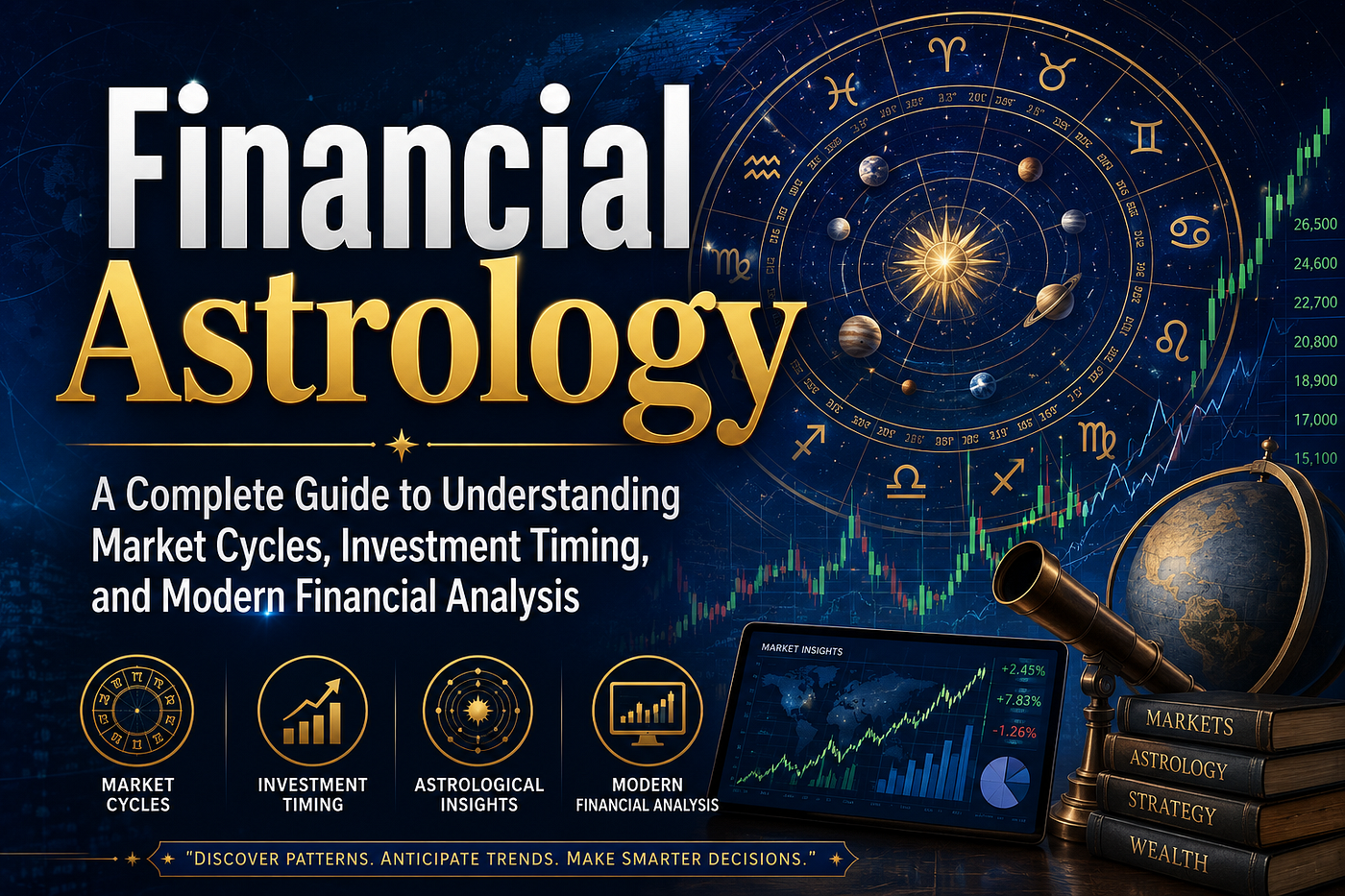
The Future of Institutional Financial Astrology: Data, Technology, Probability and Market Timing
Financial markets are entering an era in which information alone is no longer enough to create an investment advantage.
The Future of Institutional Financial Astrology: Data, Technology, Probability and Market Timing
Financial markets are entering an era in which information alone is no longer enough to create an investment advantage.
Institutional investors already have access to economic databases, company fundamentals, quantitative models, technical indicators, alternative datasets, satellite information, sentiment analytics, artificial intelligence, and real-time global news.

The challenge is increasingly about interpretation and timing.
When should portfolio risk increase?
When should exposure be reduced?
When is a correction likely to represent opportunity rather than the beginning of a deeper deterioration?
When should a fund review leverage, liquidity, or hedging?
These questions are helping create interest in increasingly diverse forms of market-cycle research, including an unconventional field known as institutional financial astrology.
Institutional financial astrology attempts to study planetary and astronomical cycles as possible timing variables within a broader professional investment framework. Unlike traditional astrology, its potential institutional use is not primarily about symbolic prediction. The more serious research question is whether predetermined astronomical cycles can provide incremental information about market timing, volatility, sentiment, or regime transitions.
There is currently no established scientific consensus demonstrating that planetary movements cause financial markets to rise or fall. Financial astrology should therefore not replace fundamental analysis, quantitative models, technical analysis, macroeconomic research, or institutional risk management.
Its future relevance will depend on something much more demanding:
data, testing, probability, technology, transparency, and measurable investment value.
If institutional financial astrology evolves in that direction, the conversation may gradually move away from belief and toward a more disciplined question:
Can astronomical timing variables improve an existing market-intelligence process?
What Is Institutional Financial Astrology?
Institutional financial astrology is the application of astrological and astronomical cycle analysis to professional financial-market research.
It can involve equities, commodities, precious metals, currencies, fixed income, stock-market indices, and other global assets.
Researchers may examine planetary conjunctions, oppositions, squares, retrogrades, eclipses, lunar cycles, planetary ingresses, and longer-term planetary relationships.
Vedic financial astrology may additionally incorporate Rahu, Ketu, nakshatras, and other Jyotish timing factors.
For institutional investors, however, the significance of these variables should not come from symbolic interpretation alone.
The signal needs to be testable.
A planetary configuration can be converted into a timestamp.
The timestamp can be compared with market behavior.
Researchers can measure what happened before, during, and after the event.
This transition from interpretation toward measurable data may define the future of institutional financial astrology.
Why Institutional Investors Are Interested in Timing
Professional investors spend enormous resources determining which assets deserve capital.
Yet a high-quality investment can still generate poor short-term results when entered during an unfavorable market regime.
A fundamentally attractive stock can decline significantly during a liquidity contraction.
A correct commodity thesis can remain unprofitable for months before the expected supply-demand imbalance becomes visible in price.
An equity portfolio can suffer substantial drawdowns even when its holdings remain fundamentally strong.
The missing variable is often time.
Institutional market timing therefore focuses not only on what to own but also on when portfolio exposure should become more aggressive, neutral, cautious, or defensive.
Institutional financial astrology attempts to contribute an additional timing perspective to this problem.
The Future Is About Probability, Not Certainty
One of the most important changes required for institutional financial astrology is a transition from deterministic predictions toward probability.
Financial markets are complex systems.
Prices are influenced by earnings, economic growth, monetary policy, liquidity, investor positioning, credit, supply and demand, technological change, and unexpected events.
No single indicator can reliably explain every market movement.
An institutional-quality timing system should therefore avoid statements suggesting that a planetary configuration guarantees a rally, decline, or crash.
A better framework might say that a particular cycle historically coincides with a higher-than-normal probability of volatility.
That hypothesis can be tested.
If historical evidence supports it, the signal can receive some weight.
If it does not, the signal should be removed.
Probability allows institutional financial astrology to become a research framework rather than a certainty-based forecasting system.
Moving From Planetary Interpretation to Planetary Data
Astronomical events have one important research advantage.
Their timing can be calculated precisely.
The dates of planetary conjunctions, retrogrades, ingresses, and eclipses can be determined long before the market outcome occurs.
This means astronomical information can be converted into structured data.
Instead of saying that a planetary event “feels important,” researchers can define exactly when it begins, how long the timing window lasts, and what market behavior is expected.
This can then be compared with financial data.
Was volatility unusually high?
Did momentum change?
Did market breadth deteriorate?
Did the probability of a reversal increase?
This is how institutional financial astrology can become more systematic.
Data Could Transform Financial Astrology Research
Modern institutional investment research depends heavily on data.
The same principle can be applied to financial astrology.
Researchers can build databases containing decades of planetary information.
These datasets can be synchronized with financial-market histories.
Equity indices can be examined.
Gold and silver can be studied.
Currency markets can be compared.
Commodity cycles can be measured.
Bond yields can be analyzed.
Each astronomical event can become another variable within a large research framework.
This does not prove that the variable has financial significance.
It simply makes the hypothesis testable.
Historical Data Is Only the Beginning
Historical market data can reveal whether an apparent relationship existed in the past.
But history alone is not enough.
A model can fit historical data beautifully and fail completely in live markets.
This is especially dangerous when researchers have access to thousands of potential astrological combinations.
The more variables available, the easier it becomes to discover patterns by chance.
Institutional financial astrology therefore needs stronger validation standards.
Historical research should be followed by out-of-sample testing and future time-stamped signals.
Only then can researchers begin determining whether a pattern may contain genuine information.
Artificial Intelligence Could Accelerate Cycle Research
Artificial intelligence may become one of the most important technologies shaping the future of institutional financial astrology.
AI can analyze enormous datasets more efficiently than manual research.
Planetary cycles can be compared with market prices.
Market prices can be analyzed alongside volatility.
Volatility can be compared with credit conditions.
Sentiment can be integrated.
Liquidity can be measured.
Macroeconomic indicators can provide additional context.
AI may discover relationships that would be difficult for a human analyst to identify manually.
However, AI does not automatically create reliable predictions.
In fact, it can make overfitting even easier.
The institutional challenge will therefore be combining AI’s analytical power with strict validation.
Machine Learning and Planetary Market Cycles
Machine-learning models could theoretically examine whether certain planetary variables contain predictive information.
A model could test whether specific cycles are associated with changes in volatility, trend persistence, reversal probability, or cross-asset correlation.
But the objective should not simply be maximizing historical accuracy.
Researchers need to ask whether the model performs on unseen data.
Does the signal remain useful when market regimes change?
Does it work after transaction costs?
Does it improve the existing portfolio process?
If not, the relationship may be statistically interesting but economically useless.
The Importance of Explainable Models
Institutional investors often need to understand why a model is producing a signal.
Completely opaque systems can create governance problems.
This means future institutional financial astrology may benefit from relatively simple and explainable models.
An investment committee should be able to understand that a timing window is being monitored because several predefined cycle variables are converging.
The committee should also understand what conventional indicators are required for confirmation.
Explainability makes the process easier to review.
It also reduces the temptation to treat a complex model as unquestionable.
Financial Astrology as an Alternative Data Layer
Institutional investors increasingly use alternative data.
This may include credit-card transactions, shipping activity, satellite imagery, web traffic, search trends, sentiment, supply-chain information, and options positioning.
Institutional financial astrology differs substantially from these conventional alternative datasets.
Planetary positions are objective astronomical information, but their relationship with financial markets remains an unproven hypothesis.
They can therefore be viewed, at most, as an unconventional cyclical data layer.
The institutional question is not whether planetary data is unusual.
The question is whether it adds measurable information after conventional variables have already been considered.
Incremental Value Is the Real Test
Imagine that a hedge fund already has a strong volatility model.
It uses options data, credit spreads, liquidity, technical structure, and market breadth.
An astrological model is then added.
If portfolio results remain unchanged, the new signal has little value.
If the model improves risk-adjusted returns, reduces severe drawdowns, or identifies volatility windows earlier, it may deserve additional research.
This concept of incremental value is critical.
Institutional investors do not need more indicators.
They need indicators that improve decisions.
Technology Can Create Time-Stamped Forecasting
One of the most valuable uses of technology is creating automatic time-stamped predictions.
The system can identify an upcoming planetary timing window.
It can record the date automatically.
It can specify the expected outcome.
For example, the model might classify the period as elevated volatility risk.
After the window ends, software can measure actual market behavior.
Did volatility increase?
How much?
Did the market reverse?
Was the signal early?
Was it late?
This creates a transparent performance history.
Such technology could significantly improve the credibility of institutional financial astrology research.
Time-Stamped Signals Reduce Hindsight Bias
Hindsight bias is a major problem in financial forecasting.
After a market crash, many indicators appear obvious.
Researchers can often find a planetary aspect, technical divergence, or sentiment signal that existed before the decline.
But that does not prove the signal was recognized beforehand.
Time-stamped forecasting solves part of this problem.
The prediction exists before the outcome.
It can be evaluated honestly afterward.
Institutions considering financial astrology should strongly favor methods that provide this transparency.
Institutional Financial Astrology and Market Timing
Market timing is likely to remain the primary potential application.
Financial astrology is poorly suited to determining fundamental value.
It cannot tell an investor how much cash flow a company will generate.
It cannot calculate debt sustainability.
It cannot measure commodity inventories.
It does not determine central-bank policy.
Its potential role is narrower.
It can attempt to identify when financial markets may enter important timing windows.
Those windows can then trigger deeper conventional analysis.
This is a more realistic role for institutional financial astrology.
Timing Windows Are More Useful Than Exact Dates
Exact market-top and market-bottom forecasts attract attention.
But institutional investors generally do not require that level of precision.
A broader timing window can still provide considerable value.
Suppose the model identifies a potentially sensitive three-week period.
The portfolio manager can review exposure during that window.
If volatility rises and technical support fails, risk can be reduced.
If the market remains strong, no major change is necessary.
This allows the timing signal to influence attention without dictating the decision.
Risk Windows Could Become a Core Application
One future application of institutional financial astrology could involve risk windows.
A risk window identifies a period during which portfolio conditions deserve increased monitoring.
This does not mean a market decline is guaranteed.
Instead, it could lead to a review of position sizes, leverage, liquidity, and hedging.
If conventional risk indicators also deteriorate, the portfolio may become more defensive.
If conditions remain constructive, the signal can expire without major action.
This asymmetrical use of timing information may be more practical than outright directional forecasting.
Opportunity Windows Could Guide Capital Deployment
Timing intelligence can also be useful after market declines.
Suppose equities experience a major correction.
Investor sentiment becomes extremely pessimistic.
Valuations improve.
Credit conditions begin stabilizing.
Liquidity becomes less restrictive.
A planetary cycle model also identifies an opportunity window.
The institution could begin monitoring for confirmation.
If price stabilizes and breadth improves, capital can be deployed gradually.
The objective is not identifying the exact low.
It is improving the environment in which capital is committed.
Professional Portfolios Need Cross-Asset Timing
Institutional portfolios are increasingly global and multi-asset.
Equity markets interact with bond yields.
Currencies affect commodities.
Credit spreads influence risk sentiment.
Gold responds to real yields and monetary expectations.
Oil can affect inflation.
Therefore, the future of institutional financial astrology should not focus on isolated single-market predictions.
A more sophisticated framework would examine whether cycle signals are appearing across multiple markets simultaneously.
Cross-asset confirmation may help distinguish meaningful timing windows from random correlations.
Equity Markets and Institutional Financial Astrology
Large equity indices provide long historical datasets.
This makes them useful for testing cyclical timing hypotheses.
Researchers can compare planetary windows with the S&P 500, Nasdaq, Dow Jones, Nifty 50, or other major indices.
But simple direction may not be the best variable.
Researchers can instead examine volatility, drawdowns, momentum changes, breadth, or the frequency of significant reversals.
This provides more nuanced information.
Gold and Precious Metals
Gold is another important market for cycle research.
It responds to real interest rates, monetary policy, the US dollar, central-bank activity, geopolitical uncertainty, and investor psychology.
Silver combines monetary characteristics with substantial industrial demand.
Institutional financial astrology can study predefined timing windows within these markets.
However, conventional macroeconomic and technical confirmation should remain essential.
A planetary cycle should never replace real-yield, currency, or supply-demand analysis.
Currency and Rate Markets
Currency markets are influenced by interest-rate differentials, economic growth, inflation, and monetary policy.
Bond markets are heavily affected by inflation expectations, central-bank decisions, fiscal conditions, and capital flows.
These markets provide additional testing environments for institutional financial astrology.
A timing model may be able to identify periods of heightened sensitivity.
But macroeconomic context remains primary.
Volatility Could Be More Valuable Than Direction
One of the most promising research questions may involve volatility rather than bullish or bearish predictions.
A portfolio manager may not need to know exactly whether the market will rise or fall.
Knowing that the probability of unusually large movement is increasing could still influence portfolio risk.
Position sizes could be reduced.
Leverage could be reviewed.
Options hedges could be considered.
Liquidity could be increased.
This makes volatility forecasting potentially more relevant to institutional financial astrology than simplistic directional calls.
Financial Astrology and Market Sentiment
Investor psychology also moves through recurring phases.
Confidence can develop into optimism.
Optimism can become complacency.
Complacency can become speculation.
During bear markets, fear can eventually become panic.
Financial astrologers have historically connected planetary cycles with collective psychology.
Modern technology creates an opportunity to test that hypothesis more objectively.
Planetary timing can be compared with investor surveys, options positioning, volatility, fund flows, and AI-generated news sentiment.
If consistent relationships appear, they can be studied further.
Behavioral Data Could Improve Testing
Behavioral finance offers measurable evidence of investor psychology.
Researchers can examine herd behavior, risk appetite, overconfidence, fear, and loss aversion.
Institutional financial astrology could use these datasets to test traditional astrological claims about collective behavior.
For example, if a planetary cycle is believed to correspond with speculative excess, researchers can measure trading volume, options activity, valuations, and sentiment.
This is more rigorous than simply describing a market as euphoric after prices have already risen.
Fundamental Analysis Should Remain Central
Institutional financial astrology should not attempt to replace fundamental analysis.
Fundamental research evaluates corporate earnings.
It studies cash flows.
It measures leverage.
It evaluates competitive advantages.
Commodity fundamentals examine supply and demand.
Macroeconomic research analyzes growth and monetary policy.
These are direct financial variables.
Astrological timing can only play a supporting role.
The future of the field depends partly on respecting this limitation.
Technical Analysis Can Provide Confirmation
Technical analysis is particularly useful because it can confirm whether a timing hypothesis is affecting the market.
Suppose an institutional financial astrology model identifies a potential reversal window.
Price approaches long-term resistance.
Momentum begins weakening.
Breadth deteriorates.
Volatility starts increasing.
Several layers now support a cautious interpretation.
If price instead breaks decisively higher, the reversal thesis becomes weaker.
The market remains the final decision-maker.
Liquidity and Credit Should Be Included
Professional timing systems should also incorporate liquidity and credit.
Financial markets can remain strong during supportive liquidity environments despite valuation concerns.
When credit conditions deteriorate, risk can rise rapidly.
A planetary timing signal that aligns with tightening liquidity and widening credit spreads may deserve greater attention than one appearing in isolation.
This is how institutional financial astrology can become part of a broader market-intelligence model.
Signal Convergence Is More Important Than One Indicator
Institutions should rarely make major portfolio changes because of one signal.
Convergence is more valuable.
Imagine a predefined planetary risk window approaches.
At the same time, liquidity tightens.
Credit spreads widen.
Market breadth deteriorates.
Momentum weakens.
Volatility rises.
Investor optimism remains excessive.
Several independent indicators are now pointing toward increasing fragility.
The timing window may strengthen the case for caution.
The same concept can be applied to potential opportunity windows.
Portfolio Risk Management Is the Real Application
The future of institutional financial astrology may ultimately depend less on forecasting returns and more on risk management.
A timing model can influence how much exposure a portfolio carries.
It can affect the pace of capital deployment.
It can influence hedging.
It may lead to greater liquidity during vulnerable periods.
These are practical institutional decisions.
Even a timing model with imperfect directional accuracy could potentially provide value if it consistently improves risk control.
Position Sizing Can Respond to Probability
Probability-based timing allows institutions to avoid binary decisions.
A mildly negative signal may justify only a small reduction in risk.
A strong convergence of several indicators might justify a larger adjustment.
This creates a graduated system.
Instead of predicting that a crash must occur, the portfolio can respond to changes in estimated risk.
That is much closer to how professional institutions manage uncertainty.
Dynamic Hedging Could Benefit From Timing
Permanent portfolio hedges can be expensive.
Institutional investors may therefore want to increase hedging only when risk appears unusually high.
An institutional financial astrology risk window could potentially trigger a hedge review.
But actual hedging decisions should still depend on volatility, technical structure, credit, liquidity, and portfolio-specific risk.
This preserves financial discipline.
Governance Will Determine Institutional Adoption
Institutional investors operate under strict governance.
Any unconventional model must fit inside that structure.
The methodology must be clearly documented.
Signal definitions should be stable.
The role of the timing model needs to be specified.
Investment committees should know whether it influences risk, exposure, hedging, or simply research attention.
Without governance, financial astrology can become subjective.
With governance, it can at least be evaluated consistently.
Transparent Failure Records Are Essential
Credibility requires recording unsuccessful signals.
A model that displays only successful predictions cannot be evaluated properly.
Institutional financial astrology should maintain complete historical archives.
When a risk window produces no meaningful market reaction, that event should remain in the dataset.
When the model misses a major market move, that should also be documented.
Failures provide essential information.
They help institutions understand when the model is less reliable.
Backtesting Must Be Rigorous
Backtesting should evaluate every predefined signal.
Researchers should establish clear success criteria.
For example, if a timing window predicts elevated volatility, the study should define how much volatility must increase and over what period.
The same rules should apply to every historical event.
This reduces subjective interpretation.
A robust model should also be tested across different markets and economic regimes.
Out-of-Sample Testing Is Non-Negotiable
Out-of-sample testing is one of the strongest defenses against overfitting.
A planetary timing model may be developed using one historical dataset.
It should then be tested on another period that was not used during model construction.
The strongest validation comes from genuine future signals.
If the model continues generating useful information without being modified after every failure, confidence may gradually increase.
If performance disappears, the hypothesis should be reconsidered.
Correlation Should Not Be Confused With Causation
A statistical relationship between planetary cycles and markets would not automatically establish causation.
Markets react directly to financial mechanisms.
Companies generate earnings.
Central banks change policy.
Investors move capital.
Commodity supply and demand change.
Credit conditions affect financing.
Planetary variables may show correlations without proving they caused the financial outcome.
Institutional research should maintain this distinction clearly.
Blockchain Could Improve Forecast Verification
Another possible future technology is blockchain-based timestamping.
Forecasts or signal records could theoretically be stored in a tamper-resistant system.
This would make it more difficult to modify predictions after the outcome occurs.
Such technology is not necessary for financial astrology research, but it illustrates how verification tools could improve transparency.
The broader principle is important:
Future institutional financial astrology will benefit from auditable research records.
Cloud Computing Can Expand Historical Testing
Cloud computing allows researchers to analyze enormous financial and astronomical datasets.
Millions of combinations can be tested across multiple markets.
This can accelerate discovery.
But it also increases the danger of data mining.
The more combinations tested, the greater the chance of discovering impressive relationships randomly.
Institutional researchers therefore need statistical controls and robust validation.
More computing power must lead to stronger standards, not weaker ones.
Real-Time Platforms Could Change the User Experience
Institutional financial astrology may eventually move from static reports toward real-time platforms.
A professional dashboard could display upcoming cycle windows.
It could combine those windows with volatility, market breadth, technical indicators, liquidity, credit, sentiment, and macro data.
The investor would not receive a simple “buy” or “sell” message.
Instead, the platform could show how several layers of risk intelligence are interacting.
This type of interface is more suitable for professional investors.
Research Logs Can Build Institutional Credibility
Every timing signal can be stored in a research journal.
The system could record the planetary event.
It could show the hypothesis.
It could store the market state at the time.
Later, it could record the outcome.
Over years, this creates a rich database.
Institutions can determine which planetary variables appear useful and which do not.
The process becomes cumulative rather than anecdotal.
The Role of Rajeev Prakash Agarwal and Specialized Research Platforms
The broader development of financial-astrology platforms and dedicated market-timing research reflects this transition toward more structured analysis.
Rather than relying entirely on individual interpretations, a technology-supported environment can organize astronomical timing, global market data, cycle observations, and market signals in one place.
For institutional investors, that direction is more relevant than traditional astrology alone.
The future competitive advantage of specialized research providers will depend increasingly on transparency, testing, time-stamped signals, data quality, and integration with conventional market research.
Institutional Financial Astrology Should Complement Existing Models
The strongest potential model is additive rather than disruptive.
Institutions should not abandon existing research processes.
Fundamental models remain valuable.
Quantitative research remains valuable.
Technical analysis remains valuable.
Macroeconomic analysis remains essential.
Alternative datasets continue to expand.
Institutional financial astrology can be evaluated as one additional timing variable.
If it contributes value, it can remain.
If it does not, it should be removed.
This is how professional research should work.
The Future Is a Multi-Layer Intelligence Model
Future institutional portfolio research may combine many independent layers.
Fundamental analysis provides information about value.
Macro analysis explains economic regimes.
Liquidity reveals financial support.
Credit identifies stress.
Technical analysis measures price structure.
Sentiment captures investor psychology.
Alternative data reveals additional economic activity.
AI identifies complex relationships.
Institutional financial astrology adds a cyclical timing hypothesis.
Risk management converts those signals into portfolio decisions.
No single layer needs to claim certainty.
The objective is better probability assessment.
Institutional Financial Astrology and Family Offices
Family offices may be one audience for this evolving methodology.
They often manage long-duration wealth across multiple asset classes.
Their portfolios may include equities, private businesses, real estate, bonds, precious metals, and alternative investments.
For these investors, a timing overlay could potentially support liquidity management and tactical risk control without requiring constant trading.
The value would lie in identifying periods when the overall portfolio deserves more or less defensive positioning.
Hedge Funds May Use Timing Differently
Hedge funds can use timing intelligence more actively.
They may adjust gross exposure.
They may alter net exposure.
They may use derivatives.
They may increase or reduce leverage.
They may rotate between assets.
A probability-based institutional financial astrology framework could theoretically contribute to these decisions when combined with conventional signals.
Again, the timing signal should never operate without validation and risk limits.
The Standard for Institutional Use Must Remain High
Because institutional financial astrology is unconventional, the standard for evidence should be demanding.
A handful of successful forecasts is not sufficient.
Professional investors should look for transparent methodology, complete signal records, independent testing, out-of-sample performance, clear definitions, and measurable portfolio impact.
Claims should be separated from verified results.
This higher evidentiary standard will ultimately help the field more than exaggerated promises.
What Could Institutional Financial Astrology Look Like in the Future?
The future version of institutional financial astrology may look very different from traditional astrology.
It may involve automated astronomical datasets.
Machine-learning models could analyze long histories.
Timing windows could be generated algorithmically.
Signals could be time-stamped automatically.
Risk probabilities could be updated as new market evidence appears.
Portfolio managers could view planetary timing alongside liquidity, credit, volatility, and technical structure.
Performance could be tracked continuously.
Unsuccessful theories could gradually be removed.
If this evolution occurs, financial astrology would become less about fixed predictions and more about structured cyclical research.
The Biggest Opportunity Is Better Questions
The future of institutional financial astrology may not depend on asking, “Will the market rise or fall?”
More useful questions include:
Is the probability of volatility increasing?
Is an established trend becoming more vulnerable?
Is the market entering a historically sensitive timing window?
Are several independent cycles converging?
Does conventional financial data confirm the timing signal?
Should portfolio risk be reviewed?
These questions are more compatible with professional investment management.
Final Thoughts
The future of institutional financial astrology will depend on whether the field can evolve from interpretation toward evidence.
Planetary cycles are objectively calculable.
Their financial relevance remains an open and unproven hypothesis.
Technology now makes that hypothesis easier to test than ever before.
Large historical datasets can be analyzed.
Artificial intelligence can compare planetary timing with volatility, sentiment, liquidity, credit, macroeconomic variables, technical structure, and cross-asset behavior.
Signals can be generated before market outcomes.
Forecasts can be time-stamped.
Results can be measured.
Failed predictions can be preserved.
Out-of-sample testing can determine whether apparent relationships survive beyond the period used to discover them.
This evolution creates a very different framework from traditional deterministic financial astrology.
The future model is more likely to be probabilistic.
It will identify risk windows rather than guarantee crashes.
It will identify opportunity windows rather than promise exact bottoms.
It will integrate price confirmation rather than ignore the market.
It will coexist with fundamental research rather than attempt to replace it.
It will use technology to increase transparency rather than simply produce more predictions.
Most importantly, institutional financial astrology will need to answer the same question that applies to every alternative investment signal:
Does it improve portfolio decisions after rigorous testing?
If astronomical timing variables consistently add useful information about volatility, market transitions, risk management, or capital deployment, professional investors may have a reason to continue studying them.
If they do not, institutional research should reject them.
That evidence-based standard is likely to determine the future of the field.
Institutional financial astrology therefore should not be defined by certainty.
Its future lies at the intersection of data, technology, probability, market cycles, disciplined market timing, and measurable risk management.
For more insights into institutional financial astrology, financial astrology market timing, professional market timing, planetary cycles, alternative data, artificial intelligence, institutional portfolio research, equities, commodities, gold, silver, currencies, and portfolio risk management, visit:
메타데이터
- post_id
- 79d7f5ebdad2
- slug
- the-future-of-institutional-financial-astrology-data-technology-probability-and-market-timing-79d7f5ebdad2
- url
- https://medium.com/@astroaifinancial/the-future-of-institutional-financial-astrology-data-technology-probability-and-market-timing-79d7f5ebdad2
- canonical_url
- https://medium.com/@astroaifinancial/the-future-of-institutional-financial-astrology-data-technology-probability-and-market-timing-79d7f5ebdad2
- author_url
- https://medium.com/@astroaifinancial
- status
- ok
- fetched_at
- 2026-08-09 04:52:39