Building a Scalable MLOps Stack — From Data to Deployment
This article explores the development of a streamlined ML system, showcasing the journey from data to deployment, simplifying complex…
Building a Scalable MLOps Stack — From Data to Deployment
This article explores the development of a streamlined ML system, showcasing the journey from data to deployment, simplifying complex processes for effective machine learning operations.
Photo by Esther Jiao on Unsplash
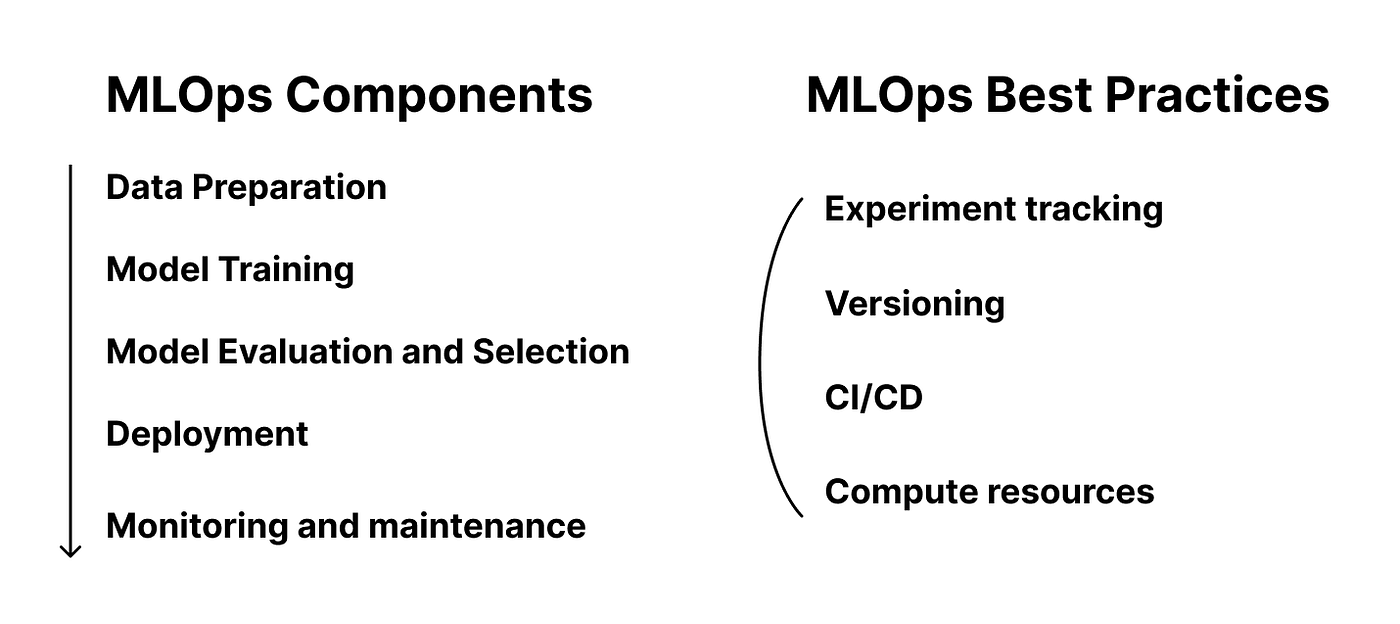
In today’s data-driven landscape, machine learning has transformed how we harness insights from vast datasets. However, transitioning from raw data to a deployable machine learning model poses various challenges, including data prep, model training, and deployment. This is where MLOps comes into play, merging DevOps best practices with data science requirements to ensure models not only get built but also thrive in practical applications.
MLOps, far from just a buzzword, represents a set of practices and tools bridging the gap between data science and operationalization. A well-structured MLOps stack empowers you to automate these processes, turning data science experiments into reliable pipelines that deliver tangible real-world value.
What is the project about ?
The core concept driving this project is the development of an all-encompassing MLOps stack, using a simple book recommender system as a starting point. While the recommender system is a crucial component, the true spotlight is on the implementation of the stack itself and how it seamlessly orchestrates the entire process.
For our project, we leverage a Kaggle dataset that offers insights into user-book interactions and ratings. This dataset is a treasure trove for crafting various recommendation systems, be it collaborative filtering or content-based.
To construct our MLOps stack, we rely on the synergy of Metaflow, AWS, and the Surprise library. These tools form the backbone of our project, empowering us to create a robust and efficient workflow that can easily be adapted for diverse machine learning applications.
- Metaflow: Metaflow serves as our workflow orchestration tool. It simplifies the management of complex data science workflows, allowing us to define, execute, and monitor tasks seamlessly. With Metaflow, we gain granular control over each step in our pipeline, making it a perfect choice for building and automating machine learning workflows.
- AWS (Amazon Web Services): AWS provides the cloud infrastructure that powers our project. It offers scalability, reliability, and a wide range of services that facilitate data storage, computation, and deployment. AWS plays a pivotal role in making our project production-ready and capable of handling real-world workloads.
- Surprise Library: The Surprise library is our go-to tool for building recommendation systems. It simplifies the implementation of collaborative filtering algorithms, making it easier to generate accurate and personalized book recommendations based on user behavior and preferences. The Surprise library’s versatility enhances the functionality of our stack.
The Stack Acrhitecture

The visual design draws significant inspiration from the exceptional illustrations created by Outerbounds and the Metaflow team.
The MLOps stack seamlessly integrates the components to create a streamlined workflow.
- Model Development: In this phase, we process data to construct the model, evaluate its performance, and prepare it for deployment. It’s the stage where the foundation of the model is laid, ensuring it meets the required standards and criteria.
- Deployment Layer: The deployment layer is where the model comes to life, generating real-world results. It maintains a strong connection with the development phase because the model must adapt to shifts in data and evolving requirements. It’s a dynamic layer that ensures the model remains effective and relevant over time.
- Data Storage: This layer serves as the repository for any artifacts generated during the model’s development and deployment. It encapsulates crucial data and information, ensuring accessibility and integrity.
- Compute Layer: The compute layer is the engine that powers the entire process. It’s responsible for performing computations, executing tasks, and facilitating the seamless flow of data and operations throughout the MLOps stack.
Workflow Overview
Let’s look at the workflow from where the model is developed and maintained. All the code is on the github repository here.
The main flow created with Metaflow is called flow.py. How the workflow works is quite simple and is described in the DAG above. It starts with the preparation of the dataset :
[embed]
Here, the objective is to convert the dataset into a Surprise dataset for the upcoming stage. Once this transformation is completed, we’re set for grid search training using Metaflow’s data parallelism method known as “foreach,” initiating simultaneous training for each model in the model_sets.
[embed]
Following the execution of a “foreach” operation, it becomes necessary to incorporate a “join” step to consolidate and retrieve the outcomes of the previously parallelized tasks.
[embed]
As evident, the inputs consist of the outcomes from each grid search training, necessitating an internal loop to extract the model and corresponding accuracy. After consolidating the results, the subsequent stage involves the selection of the optimal model among them.
[embed]
The selection process relies on the computed recall score for each model, with the best-performing one chosen for deployment.
[embed]
Lastly, the model is serialized, allowing it to be employed in production environments.
References and Enhancements
I drew inspiration from Outerbounds’ resource while constructing this stack, as it offered a clear and comprehensive explanation. This resource showcases how the combination of Metaflow with other tools can empower you to tailor a stack to your specific requirements.
Additionally, I benefited from a fantastic video provided by Saturn Cloud, which gives an overview of using AWS with Metaflow, with a focus on the CloudFormation template.
Moreover, the stack could be enhanced, for example :
- Deployment Layer Expansion: Consider integrating a robust deployment layer to ensure seamless transition of models to production environments (guaranteeing model availability and use in real time).
- Model Monitoring in Production: Emphasize the importance of continuous monitoring of the model in production. This practice can help detect model drift, ensure ongoing accuracy and resolve problems as they arise.
- Job Scheduling Integration: Explore the integration of a job scheduling framework as part of a complete CI/CD pipeline. Task scheduling can automate routine tasks, such as model recycling and data updates, to ensure that the stack remains up-to-date and efficient.
By continuously refining the stack and incorporating these improvements, we can maintain its relevance and effectiveness in the dynamic landscape of machine learning and data science.
Thanks for taking the time to read this article, I hope you enjoyed discovering this simple MLOps stack. Please feel free to share this post with your friends, and if you are interested in data science or machine learning, check out my other articles here.
WRITER at MLearning.ai / LLM Coding / Multimodal MLearning
[embed]Mlearning.ai Submission Suggestions How to become a writer on Mlearning.aimedium.com
메타데이터
- post_id
- 79e30bcceec2
- slug
- building-a-scalable-mlops-stack-from-data-to-deployment-79e30bcceec2
- url
- https://medium.com/@npogeant/building-a-scalable-mlops-stack-from-data-to-deployment-79e30bcceec2
- canonical_url
- https://medium.com/@npogeant/building-a-scalable-mlops-stack-from-data-to-deployment-79e30bcceec2
- author_url
- https://medium.com/@npogeant
- status
- ok
- fetched_at
- 2026-06-29 01:02:39




