Why the Direction of a Network Connection Changes Everything in Security
Most security teams focus on what’s encrypted. The smarter question is: which way does the traffic flow?
Why the Direction of a Network Connection Changes Everything in Security
Most security teams focus on what’s encrypted. The smarter question is: which way does the traffic flow?
There’s a deceptively simple architectural decision baked into the Qualys Cloud Agent that most people gloss over and it changes your entire security posture. It has nothing to do with encryption algorithms or certificate authorities. It’s about which direction the connection travels.
“In enterprise security architecture, the direction of a network connection matters as much as the encryption on it.”
The one rule that defines the agent
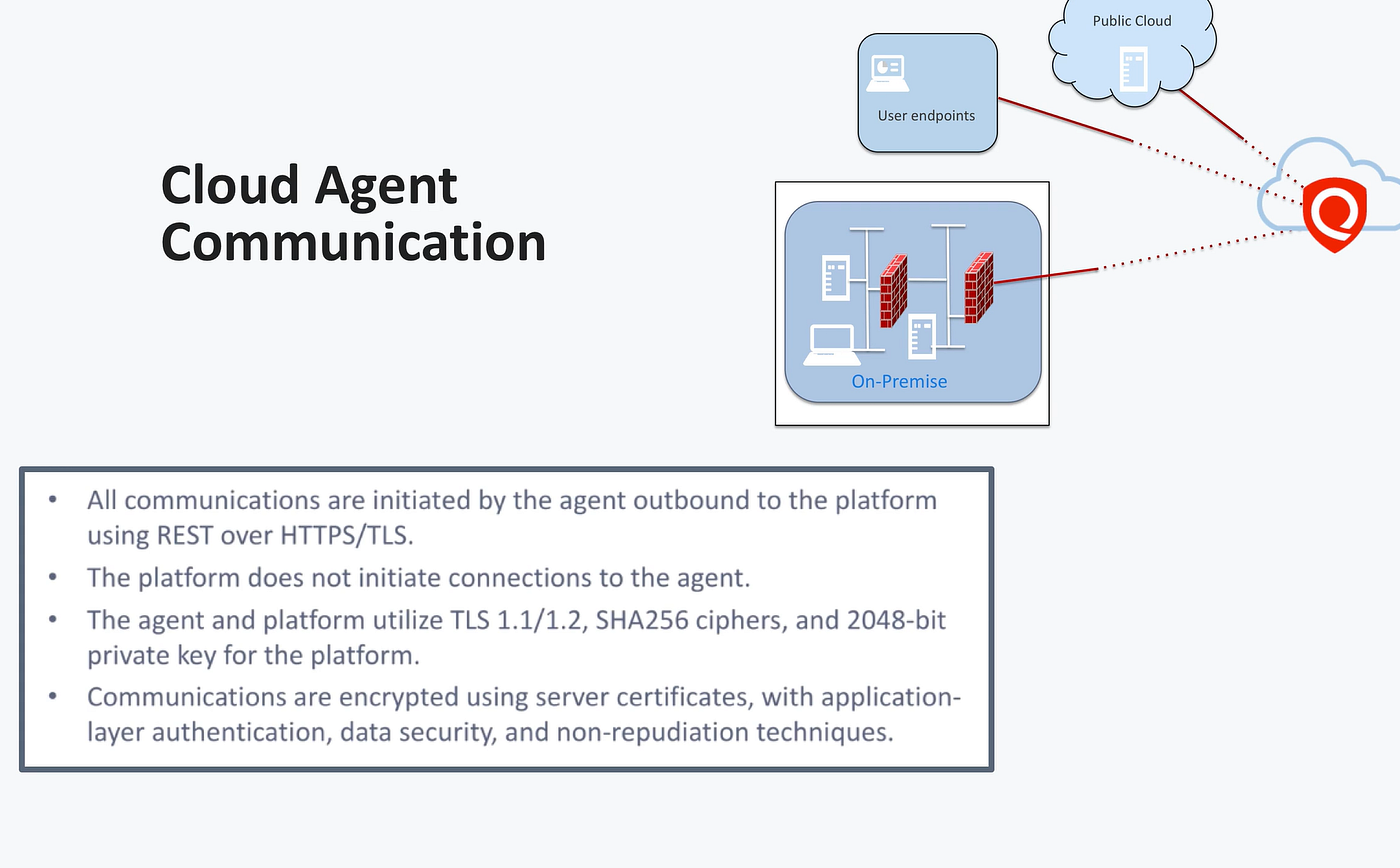
The Qualys Cloud Agent never listens. It never waits for the platform to call it. Every single connection is initiated by the agent, outbound, over HTTPS. The platform has no path to reach back in.
How Qualys Cloud Agent communicates
→Agent initiates ALL connections outbound to the platform
→Platform never calls back to the agent
→Protocol: REST over HTTPS / TLS
→No inbound firewall rules required — ever
That last point is the one worth pausing on. No inbound firewall rules — ever. Think about how many exceptions, tickets, and change-management cycles your team spends managing inbound rules for security tooling. Qualys eliminates that entire category of work.
The crypto stack: what’s actually running under the hood
The communication layer isn’t just encrypted — it’s authenticated and non-repudiable at the application layer. Here’s what the stack looks like:
TLS version — TLS 1.1 / 1.2 Cipher suites — SHA-256 Strong encryption Key size — 2048-bit private key (platform-side) Authentication — Server certificate authentication Integrity — Application-layer non-repudiation
The agent doesn’t just encrypt telemetry — it verifies it’s talking to the legitimate Qualys platform before sending anything. No man-in-the-middle, no rogue collector endpoint.
Legacy scanning vs. agent-based: a structural comparison
To understand why this architecture wins, you need to see what it replaced.
Legacy credentialed network scans
Open ports on every endpoint
Credential storage and rotation
Scanner appliance per network segment
Firewall exceptions at every boundary
Blind spots: cloud, roaming, remote assets
Qualys Cloud Agent model
Zero inbound ports opened
No credential management required
No scanner appliances per segment
Firewall stays clean, no exceptions
Works on-prem, cloud, and roaming endpoints
Legacy scanning is fundamentally a remote-access problem. You’re trying to inspect a machine from the outside — which means you need a way in. That way in is your attack surface. The agent model inverts this entirely.
“The agent lives on the asset — it already knows its own environment best. There’s nothing to scan from the outside.”
Why this is Zero Trust in practice, not just on paper
Zero Trust gets thrown around as a marketing term far too often. But the outbound-only agent architecture is a genuine, structural expression of Zero Trust principles:
No implicit trust by network position. The agent doesn’t trust that it’s on a safe internal network — it connects outbound regardless of where it lives. On-prem, cloud, VPN, coffee shop WiFi — same behavior, same encrypted channel.
No lateral movement surface. Because there are no inbound listeners, there’s no port for an attacker to reach. Compromise of the network perimeter doesn’t give you a path to the agent.
Continuous, not periodic. Traditional scanners run on schedules. The agent provides continuous, authenticated telemetry. Your vulnerability posture is measured in near real-time, not in scan windows.
The result: clean telemetry, no added attack surface
Continuous, authenticated, encrypted telemetry — from every asset — with no attack surface added to your network. That’s what outbound-only architecture delivers. Not as a feature. As a structural property.
If your organization is still running credentialed network scans, the migration path to an agent-based model is worth an honest architectural review. The security benefits are structural, not cosmetic — and the operational overhead reduction is significant.
The direction of a connection isn’t a footnote in your architecture doc. For security tooling, it’s the architecture.
Also Explore Recent Cyber Attacks , Recent Global Cyberattack: Telus Data Breach (2026)
Qualys#CloudAgent#ZeroTrust#VulnerabilityManagement#NetworkSecurity#CyberSecurity#EnterpriseArchitecture
메타데이터
- post_id
- 79f4ec0006c8
- slug
- why-the-direction-of-a-network-connection-changes-everything-in-security-79f4ec0006c8
- url
- https://medium.com/@majjipradeepkumar/why-the-direction-of-a-network-connection-changes-everything-in-security-79f4ec0006c8
- canonical_url
- https://medium.com/@majjipradeepkumar/why-the-direction-of-a-network-connection-changes-everything-in-security-79f4ec0006c8
- author_url
- https://medium.com/@majjipradeepkumar
- status
- ok
- fetched_at
- 2026-07-13 06:51:10




