Standardizing Behavioral Assays: A Comparative Guide to Elevated Plus and Radial Arm Mazes
Behavioral neuroscience labs face a recurring challenge: selecting the right maze paradigm and ensuring the apparatus meets the…
Standardizing Behavioral Assays: A Comparative Guide to Elevated Plus and Radial Arm Mazes
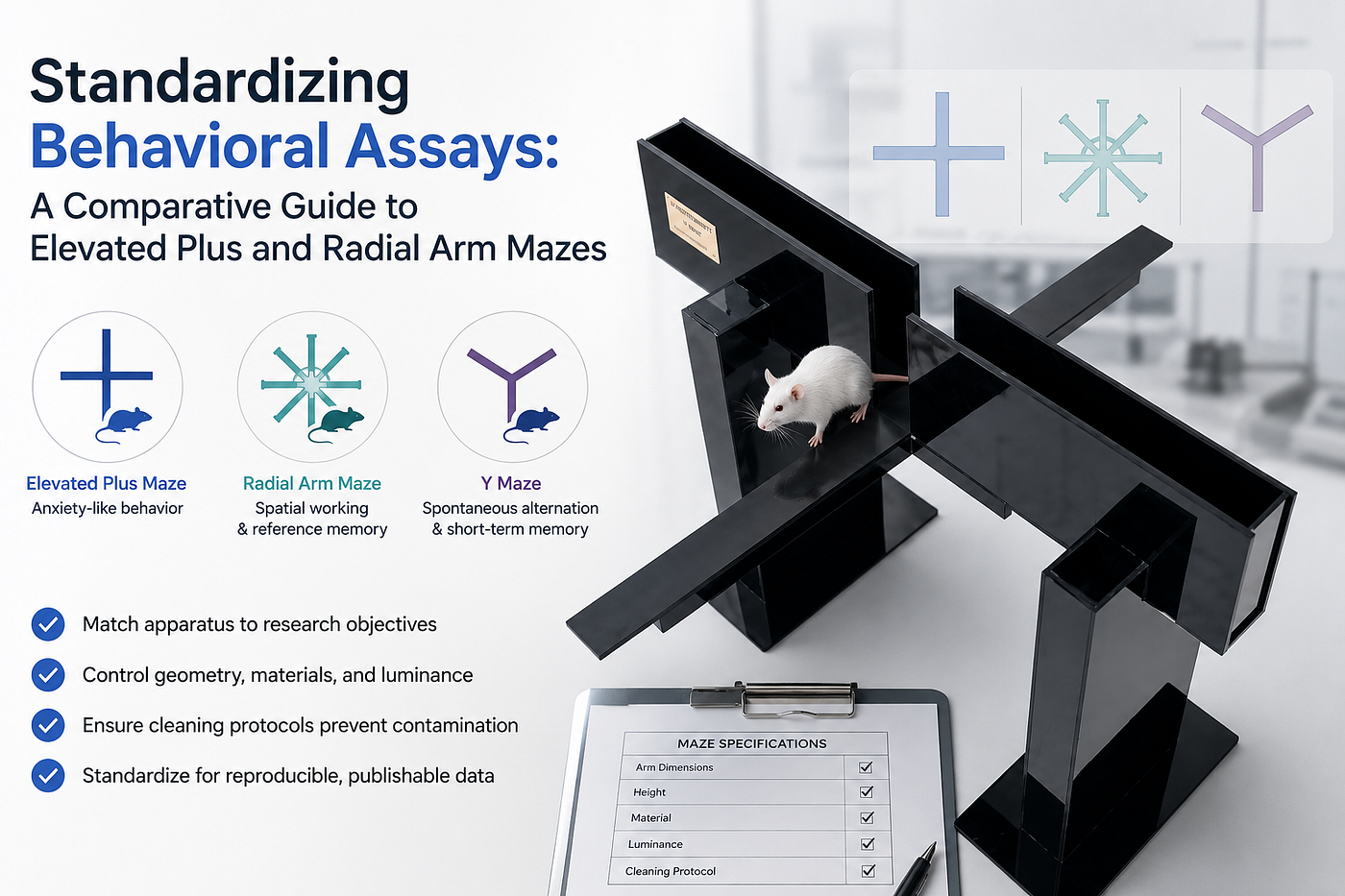
Behavioral neuroscience labs face a recurring challenge: selecting the right maze paradigm and ensuring the apparatus meets the experimental demands of the protocol. Choosing between an elevated plus maze apparatus, a radial arm maze, and a Y maze is not simply a matter of preference — it directly affects data reproducibility, ethical compliance, and publication credibility.
Maze Selection Tied to Research Objectives
Each paradigm measures a distinct behavioral construct. The elevated plus maze apparatus quantifies anxiety-like behavior by exploiting the innate conflict between open-space aversion and locomotor drive in rodents. The radial arm maze evaluates spatial working and reference memory through baited arm-entry patterns. The Y maze, by contrast, leverages spontaneous alternation to assess short-term spatial recognition without food deprivation.
A lab transitioning from anxiolytic screening to spatial cognition research must reconfigure not just protocols but procurement specifications. An apparatus validated for anxiety models carries different arm dimensions, platform heights, and material requirements than one built for memory assays. Procuring a single maze type for dual-purpose use introduces confounds that compromise dataset integrity.
Where Apparatus Variability Enters the Picture
In a contract research setting, inconsistent maze geometry across study batches has led to statistically irreproducible anxiety indices. The elevated plus maze apparatus, when manufactured without standardized open-arm lengths (typically 50 cm × 10 cm for adult mice), produces skewed time-in-open-arm metrics. Even a 3–5 cm deviation alters the perceived threat level and inflates variability between cohorts.
Similarly, radial arm maze arms that differ in width or texture between procurement cycles create tactile cue inconsistencies. Rodents rely on distal spatial and proximal tactile cues simultaneously; uncontrolled changes to either introduce noise. Procurement teams specifying maze dimensions only by photograph rather than technical drawing routinely encounter this failure mode.
Apparatus Material and Luminance Control
Material selection is a compliance and reproducibility issue. Acrylic mazes allow light transmission through walls and floors, while opaque PVC eliminates this variable entirely. Laboratories running photosensitive rodent strains or combining maze testing with optogenetic stimulation must specify material opacity as a procurement criterion, not an afterthought.
Luminance above the maze must remain consistent across sessions. An elevated plus maze apparatus tested at 30 lux produces markedly different open-arm avoidance than one tested at 80 lux. Procurement should always include validated lighting protocols and lux specifications for each maze type.
Cleaning and Cross-Contamination Protocols
Between-trial olfactory contamination is among the most overlooked sources of behavioral assay error. For radial arm maze and Y maze tests, residual olfactory cues from prior subjects actively guide or mislead subsequent animals. Apparatus surfaces must tolerate repeated cleaning with 70% ethanol without crazing or odor retention.
VJ Instruments manufactures maze apparatus with smooth, non-porous surfaces to support high-frequency cleaning without material degradation — a factor labs should evaluate during vendor qualification.
FAQs
What arm dimensions are standard for an elevated plus maze apparatus in adult rats? Typically 50 cm × 10 cm open arms, 50 cm × 10 cm closed arms with 40 cm walls, elevated 50 cm from the floor. Deviations from these specifications require justification in the methods section.
Can the same radial arm maze be used for working and reference memory tasks? Yes, but baiting protocols and inter-trial intervals differ significantly. Apparatus selection remains consistent; only the procedural design changes.
How often should maze surfaces be replaced or resurfaced? Surface integrity should be inspected every six months. Crazing, discoloration, or odor retention are replacement triggers regardless of calendar schedule.
Is the Y maze suitable for pharmacological screening? Yes, particularly for acute drug effect studies due to its short testing window and absence of food deprivation requirements.
메타데이터
- post_id
- 79fcf2695fbc
- slug
- standardizing-behavioral-assays-a-comparative-guide-to-elevated-plus-and-radial-arm-mazes-79fcf2695fbc
- url
- https://medium.com/@maharghabarman7/standardizing-behavioral-assays-a-comparative-guide-to-elevated-plus-and-radial-arm-mazes-79fcf2695fbc
- canonical_url
- https://medium.com/@maharghabarman7/standardizing-behavioral-assays-a-comparative-guide-to-elevated-plus-and-radial-arm-mazes-79fcf2695fbc
- author_url
- https://medium.com/@maharghabarman7
- status
- ok
- fetched_at
- 2026-07-15 21:27:05