Steph Curry and the Mavericks: The Clock Golden State Can’t Stop
Dallas is no longer just another opponent for Steph Curry. It is the mirror showing Golden State’s age, Klay Thompson’s absence, Cooper…
Steph Curry and the Mavericks: The Clock Golden State Can’t Stop
Dallas is no longer just another opponent for Steph Curry. It is the mirror showing Golden State’s age, Klay Thompson’s absence, Cooper Flagg’s rise, and the shrinking runway around a dynasty.
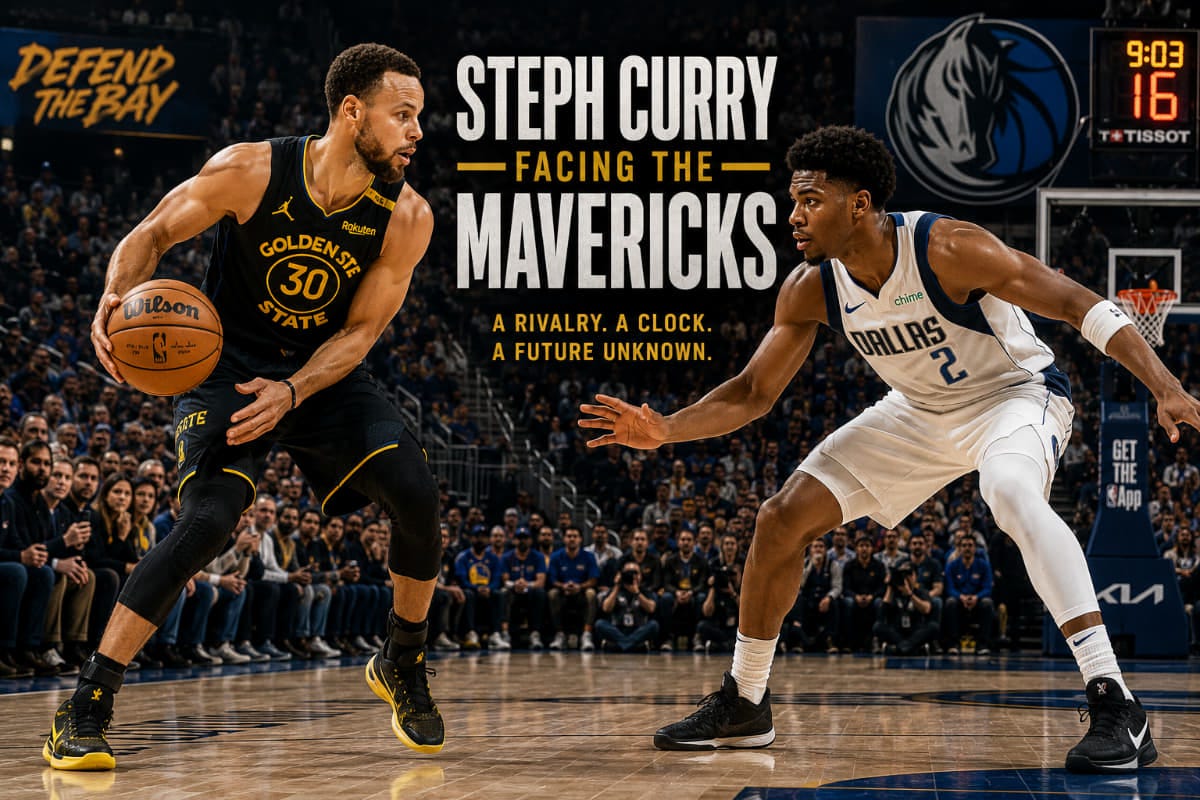
Steph Curry facing the Mavericks no longer feels like a routine Western Conference matchup. Look across the floor at Dallas now, and you see a ticking clock.
The sound comes first. Shoes bite the hardwood. A defender yells “top lock” before Curry even clears the wing. Draymond Green points with two fingers. Across the court, a younger Maverick crouches lower, trying to stay attached before the screen arrives.
Then the old panic returns.
Curry catches near the logo, and the building changes temperature. Dallas has lived through every version of that fear. The rookie blur. The MVP inferno. The playoff surgeon. The former Splash Brother walking back in navy. The Cooper Flagg reboot.
However, this matchup no longer asks one simple question: Can Curry still roast Dallas?
He can.
Curry has averaged **24.1 points, 6.6 assists, and 4.4 rebounds across 49 regular-season games against Dallas. He owns a 30–19** career regular-season record in the matchup. Those numbers prove something real. They show durability. They do not show the ache around it.
The unspoken reality sits deeper. Dallas keeps changing. Curry keeps aging. Every meeting now measures how much Golden State has left around its greatest player.
The young guard and the old Dallas weight
In November 2009, a fragile rookie Steph Curry walked into American Airlines Center and tried to decode NBA defense in real time. Dallas still belonged to Dirk Nowitzki’s long shadow. Jason Terry hunted pockets of space. Shawn Marion flew around passing lanes. The crowd carried the sharp impatience of a franchise used to winning, not rebuilding.
Curry did not look like a revolution yet. He looked slight. He looked breakable. Still, his hands moved fast. He finished that early Dallas test with 18 points, six assists, four rebounds, and three steals in a 111–103 Golden State win.
That line matters because it shows the first version of Steph Curry facing the Mavericks: a young guard learning how to survive contact before he learned how to terrify a league.
Dallas tested him with adult strength. The Mavericks bumped him on cuts, chased him over screens, and forced him to read help defenders who arrived a half-beat earlier than college bodies ever did. Curry answered with balance. Not dominance. Balance.
When balance became cruelty
Years passed, and the balance became cruelty.
By February 2015, Curry had turned the league’s geometry inside out. The Mavericks still had serious names on the floor. Monta Ellis could score in bunches. Chandler Parsons had size on the wing. Tyson Chandler protected the rim. Dirk still bent defensive game plans with his shooting touch.
None of it mattered when Curry caught flame.
On Feb. 4, 2015, Curry scored and made 10 threes as Golden State erased a 22-point deficit and beat Dallas 128–114 at Oracle Arena. He did not merely shoot well. He made a professional defense look late to a future it could not yet name.
That night was not just a hot streak. It redefined Golden State’s offensive identity in public view.
Curry sprinted into threes before Dallas could set its feet. He dragged bigs above the arc and punished every late hip turn. When Ellis or Parsons lunged, Curry slid sideways into clean air. When Chandler stayed back, Curry treated the space like an invitation.
In that moment, Dallas became part of the league’s education. The Mavericks did not defend poorly because they lacked effort. They defended like a normal NBA team. Curry punished normal.
That became the first great truth of this matchup. Steph Curry facing the Mavericks forced Dallas to confront a future that had already arrived. The floor had stretched. The old rules no longer held.
The postseason peak and the Luka problem
The rivalry sharpened in 2022 because Dallas finally had its own gravitational star.
Luka Dončić gave the Mavericks a different kind of control. He did not move like Curry. He did not need Curry’s blur. Luka slowed defenders until they made the first mistake, then carved the floor with his shoulders, eyes, and timing.
Across the court, Curry offered the opposite threat. He created chaos without holding the ball. He ran through screens like a man fleeing a fire. Dallas could stare at him for 20 seconds and still lose him on the 21st.
That contrast made the 2022 Western Conference finals feel bigger than the series score.
Curry controlled the series without forcing it
The Warriors beat Dallas in five games. Curry won the first **Magic Johnson Western Conference Finals MVP after Golden State closed out the Mavericks in Game 5. In that clincher, he scored 15 points and added nine assists**, while the Warriors advanced to their sixth Finals in eight seasons.
Curry did not need to bury Dallas with 50. That was the point.
He controlled the series with absence as much as action. Dallas shaded two bodies toward him. Golden State cut behind that attention. Andrew Wiggins attacked tilted floors. Kevon Looney punished the glass. Draymond Green turned every overreaction into a pass that arrived on time.
The box score undersold the pressure.
When Curry walked his defender into a screen, Dallas had to choose. Step high, and the slip opened. Drop back, and the pull-up three came. Switch, and Curry hunted the big. Blitz, and the Warriors played four-on-three.
That series captured the mature version of Steph Curry facing the Mavericks. The rookie no longer searched for oxygen. The MVP no longer needed constant explosions. He had become the system itself.
However, Dallas had its own warning light. Luka dragged a flawed roster to the conference finals and made Golden State sweat through possessions that should have felt safe. He controlled pace. He attacked matchups. And he made the Warriors defend until the shot clock felt heavy.
Dallas became the mirror
For Golden State, beating Dallas in 2022 meant more than eliminating a lower seed. It meant holding off the next Western Conference empire before it fully hardened.
For Curry, the moment carried a quieter meaning. He had outlasted one era of Dallas, overwhelmed another, and survived Luka’s first real charge at the throne.
The Warriors won the title weeks later. Curry won Finals MVP. The dynasty breathed again.
Still, Dallas had already become a mirror.
In July 2024, the Warriors’ past walked out the door. Klay Thompson joined Dallas through a sign-and-trade tied to the league’s first six-team transaction. The move ended the Splash Brothers as a nightly reality and strengthened a Mavericks team that had just reached the Finals.
Suddenly, Steph Curry facing the Mavericks felt less like a rivalry and more like family business.
Klay did not just change teams. He carried years of muscle memory with him. He carried the corner threes, the Game 6 mythology, the quiet swagger, the boat rides, the four rings. When he put on Dallas navy, the Mavericks became a container for Golden State grief.
Nostalgia met Curry’s closing knife
On Nov. 12, 2024, Klay returned to Chase Center as a Maverick. The night could have drowned in sentiment. Fans roared for him. Old highlights hovered over the building. Curry embraced him, then hunted the win with cold precision.
Curry scored , including Golden State’s final 12, to beat Thompson’s Mavericks 120–117 in an NBA Cup game.
That final stretch cut through the nostalgia.
Curry did not rage. He did not posture. He simply closed. A three. A drive. Another deep shot. Each possession tightened the emotional knot. Klay stood on the other side, wearing the uniform of a franchise that had become Golden State’s measuring stick.
With the Splash Brothers era officially over, playing Dallas suddenly felt intensely personal.
That game gave the matchup a new charge. The Mavericks were no longer just the team Curry had cooked, conquered, or survived. They now held a piece of his own story. Every Curry jumper over Dallas carried two shadows: what the Warriors had been, and what they no longer could be.
Despite the pressure, Curry still made the night his. That matters. Late-career greatness rarely announces itself through speeches. It shows up when the arena wants closure and the player refuses to offer it.
The Luka trade shattered the rivalry’s center
The next shock arrived in February 2025.
Dallas traded Luka Dončić to the Los Angeles Lakers for **Anthony Davis** as part of a three-team deal. The move came less than a year after Dončić led the Mavericks to the NBA Finals, which made the trade feel less like roster management and more like a basketball earthquake.
Suddenly, the Warriors-Mavericks matchup lost its cleanest axis.
Curry versus Luka had made sense. One star bent basketball with motion. The other bent it with possession. One represented the dynasty’s last great guard. The other represented the next decade’s slow, heavy takeover.
Then Dallas ripped that frame apart.
Anthony Davis gave the Mavericks a championship-credible frontcourt anchor. He brought size, defensive menace, playoff scars, and a different kind of pressure than Luka ever applied. Against Curry, that matters. Davis can erase mistakes near the rim, stretch a defensive shell wider, and make Golden State think twice before treating every possession like a three-point puzzle.
Those questions changed the matchup. Could Golden State’s aging core handle elite frontcourt pressure? Could Curry’s shooting still erase the math of length and rim protection? Or could Dallas win without the ball living in Luka’s hands?
For Curry, the trade revealed another layer. Golden State had built continuity around him for more than a decade. Dallas, after touching the Finals, chose shock. The contrast was brutal.
One franchise protected its identity until age began pulling at the seams. The other detonated its identity and tried to rebuild around a new kind of spine.
That is why Steph Curry facing the Mavericks now feels so strange. The jersey says Dallas. The meaning keeps changing.
Cooper Flagg turned Dallas into the future again
[embed]
Dallas found its new organizing principle
The Mavericks found their new face in June 2025.
Dallas selected Cooper Flagg with the №1 pick in the 2025 NBA Draft, hoping the Duke forward could become a franchise cornerstone less than five months after the Luka trade. Flagg did not arrive as a supporting curiosity. He arrived as a new organizing principle.
That changed the emotional temperature again.
Flagg did not carry Luka’s slow-burn genius. He brought youth, length, defensive appetite, and the raw confidence of a teenager who had never known the NBA without Curry’s influence. He entered the league after Curry had already reshaped it.
A Christmas stage for two eras
On Christmas Day 2025, the two shared the holiday stage.
[embed]
Golden State beat Dallas 126–116 while Curry scored 23 points. Flagg outscored him with 27 points, shot 13-for-21, grabbed six rebounds, and added five assists in his Christmas debut. The Warriors still won because their three-point volume swallowed Dallas: Golden State went 14-for-50 from deep while the Mavericks made only four threes.
That game gave the rivalry its cleanest new image.
Curry, older now, still controlled the emotional final notes. Flagg, younger and bigger, showed the restless force Dallas hopes will define its next decade. The scoreboard favored Golden State. The future did not feel settled.
A month later, Dallas pushed the point harder.
On Jan. 22, 2026, Curry scored 38 points and went 8-for-15 from three in Dallas. The Mavericks still won 123–115 behind Naji Marshall’s 30 points, Flagg’s 21 points and 11 rebounds, and a fourth-quarter surge that flipped the game. Curry also became the first player in league history to attempt 10,000 threes that night.
That loss said more than another Curry masterpiece would have.
He did enough. He shot well enough. And he dragged Golden State through enough possessions to make the game winnable. Yet Dallas kept coming with bodies, rebounds, and fresh legs. Marshall attacked gaps. Flagg cleaned the glass. Max Christie spaced the floor. The Mavericks did not need one singular genius to match Curry shot for shot.
They beat the ecosystem around him.
That is the uncomfortable part. Curry can still win his matchup. He can still terrify a defense. He can still make a road arena hold its breath from 30 feet.
But he cannot guard time. He cannot rebound for everyone. He cannot make old legs young.
What Dallas keeps revealing
The Mavericks have become a stress test for Golden State’s remaining runway.
Not because Dallas owns Curry. The numbers reject that idea. Not because one defender has found the answer. Nobody has. The truth lives in the way Dallas keeps changing while Curry stays central.
Every Dallas era tells on Golden State
In 2009, Dallas showed the rookie how physical the league could feel. In 2015, the Mavericks helped reveal how far Curry could stretch the sport. 2022 had Luka’s team force Golden State to prove its championship machinery still worked. In 2024, Klay’s arrival made the matchup ache. In 2025 and 2026, Anthony Davis gave Dallas a sturdier defensive backbone while Flagg made the franchise young again.
Through every act, Steph Curry facing the Mavericks has told us where the Warriors stand.
Early, the answer was promise.
Then it became power.
Now, it has become negotiation.
The negotiation with age
Golden State negotiates with age every night. Curry negotiates with coverage, mileage, and the burden of still being the first name on every scouting report. Steve Kerr negotiates with lineups that must protect Curry without dulling him. Draymond Green negotiates with the thin edge between anticipation and exhaustion.
Dallas sees all of it.
Across the court, the Mavericks can throw a new kind of challenge at Curry now. Davis can punish small lineups. Flagg can chase, crash, and run. Dallas can make Curry defend through traffic. It can turn missed threes into punishment. It can lose the aesthetic battle and still win the possession count.
However, Curry remains the one player who can make all that planning feel fragile.
One relocation three can break a scheme. One high drag screen can force panic. One fourth-quarter burst can turn a young team’s confidence into noise.
That tension keeps the matchup alive. Dallas represents the league’s churn: Luka gone, Klay relocated, Davis anchoring a new frontcourt reality, Flagg rising fast. Curry represents the rare constant, the player whose prime changed basketball so completely that even his decline still bends the sport.
Finally, the image sticks.
Curry catches the ball near the logo. A younger Maverick sprints at him with both arms high. The crowd rises before the shot, because everyone in the building knows the old danger. For one suspended second, the ball hangs above the rim.
Nobody knows whether they are watching the past survive or the future arrive.
READ MORE: The Unspoken Reality of Anthony Edwards Facing the Celtics
FAQs
Q. Why does Steph Curry facing the Mavericks still matter?
A. Because Dallas keeps changing around him. Each version of the Mavericks shows where Curry and the Warriors stand now.
Q. What is Steph Curry’s record against the Mavericks?
A. Curry owns a 30–19 regular-season record against Dallas. He has averaged 24.1 points in those games.
Q. Why was Klay Thompson’s Mavericks return so emotional?
A. Klay carried the Splash Brothers era into a Dallas jersey. That made the matchup feel personal for Curry and Warriors fans.
Q. How did Luka Dončić’s trade change this rivalry?
A. The trade removed the clean Curry-Luka contrast. Dallas shifted from one superstar identity into a stranger, more uncertain future.
Q. What does Cooper Flagg add to the Curry-Mavericks story?
A. Flagg gives Dallas youth, size, and a new franchise face. Against Curry, he turns the matchup into a generational mirror.
Originally published at https://sportsorca.com on May 20, 2026.
메타데이터
- post_id
- 7a0b84798797
- slug
- steph-curry-and-the-mavericks-the-clock-golden-state-cant-stop-7a0b84798797
- url
- https://medium.com/@Gusclark/steph-curry-and-the-mavericks-the-clock-golden-state-cant-stop-7a0b84798797
- canonical_url
- https://medium.com/@Gusclark/steph-curry-and-the-mavericks-the-clock-golden-state-cant-stop-7a0b84798797
- author_url
- https://medium.com/@Gusclark
- status
- ok
- fetched_at
- 2026-06-24 11:06:28