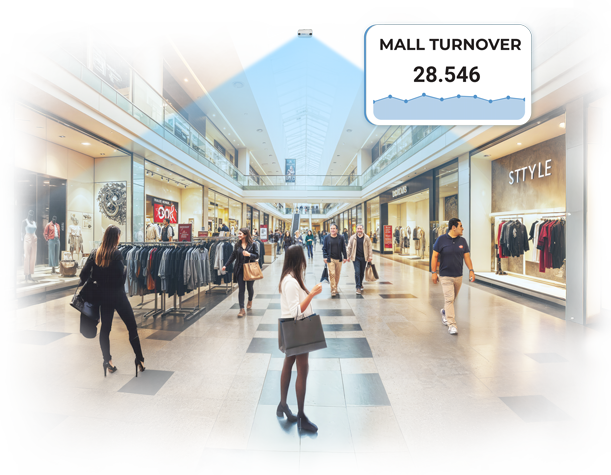
Can People Counting System Distinguish Between Staff and Customers?
For years, people counting solutions offered a basic metric to businesses: how many people were passing through the doors? While this basic…
Can People Counting System Distinguish Between Staff and Customers?
For years, **people counting solutions offered a basic metric to businesses: how many people were passing through the doors? While this basic metric is useful for basic analysis, as we move into a more data-driven world, simply knowing that a person has entered is not enough. The single most important question that all [modern people counting system](https://vemcogroup.com)** users want to know is: Can this people counting system tell the difference between employees and customers?
The quick answer is: Yes, but only if you select the appropriate technology.
The old people counting technology did not know or care what type of person was passing through. A security guard on patrol, a sales associate greeting customers, or a cleaning crew entering after hours all contribute to a simple count on a counter. The problem with this is that it leads to a significant problem known as “data pollution.”
The Problem with Unfiltered Data
When your staff counts are lumped in with customer traffic, the resulting data is a flawed foundation for strategic decisions. Consider the impact on your most vital metrics:
- Conversion Rate Corruption: The ultimate retail KPI is Conversion Rate (Transactions ÷ Total Footfall). If your system is double-counting a salesperson who enters and exits the store 20 times during a shift, your footfall is inflated, making your conversion rate appear artificially low. You lose visibility into true sales performance.
- Labor Optimization: **Occupancy management solutions** rely on traffic data to forecast busy periods. If your ‘peak’ traffic is actually your staff arriving for their shift, you risk overstaffing during quiet periods and missing the true customer surge.
- Inefficient Leasing: In commercial real estate, lease renewals are often based on ‘draw’ — how many unique visitors a location generates. High staff traffic can obscure the real value of the space.
To solve this, advanced people counting solutions have evolved beyond simple visual tracking. They have introduced a specialized layer of intelligence: the staff exclusion system.
Three Ways Technology Excludes Your Staff
The journey to true staff-customer differentiation has produced several innovative solutions, each with varying degrees of accuracy and complexity.
1. Logic-Based Filtering (The Software Approach)
The first, and most rudimentary, approach is software-based filtering. The system looks for patterns that deviate from normal customer behavior.
- Repeater Logic: If a ‘person’ crosses the threshold multiple times within a very short window (e.g., a greeter standing near the entrance), the software can be programmed to count only the first entry.
- Time-Based Filtering: The system can automatically discard any traffic counted during non-operational hours, such as before the store opens or after it closes.
Verdict: While better than nothing, logic-based filtering is imprecise. A customer who forgets their keys and immediately re-enters would be excluded. It cannot handle complex scenarios, like a staff member walking in and out of a specific aisle multiple times.
2. Advanced AI/Video Analytics (Looking the Part)
The next level of sophistication utilizes the power of deep learning and computer vision. These systems are trained to identify specific visual markers.
- Uniform/Dress Code Recognition: The AI is trained on hundreds of thousands of images to recognize the specific colors or patterns of a company uniform. It creates an ‘exclusion rule’ based on attire.
- Gait and Posture: More advanced systems are beginning to experiment with recognizing the different posture and walking patterns (gait) that might distinguish a relaxed customer from a working employee.
Verdict: AI-driven recognition is highly promising, particularly as algorithms improve. Its primary drawback is variability: variations in lighting, obscured views, or slightly different staff outfits can still lead to misidentification. It is also more computationally expensive, often requiring powerful on-site servers.
3. Exclusion Tags and Beacons (The Gold Standard)
Currently, the most accurate and reliable method for staff exclusion systems is the use of physical hardware tags. This method removes all guesswork.
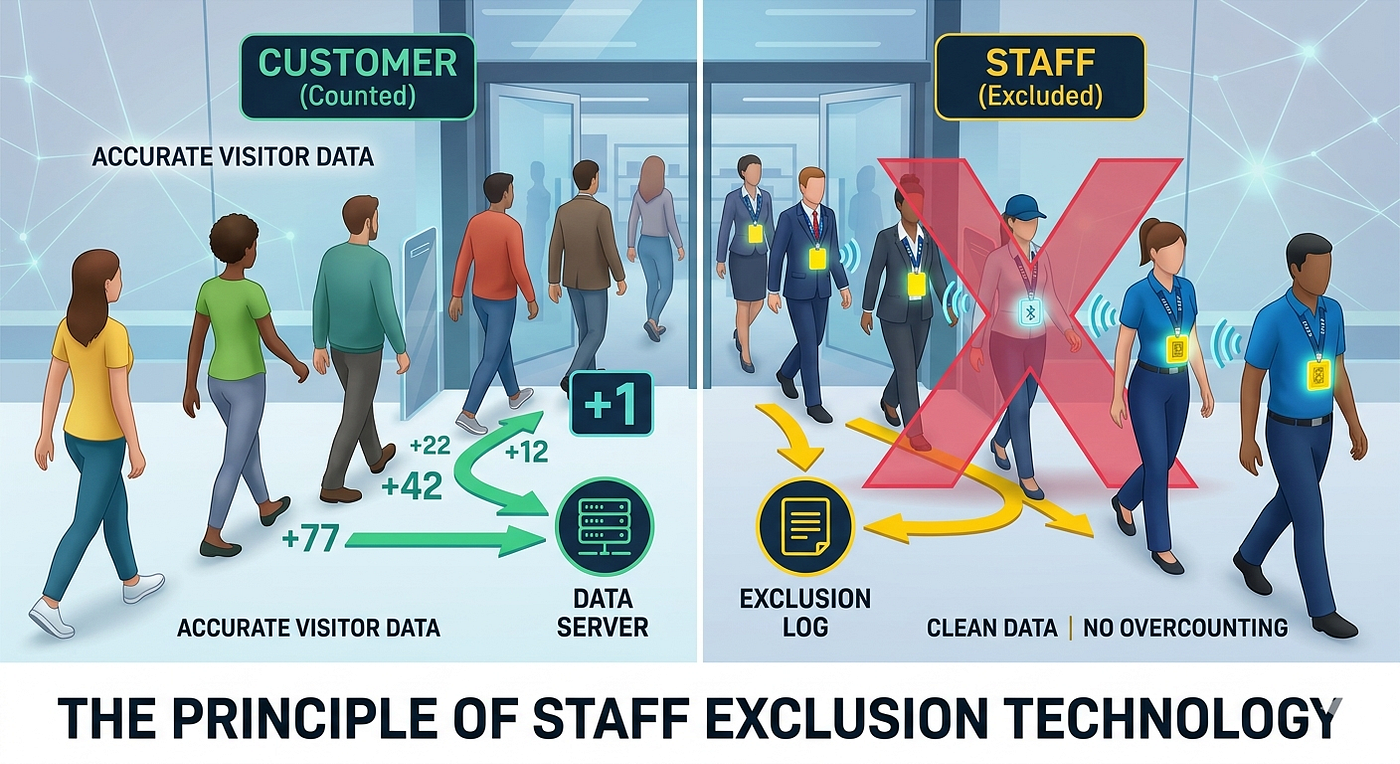
- The Technology: Staff members wear a discreet active or passive electronic tag, which is often integrated into their employee badge. The overhead people-counting sensor (often a high-end 3D or stereoscopic device) is equipped with a matching receiver (e.g., Bluetooth Low Energy/BLE or Infrared/IR).
- The Process: When a person walks under the sensor, the counting technology creates a detection. Simultaneously, the sensor queries for a tag signal. If it receives a matching staff tag signal within the detection zone, it flags that count as ‘staff’ and filters it from the core customer traffic data.
Verdict: This method offers the highest level of accuracy, often exceeding 98%. It is not reliant on lighting conditions or specific attire and can perfectly differentiate a salesperson standing with a customer. It provides clean, unpolluted data for strategic decision-making.
Choosing the Right Path for Your Organization
The best solution depends heavily on your specific environment and data needs.
- A Physical Tag System is essential for high-volume retail environments where staff frequently interact at entry points (like luxury automotive showrooms or electronics retailers).
- AI Visual Recognition might be suitable for environments with strict dress codes (e.g., large-scale logistics where safety vests are mandatory) and less frequent entry/exit.
- For corporate occupancy management solutions, staff differentiation is often less critical than total occupant load, making simple depth-based counting sufficient.
As people counting technology continues to merge with AI and edge computing, the question of ‘staff versus customer’ will soon become obsolete, replaced by a nuanced understanding of intent, journey, and true engagement. The future isn’t just about counting people; it’s about understanding the context of the crowd.
메타데이터
- post_id
- 7a1df2c76e02
- slug
- can-people-counting-system-distinguish-between-staff-and-customers-7a1df2c76e02
- url
- https://medium.com/@vemcogroup/can-people-counting-system-distinguish-between-staff-and-customers-7a1df2c76e02
- canonical_url
- https://medium.com/@vemcogroup/can-people-counting-system-distinguish-between-staff-and-customers-7a1df2c76e02
- author_url
- https://medium.com/@vemcogroup
- status
- ok
- fetched_at
- 2026-06-09 15:37:30