What the Psychedelic Renaissance Forgot
Scientific research has returned psychedelics to medicine. The deeper psychological and spiritual journey is still largely missing.
What the Psychedelic Renaissance Forgot
Scientific research has returned psychedelics to medicine. The deeper psychological and spiritual journey is still largely missing.
“The underground never dies.” Ralph Metzner
I’ve spent almost my entire adult life in the psychedelic underground.
That probably sounds strange today. Psychedelics appear regularly in newspapers, scientific journals, podcasts, documentaries, and bestselling books. Every few weeks, another study seems to announce encouraging results for depression, PTSD, addiction, or end-of-life anxiety. From a distance, it can feel as though we are living through a psychedelic renaissance.
However, for the millions who have already experimented with entheogens, and for those who hope to begin their own journey, the reality has changed far less than the headlines suggest.
When Amari and I first began exploring psychedelics forty years ago, there was no internet. There were no integration therapists, no online communities dedicated to healing, no bookstores filled with psychedelic authors. If you wanted to understand what was happening to you, you were largely on your own. Knowledge passed quietly from one person to another, through trusted friendships and private conversations, because there was nowhere else for it to go.
We were fortunate to discover Stanislav Grof’s books early in our journey. Inspired by his work, we ventured into the largely unknown territory of the unconscious, eager to shed our emotional baggage and gain spiritual insights.
But the path is extremely complicated and confusing without an experienced mentor who has already traveled it. For years, we carried questions that remained unanswered. What exactly were we experiencing? Where were we in the process? Why did certain inner obstacles seem impossible to move beyond?
I remember how we reached out to therapists in the transpersonal community several times, hoping to receive support. But our chances were close to zero because nobody wanted to risk their reputation. There are two ways to kill a conversation: mention LSD or death.
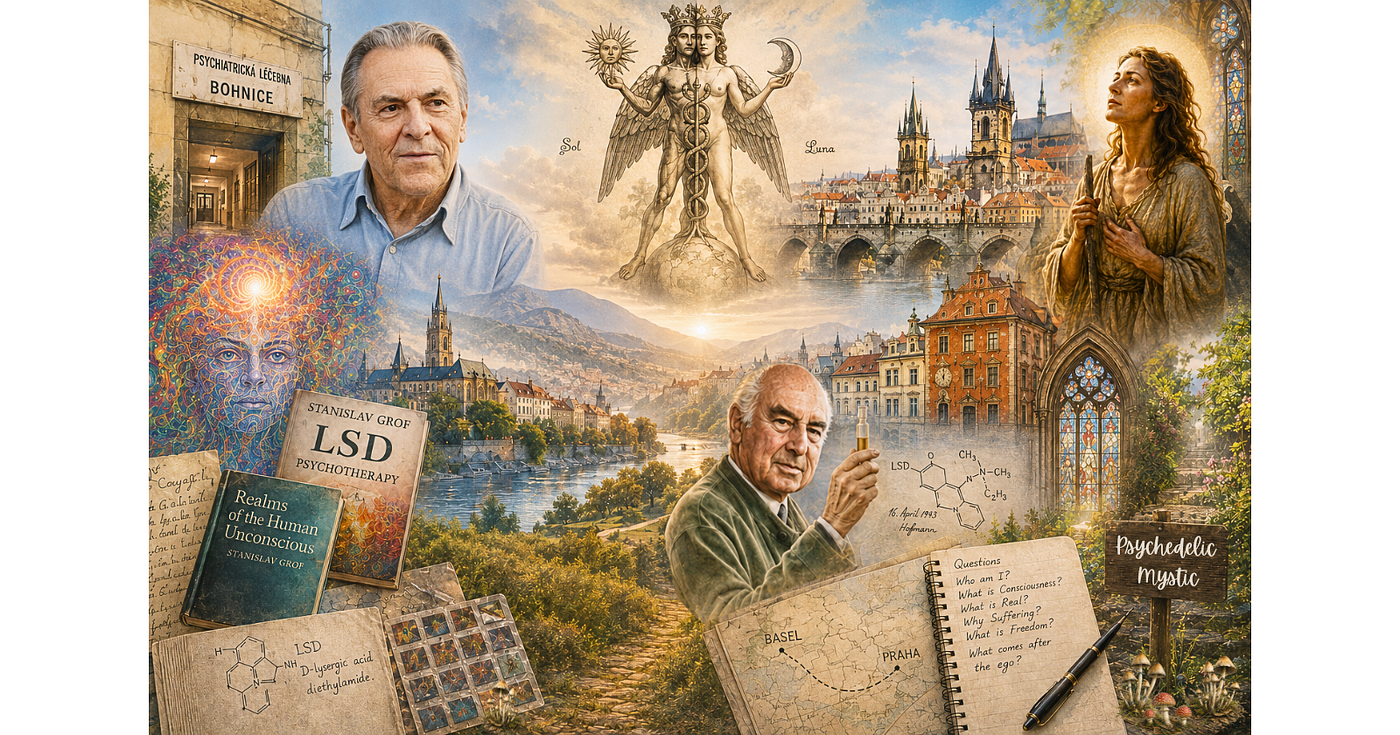
Eventually, we even moved to the Czech Republic in 1994, where Grof had pioneered LSD-Psychotherapy in the 1950s. When we appeared at the doorstep of the Bohnice Psychiatric Hospital and asked to see the room where Grof had conducted those historic LSD sessions, the astonished expression of the psychiatrist who attended to us said everything. We were probably the first, and perhaps the last, ‘LSD tourists’ to ever show up there.
After following one breadcrumb trail after another, I eventually received a telephone number in Switzerland two years later. The intermediary barely let me introduce myself before asking, “How are you going to pay the 5,000 Swiss francs?”
Our struggles were not unusual. For most ordinary people, safe access to psychedelic sessions remains something they read about rather than something they can realistically experience. Unfortunately, not a single country offers a nationwide legal framework. The few options that exist are generally limited to a few treatment sessions for specific long-term psychiatric illnesses and end-of-life anxiety. For everyone else, the choices remain remarkably similar to those we faced forty years ago: know someone, travel to a retreat if you can afford it, or continue alone.
At the same time, the essence of the psychedelic path, the ‘bringing forth of the soul’, has quietly slipped into the background. After waiting decades for psychedelics to return to mainstream research, I imagined that the deeper questions surrounding them would resurface as well. Instead, the conversation has largely become a medical one, restricted to the clinical approach.
Psychedelic sessions are increasingly viewed as a treatment for specific disorders rather than as part of a much longer process of psychological and spiritual transformation. The emphasis is on reducing symptoms, and not on the deeper journey described by Grof, Metzner, and others.
The ego occupies the brain. The divine resides in the heart.
Current discussions hardly ever bring up topics that we spent decades exploring, such as the nature of the ego and the psyche, perinatal trauma, karma, ego death and rebirth, ancestral and collective healing, the role of the divine, and ultimately, the end of the cycle of suffering.
“What LSD brings about is a reduction of the intellectual faculties in favor of an emotional experience of the world. One forgets oneself and becomes filled with other dimensions of being, the spiritual dimensions, the dimensions that can be perceived only with the heart. In this respect, LSD can help people who strive to broaden this unsatisfying, purely material aspect of reality and to enter more deeply into the spiritual, into the emotional, into the dimensions of beauty, of the all-encompassing, of love. This is a state of ecstasy.” Albert Hofmann
The more we reflected on our own journey, the more we realized that what we had been doing belonged to a much older tradition, an undercurrent very much alive in the West, and not only found in faraway or lost cultures. Long before LSD and other psychedelics became associated with the counterculture and neuroscience, individuals from Europe and the Levant sought transformation through various mystical paths and techniques that included the use of entheogens. Initiates of ancient mysteries, Christian and Jewish ascetics, and Hermetic philosophers all spoke, each in their own symbolic language, of purification, death-rebirth cycles, and union with the Divine.
In dreams and psychedelic sessions, we reconnected with this mystical community, or ‘re-membered,’ as Metzner would say, as if a torch had passed on to light the way. We had studied little of it beforehand. The experiences came first. Gradually, the pieces of the puzzle fell into place; we learned how other seekers described the same inner processes centuries before us, and we received insights into their meaning in the sessions themselves.
At the first LSD Symposium in Basel in 2006, people often spoke about how remarkable it was that Hofmann, also known as the ‘Mystical Scientist’, discovered LSD in Basel, a city whose history is intertwined with Paracelsus, alchemy, and the healing arts. Metzner’s lecture, ‘Albert Hofmann, LSD and the Quest for the Alchemical Philosopher’s Stone’, explicitly argued that psychedelic research continues a Western alchemical tradition of transformation. Stanislav Grof also pioneered LSD-Psychotherapy in Prague, another European city long associated with alchemists, hermits, and saints.
We realized in the past few years that people are still asking the same questions we once struggled with. Many get stuck with very difficult emotional material and don’t know how to move past that. Others have experiences that change them dramatically, yet they often lack guidance for discerning where those experiences fit into a lifetime of inner development. So much knowledge remains in the underground, scattered across conversations and notebooks that never see the light of day.
For this reason, we’ve decided to make our lifetime of recordings and insights public.
Our own story is unusual because there are two of us. We explored this path in partnership, comparing experiences, questioning each other’s conclusions, and watching where our journeys converged and where they took different directions. Those similarities and differences taught us things that neither of us would have comprehended alone.
We also came to realize that, although Grof laid the foundations for understanding the inner journey, very few people have continued building on his observations and cartography of the psyche. That’s why we created Psychedelic Mystic: to share what we have learned, where our journeys led us, where they differed, and the revelations that emerged as we tried to understand experiences that lay beyond what Grof had already described. Above all, we’d like to continue the conversation about the deeper psychological and spiritual transformation, which we see as part of a much older stream of wisdom that has remained largely within mystery traditions.
Thank you for reading. We hope this essay has given you something to reflect on. The essays we publish here on Medium accompany our book, Wholeness and Oneness, and allow us to share experiences and insights that didn’t find a place in its pages. If you’d like to explore further, you can read the book free online at Psychedelic Mystic, where you’ll also find links to the eBook editions: https://psychedelicmystic.life
If this essay resonated with you, I’d love to hear your thoughts in the comments. Sophia Meta
메타데이터
- post_id
- 7a20f074e1ef
- slug
- what-the-psychedelic-renaissance-forgot-7a20f074e1ef
- url
- https://medium.com/@psychedelicmystic/what-the-psychedelic-renaissance-forgot-7a20f074e1ef
- canonical_url
- https://medium.com/@psychedelicmystic/what-the-psychedelic-renaissance-forgot-7a20f074e1ef
- author_url
- https://medium.com/@psychedelicmystic
- status
- ok
- fetched_at
- 2026-07-22 16:12:32