5,811 Dermatology Cases Expose the Clinical AI Demo Trap
Google warns MedGemma needs use-case validation; a May 2026 Yale cohort shows why real consults, context, and handoffs must decide the…
Clinical Proof Gate
5,811 Dermatology Cases Expose the Clinical AI Demo Trap
Google warns MedGemma needs use-case validation; a May 2026 Yale cohort shows why real consults, context, and handoffs must decide the budget.
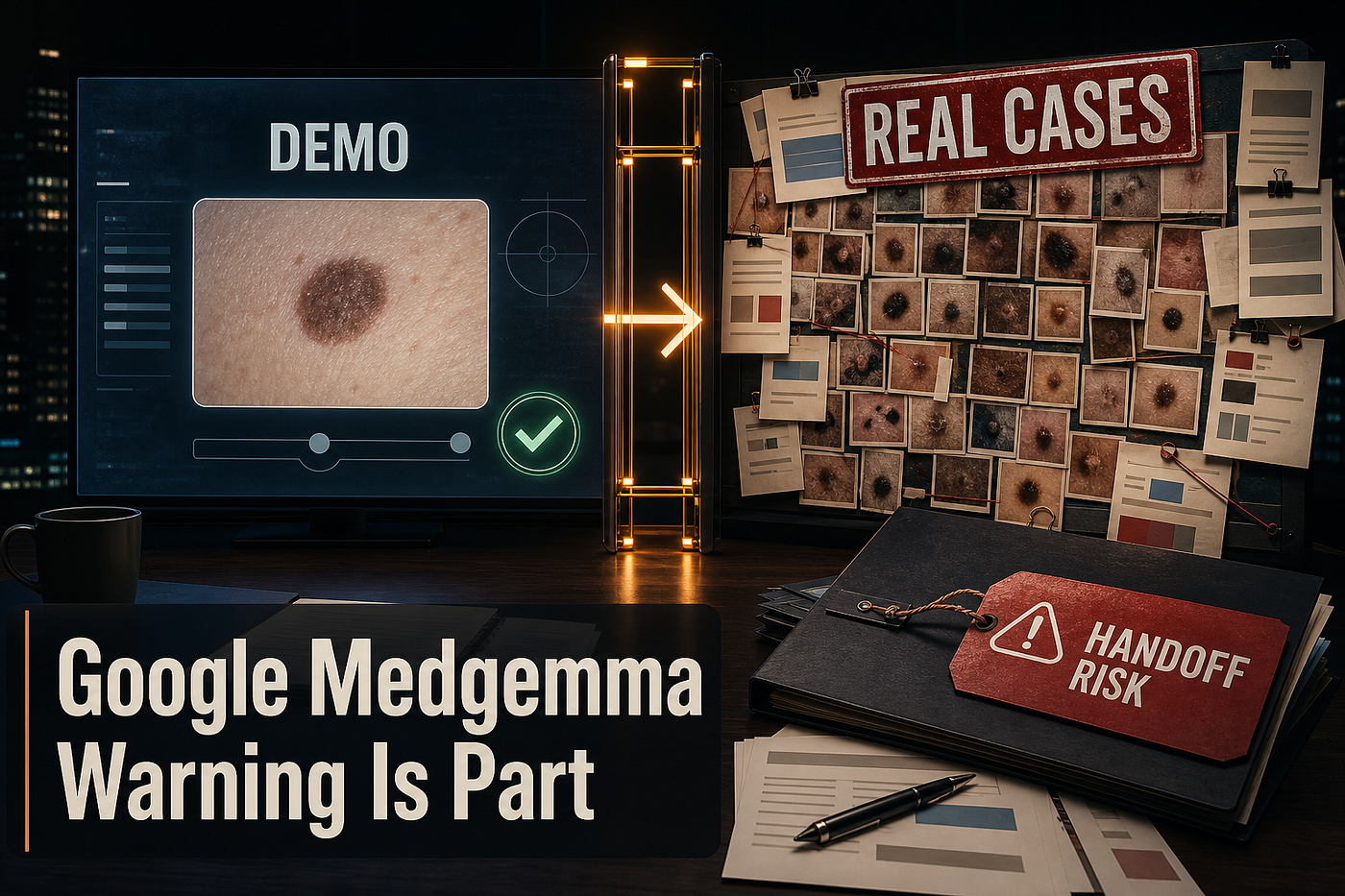
Google’s MedGemma Warning Is the Part Hospitals Cannot Skip: Google warns MedGemma needs use-case validation; a May 2026 Yale cohort shows why real consults, context, and handoffs must decide the budget. Image created by the author with diffusion-synthesis and Python post-processing.
Google’s MedGemma documentation can look like a ready-made answer on a hospital buyer’s screen: open medical models, image-and-text reasoning, and a quicker route to a dermatology triage pilot. But the wrong approval does not stay in a conference-room demo. It moves into the consult queue, where a clinician has to catch the miss.
Google’s own documentation says MedGemma needs validation for the intended use case and is not clinical-grade. In May 2026, a Yale-authored real-world dermatology evaluation tested 5,811 consult cases and 46,405 clinical images across models including MedGemma-4B and GPT-4.1. ECRI put the same risk in plainer institutional language, naming “Navigating the AI Diagnostic Dilemma” its #1 patient safety concern for 2026 because unchecked dependence on diagnostic AI is already a safety problem.
The screenshot is clean. The rash is not.
Thank you for the exact standard.
The demo is not the consult
A demo rewards bounded questions. A consult punishes missing context, strange lighting, multiple lesions, half-written notes, and the awkward fact that someone still has to decide whether a patient needs urgent evaluation.
That difference matters because MedGemma is attractive for the right reasons. Google’s page describes open models for medical text and image comprehension, with a 4B multimodal version and 27B text models. The 2025 MedGemma technical report frames the project as a foundation for medical image and text tasks, not a finished bedside product.
That distinction is the buyer’s first guardrail.
The Yale evaluation shows why. On public dermatology benchmarks, GPT-4.1 reached 42.25% top-3 diagnostic accuracy on DermNet, while MedGemma-4B led the open-weight models at 26.55%. On real consult images alone, GPT-4.1 fell to 24.65%, and open-weight models ranged from 1.50% to 13.35%.
That is not a small polish problem. It is the distance between a controlled card and a queue of referrals from primary care or the emergency department.
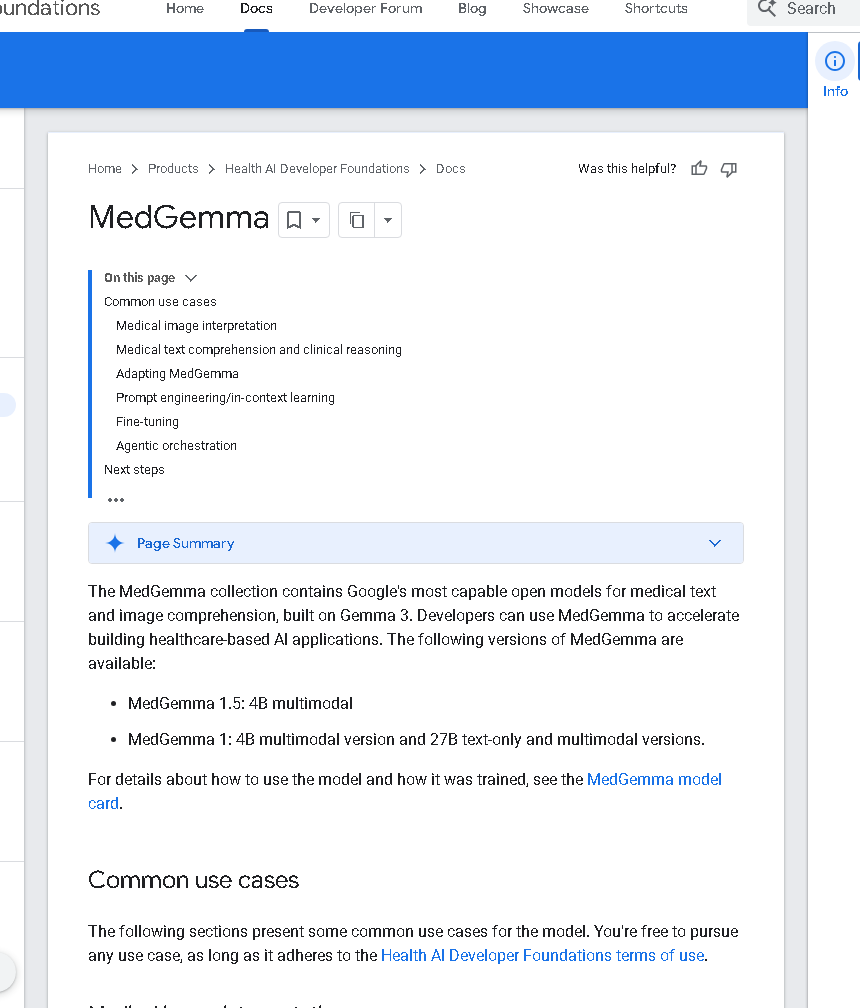
Figure 2. Proof of operating detail: The cited source, Health AI Developer Foundations Medgemma, gives the article the implementation surface teams must design around. Source: Google
The first trap is benchmark theater. A vendor can show a clean model response, a confident differential, and a chart that looks close enough for budget season. The counter is simple: bring the pilot the same messy images your clinicians already receive.
If the model was sold on dermatology triage, test it on dermatology triage, not on museum-grade lesion cards.
Context is the failure surface
Clinical context is supposed to make the model safer. In medicine, that sounds obvious. A rash without age, symptoms, immune status, medications, duration, or a referring concern is an incomplete object.
The Yale cohort confirmed part of that promise. Adding clinical context improved performance. MedGemma-4B reached 28.75% top-3 accuracy among open-weight models with context, and GPT-4.1 reached 38.93%.
For severe-case triage, several context settings pushed sensitivity into the moderate range, above 50% and in some cases higher.
Then the hidden cost appears. The same study found that outputs were highly sensitive to incomplete or erroneous consultation context. A note can guide the model toward the right answer.
It can also become a leash.
This is the second trap: treating more EHR text as automatically safer. A referring note that says “cellulitis?” can focus the answer. A wrong or leading note can anchor it.
The model is not only reading the patient; it is reading the human who guessed before it.
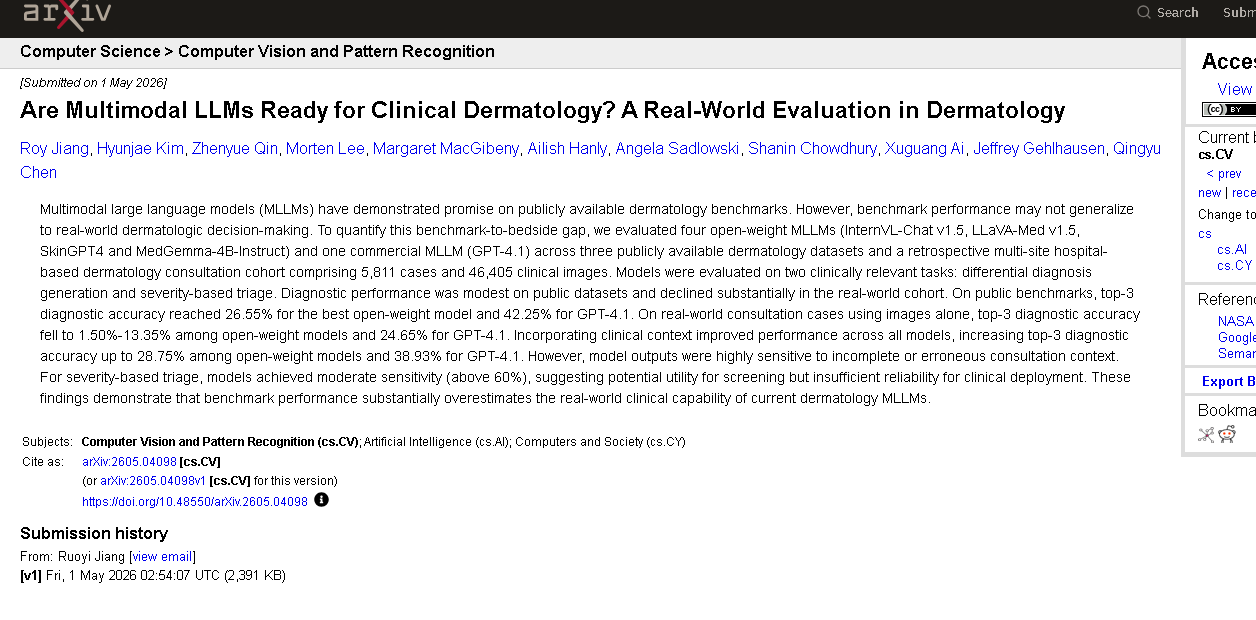
Figure 3. Proof of source-backed strategy: The cited source, real-world dermatology evaluation, gives the article a primary source readers can inspect. Source: Arxiv
That is a game-theory problem before it is a technical one. Vendors gain by showing the best context path. Buyers gain by shortening procurement.
Clinicians lose if the system turns weak notes into confident recommendations and then calls the physician “the human in the loop.”
The counter is to stress the context on purpose. Run the same cases three ways: image-only, accurate note, and thin or misleading note. Measure not only accuracy, but degradation.
A model that improves with perfect context and collapses with normal context is not ready for the handoff it is being asked to enter.
The buyer owns the handoff
The regulatory environment is already moving toward transparency and lifecycle responsibility. The FDA’s AI-enabled medical device list identifies authorized AI-enabled devices and notes that the list is not comprehensive. It also says the agency is exploring ways to tag devices that include foundation-model functionality.
ONC’s HTI-1 final rule adds another pressure point: algorithm transparency for AI and predictive algorithms inside certified health IT. ONC says certified health IT supports care delivered by more than 96% of hospitals and 78% of office-based physicians.
That means the buyer’s job is not to admire model capability. The buyer has to design the handoff.
Healthcare has seen this movie before. Electronic health records were sold as cleaner information systems, then clinicians absorbed new clicks, inboxes, alerts, and documentation debt. The pattern repeats when a tool promises efficiency but exports uncertainty to the person closest to the patient.
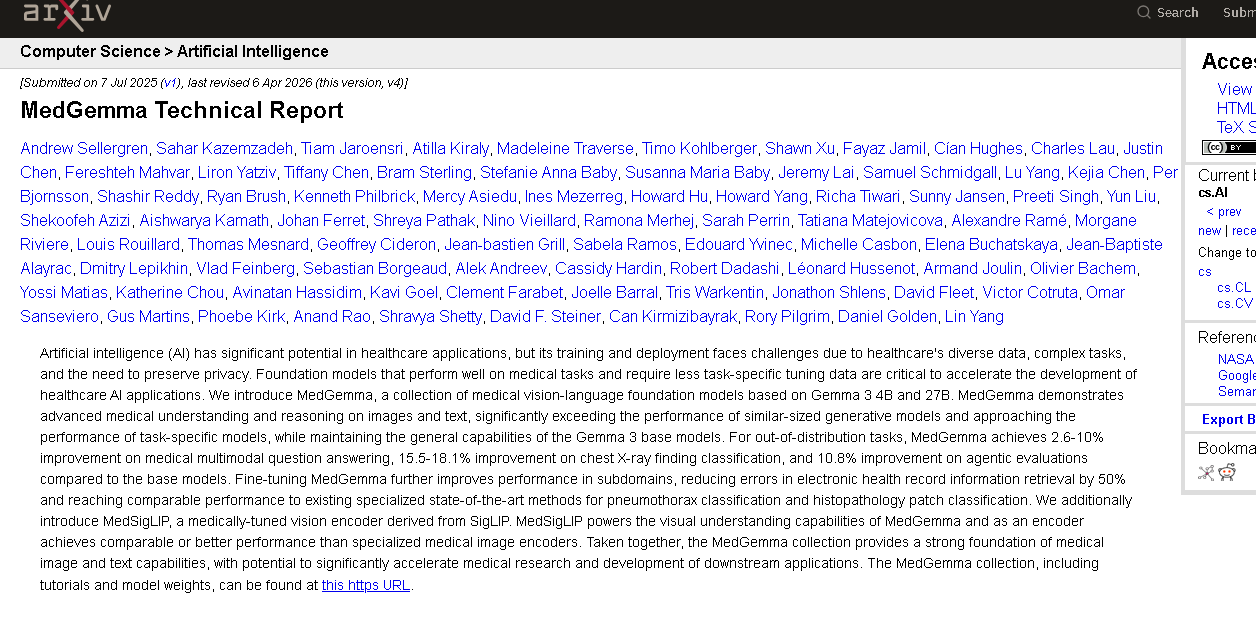
Figure 4. Proof of research footing: The cited source, MedGemma technical report, gives the article external evidence instead of campaign language. Source: Arxiv
The third trap is the phrase “human in the loop.” It sounds safe until nobody names the human, the moment, the authority, or the time budget. A dermatologist who gets an AI-sorted queue without a visible audit trail is not supervising a system. They are cleaning up after one.
The counter is operational ownership. The pilot has to say who can override, when the model must abstain, what gets logged, how severe cases are escalated, and which failure threshold stops rollout. If nobody can point to the rollback rule before launch, the system is not governed.
It is merely decorated.
Approve the proof, not the polish
The approval test is practical. Before funding a diagnostic or triage pilot, require a handoff reliability test on recent de-identified cases from the real service line. Include bad images, common diagnoses, rare severe cases, incomplete notes, and cases where the referring clinician’s suspicion was wrong.
A credible pilot should prove these things in plain language:
-
It performs on real consult material, not only public benchmarks or selected demo cases.
-
It shows how accuracy changes when context is absent, accurate, thin, or misleading.
-
It records abstentions, overrides, escalation decisions, final diagnoses, review time, and the clinician who held authority.
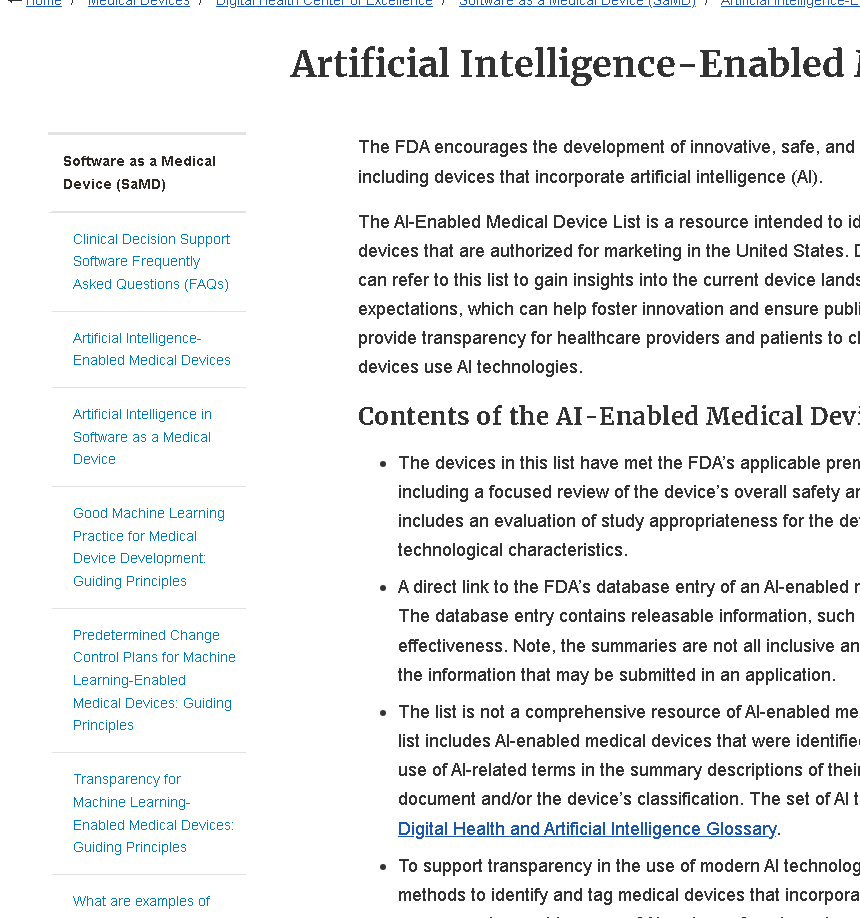
Figure 5. Proof of source-backed strategy: The cited source, AI-enabled medical device list, gives the article a primary source readers can inspect. Source: FDA
- It sets stop rules before rollout, including severe-case miss thresholds and audit failures.
That is not bureaucracy. It is the price of putting a probabilistic system near a clinical decision.
The end-state risk is easy to see. If every hospital buys the cleanest demo, vendors learn to optimize the room, not the bedside. If buyers demand consult-proof evidence, vendors learn to build for handoffs, surveillance, and failure visibility.
Incentives follow the purchase order.
MedGemma’s documentation already gives buyers permission to be demanding. The Yale evaluation supplies the object lesson: 5,811 consults, 46,405 images, and a sharp gap between benchmark confidence and clinical reality. The decision is no longer whether the model is impressive.
The decision is whether the pilot proves the handoff under the same incomplete context clinicians face every day.
Thank you to the clinicians, founders, product leads, and hospital buyers doing that proof work before the consult queue becomes a liability transfer.
A parallel version of the same pressure shows up in Google’s 2025 Cards Punish Reporting Without a First-Screen Proof.
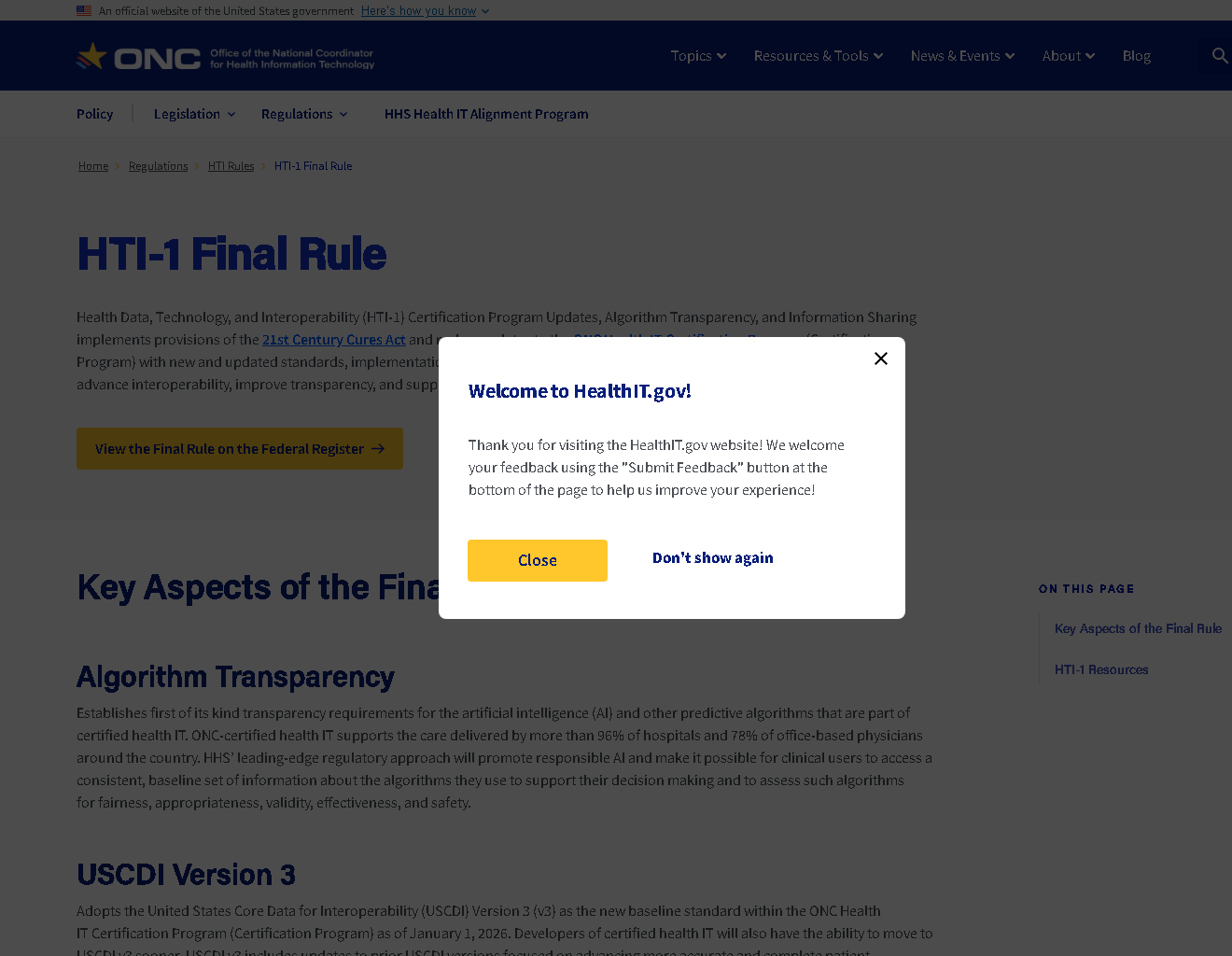
Figure 6. Proof of source-backed strategy: The cited source, HTI-1 final rule, gives the article a primary source readers can inspect. Source: Healthit
Related reading
메타데이터
- post_id
- 7a2288b62d62
- slug
- 5-811-dermatology-cases-expose-the-clinical-ai-demo-trap-7a2288b62d62
- url
- https://medium.com/kairi-ai/5-811-dermatology-cases-expose-the-clinical-ai-demo-trap-7a2288b62d62
- canonical_url
- https://medium.com/kairi-ai/5-811-dermatology-cases-expose-the-clinical-ai-demo-trap-7a2288b62d62
- author_url
- https://medium.com/@james.kuhman
- status
- ok
- fetched_at
- 2026-07-17 15:23:30