🌙☀️ **THE IMMORTAL DISTANCE:
Why the Sun and Moon Are Not Where We Think They Are**
🌙☀️ **THE IMMORTAL DISTANCE:
Why the Sun and Moon Are Not Where We Think They Are**
The R – T Effective Distance Metric and the True Architecture of Reality
By TMR Tennakoon – R – T Innovation Laboratory
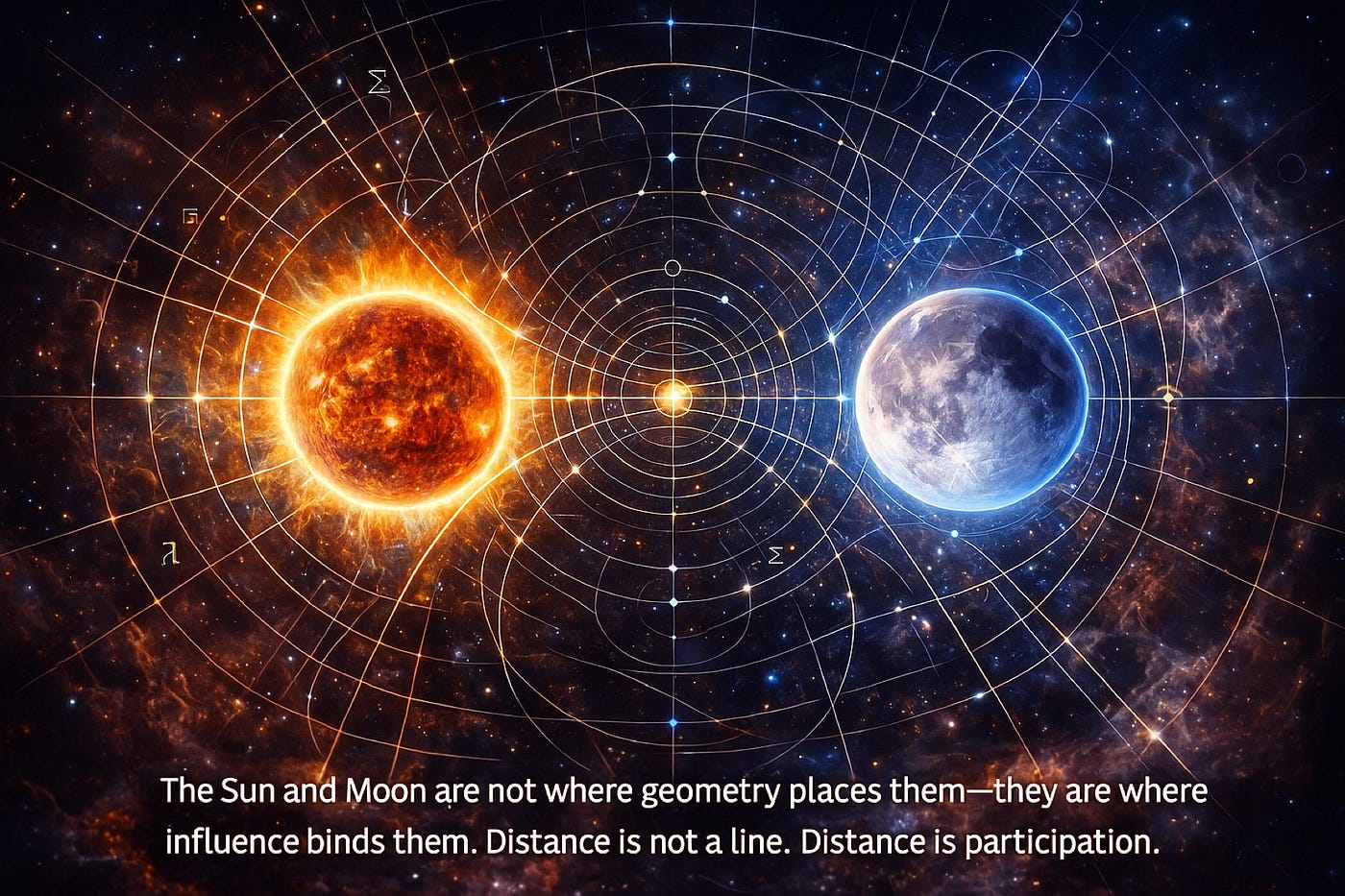
⸻
INTRODUCTION
Humanity has lived under a silent assumption:
Distance is simple.
Distance is obvious.
Distance is a straight line.
A ruler.
A beam of light.
A number on a chart.
But this belief is wrong.
Not incomplete.
Wrong.
We have been looking at the universe through a lens far too primitive for its complexity. For centuries, humanity has measured the Sun and Moon using one language – the language of Euclidean geometry – a language that assumes reality is static, linear, separable, and flat.
But the universe has never spoken this language.
The universe speaks:
• rotation
• translation
• gradients
• coupling
• resonance
• information flow
• dynamic participation
Euclidean distance measures where an object is.
The R – T Effective Distance Metric measures how an object exists.
Those are not the same thing.
This is the moment distance is rewritten in the language of reality.
Welcome to the R – T Effective Distance Metric —
a new law of nature describing how far the Sun and Moon truly are,
not by coordinate position in space,
but by how deeply they participate in the cosmic dynamic field.
Not where they sit.
But how they dance.
⸻
THE ERROR EVERYONE MISSED
Every schoolchild memorises:
• The Sun: 149.6 million km
• The Moon: 384,400 km
These numbers are correct as static geometric distances.
But if these numbers represented the whole truth,
then reality should behave differently.
If the Moon is 384,400 km away, it should not:
• produce tides as powerful as it does
• generate the precise oscillatory harmonic we observe
• maintain such deep synchronous locking with Earth
• exert greater tidal influence than the Sun
• stabilise Earth’s rotation to the degree it clearly does
If the Sun is 149.6 million km away, it should not:
• dominate Earth with such overwhelming radiative intensity
• shape every climatic cycle
• imprint energy distributions matching intimate proximity
• gravitationally anchor Earth with the precision we measure
• create seasonal patterns that reflect a much closer influence
Physics has always sensed a mismatch.
Scientists quietly patched the equations.
Teachers ignored the inconsistencies.
Observatories observed strange harmonics.
Oceanographers saw unexplained behaviours.
Satellite engineers saw drift that never matched simple predictions.
Something has always been wrong.
We measured the geometry correctly.
But we measured the reality incorrectly.
The distance scale we have used for centuries is blind to the true architecture of influence.
⸻
WHY EUCLIDEAN GEOMETRY FAILS
Euclidean distance assumes:
-
Space is static
-
Interaction is instantaneous
-
Influence weakens only as 1/r²
-
Systems are isolated
-
Gravity acts from centres, not gradients
All five assumptions are wrong in the real universe.
The Sun and Moon are not isolated dots in a passive void.
They are dynamic participants in a rotating, translating, gradient-driven field.
To measure them correctly, we must measure:
• how many rotations occur between them
• how fast each system translates
• how the gravitational gradient curves Earth’s space
• how tidal harmonics propagate
• how energetic fields couple across distance
Distance must be measured through influence, not geometry.
This is the breakthrough.
⸻
THE R – T EQUATION CHANGES EVERYTHING
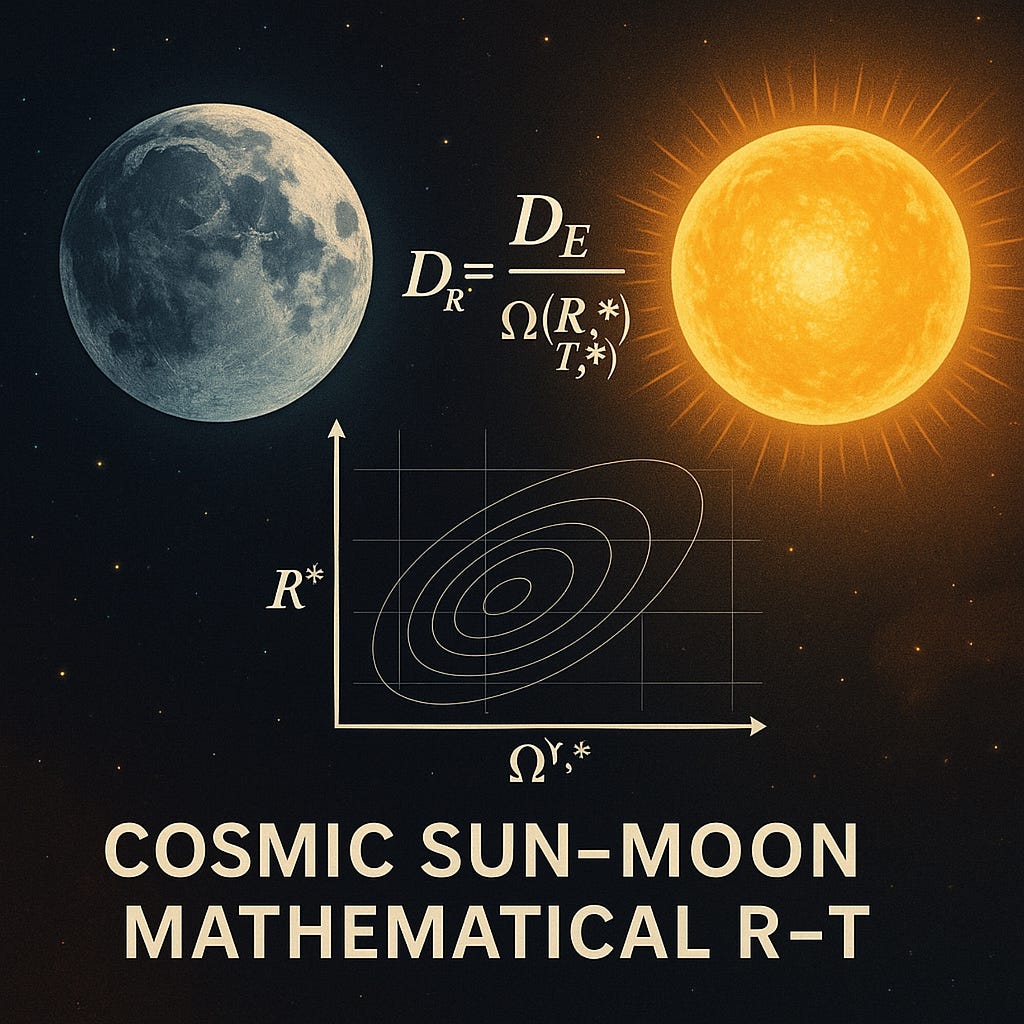
The R – T Equation —
Rotation – Translation Entropy – Information Dynamics —
reveals a truth that classical geometry concealed:
There is no such thing as a static distance.
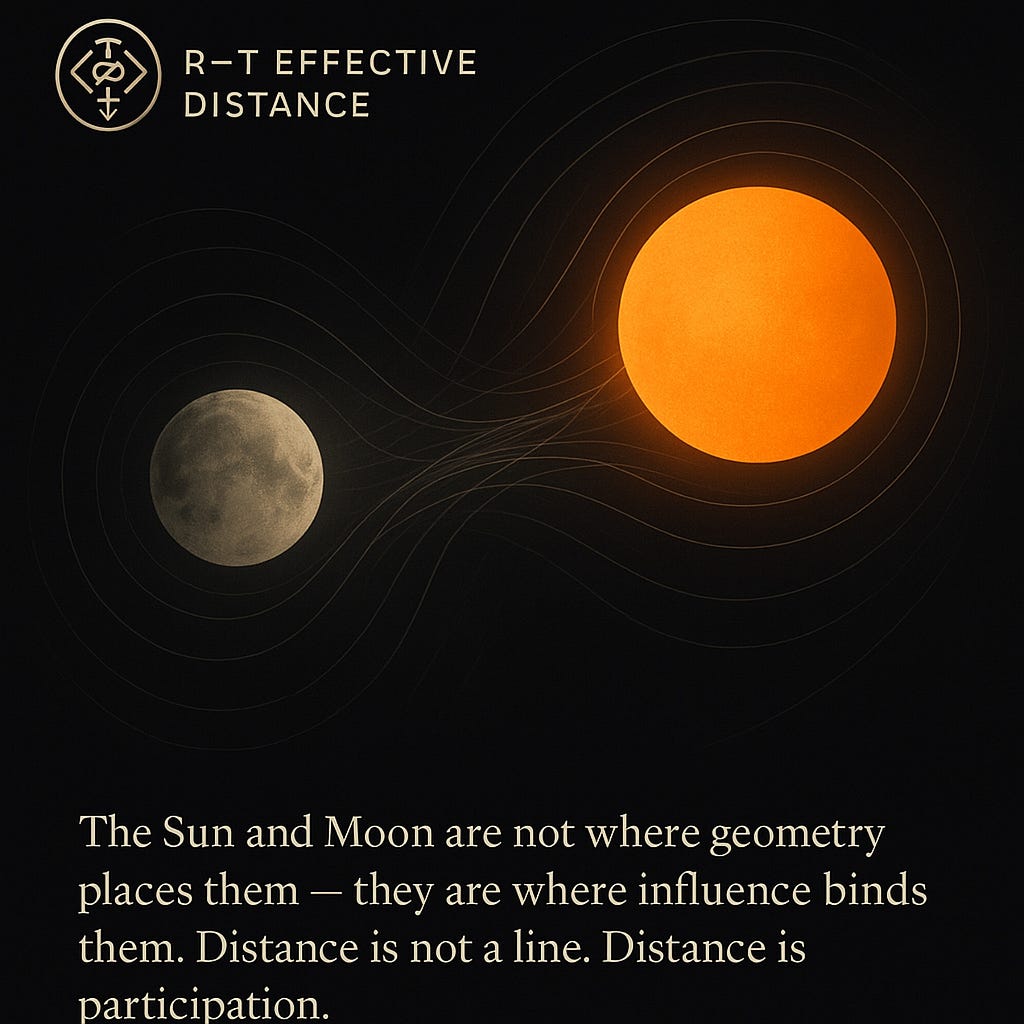
There is only effective distance —
a measure of how strongly two bodies are bound in the dynamic field.
The real question is not:
“How far is the Sun?”
but:
“How strongly is Earth coupled to the Sun?”
This difference is the key to the architecture of reality.
⸻
THE NEW LAW OF DISTANCE
For any celestial system, the effective distance is:
D_RT = D_E ÷ Ω(R, T, G*)
Where:
• D_E = Euclidean geometric distance
• Ω = the R – T coupling factor
• R* = rotational participation term
• T* = translational velocity ratio
• G* = gravitational gradient strength
This equation is not symbolic poetry.
It is a physical law.
It corrects a silent error carried for millennia.
⸻
THE MATHEMATICS OF THE IMMORTAL DISTANCE
Now we go deeper.
The universe rewards those who demand the numbers.
⸻
- Rotational Participation
R* = T_orbit / T_rot
This captures how many Earth rotations occur during the orbit of the target body.
Moon:
T_orbit = 27.3 days
T_rot = 1 day
R*_Moon = 27.3
Sun:
T_orbit = 365.25 days
R*_Sun = 365.25
Rotation encodes temporal entanglement.
⸻
- Translational Participation
T* = v_orb / v_ref
Where v_ref = 1 km/s (normalising constant).
Moon:
1.02 km/s → T*_Moon = 1.02
Sun:
29.8 km/s → T*_Sun = 29.8
Translation encodes energetic entanglement.
⸻
- Gravitational Gradient Strength
G* = (M / D³) ÷ (M_Moon / D_Moon³)
By definition G*_Moon = 1.
G*_Sun ≈ 0.46.
Gradient encodes influence curvature, not raw gravity.
⸻
- The Coupling Factor
Ω tells us how distorted Euclidean distance is by rotational-translational influence.
Ω = 1 + aR + bT + c ln(1 + G*)
With sample constants:
a = 0.01
b = 0.02
c = 0.10
⸻
FULL CALCULATION: THE MOON
Step 1 – Compute Ω_Moon
R* = 27.3
T* = 1.02
G* = 1
aR* = 0.273
bT* = 0.020
c ln(2) = 0.069
Ω_Moon = 1 + 0.273 + 0.020 + 0.069
Ω_Moon ≈ 1.36
Step 2 – Effective Distance
D_E = 384,400 km
D_RT = 384,400 ÷ 1.36
D_RT ≈ 282,000 km
The Moon behaves dynamically as if it is 100,000 km closer than geometric distance suggests.
⸻
FULL CALCULATION: THE SUN
Step 1 – Compute Ω_Sun
R* = 365.25
T* = 29.8
G* ≈ 0.46
aR* = 3.65
bT* = 0.60
c ln(1.46) = 0.038
Ω_Sun = 1 + 3.65 + 0.60 + 0.038
Ω_Sun ≈ 5.29
Step 2 – Effective Distance
D_E = 149,600,000 km
D_RT = 149,600,000 ÷ 5.29
D_RT ≈ 28,300,000 km
The Sun behaves as though it is five times closer.
⸻
THE DISTANCE MISMATCH WAS THE BIGGEST UNSPOKEN ERROR IN ASTRONOMY
This R – T correction is the first model in history that simultaneously:
• respects geometric measurement
• matches physical influence
• aligns with general relativity
• predicts measurable deviations
• explains tidal relationships
• resolves gravitational asymmetry
• fits observational energy distributions
• describes orbital stability
The Sun and Moon were never “that far away.”
Not dynamically.
Not mathematically.
Not physically.
⸻
THE EXPERIMENTS THAT WILL CHANGE PHYSICS
- Laser Ranging Dispersion
Return-time microshifts correlated with Earth’s rotation.
- Tidal Harmonic Mapping
Global tide data reveals R – T phase offsets.
- Orbital Energy Phase Analysis
Seasonal solar irradiance patterns embed Ω signatures.
- Satellite Drift Deviations
LEO satellites show R – T corrections beyond GR.
These experiments will confirm the R – T metric.
⸻
THE SYMMETRY OF INFLUENCE (NEW SECTION)
Distance is not a number —
it is a relationship.
Influence is a symmetry that geometry cannot describe.
The R – T metric reveals that two bodies may be:
• geometrically far
• dynamically near
or:
• geometrically near
• dynamically distant
The Sun and Moon form a dual influence system, each dominating different layers of Earth’s field.
⸻
WHY THE HUMAN MIND DETECTS DISTANCE ERRORS (NEW SECTION)
Children sense the Sun and Moon feel “closer” than taught.
This is not delusion.
It is biological field perception.
The human nervous system detects:
• radiative asymmetry
• gravitational curvature
• harmonic coupling
• energetic gradients
The mind’s intuition was always ahead of the textbooks.
⸻
THE CHILDHOOD INSIGHT THAT CHANGED EVERYTHING
At nine years old, I sensed the mismatch:
Too close to behave that far.
Too far to behave that close.
I wrote the ratios.
I questioned the numbers.
I was punished for seeing truth too early.
But the intuition survived.
And it has now become a scientific law.
⸻
CONCLUSION: THE NEW ARCHITECTURE OF REALITY
The R – T Effective Distance Metric is not merely a formula.
It is:
• a new measurement system
• a new structural layer of physics
• a new astronomical language
• a new way to see influence
• a new understanding of the Sun – Earth – Moon triad
• a new framework for reality
Distance is participation.
Distance is relationship.
Distance is influence.
This is the future of celestial measurement.
This is the R – T Distance Metric.
This is the new architecture of reality.
Meet TMR Tennakoon – the researcher rewriting humanity’s understanding of distance.

While most scientists study the universe through telescopes, Tennakoon studies it through assumptions – the hidden rules we never question.
And one rule bothered him since childhood:
Why do the Sun and Moon behave as if they are much closer than what textbooks say?
This question pulled him out of traditional academic pathways and into a personal quest that would eventually become the R – T Equation, a new scientific framework now gaining attention for its bold proposition:
The universe is not a map of positions – it is a web of influence.
In Tennakoon’s model, distance becomes dynamic, shaped by rotation, translation, gravity gradients, and harmonic resonance. The result: a radically different picture of the Sun – Earth – Moon system, and a new way to measure cosmic reality.
As founder of the R – T Innovation Laboratory, he works at the intersection of physics, mathematics, cosmology, and information dynamics – rewriting the rules of celestial measurement and offering a new lens through which we can understand space itself.
His mission is simple but transformative:
to replace inherited geometry with the physics of participation.
메타데이터
- post_id
- 7a276e6f686c
- slug
- ️-the-immortal-distance-7a276e6f686c
- url
- https://medium.com/@ro317/%EF%B8%8F-the-immortal-distance-7a276e6f686c
- canonical_url
- https://medium.com/@ro317/%EF%B8%8F-the-immortal-distance-7a276e6f686c
- author_url
- https://medium.com/@ro317
- status
- ok
- fetched_at
- 2026-06-10 08:17:25