The Paper Pilot
Why 10,000 Pages of Documentation Are the Most Expensive Text on Earth
The Paper Pilot
Why 10,000 Pages of Documentation Are the Most Expensive Text on Earth
8 min read · Aviation, Engineering, Documentation, Safety, Aerospace
A replacement part costs $200. The documentation to prove it’s safe costs $2 million.
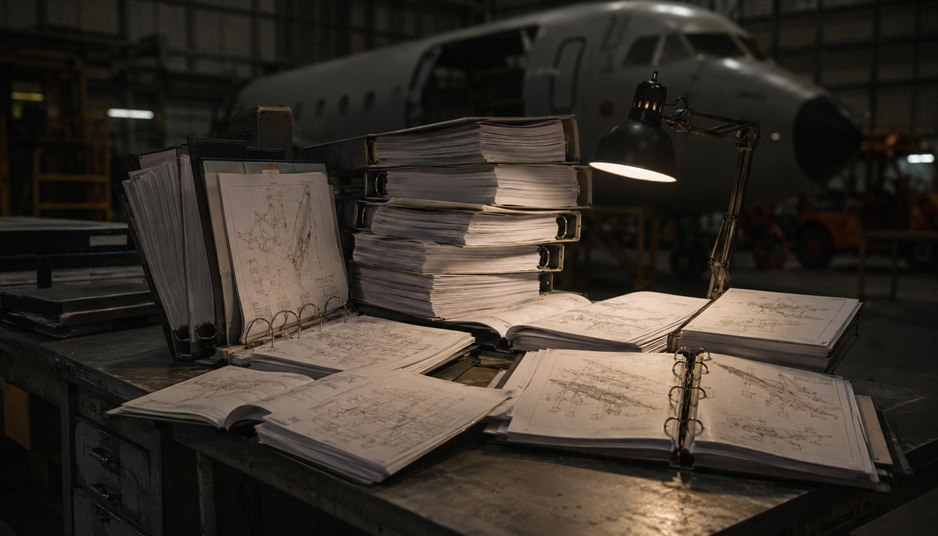
I watched a technician in a Montreal hangar flip through a Component Maintenance Manual at three in the morning. He was looking for one page. Task 72–00–00, inspection interval for a turbine blade root. The page was missing. Not torn out — just never printed in the revision cycle. A pagination error during the last update batch.
He grounded the aircraft.
One page. One missing page in a binder three inches thick, and a $90 million aircraft sat on the tarmac for eleven hours while the airline scrambled to get a verified replacement copy from the OEM. The flight was cancelled. A hundred and eighty-seven passengers rebooked. The crew timed out. The downstream schedule collapsed like dominoes across three cities.
Eleven hours. For a page.
And the technician was absolutely right to do it.
People outside aviation don’t understand documentation. They think it’s bureaucracy. Red tape. Government overhead. Something that slows down real work. I have heard software engineers — smart, capable people — laugh at the idea that a single bolt requires a paper trail stretching back to the smelter that produced the raw metal.
They stop laughing when I explain what happens without it.
In 1989, United Airlines Flight 232 lost all three hydraulic systems after an uncontained engine failure. The fan disk that fractured had a microscopic fatigue crack that originated during the titanium forging process. That crack was invisible to the inspection methods available at the time. But here’s the thing — the documentation trail is what allowed investigators to trace the failure back through the entire supply chain, identify every other disk from the same batch, and pull them from service worldwide before another aircraft was lost.
Documentation isn’t paperwork. Documentation is memory. The kind of memory that keeps people alive.
Let me walk you through what sits behind a single commercial aircraft.
The Aircraft Maintenance Manual — the AMM — is typically between 15,000 and 25,000 pages. It covers every system on the aircraft, organized by ATA chapter numbers. Chapter 21 is air conditioning. Chapter 27 is flight controls. Chapter 72 is the engine. Chapter 32 is landing gear. There are roughly a hundred chapters, each subdivided into systems, subsystems, and components. The AMM tells you how to remove, install, inspect, test, and troubleshoot every single item on the aircraft, from the cockpit door handle to the APU exhaust nozzle.
That’s just one manual.
The Illustrated Parts Catalog — IPC — is another 10,000 to 20,000 pages. Every part on the aircraft, drawn, numbered, cross-referenced. Every washer. Every O-ring. Every bracket. If you need to replace the number four fuel filter on the left engine, the IPC tells you the exact part number, the vendor, the interchangeability codes, the effectivity block (which serial number aircraft use which variant of the part), and the next higher assembly. It’s not a parts list. It’s a forensic genealogy of every piece of metal, composite, and rubber on the airframe.
Then there are Component Maintenance Manuals — CMMs — one for every significant component. The landing gear actuator has its own CMM. The engine fuel control unit has its own CMM. The weather radar transceiver has its own CMM. Each one written by the component manufacturer, each one running hundreds of pages, each one specifying exact tolerances, test procedures, materials, and overhaul intervals down to the micron and the hour.
Service Bulletins. Airworthiness Directives. Engineering Orders. Structural Repair Manuals. Wiring Diagram Manuals. Fault Isolation Manuals. Master Minimum Equipment Lists.
A single aircraft type — say, the Boeing 737 MAX — generates north of 100,000 pages of active documentation. Multiply that by variants. Multiply that by revisions. Multiply that by the thirty-year service life of the average commercial aircraft.
We are talking about millions of pages. Per aircraft type.
Here’s where it gets expensive.
Every single one of those pages has to be written by a qualified engineer. Not a technical writer — an engineer. Or more precisely, a technical writer working under the direct supervision of an engineer, with the final text reviewed and approved by a Designated Engineering Representative — a DER — who holds authority delegated from the FAA or Transport Canada.
A DER sign-off isn’t a rubber stamp. I have sat in meetings where a DER rejected a CMM revision because the torque sequence diagram was ambiguous. Not wrong — ambiguous. The diagram showed the correct torque values but didn’t clearly indicate whether the sequence was clockwise or star pattern. The DER sent it back. Three weeks of rework. Twenty thousand dollars in engineering time. For a diagram that was technically correct but could theoretically be misread by a tired technician at two in the morning.
And the DER was absolutely right to do it.
Because that’s the entire point. Documentation in aviation isn’t written for the best-case scenario. It’s written for the worst case. The technician who’s been on shift for ten hours. The one working in a hangar in Iqaluit in January where it’s minus forty and the lighting is bad. The one who doesn’t speak English as a first language but is using English-language manuals because that’s the international aviation standard. The one who just got divorced and can’t focus. The one who is doing this task for the first time.
The documentation has to be so clear, so precise, so unambiguous that any qualified technician anywhere in the world can follow it and get the same result every time. That is an insanely high bar. And meeting it is insanely expensive.
I know facilities in Montreal where updating a single ATA chapter costs between $500,000 and $1.5 million. Not writing it from scratch — updating it. Because the aircraft manufacturer issued a new Service Bulletin that changed the inspection interval on a wing spar fitting, and now every reference to that fitting in the AMM, the IPC, the SRM, and three CMMs has to be located, verified, updated, cross-checked, reviewed by engineering, approved by the DER, formatted to S1000D standard, distributed to every operator, and incorporated into every airline’s maintenance tracking system.
S1000D. That’s the international specification for technical publications. It’s the standard that governs how aerospace documentation is structured, written, tagged, and delivered. It was originally developed for European military aircraft in the 1980s. Today it’s the backbone of most commercial aviation documentation systems.
S1000D breaks documentation into data modules — discrete, self-contained blocks of information that can be assembled into different publications for different purposes. A data module about removing a hydraulic pump can appear in the AMM, in the CMM, and in the training manual, maintained in one place and published to many. In theory, this is elegant. In practice, it means that a single error in a single data module can propagate across dozens of publications simultaneously.
I have seen it happen. A unit of measurement was entered incorrectly in a data module — pounds instead of Newton-meters for a torque value. The error made it into three different manuals before anyone caught it. The recall and re-verification process took four months and cost the OEM roughly $800,000. Nobody was hurt. But the potential was there. A technician following the incorrect torque value could have under-torqued a flight-critical fastener. The fastener could have loosened in service. The consequences cascade from there.
Eight hundred thousand dollars. For a typo.
Now imagine maintaining all of this for an aircraft that’s been in service for thirty years.
The Boeing 737 — not the MAX, the original 737 Classic — entered service in 1968. There are still 737 Classics flying revenue service in some parts of the world. The documentation for these aircraft has been revised, updated, supplemented, and amended thousands of times over more than five decades. Some of the original technical writers are dead. Some of the original manufacturers no longer exist. Parts have been superseded three, four, five times. Engineering drawings reference drafting standards from the 1960s.
Try updating a wiring diagram for a 737–200 to comply with a modern EASA Airworthiness Directive. The original diagram was hand-drawn on vellum. The wire bundle callouts use a naming convention that was abandoned in 1985. The connector pin assignments reference a military specification that was superseded in 1992. The current revision of the diagram is a scan of a photocopy of a microfilm of the original vellum.
And someone has to make it accurate. Verifiably accurate. Because a technician in Lagos or Dhaka or Bogotá might be using that diagram tonight to troubleshoot a fault on a thirty-year-old aircraft, and if the diagram is wrong, the consequences aren’t a software bug that gets patched in the next sprint.
The consequences have funerals.
The transition from paper to digital documentation was supposed to fix everything. Electronic Flight Bags. Interactive Electronic Technical Publications — IETPs. XML-based data modules delivered through secure portals. No more missing pages. No more revision control nightmares. No more three-inch binders getting soaked in hydraulic fluid on the hangar floor.
In some ways, it’s better. Search functionality alone is revolutionary. Instead of flipping through an index, then finding the chapter, then finding the section, then finding the page, a technician can type a part number and get the relevant task in seconds. Revision management is automated. Distribution is instant. An OEM can issue a critical Service Bulletin and have it in the hands of every operator worldwide within hours instead of weeks.
But digital documentation brought its own nightmares.
Cybersecurity. How do you protect a database containing the complete maintenance procedures for every aircraft in an airline’s fleet? That database is a target. Not for theft — for sabotage. A subtle modification to a torque value or an inspection interval, buried in a database of millions of data modules, could go undetected for months. The integrity verification requirements alone — the checksums, the digital signatures, the access controls, the audit trails — add another layer of cost and complexity that makes the old paper system look almost quaint.
And there’s the dependency problem. Paper doesn’t need a server. Paper doesn’t need a network connection. Paper doesn’t need a software license. I have been in hangars where the IETP system went down and technicians couldn’t access the maintenance data they needed to complete a task. They stood there. Waiting. For IT support. At three in the morning. While a $150,000-per-day AOG clock was ticking.
Some operators still keep paper backups. Just in case.
The people who write this documentation are invisible. Nobody knows their names. Passengers don’t think about them. Airlines don’t advertise them. They sit in offices in Montreal, Toulouse, Wichita, and Singapore, writing and rewriting the same procedures with obsessive precision, arguing about whether a warning note should say “may cause” or “will cause,” debating the exact placement of a callout arrow on an exploded view diagram, spending three days verifying that a part number cross-reference is correct across four different publications.
They are the most important writers in the world. Not because their prose is beautiful — it is deliberately, aggressively not beautiful. It is flat. Declarative. Imperative mood. Short sentences. Active voice. No ambiguity. No style. No personality. The S1000D writing rules explicitly prohibit anything that could be misinterpreted by a non-native English speaker. No idioms. No humor. No metaphors.
It is the most constrained, the most disciplined, the most consequential writing that exists. Every sentence is a safety argument. Every paragraph is a link in a chain that connects a raw material to a finished aircraft to a passenger arriving safely at their destination.
Ten thousand pages per aircraft. Millions of pages industry-wide. Updated continuously, verified obsessively, maintained indefinitely.
Two million dollars to document a two-hundred-dollar part.
And when you board your next flight and the seatbelt sign comes on and the engines spool up and the nose lifts off the runway, you will not think about any of this. You will not think about the technician in Montreal who checked the CMM at three in the morning. You will not think about the DER who rejected the ambiguous diagram. You will not think about the technical writer in Toulouse who spent a week getting a single data module right.
You will put on your headphones and order a coffee and fall asleep.
And that, in the end, is the point.
The documentation works so well that you never have to know it exists. The ten thousand pages did their job. The paper trail held. The chain didn’t break.
But here’s my question. We’re now building autonomous systems, AI copilots, machine-learning-based predictive maintenance platforms — systems so complex that no single engineer can fully understand them. Systems that modify their own behavior based on operational data.
How do you write a maintenance manual for something that rewrites itself?
Written by Andrii Klymenko — Researcher & Writer. Exploring the human side of science. One micro-shift at a time.
☕ Want to support my work or explore more?
→ andriiklymenko.carrd.co
Or tip $1 instantly via PayPal: paypal.me/AndriiKlymenko400/1
메타데이터
- post_id
- 7a2c18cc0d8a
- slug
- the-paper-pilot-7a2c18cc0d8a
- url
- https://medium.com/@a.klimm67/the-paper-pilot-7a2c18cc0d8a
- canonical_url
- https://medium.com/@a.klimm67/the-paper-pilot-7a2c18cc0d8a
- author_url
- https://medium.com/@a.klimm67
- status
- ok
- fetched_at
- 2026-07-13 07:32:09






