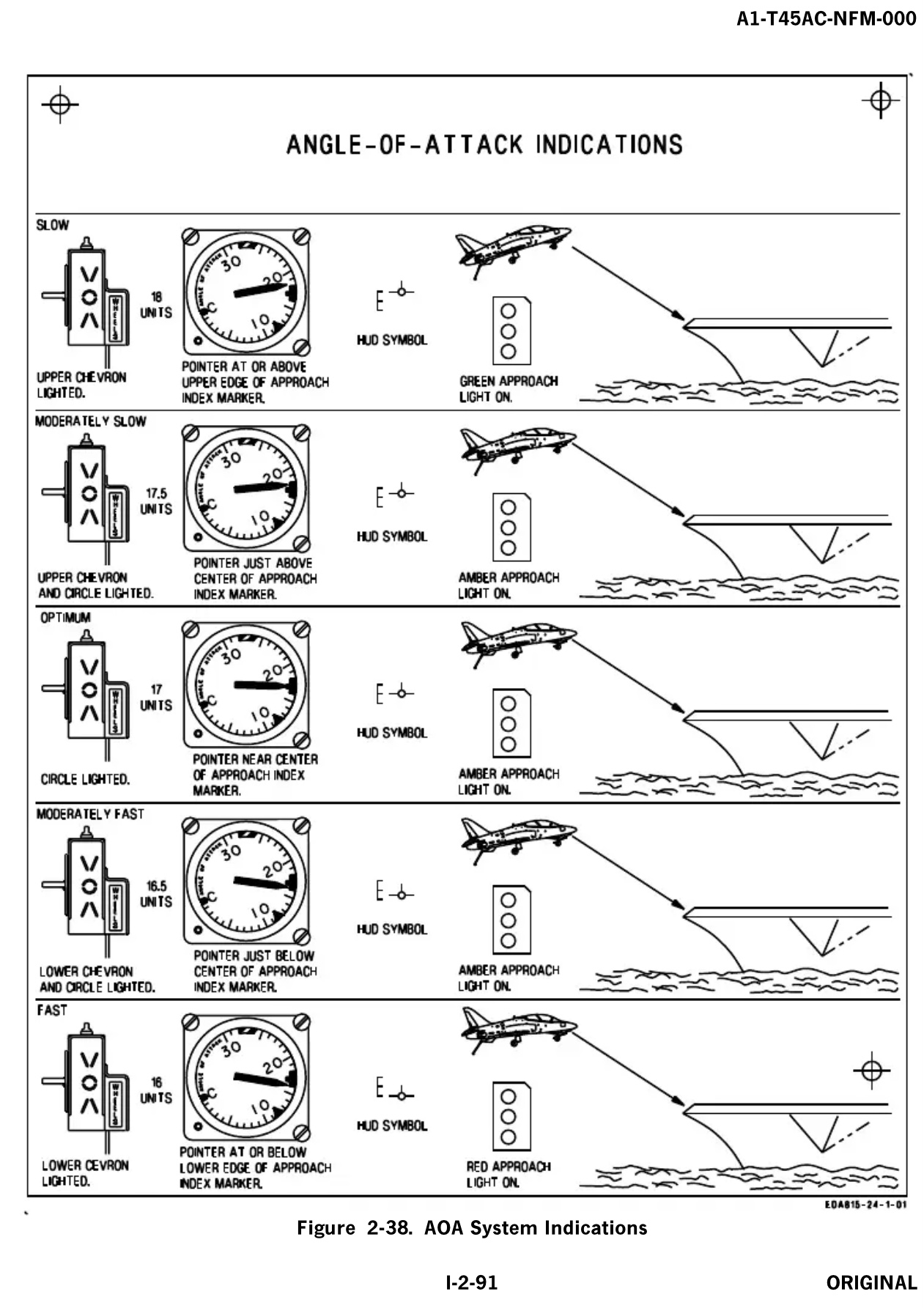
A Response to the DMMS AOA “Debate”
Recently I had a “debate” with Dan Gryder following a comment I made “if you have AOA you don’t need DMMS.” My comment is correct, it is…
A Response to the DMMS AOA “Debate”
Recently I had a “debate” with Dan Gryder following a comment I made “if you have AOA you don’t need DMMS.” My comment is correct, it is factually correct, and losing a debate does not change the veracity of fact. Scopes lost his monkey debate.
https://www.youtube.com/watch?v=Ima88haD3cs
Dan, however, asked different questions. “What can you do immediately?” and “What if you cannot afford an AOA?” These are fair questions. And DMMS is a fair answer. DMMS plus constant AOA turns for which you need no AOA indication is even better. Having AOA would be best but it is true too many don’t have it and are not going to get it soon. Dan and I agree on this.

It is understandable that Dan creates the debate as such generates interest and interest enables both concepts to gain increased attention.
It does leave us with comments and questions, however, that to some extent should be addressed. Losing in this case should not be cause for rejection of the concept. After all, the debate was there to generate attention not to resolve goodness and badness. Many comments had legitimate concern even if such got taken to an extreme.
So, what were the comments? Generally they fall into the following:
- Jim Allen is an “egghead”
- Jim Allen is a moron
There seems to be incongruity between these first two points. Though to alleviate some confusion, I am not a PhD. I do, however, have a public high school diploma: P-H-D. Dan was speaking facetiously trying to make AOA sound difficult. Wittingly or not, he was also trying to lower expectations for himself while raising them for me all while trying to create an us against him dynamic. Which gets to the next few points.
- Jim Allen is book smart while Dan is street smart
- AOA is another distracting gizmo
- AOA is too complicated
There seemed to be some confusion in the comments with belief that AOA only showed stall. This is false. AOA shows a range yet this range is referenced in terms of nearness to stall. Such actually makes AOA more representative to just how well your airplane is flying. It means AOA is a direct measure as to “how hard the wing is working.” But there is some validity to this sort of comment that some AOA systems have insufficient range for utility. Such are mere stall warning. Such limitation isn’t true, however, for most AOA systems. The reality is AOA is both book smart and street smart. Airspeed, however, is actually really convoluted though DMMS does simplify this to make for street smart. Which means Dan had to have some book smarts to so simplify.
- politician
- salesman
Nope, neither. My speaking is completely free and voluntary, I have no profiting agenda. I have nothing to sell you. I am, however, giving away a simple technique for you to consider as you fly — the constant AOA turn. And I’m giving you other considerations via my other Medium articles. I am not monetized here. There is no gain in this for me other than staving off boredom with winter snows outside.
- Airspeed is kinetic energy
Sort of. True airspeed is kinetic energy. Indicated airspeed is not though it is an absolute measure that gives a sense of kinetic energy; it is proportional to kinetic energy though the proportional scaling is environmentally dependent. AOA, however, is a relative energy measure showing margin to your point of energy insufficiency. As the point of insufficiency changes, AOA adapts with it such that you never need to account for the changes. Your AOA scale actually becomes a consistent measure of adequacy. Airspeed is not consistent. AOA is consistent.
- AOA is for precision landings
This is true. AOA is required for precise landings such as that on an aircraft carrier. Yet it isn’t just the final and landing that are flown via AOA. The whole pattern is. AOA enables easy and precise control. Why wouldn’t you want precision in your landings?
Yes, it is true airlines use airspeed and have fairly precise landings, yet they’re not strictly using airspeed. They have to adapt airspeed to account for weight. AOA does this work for you and in so doing removes chances of error in the calculations or of the fingers crossing lines in tables. Perhaps in your light piston GA airplane, you use the “subtract one knot for every hundred pounds below max gross weight” rule of thumb? With AOA, no such work is required. Onspeed AOA is onspeed AOA while Vref changes with weight.
- Jim Allen doesn’t look at airspeed [and that is really dangerous]
As AOA is a direct measure of capacity to stall or stall margin, AOA is actually safer.
I haven’t looked at airspeed flying my plane in a landing pattern in a long time except for flying at night as my AOA gauge is not illuminated. But then again, I haven’t flown at night in a long time either. The last time I did and I could not see the AOA, I was really uncomfortable. I do have known pattern speeds (90/80/75NF65HFFF) and I have years with this airplane prior to installing the AOA gauge. Though, excluding break turns in overhead entries, I’ve always done constant AOA turns in the pattern with it. The plane does have a nice feel to it with the three-point attitude being just as it squats down. This is a non-stalling three-point attitude plane. Don’t squat till final though, or do a wheel landing and never squat, now you’re doing that airmanship stick and rudder thing, using feel with pitch and power. If you want the three point, don’t go any slower than the speed at which it squats. If you do get slower, it will get mushy. But it doesn’t have much rumble to stall while the mushiness is a slow decay to a sharp stall break, so don’t get mushy. Any mushiness push the nose and consider power.
“Yes the F-4 had aural tone. It took some adjustment. You either fly angle of attack or airspeed. In a jet on final approach using airspeed you are taught to use pitch to point the nose to go where you want or center the flight director and to control speed with power. Using AOA you control AOA with pitch and descent on flight path with power. I think this is part of the resistance of airlines to adding AOA indications. Most pilots would find no need for AOA in their accustomed instrument crosscheck. Once I was used to flying angle of attack I preferred it over airspeed. As an instructor in the back of the F-4 where some aircraft had very limited visibility depending on displays for weapon systems, I flew my overhead patterns starting at the turn from downwind to final to touchdown using only aural AOA and outside references including VASI without looking in the cockpit at all. I have flown many other aircraft with AOA, but the only one I flew with Aural AOA was the F-4. (Except a test program in the T-38, but that is a long story.)” — Tom Tilden
https://www.youtube.com/watch?v=WCSaFcPG9BE
- AOA is a secondary instrument
This is a legal technicality. The FAA minor alteration consideration for easing installation of AOA does not change the certification of an aircraft while the platform retains the certified published speed numbers. The certified speed numbers, however, are only valid at maximum gross weight and forward cg. In terms of stall they also only apply straight and level. The AOA values adjust with weight, cg, load. AOA is always valid while airspeed needs to be adjusted and interpreted to gain validity. As for my RV, it is an experimental; I say AOA is primary, AOA is primary. There were no specific speeds published in its airworthiness certification or operating limits. There are no legal stipulations forcing speed to be primary. Fear not, you can still use AOA even if secondary. All you need to do is make a crosscheck with speed and/or pitch while flying straight and level each arrival. Good habit to make it a downwind check. With such, you’ve verified AOA and can now use the AOA no longer needing to scan speed for the rest of the pass. This is a bit like flying a VOR approach “in the pink” while having a pointer also up and active on your HSI. You have realtime VOR signal in the pointer hence you’re legal. (Learn to use pointers, they’re actually awesome.)
- AOA have insufficient range of display
For some systems, this is true. Have to do your homework before selecting.
I’ll also note some of the inertial systems have slow hamsters running their wheels and just generally aren’t good. AV-20 in an SR20 not a good match. A buddy had that particular combination and as an AOA, it was useless. Far too often it was reading slow and giving false alerts.
- I don’t need AOA
What do you get with DMMS? An increased margin compared to normal operations. But you still cut into this margin. What do you get with AOA? Preserved margins into which you don’t normally cut.

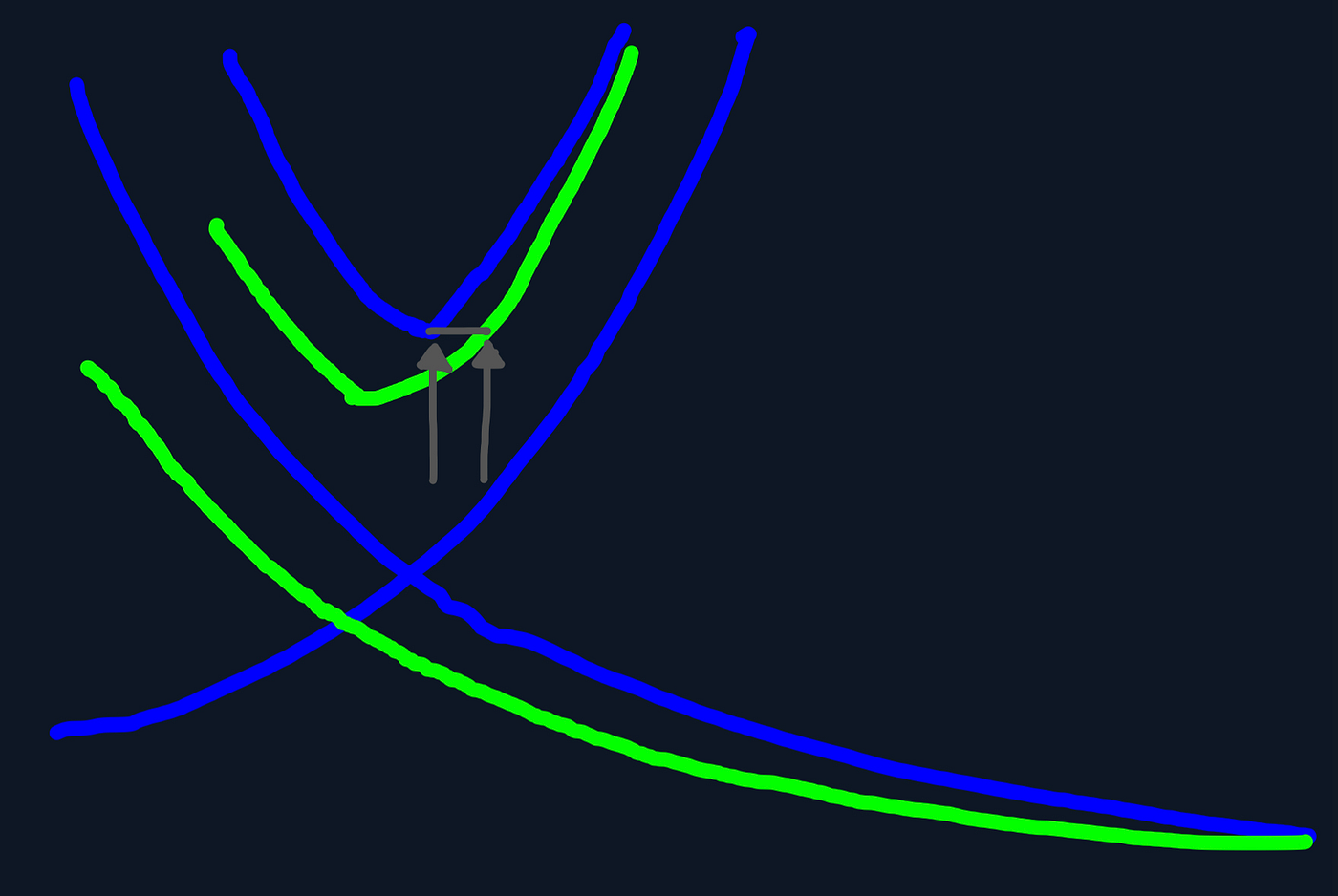
Vn adapted from Fly Onspeed Organization
With DMMS, you’re holding the red line which means you can still eat your margin. With AOA, you stay on a curve maintaining margin. The green curve is the onspeed AOA curve and can be used. Though I like contingency energy, so instead consider the blue curve till nearing or on base. Then go to the green. If you limit bank and pull, you can be both on the blue curve and on the red line slipping below aka faster than blue curve in your straights. Alternately, if you use constant AOA turns, you can hold a straight ahead DMMS while following the curves faster speeds in turns.
- the grease off that guy’s head product will clog his AOA port
Hate to disappoint, I don’t use product. It is genetic unfortunately. Though this gives me opportunity to segue to Cirrus. Consider for a moment the Cirrus G6 SR22 and S22T has AOA with their flight into known icing (FIKI) models but does not with the non-FIKI variants. Why is this? I don’t know for sure but I have a two-part hypothesis. I suspect that as they were cutting into the leading edge, they gained opportunity to change their stall horn to an AOA system, seeing they were going to have to prove certification again with the modified leading edge, simultaneously changing to an AOA wouldn’t really add cost. Meanwhile as the FIKI is a TKS anti-ice fluid based system, the old stall horn suction port really would likely jam with TKS. Now, pressure differential systems do use ports and would similarly jam. Cirrus went with a stagnation point sensor system, they essentially have a small metal flap that shifts position as it floats in the pressure field around the leading edge. As AOA increases, the stagnation point, where the relative wind hits the wing, moves down and aft along the wing underside. Hence more and more pressure pushes the flap up. Measuring fine movements gives AOA. You may have seen similar stall warning systems in other planes, they just lacked the precision measurement hence were binary and merely stall warning. Pretty smart on Cirrus’ part. Now if they could just teach their pilots “three o’clock” or 0.6 numeric value on that AOA. It’s pretty simple. Plane will hold it pretty well. Use clicks of trim to fix minor deviations.

https://www.cirruspilots.org/Publications/Articles/a-new-angle-on-angle-of-attack

https://www.cirruspilots.org/Publications/Articles/a-new-angle-on-angle-of-attack
- too complicated
If you think AOA is complicated, then you’ve forgotten how messy airspeed actually is. AOAs hold at constant values regardless of conditions. Stall is always one AOA. L/Dmax is always one AOA. Minimum power required is always one AOA. AOAx and AOAy are constant with weight and load. Onspeed AOA, equivalent to Vref, is a constant AOA. As most of your important values become constant with AOA, AOA flying is simpler.
To be fair, these values change with flap configuration, but so too do airspeeds. Advanced electronic systems, however, will compensate such that you don’t need to consider values changing with flaps, the systems display consistently regardless of flaps. Also, while AOAx is constant for jets, AOAy varies with altitude for all players while AOAx varies (minimally) for propellers. But such is to a small degree that AOAx and AOAy can be treated as constant for practical use within the altitudes they’d actually matter. Remember Vx and Vy change with altitude. Vx and Vy change with weight but AOAx and AOAy do not.
Constant AOA can be used for all values except Va and Vne. With Va, AOA can still be used if cross checked with the accelerometer so as to be at or less than one g when observing the AOA number. If you’re one or less g while your AOA is at or greater than Va equivalent AOA, then you’re at or slower than present weight Va. The AOA number for Va is already weight adjusted whereas airspeed is not. Regarding Vne, the airspeed indicator is often misleading as flutter is often the cause of Vne and flutter is true airspeed dependent not indicated. So, airspeed is just as bad if not worse as it can give a false sense of security regarding Vne while AOA more easily and readily gives all other values.
Airspeeds are messy. AOAs are consistent and clean.
- slave to a gizmo
- hooked on technology
How is AOA any more a gadget than is an airspeed indicator? ASIs are gadgets. They’re complicated and delicate gadgets. They were designed and made by Swiss watch makers. They aren’t actually airspeed either. They’re pressure differentials. They take a lot to get sufficiently precise and have lots of errors for which need to be compensated. If you’re set to airspeed, you are a slave to a gadget and a slave to a technology. An ASI is not a simple thing. An ASI has multiple avenues of faults. Remember your ASI works by comparing total pressure from the pitot to “ambient” pressure at the static leaving you with dynamic pressure remaining then converting this to a speed. But pitots are never perfect and statics never capture true ambient. This is before you get to the gear inside the ASI. As small aircraft pilots we tend to blow off differences between instrumented, calibrated, and equivalent airspeeds. We treat them synonymously. Yet they reflect challenges and differences from what you are reading on your gadget and your actual flying conditions. Meanwhile you have to go to true airspeed to actually be dealing with your kinetic energy state. You think you’re talking energy while looking at an indicated airspeed and you’re not even close to it. And again, you can stall at any airspeed but only one angle of attack. Indicated airspeeds are measures of absolute kinetic energy state, but they’re poor measures of such. Meanwhile you’re trying to estimate relative kinetic energy state from them while AOAs are a direct measure of relative kinetic energy state. No interpretation required with AOA.

Pilot Handbook of Aeronautical Knowledge

Pilot Handbook of Aeronautical Knowledge
To be fair, a pressure differential AOA like my Lift Reserve is rather similar to the airspeed indicator in its internal function. About the only difference is that in compares an offset angle “aft” yet still semi forward facing port to pitot or pitot like “forward” port as opposed to the static port that the ASI did.

https://www.mountainflying.com/Pages/articles/alpha_systems_aoa.html
See the similarity? Is a pressure differential AOA any more complicated a device? Then add the complications of airspeed versus pressure and kinds of airspeeds as well as airframe airflow disturbances. Turns out AOA is simpler than airspeed.
Vane AOAs are probably even simpler to get your head around. A “flap” aligns with the relative wind and the angle between it and the longitudinal axis of the plane is measured. Granted, the wing might have an angle of incidence relative to fuselage, but such is constant. These are essentially like a glider’s side strings. Double slit AOA probes? Close enough for our concerns to be synonymous. They too seek the relative wind by zeroing out pressure difference between the slits then the angle of the probe is measured relative to frame. Cirrus does use a stagnation point sensor, but from a pilot perspective, I’d treat it as in kind with vanes.
Gliders can use side strings for “alpha” which is AOA just as they use yaw strings for “beta” or to coordinate flight as we use a ball. A side string is essentially the simplest and cheapest form of a vane.

https://www.youtube.com/watch?v=4hc98LC--Yc
The Wrights used something very similar to a side string on the 1903 flyer. They had a string out in front of them mounted next to an aft pointing peg. They’d compare the angle of the string versus peg. Thus they got alpha and beta from the same string. They would later design and patent a more robust AOA system. Aviation actually started based in AOA not airspeed.
To be fair, normalizing AOA values adds some complication to systems. Hence many don’t normalize. Though normalizing is pilot friendly. A normalized AOA shows critical angle as a value of one. Your value towards one shows your wing’s lift capacity presently used while one minus your value is how much you have left to use. The onset is not linear, however, as there is a zero limit you approach the faster you go. Zero is the proper value for a zero g non-lift producing wing. (Most no longer calibrate through a zero g unload instead accepting something fast enough to be a lower limit AOA value.) With a normalized system, 0.6 is always onspeed AOA for your present load and configuration. Stall is always 1.0.
- not an airline pilot; clueless
On the charge that I am not an airline pilot and therefore haven’t a clue, let’s take the most famous airline pilot at his word:
In June 2011, regarding both Air France 447 and Colgan Air 3407, Chesley “Sully” Sullenberger stated “One of the things we could do … is to provide and display directly in the cockpit critical angle of attack information; this angle of the air flow over the wing information that the airplane already measures, but is not displayed to the pilot. Had they had the information displayed directly into the cockpit, it would have helped them if they were trained to use it effectively.”
https://www.cbsnews.com/news/sullenberger-on-lessons-of-air-france-crash/
And he has held this stance for some time, “‘I believe the transport airplane community, as a whole, would not expect the crew to lose all three speed indicators in the cockpit,’
Sullenberger went on to say that there is a need for the pilots to receive information about Angle of Attack. ‘We have to infer angle of attack indirectly by referencing speed. That makes stall recognition and recovery that much more difficult. For more than half a century, we’ve had the capability to display Angle of Attack in the cockpits of most jet transports, one of the most critical parameters, yet we choose not to do it.’”
You can also refer to Mike “Vac” Vaccaro, current FedEx pilot and former Air Force Phantom (old Rhino!) pilot
— — — — — — — — — — — — —
Egghead alert: it is about to get wonky with run-on story too -
I’d like to take a bit to talk about my RV and its AOA systems. I am not advertising these as the preeminent systems. Though I do think my primary Lift Reserve AOA should be considered for your backup systems. It is a certified instrument too, so it is available to all. I would encourage also seeking an electronically integrated AOA as primary. Though which becomes a difficult choice. For experimentals, the Fly Onspeed Organization system is ideal, but they don’t produce it. You either have to do it yourself or find someone doing them onesie-twosie. It isn’t certified, so to the rest of you, sorry. I don’t have one of these myself and won’t with this RV, but should I get another, I will.
So, I got my RV-6 coming up on a decade ago. When I got it, it had no AOA and I flew it as it was for “years,” though it also had some downtime eating those years as I managed to put a jack through the wing during a tire change. But I had time with it airspeed only. Flying this RV-6 I found easier to three-point land. Slow it enough to just squat and I’m good. This was a little weird to me as I learned conventional gear in an RV-4 which I found much easier to wheel land. I knew I wanted an AOA so I got what seemed the simplest in the Lift Reserve. This actually sat in my closet for over a year before getting into the plane. So too has a camera I plan to mount under the nose for forward vision parking, got it around the same time and in the closet it sits.
Note I mounted the AOA gauge rotated ninety degrees clockwise; made no sense to me to have low AOA high energy right high AOA low energy left but made perfect sense high AOA above low AOA.

Anyway, first flight after installing though not yet calibrating the Lift Reserve, a flight intended to calibrate, I have a pitot failure on takeoff… I was actually just about to abort the takeoff as airspeed had not yet come to life while I was rolling but with a wind gust I found myself already airborne. So I kept the power in and climbed on pitch. Got to altitude, did a stall noting where the stall fell on the gauge, then used the AOA stall plus two tics for my recovery. Worked great.
Now, this particular system, being over-simple, has no inflight calibration. Calibration is done by adjusting the angle of the probe between flights. It is a pressure differential system and this brings considerations; this is why we are going to get wonky.
Previously I wrote a piece that mentioned my particular AOA and noted references for it. Well, those have been thrown away. The initial process was to do stalls and then adjust the probe till getting the primary landing configuration stall to occur on the gauge at the desired tic, then note all other stalls’ positions on the gauge.
I subsequently realized my no-flaps tests were all power on while my half flap and no flap tests were power off. Worse, I flipped my no flap versus half and full flap results after the fact thinking I must have marked them wrong as they didn’t make sense in comparison to each other.
While not needing to realign the probe this time, new tests got me better marks.
Turns out, for my airplane, the stall mark doesn’t change with flap configuration. You cannot count on this, I got lucky in this regard. Here is what I have now:

Funny thing, after installing the AOA, I’ve had much easier time wheel landing yet have been reluctant three-point. It has taken me a while to work myself back to that green-to-white tic, with which I can once again consistently three-point. Initially the AOA gauge made me want to be fast.
Now, this being a pressure differential gauge, it has a peculiar susceptibility. Though the source of this error actually gives it an advantage over vane and stagnation point AOA systems.
“This instrument measures the difference in dynamic pressure at two ports. The pressure at each port is proportional to two things — the dynamic pressure due to airspeed, as would be measured by a perfect pitot tube, and the cosine of the angle of the axis of port opening relative to the angle of the oncoming air — the angle of attack of that particular port. As the angle of attack of the instrument changes, the difference between the dynamic pressures at the two ports also changes. As you increase the angle of attack, the angle of attack of the top port increases and the bottom one decreases, so the pressure at the top one decreases and the bottom one increases, so our instrument shows a change in the difference between the two. So far, so good — it’s pretty close to an angle of attack instrument. Here’s where the problem is — changing the angle of attack is not the only way to change the difference in pressure between the two ports. You can also change this by changing the airspeed without changing the angle of attack. Imagine the top port is directly into the wind, and the bottom port is angled downward about 45 degrees. The pressure at the top port will be 100% of the dynamic pressure, and the pressure at the bottom port will be about 70% of the dynamic pressure. Our instrument shows us some reading (I don’t know what reading — it depends on how it’s calibrated.) Now imagine you double the airspeed in the wind tunnel. The dynamic pressure with go up by a factor of 4. Here’s the important point: The difference in pressure between the two points will also go up by a factor of 4. So the differential pressure gauge changes!”
https://www.stoneylake.org/pipcom/AOAr.htm
There are solutions to this. Electronic systems can calculate this out. Mine, however, is a simple pneumatic pressure comparison. I could fix this, however to do so, I have to adjust my probe such that stall occurs half way between the two ports. If stall occurs midway between the two ports, accelerated stall will show at the same point on the gauge as unaccelerated stall. But doing so will change where stall occurs on the gauge, and I’m unwilling to do that. Instead, I get:

So, I have a deviation displayed critical angle versus actual critical angle on my AOA with accelerated stall. Compare this to how much an airspeed indicator changes one to four g.

Pilot Handbook of Aeronautical Knowledge

RV-6 ASI with Vs and 4g accelerated stall noted
A 4g stall doubles the stalling airspeed yet shifts a mere tic and a half on my rudimentary pressure differential “AOA” gauge. I think I’m ok.
Yet this very same problem for pressure differential systems creates an advantage that true AOA vanes as well as stagnation point sensors lack.
“Generally AOA is useless for the actual takeoff. By this I mean power up through rotation. After rotation, AOA is great. But the same difference between true AOA and pressure differential systems that created vulnerability for errors in accelerated stall readings actually create value for the ground roll for the pressure derived systems. Below are my comments to these notions which I think belong to the wider audience hence this posting: The takeoff discussion is one that actually gets a bit complicated. Consider a tricycle gear plane, your ground roll is entirely at zero AOA. Similarly, for the tailwheel, you’re at zero AOA after lifting the tail (I like calling going ‘on step’ to match float planes). Prior to this, your AOA was your sitting angle. AOA gives you nothing for when to rotate. It is only after rotation that AOA provides you data… Bottom line AOA becomes useful after rotation but you’re still using speed to rotate and such should be explicitly acknowledged. But Pressure Systems, not true AOA as with vanes [stagnation point systems also lose out here]… A caveat to the takeoff discussion I missed is that while your actual AOA is zero during takeoff roll, the pressure system will actually show a decreasing value through acceleration as the front ram hole gets more than the more downward ram hole. Similarly, upper / lower wing pressure systems will also show a ramping downward as, while the shape won’t change, the intensities will [this will be an IGE pattern of changing intensity hence may need different reference values]. Hence, pressure based systems actually have an advantage in takeoff roll as compared to true vane systems. As yours is aimed predominantly at pressure based audiences, you can take advantage of this to not only check system function in ground roll, and also actually use the system throughout takeoff. Interesting systems design aspect I had not considered. That which created vulnerability to accelerated stall actually creates value here, and the fix to accelerated stall indications does not hurt it here.”
https://vansairforce.net/threads/aoa-recommendations.234762/
Upon this realization, I started watching my AOA on takeoff. After about ten goes, I’ve now transitioned to using the AOA for takeoff, two tics into the green, rotate. I still use airspeed alive to lift my tail. Then my eyes are generally outside only coming in to check the AOA for the two tics. Such is easier than looking for speed.
Last year, I decided I needed a heated pitot tube. Previously I had had a true pitot tube being the pitot aluminum tubing bent to face forward and opening bell shaped out. Airflow truly stagnated to that port. But, from desert to New Hampshire a few years ago, heated pitot seemed wise.
I had changed out my DG for a Garmin G5 a few years prior while the plane had a Dynon D10A swapped for the artificial horizon before it came into my possession. Turns out the D10A integrates with a heated probe so as to also give AOA. G5, however, does not tie to Garmin’s equivalent probe. So now I have two AOAs. They’re both pressure differential so similar in that regard.
Dynon is interesting. Their display is an indexer but it has a reverse fill. At high speeds low AOA it is full. As you slow, the color filling disappears. There is a logic to this as you are losing excess capacity for lift generation and maneuver. But I find it really annoying. Garmin displays a similar indexer though they fill theirs as you slow. I find such more appropriate. So, I’ve turned off the visual display of my Dynon AOA. I do have tones, however. They are progressive and they come alive right about where the plane squats and right about where you want to be for a three-point landing. This brings up another commenter point. Some AOAs lack sufficient range of display. Dynon’s display is sufficient were I to use it, but the tones are not if wheel landing. On the wheel landing, I don’t hear anything till well into rollout. Instead, the tones are really low energy stall warning. For the three-point, however, they’re perfect. Tones alive slow pulse rate, good, pulse rate increasing, rapid, or solid tone, get the nose down. While plenty good enough for landings, I must admit, my Lift Reserve also has insufficient range of display for full utilization. The AOA needle pegs full fast while still slower than L/Dmax meaning I cannot use the AOA for best glide.


Dynon D10A AOA from pilot and installation manuals
Interestingly Dynon has another vulnerability in their AOA. They actually do normalize theirs even if they don’t give you a displayed numeric value of such. To do this, they need to integrate the static port into their system. Garmin does something similar but uses separate independent static on their AOA probe. Thus Dynon has created a single point of failure common to both airspeed and AOA. So much for redundancy.
https://vansairforce.net/threads/close-call-stall-on-final.238764/
메타데이터
- post_id
- 7a40cfd7ff5c
- slug
- a-response-to-the-dmms-aoa-debate-7a40cfd7ff5c
- url
- https://medium.com/@jamesmcclaranallen/a-response-to-the-dmms-aoa-debate-7a40cfd7ff5c
- canonical_url
- https://medium.com/@jamesmcclaranallen/a-response-to-the-dmms-aoa-debate-7a40cfd7ff5c
- author_url
- https://medium.com/@jamesmcclaranallen
- status
- ok
- fetched_at
- 2026-06-16 19:09:56