The Hidden Problem With Video Translation Nobody Talks About
Most people think video translation is a solved problem.
The Hidden Problem With Video Translation Nobody Talks About
Most people think video translation is a solved problem.
We already have AI tools that can:
- translate subtitles
- generate captions
- even clone voices
So it feels like global video content should be easy by now.
But in reality, there is still a hidden problem almost nobody talks about. Video translation is not a translation problem. It’s a workflow problem.
The illusion of “one-click translation”
Many tools today advertise: “Translate your video in one click”
But what actually happens behind the scenes is very different.
Video translation is not one step.
It is a chain of fragile processes:
- speech recognition
- transcription
- segmentation
- translation
- subtitle timing
- rendering
- optional dubbing
If any one step fails, the entire result breaks.
Why most AI video tools still feel “off”
Even with modern AI, users often notice problems like:
- subtitles slightly out of sync
- unnatural phrasing
- missing context
- robotic voiceovers
- timing that feels “almost right” but not perfect
These are not model problems alone.
They come from pipeline mismatch.
Different tools optimize different parts of the workflow, but not the entire system.
The real bottleneck: context loss
One of the biggest hidden issues in video translation is context loss.
When speech is converted into text:
- tone is lost
- emotion is flattened
- references become ambiguous
- timing is disconnected from meaning
Then translation happens on top of incomplete information.
So the final output is often:grammatically correct, but emotionally wrong
Why subtitles alone are no longer enough
Subtitle translation was enough when:
- audiences were used to reading subtitles
- content was short-form
- distribution was local
But now content is:
- global
- algorithm-driven
- consumed on mobile
- watched in multiple languages
So users expect more than text translation.
They expect experiences.
The rise of full video localization
A new approach is emerging:
Instead of translating text, we translate the entire video experience.
That includes:
- speech understanding
- timing alignment
- emotional tone preservation
- optional voice generation
- multi-language output
This is no longer subtitle translation.
This is video localization engineering.
Why this matters for creators
If you’re a creator today, the difference is huge:
Subtitle-only workflow:
- fast
- cheap
- readable
- limited experience
Full localization workflow:
- immersive
- scalable
- global-ready
- higher engagement
The gap between the two is becoming larger every year.
The future is not translation — it’s adaptation
We are moving toward a world where:content is not translated — it is adapted per language and culture.
That means:
- tone changes per audience
- pacing changes per region
- even voice style may vary
Translation is just one part of that system.
Conclusion
Video translation still feels “unfinished” not because AI is not good enough, but because we are still thinking about it the wrong way.
It is not a language problem.
It is a systems problem.
And systems are much harder to fix than models.
If you’re exploring full video localization workflows, you can try:
AI Video Translator https://ai-video-translator.com
Subtitle Generator https://ai-video-translator.com/subtitle-generator
AI Dubbing https://ai-video-translator.com/ai-dubbing
Transcription Tool https://ai-video-translator.com/transcription
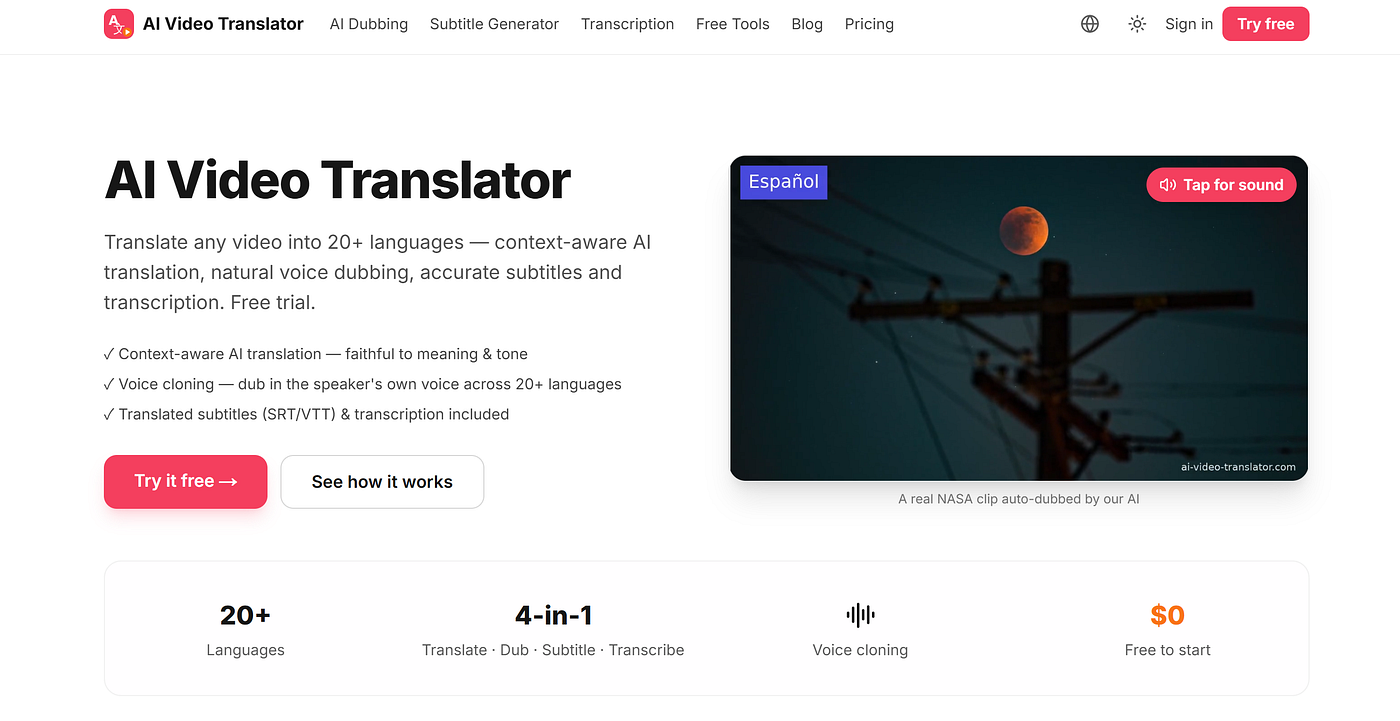
Instead of a fragmented pipeline that causes context loss, AI Video Translator fixes the systems problem by integrating transcription, translation, and voice synthesis into a single workflow.
메타데이터
- post_id
- 7a4802ea33d7
- slug
- the-hidden-problem-with-video-translation-nobody-talks-about-7a4802ea33d7
- url
- https://medium.com/@peterslab/the-hidden-problem-with-video-translation-nobody-talks-about-7a4802ea33d7
- canonical_url
- https://medium.com/@peterslab/the-hidden-problem-with-video-translation-nobody-talks-about-7a4802ea33d7
- author_url
- https://medium.com/@peterslab
- status
- ok
- fetched_at
- 2026-07-23 23:41:22