12 Claude Skills to 114 in 4 Months. The Five Mistakes I'd Undo If I Could
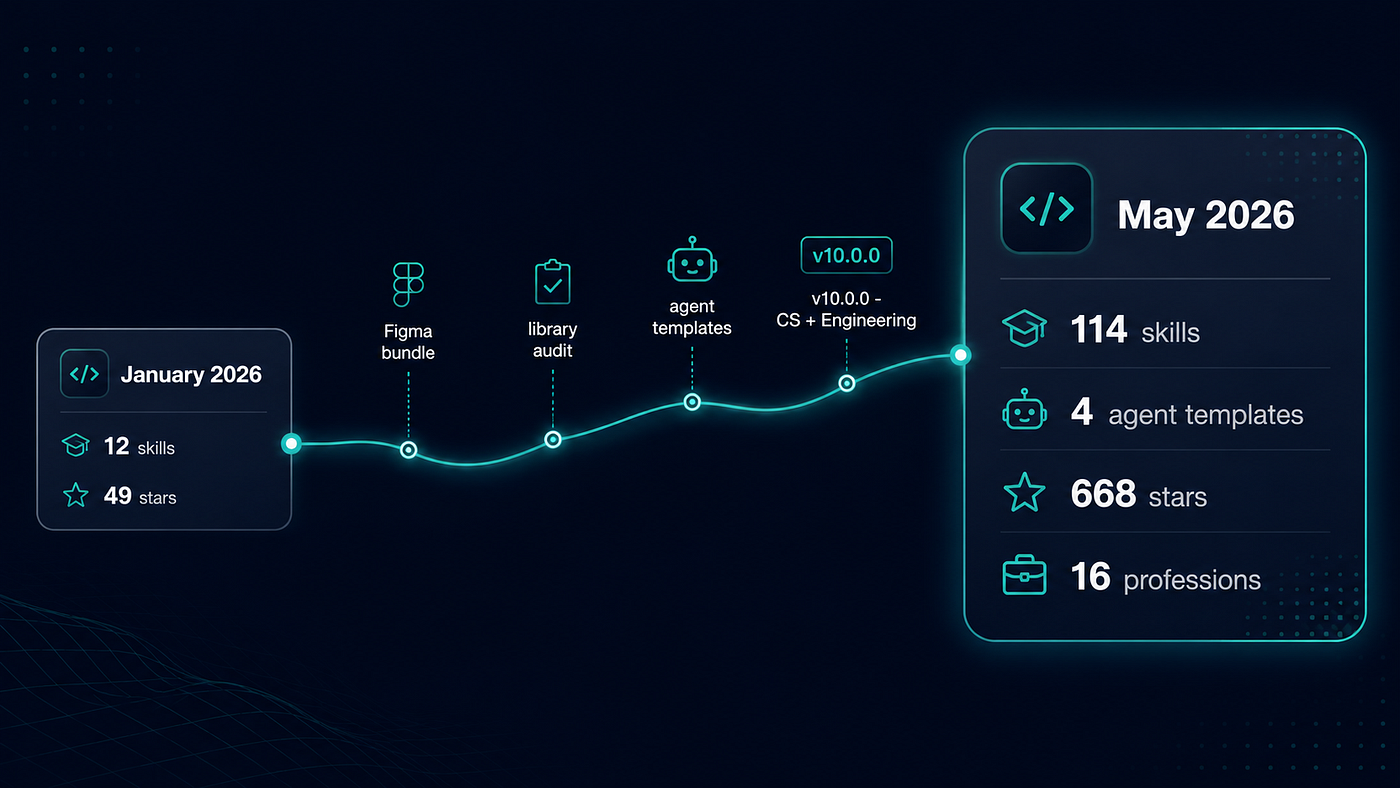
From 12 skills and 49 stars in January to 114 skills, 668 stars, and curator-shared in May. The honest journey, including what I got wrong.
4 Months After I Wrote ‘Claude Skills: The AI Feature That’s Quietly Changing How PMs Work’ — Here’s What Actually Happened
I had 12 skills and a hypothesis when I wrote Part 1 in January. By May, the library was at 114 skills, 668 stars, and being shared by curators I’d never heard of. This is the honest journey.
Four months ago, in January 2026, I published Part 1 of what became the Claude Skills Series. The article was called “Claude Skills: The AI Feature That’s Quietly Changing How Product Managers Work.” It got 977 claps. It became my most-read article. It still drives more search traffic than anything else I’ve written.
I want to revisit it now because the situation has changed in ways that are worth documenting honestly. The library I wrote about — pm-claude-skills — has grown from 12 skills to 114. The 49 stars I had on the repo in late January are now 668. Two well-known AI curators shared the repo within days of each other earlier this month. A PM thought leader I respect cited Part 1 in his LinkedIn write-up about Claude Skills, alongside articles by others I read regularly.
This wasn’t planned. None of it was predictable from where I was sitting in January. And I’ve learned things in the 4 months since that I want to share — both because the original article has aged in interesting ways and because the lessons might be useful to anyone starting a similar project right now.
If you’re new to this work and want the original framing of what Claude Skills are and why they matter, read Part 1 first. This article is the journey since.
What the Library Looked Like in January
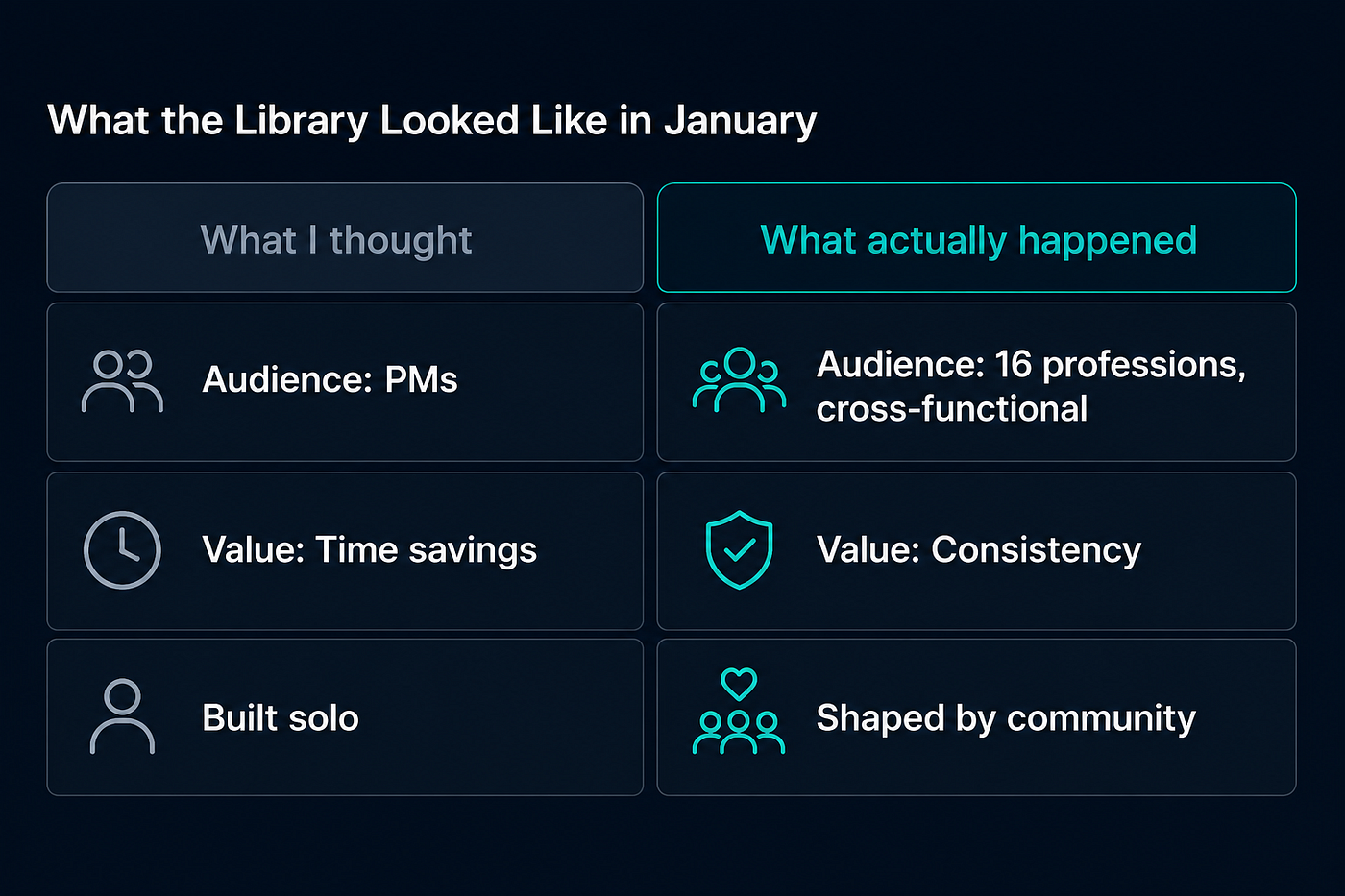
When I published Part 1, the repo had 12 skills. All of them were focused on product management. The README claimed they’d save 8–9 hours per week. The audience I imagined was other PMs who wanted to do their work faster.
The article ended with a line about how this was just the beginning. I didn’t know what I meant by that. I had vague ideas about building more skills, possibly publishing more articles, and maybe getting some other PMs to contribute. None of it was a plan.
A few specific things I believed in January that turned out to be wrong:
I thought the audience was PMs. It is partly. But the library now spans 16 professions and the most active users include CSMs, engineering managers, designers, and finance leads. The “PM” in pm-claude-skills increasingly stands for Professional, not just Product Management.
I thought the value was time savings. It is partly. But the deeper value turned out to be consistency. The skills don’t just make work faster — they make the output reliably structured in ways that scale across teammates. A team using the same retro skill gets retros that are consistent regardless of who’s running the meeting. That consistency is more durable than the speed gain.
I thought I’d build all the skills myself. I didn’t. Community contributions have shaped the library more than I have over the past 3 months. A pull request from a contributor I’d never met triggered a library-wide audit that rewrote every skill in the library. Other contributors have added skills I wouldn’t have thought to build. The open-source aspect of the project turned out to matter more than the skills themselves.
The Things That Worked
Looking back at the 4-month arc, four things drove the growth. None of them was what I expected.
Consistent shipping over a long enough window
Between January and May, the library had 12 numbered releases. Not random patches — substantive bundles. New skills, agent templates, and structural improvements. The Figma bundle in April. The Customer Success bundle in May. Four agent templates following Anthropic’s official architecture announcement.
This matters because sustained activity over 4–5 months looks different to GitHub’s discovery systems than a flurry of activity followed by silence. The repo has been in a state of visible improvement long enough that aggregators have noticed. Search rankings improved gradually. Curators added the repo to “interesting AI projects” lists.
I didn’t plan this cadence as a growth strategy. The shipping was driven by my own use — I kept finding workflows I hadn’t covered, kept seeing skills that could be improved, kept getting PRs that suggested additions. The compounding came from that sustained engagement with my own work.
Writing alongside building, but as documentation rather than promotion
The Claude Skills Series is now at 20+ articles. Most of them don’t perform as well as Part 1. That’s expected — Part 1 caught the very beginning of a topic before it became saturated, and that’s a one-time advantage.
But the articles that perform best aren’t the ones that announce new features. They’re the ones that reflect on what I’ve learned. Part 14 (“A Pull Request Made Me Rebuild All 93 of My Claude Skills”) substantially outperformed surrounding release-style articles. Part 13 (re-testing skills on Opus 4.7) did better than the upgrade announcement articles around it.
The lesson, slowly: people want lessons, not press releases. The release articles are useful for telling existing readers what’s new. The reflection articles are what attract new readers.
Responding to community contributions seriously
The PR I mentioned — the one that triggered the library-wide audit — came from a contributor I’d never spoken to. They flagged that several skill descriptions weren’t following the format I’d documented. They were right.
The easy response would have been to close the PR with a quick fix and move on. The harder response, which turned out to be the right one, was to spend two weeks auditing every skill in the library against the standards I’d set, then writing about what I’d found and changed. That contributor’s name is in the contributors list now. Their feedback shaped the library more than any single feature I added.
This pattern has repeated. Someone reports an inconsistency, I take it seriously. Often, the fix reveals a broader issue, and the library improves across the board. This is what open source is supposed to feel like, and it’s what kept the quality climbing rather than plateauing.
Catching ecosystem waves
The library’s biggest growth spikes coincided with external events I didn’t control. Anthropic’s Skills Directory expansion in February. Karpathy’s CLAUDE.md viral moment in March. Anthropic’s agent template announcement in May. Each of these brought broader attention to Claude Skills generally, and the library was one of the more developed PM-focused options when people came looking.
I couldn’t have planned for any of these. But I could control what state the library was in when they happened. By the time Anthropic announced agent templates in May, my library already had the architecture they described, because that was the natural direction the work had been heading.
The lesson: you can’t predict which waves will lift your work. You can position yourself so that when waves come, you’re ready to ride them rather than rushing to build something for them.
The Curator Moment
Earlier this month, two things happened within days that I want to mention because they were genuinely surprising.
Tom Dörr, who runs an AI-curation account on X, posted about the repo with the line “106 Claude Code skills for 15 professions.” That post drove about 150 stars in a day.
A few days later, Dan Kornas, an AI/ML engineer with 90K followers, wrote a substantive analytical breakdown of the library. His framing — “Claude workflows shouldn’t start from blank prompts” — captured something about the library’s underlying thesis better than I’ve articulated it myself.
Both shares were unsolicited. I hadn’t reached out to either curator. I hadn’t asked anyone to share it. The library showed up on their radars because they curate this space carefully, and someone they follow had presumably found it useful enough to surface.
What I noticed in the aftermath:
The momentum doesn’t fade as fast as I expected. A week after the spike, the star count keeps climbing — slower than the initial surge but still meaningfully above baseline. The library has moved from “interesting to a small group” to “part of the regular consideration set for people who watch this space.”
The conversions look different from past growth. Earlier waves of stars came mostly from product managers — my established audience. The recent stars are coming from a mix of AI engineers, ML practitioners, CSMs, designers, and folks I can’t identify from their profiles. The audience is becoming substantially broader.
The contribution rate has increased. Pull requests in the past week have been more substantive and more frequent than in the previous month. The new visitors aren’t just stargazing — a meaningful subset are actively engaging with the library.
I’m being careful not to over-interpret this. It might be a momentary spike that flattens. But the pattern feels different from previous waves — more sustained, more cross-professional, more contribution-heavy.
What I Got Wrong
Equal time for the things I’d do differently if I were starting over.
I built skills for tasks I don’t actually do
About 15–20 of the 114 skills in the library are skills I built and have never seen anyone else use, including myself, more than once or twice. They were good ideas at the time. They turned out to address tasks nobody actually does often enough to justify a skill.
Annual performance review skill. Quarterly planning skill. Investor pitch deck skill. Each took an hour or two to build. None of them paid back.
The rule I have now: if I haven’t done a task at least 5 times in the last 6 months, I don’t build a skill for it. I write a one-time prompt instead.
I optimised for breadth over depth too long
When the library hit 50 skills, I felt pressure to keep adding more. New skills feel like progress. Refining existing skills doesn’t.
The reality: 30 great skills serve users better than 100 mediocre ones. The library improved more from the audit-and-rewrite cycle than from any single batch of new skills. I should have done the audit at 50, not waited until 90.
I underestimated the description-rewrite leverage
I spent months thinking about skill content — better instructions, more thorough quality checks, more sophisticated subagent orchestration. The single largest reliability improvement in the library came from rewriting every skill’s description to a consistent format (“verb the thing, use when X, produces Y”).
This single change took trigger reliability from roughly 30% to 90%+ across the library. The skill content didn’t change. Just the descriptions.
The lesson: when something isn’t working, check the description first. It’s almost always the description.
I tracked stars for too long
For about a month, I checked the star count daily. This was a bad habit. Stars are a vanity signal. They correlate weakly with actual library use. They feel like progress when they’re actually noise.
The metrics that matter are forks, clones, contributors, and downstream mentions. Switching focus from stars to those metrics changed how I evaluated my own work. Articles that brought stars but not forks weren’t moving the needle. Articles that brought sustained downloads were.
I should have gone cross-profession sooner
The library was PM-only for the first 3 months. The expansion to Engineering, Legal, Finance, HR, Sales, Design, and others came in March-April. Looking at the usage signals now, the cross-profession expansion was probably the single highest-leverage strategic decision in the project’s history.
If I’d done it in February, the library would be 2–3 months further along on that growth trajectory. The work to write skills for adjacent professions wasn’t dramatically harder than writing more PM skills, but the audience expansion was substantial.
What I’d Tell Myself in January
If I could send a note back to the version of me who’d just published Part 1, here’s what I’d write:
The library will work. Not because of any single skill you build, but because you’ll be consistent for five months. The compounding from consistency will surprise you. The community will surprise you more.
Don’t optimise for stars. Optimise for quality. Stars follow quality. The reverse isn’t true.
The articles you write alongside the library matter more than you realise. People remember the story of the project, not the project itself. Tell the story honestly. The reflection pieces will outperform the release pieces every time.
Expand beyond PM earlier than you’d think. The cross-profession potential is the biggest growth lever and you’ll wait too long to use it.
When someone contributes — take it seriously. The PR that feels like extra work is often the one that reshapes everything.
Don’t build skills for tasks you don’t actually do. The unused skills will accumulate. Skip them.
The biggest reliability lever is the description format. Spend more time there than feels reasonable.
You won’t predict which articles take off. You won’t predict which ecosystem waves lift the library. Keep shipping anyway. Position yourself for waves rather than chasing them.
Most importantly: this is a real project that real people will use. Treat it that way from day one.
That’s the article I should have read in January. Hopefully, it helps someone else start their own library now.
Where the Library Is Now
The pm-claude-skills library has grown from the 12 skills I wrote about in Part 1 to 114 skills + 4 working agent templates across 16 professions. Customer Success, Engineering, Product Management, Marketing, Data & Analytics, Leadership, Design, Figma, Business Strategy, Legal, Finance, HR, Sales, Operations, Research, and Education.
Recent milestones:
- v10.0.0 shipped this week with 4 new Customer Success skills (Customer Health Scorecard, QBR Deck, Customer Escalation Brief, Churn Analysis) and 4 new Engineering skills (CI/CD Playbook, SLO & Error Budget, Developer Onboarding Doc, On-Call Runbook).
- 4 working agent templates demonstrating the Anthropic agent template architecture announced in May: PM Sprint Agent, PM Discovery Agent, PM Stakeholder Comms Agent, PM Launch Agent.
- Open-source MIT licence. Two-minute install via Claude Code marketplace.
- Star roadmap milestones at 100, 250, 500 unlocked — each delivered new skills or bundles. The next milestone at 1000 unlocks a Startup Founder kit.
The library is at github.com/mohitagw15856/pm-claude-skills.
What’s Next
I’m being deliberate about not announcing major plans publicly. The thing I’ve learned about open-source projects is that the work compounds when it’s quiet — when I’m refining existing skills, responding to issues, helping contributors — and stalls when I’m publicly committing to things and rushing to deliver them.
The honest version of “what’s next” is:
- Continue maintaining and refining the existing 114 skills based on real use
- Build the next agent templates (Legal Contract Review and Sales Pursuit are the most-requested in the SKILL_REQUEST.md file)
- Work toward the 1000-star milestone unlock — a Startup Founder kit
- Keep writing the Claude Skills Series, but slower, with more reflection and fewer release announcements
The library is at a scale where its growth is genuinely shaped more by what users want than what I think they should want. That’s the right place for it to be.
On the Original Article
Part 1 is now 4 months old. Some of what it said is still accurate — the underlying definition of Claude Skills, the rationale for using them, and the basic architecture. Some of it has aged less well — the library scale references are dramatically out of date, the “12 skills” I started with became the launching point rather than the destination.
If you read Part 1 today and felt like it was useful, I’d encourage you to think of it as the conceptual introduction. The practical state of the library has moved a long way since then. The articles in the rest of the series document the journey forward.
The articles I’d recommend reading next, in order:
- **Part 9: 80 Claude Skills for Every Profession** — where the cross-profession expansion started
- **Part 14: A Pull Request Made Me Rebuild All 93 of My Claude Skills** — the audit that established the library’s quality standards
- Part 16: Anthropic Just Released 10 Agent Templates. So I Built My First One Using the 106 Skills I’d Already Shipped. — When the agent template architecture became the next layer
If you find any of them useful, star the repo — it’s the single highest-leverage thing readers can do to help other people find this work.
Thank You
To everyone who starred, forked, contributed, shared, commented, or just lurked — thank you. The library is in the state it’s in because real people decided this work was worth marking. The 668 stars represent 668 individual decisions. The contributors’ names in the README represent dozens of people who chose to make this better.
The next milestone is 1000 stars. The work continues.
메타데이터
- post_id
- 7a4c235fc09a
- slug
- 12-claude-skills-to-114-in-4-months-the-five-mistakes-id-undo-if-i-could-7a4c235fc09a
- url
- https://medium.com/product-powerhouse/12-claude-skills-to-114-in-4-months-the-five-mistakes-id-undo-if-i-could-7a4c235fc09a
- canonical_url
- https://medium.com/product-powerhouse/12-claude-skills-to-114-in-4-months-the-five-mistakes-id-undo-if-i-could-7a4c235fc09a
- author_url
- https://medium.com/@mohit15856
- status
- ok
- fetched_at
- 2026-06-14 11:28:49