AI Threat Modelling Is No Longer Optional, It’s the New Security Perimeter
Artificial Intelligence is no longer a futuristic experiment sitting in isolated labs. It is already embedded inside enterprise workflows…
AI Threat Modelling Is No Longer Optional, It’s the New Security Perimeter
Artificial Intelligence is no longer a futuristic experiment sitting in isolated labs. It is already embedded inside enterprise workflows, customer support systems, fraud detection engines, recommendation platforms, and internal automation pipelines.
The problem is this, most organizations deployed AI faster than they learned how to secure it.
Traditional applications fail in predictable ways. Databases leak. APIs get abused. Credentials get stolen. Security teams understand these attack surfaces because they have spent decades defending them.
AI systems are different.
A large language model can leak internal instructions without a single database breach. A fraud detection model can slowly become blind to malicious activity because attackers manipulated the training data months earlier. A chatbot connected to internal tools can become a bridge into sensitive systems if its guardrails fail.
This is why AI threat modelling matters now more than ever.
The Security Shift Most Teams Are Missing
For years, threat modelling revolved around assets like:
- Databases
- API keys
- Source code
- Servers
- User credentials
AI introduces completely new assets that many organizations still do not inventory properly.
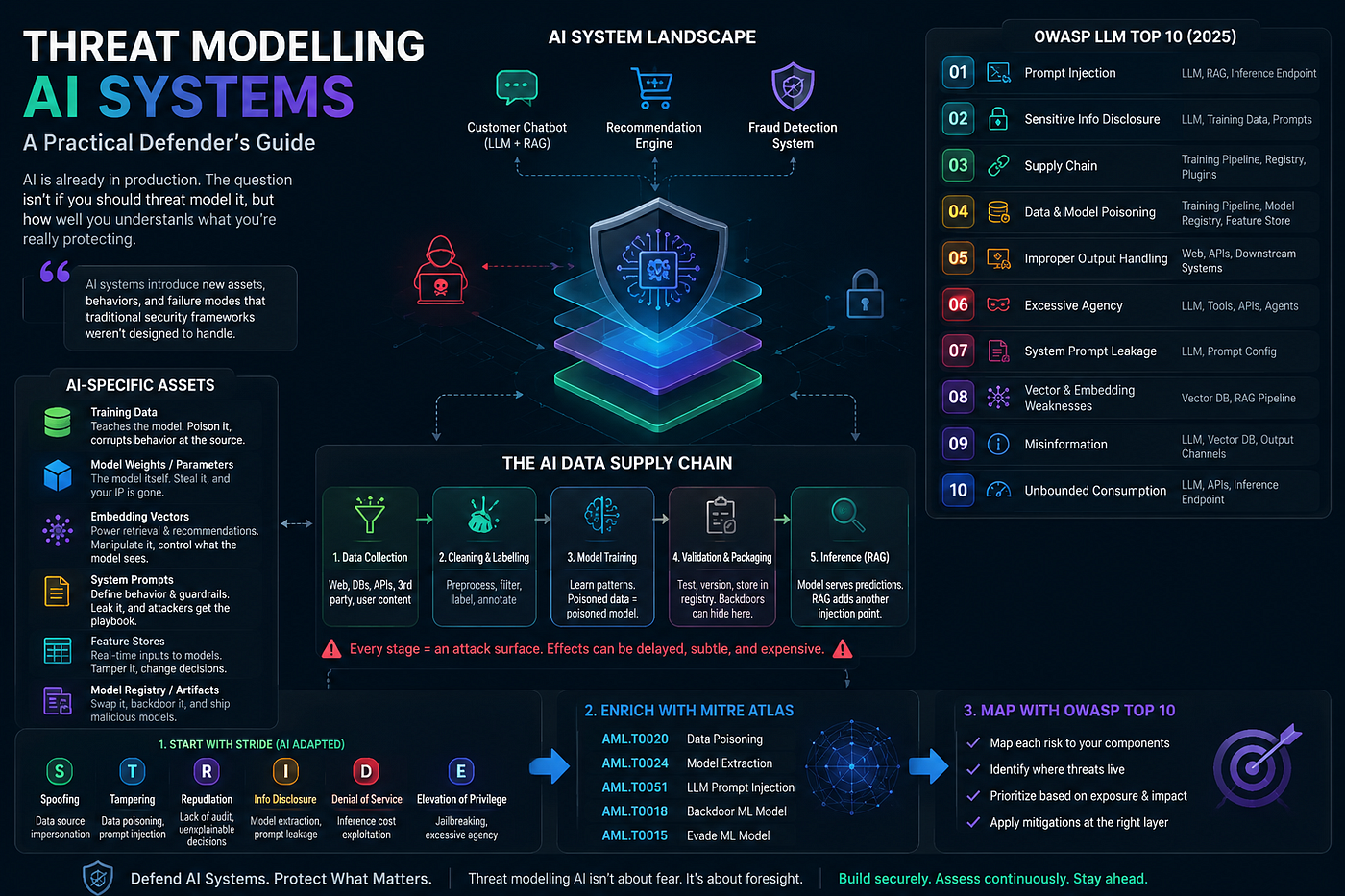
New AI Assets Attackers Care About
- Training Data corrupt the data, corrupt the model.
- Model Weights steal them, and you steal the organization’s AI capability.
- System Prompts leak them, and attackers learn the guardrails.
- Embedding Vectors manipulate retrieval systems and recommendation engines.
- Feature Stores alter what the model “sees” during inference.
- Model Registries swap legitimate models with backdoored ones.
These are not theoretical risks anymore.
In 2025, researchers demonstrated how prompt injection worms could spread between AI agents through RAG based systems, silently extracting data and propagating themselves without direct user interaction. That changed how many defenders viewed AI security entirely.
Why Traditional STRIDE Alone Is Not Enough
Frameworks like MITRE STRIDE still provide an excellent foundation:
- Spoofing
- Tampering
- Repudiation
- Information Disclosure
- Denial of Service
- Elevation of Privilege
But AI bends these categories in uncomfortable ways.
A poisoned training dataset is technically “tampering,” but unlike a modified database record, the damage may remain invisible until the model is retrained and deployed weeks later.
A jailbroken LLM is not just a content moderation issue. If that model has tool access, database queries, email capabilities, or code execution privileges, the attacker effectively inherits those permissions.
The perimeter is no longer the server. The perimeter is now the model’s behavior.
The Mega Corp Scenario Every Enterprise Should Recognize
Imagine a company deploying:
- A customer support chatbot connected to internal documentation
- A recommendation engine trained on customer behavior
- A real-time fraud detection system
Everything works perfectly during testing.
Then reality arrives.
An attacker injects malicious content into the chatbot’s knowledge base. The AI begins confidently serving false policy information to customers.
Meanwhile, the fraud model slowly stops detecting a specific fraud pattern because attackers manipulated training data over multiple months.
Nothing crashes. No alarms trigger. Dashboards remain green.
That is what makes AI security uniquely dangerous: compromise often looks like normal behavior.
MITRE ATLAS and OWASP Are Becoming Essential
This is where frameworks like OWASP OWASP LLM Top 10 and MITRE ATLAS become critical.
They help defenders move beyond generic security thinking into AI specific threats like:
- Prompt Injection
- Model Extraction
- Data Poisoning
- Excessive Agency
- Embedding Attacks
- Denial of Wallet
More importantly, they teach security teams where these risks actually live:
- Inference endpoints
- Vector databases
- RAG pipelines
- Training systems
- Tool integrations
That architectural awareness is what modern AI defense requires.
The Future of Security Is Behavior-Centric
AI systems are not simply software with smarter interfaces. They are probabilistic systems with evolving behaviors, opaque reasoning paths, and entirely new trust boundaries.
That sounds intimidating, but it is also an opportunity.
The organizations that treat AI security seriously today will build safer systems, earn more trust, and avoid learning painful lessons in production later.
Threat modelling for AI is not about fear. It is about understanding how intelligent systems fail before attackers teach you the hard way.
And right now, that might be the most important security skill to learn.
메타데이터
- post_id
- 7a4daa36e9bd
- slug
- ai-threat-modelling-is-no-longer-optional-its-the-new-security-perimeter-7a4daa36e9bd
- url
- https://medium.com/@himadrisingh061/ai-threat-modelling-is-no-longer-optional-its-the-new-security-perimeter-7a4daa36e9bd
- canonical_url
- https://medium.com/@himadrisingh061/ai-threat-modelling-is-no-longer-optional-its-the-new-security-perimeter-7a4daa36e9bd
- author_url
- https://medium.com/@himadrisingh061
- status
- ok
- fetched_at
- 2026-06-09 15:37:30