How AI is Hollowing Out the Collegiate Mind — and Who Can Save It
It started with an act of profound empathy.
How AI is Hollowing Out the Collegiate Mind — and Who Can Save It
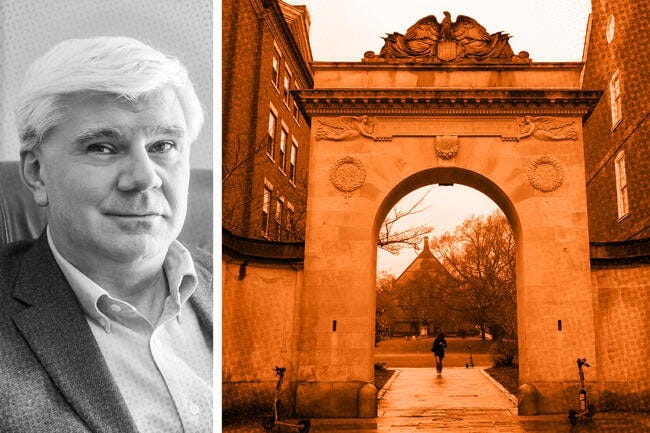
Image Credit: Roberto Serrano | Scott Eisen/Getty Images
It started with an act of profound empathy.
Following the trauma of a campus shooting during finals week last December, Brown University economics professor Roberto Serrano wanted to alleviate the mounting anxiety of his students. He announced that the midterm for his welfare economics and social choice theory course would be a take-home exam.
What happened next was a masterclass in the unintended consequences of the artificial intelligence era.
Almost immediately, enrollment in Serrano’s class swelled from its usual 30 students to 86. When the take-home midterms were graded, the results were staggering. The class average was an astronomical 96%. Historically, scores for this rigorous exam hovered between 65% and 80%. Suddenly, Serrano was looking at a roster of nearly 90 economic savants, all of whom possessed a masterful, seemingly effortless understanding of complex social choice theory.
Serrano suspected he wasn’t grading his students; he was grading ChatGPT.
Alerting his students to his suspicions, he made a drastic pivot. The final exam would be administered in person, with pen and paper, and it would count for 80% of their final grade. Stripped of their digital crutches and forced to rely entirely on their own neural pathways, the students collapsed. The average score on the final plummeted to a “historic low” of 48.6%.
When Serrano presented this glaring statistical anomaly to the university administration, demanding action, the response was, in his words, “meek.” The university claimed he hadn’t provided the “necessary details” to pursue disciplinary action. The cheating stood. The hollow victory remained.
Serrano’s classroom is not an anomaly; it is a microcosm of a silent epidemic ravaging higher education. In a recent survey, nearly 30% of Princeton students admitted to using AI to cheat on exams or assignments. A recent essay penned by a Stanford graduate grimly declared that AI outsourcing has simply become a “fact of life” on campus.
We are no longer just dealing with a crisis of academic integrity. We are facing an existential crisis of intellectual growth.
The Atrophy of the Mind
To understand the true risk AI poses to higher education, we have to look past the grades and look at the brain.
Mental learning and intellectual growth are not passive states of absorption; they are the byproducts of cognitive friction. When you sit with a complex economic theory or a brutal calculus problem, you experience frustration. You try an avenue of logic, realize it’s flawed, and back up. You wrestle with the material until the disparate puzzle pieces suddenly snap together.
That “snap” is learning. It is the literal forging of new neural pathways. It is how critical thinking is built.
Generative AI removes the friction. It provides the polished, perfectly formatted answer without the agonizing, messy process of arriving at it. When a student uses AI to write an essay or solve a take-home exam, they are not just cheating the professor, they are outsourcing their own cognitive struggle. They are treating the university as a credentialing factory rather than a gymnasium for the mind.
If we allow a generation of students to outsource their critical thinking to large language models, we will graduate a cohort of intellectually frail adults. They will possess Ivy League degrees but lack the mental stamina required to solve novel problems or evaluate complex ethical dilemmas.
Who — and What — Will Save Higher Education?
If universities respond to this crisis as “meekly” as Brown’s administration allegedly did, the value of a college degree will plummet. So, how do we save the collegiate mind?
It cannot be saved by technology. The current administrative instinct is to fight AI with AI, by deploying algorithmic “detectors” like Turnitin’s AI checker. But this is a losing arms race. AI models will always evolve faster than the detectors designed to catch them, and the false-positive rate of these tools has already falsely accused innocent students, creating a toxic atmosphere of paranoia.
Instead, higher education must be saved by a radical return to the analog, driven by courageous educators and institutions willing to prioritize rigor over comfort.
1. The Return to the Socratic and the Oral
We must completely rethink assessment. The era of the unproctored take-home essay and the remote midterm is over. To save intellectual growth, educators must return to the in-person, blue-book exam. But more importantly, we must revive the oral examination (the viva voce). If a student submits a brilliant thesis, they must be able to sit in a room with their professor and defend it verbally. You cannot fake real-time intellectual agility.
2. Process Over Product
Professors must shift their grading models to evaluate the process of learning, not just the final product. This means grading outlines, rough drafts, handwritten mind maps, and in-class problem-solving sessions. AI is excellent at generating a final product; it cannot replicate the messy, iterative human process of figuring something out.
3. Institutional Courage
The ultimate savior of higher education will have to be the institutions themselves. Currently, universities are highly incentivized to keep students (and their paying parents) happy. High grades, low stress, and smooth sailing look great on brochures. But universities must remember their core mandate: they are guardians of knowledge and truth. Administrators must stand behind professors like Roberto Serrano when they demand in-person accountability. They must accept that fighting AI-driven intellectual atrophy will result in lower grades and angrier students.
Professor Serrano’s 48.6% average on that final exam wasn’t just a failing grade for his students. It was a glaring, flashing warning light on the dashboard of higher education.
We can either look at that warning light, shrug, and let the machines do our thinking for us — or we can step back into the classroom, pick up a pen, and embrace the difficult, beautiful, frustrating friction of learning how to think again.
메타데이터
- post_id
- 7a4ec6c75c85
- slug
- how-ai-is-hollowing-out-the-collegiate-mind-and-who-can-save-it-7a4ec6c75c85
- url
- https://medium.com/the-infinite-within/how-ai-is-hollowing-out-the-collegiate-mind-and-who-can-save-it-7a4ec6c75c85
- canonical_url
- https://medium.com/the-infinite-within/how-ai-is-hollowing-out-the-collegiate-mind-and-who-can-save-it-7a4ec6c75c85
- author_url
- https://medium.com/@tosinadeoti
- status
- ok
- fetched_at
- 2026-07-14 12:48:22






