Nature’s Oddities: The Hummingbird Moth
Look at that picture. Weird right? Is it a fat bee? A butterfly? A small hummingbird? None of those. It’s a hummingbird moth. Something I…
Nature’s Oddities: The Hummingbird Moth
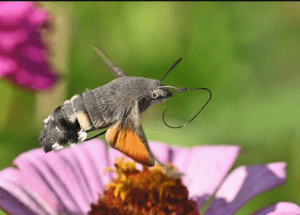
Look at that picture. Weird right? Is it a fat bee? A butterfly? A small hummingbird? None of those. It’s a hummingbird moth. Something I never knew about until a friend said she just saw one in her garden.
According to the University of Wisconsin-Madison:
Hummingbird moths visit flowers during the day (unlike most moths), hovering over the plants to feed on nectar with a long proboscis. They typically stay at each flower only briefly, before darting off to a new flower. The proboscis coils up like a party noisemaker when not in use.
Why the name hummingbird moth?
So what’s in a name? In this case, the name says a lot. A page I found on the U. S. Forest Service website tells us:
They fly and move just like hummingbirds. Like them, they can remain suspended in the air in front of a flower while they unfurl their long tongues and insert them in flowers to sip their nectar. They even emit an audible hum like hummingbirds.
Pretty cool huh? Unlike my friend, I’m sure I would have assumed baby hummingbird or some scary misshapen bumble bee. In North America there are four species of hummingbird moths. With the most commonly seen ones being the two varieties of clearwings, the Snowberry Clearwing and the Hummingbird Clearwing.
And as their name tells us, they are members of the same family (order) as any moth, Lepidoptera. As are butterflies and a smaller type of butterfly called Skippers.

But while Skippers are in the same order, they are not hummingbird moths. Nor half as weird-looking, IMHO. Just a little extra info bit I threw in. Detoured finds often pop up while looking for subject matter information.
And a hummingbird moth is born
Also according to the Forest Service:
The females entice the males with an aroma or pheromone that they produce … After mating, they lay their tiny, round, green eggs on their larval food plants, usually on the underside of the leaves. The caterpillars … are commonly green, well camouflaged among the leaves. When they are fully-grown they drop to the ground, spin a loose cocoon and pupate, partially protected by leaf litter.
Some gardeners hate that litter, the website tells us. But it’s a necessary part of creating a safe resting place until the adults finally emerge in the spring. And their emergence plays an essential role in nature.
Not only are they really interesting to look at, but they are especially important pollinators because many of them are not limited to daytime only. Better Homes & Gardens explains:
Their ability to visit flowers throughout the day and night allows for the pollination of a wide range of plants, ensuring fruit production and continued biodiversity.
Pretty impressive, beyond the just plain cool factor. And a special thanks to my friend for getting me started on this insect world exploration!
메타데이터
- post_id
- 7a4ec75933d8
- slug
- natures-oddities-the-hummingbird-moth-7a4ec75933d8
- url
- https://medium.com/@ronnieann2007/natures-oddities-the-hummingbird-moth-7a4ec75933d8
- canonical_url
- https://medium.com/@ronnieann2007/natures-oddities-the-hummingbird-moth-7a4ec75933d8
- author_url
- https://medium.com/@ronnieann2007
- status
- ok
- fetched_at
- 2026-06-26 06:47:43