Can AI Recreate the Joy of a Design Thinking Workshop for Solo Founders?
The joy of design thinking may not come from being in the same room but from moving through uncertainty with structure, creativity and real…
Can AI Recreate the Joy of a Design Thinking Workshop for Solo Founders?
The joy of design thinking may not come from being in the same room but from moving through uncertainty with structure, creativity and real user feedback.
Photo by UX Indonesia on Unsplash
TL;DR: Yes, but the experience is not exactly the same way. The joy of a design thinking workshop does not come from being in the room with a diverse group of people. It comes from a mix of structure, shared discovery, creative tension, rapid iteration and seeing real users interact with something you have made as a team. A solo founder can recreate some of this with help from AI, remote tools and disciplined customer testing, but the human part still matters.
I personally enjoy collaborative problem-solving workshops.
There is something energising about walking into a room with a messy problem and leaving with a clearer direction. As a facilitator, I enjoy creating the conditions for teams to think differently: sticky notes on walls, quiet sketching, time-boxed decisions, animated but useful discussions, and the occasional “ah-ha” moment when a team suddenly sees the problem from a new angle.
But recently I started asking myself a different question.
What exactly creates that joy?
Is it the opportunity to collaborate and exchange ideas with a team? Is it the silence that comes from focused individual work and achieving a state of flow? Is it the time pressure? Is it the moment when scattered observations turn into a pattern? Is it the act of building a prototype? Or is it the emotional high and sometimes disappointment of watching a real user respond to the thing you have created?
This question is important since more people are working alone with AI, remotely, or in small teams to create things. Solo founders often do not have workshop space, a cross-functional team, or a facilitator to help them through the process. However, they continue to deal with the same uncertainty:
- Is this a real problem and who has it?
- What are my assumptions?
- What should I build first?
Design thinking and design sprints were developed to reduce this uncertainty through a structured, human-centred process. But the classic version assumes collaboration. So the question becomes: can a solo founder experience the same emotional journey alone, especially with AI as a thinking partner?
Photo by Hana Fleur on Unsplash
The emotional journey of a design thinking workshop
Research by Benedikt Ewald and colleagues (2019) on emotions during design thinking workshops offers a clue. Their work suggests that emotions for participants changes across the process.
Photo by Adomas Aleno on Unsplash
Participants tend to feel positive emotions during the early “understand” or empathy phase, when they are learning about the problem and discovering new perspectives. That makes sense. Understanding a real human need is energising. It gives the work meaning.
But emotions can become more negative during synthesis and definition. This phase is the part where teams cluster observations, debate what matters, turn raw notes into themes, and decide which problem to focus on. It can feel messy. People disagree; good ideas get parked. Some voices dominate, while others feel judged.
Then, after the team moves into ideation, prototyping, and testing, positive emotions return. The process progresses as follows: the problem becomes tangible, ideas are transformed into sketches, sketches evolve into prototypes, and prototypes generate feedback. Even negative feedback can feel useful because it replaces uncertainty with evidence.
That emotional journey is compelling because it shows that joy in design thinking does not come from constant positivity but, instead, comes from continuing to move forward.
Why synthesis ‘eg. Affinity mapping’ feels hard
For me, one of the most revealing parts of the research is the emotional dip during synthesis.
This is also the phase where I have felt, many times during workshops I lose energy. At the start, everyone is excited. There are lots of observations, quotes, ideas, and sticky notes. But then someone has to make sense of them.
- Which notes belong together?
- Which ‘How might we’ question should we choose?
- Which insight is important?
This is where collaboration can become emotionally difficult. Synthesis requires judgement. And judgement creates tension.
In a team, that tension can be useful when facilitated well. Different perspectives challenge weak assumptions. People spot blind spots. A technical person may question feasibility. A commercial person may ask who will pay. A designer may bring the conversation back to the user.
But for a solo founder, synthesis can become lonely. There is no room full of people to challenge the pattern you think you are seeing. There is also no one to stop you from falling in love with your first idea.
This is one place where AI can genuinely help.
Tolls like Miro AI can now cluster sticky notes, summarise themes, group ideas by sentiment, and help turn messy workshop output into more structured insights. Used well, AI can reduce the emotional drag of synthesis. It can help a solo founder move from raw research to clearer opportunity areas faster.
However there is a distinction, AI is useful when it helps you think but it is dangerous when it helps you avoid thinking.

Design thinking with AI
Can AI replace the workshop room for solo founders?
Not fully.
The joy of an in-person design thinking workshop comes partly from social energy and partly from focused flow state. AI cannot recreate that human chemistry but it can recreate some of the workshop’s emotional functions.
It can create momentum by giving the founder a next step.
It can create surprise by offering alternatives the founder had not considered.
It can create challenge by questioning assumptions.
It can create structure by enforcing a process.
It can create confidence by helping turn vague thoughts into something visible.
Introducing EcoMatter.ai
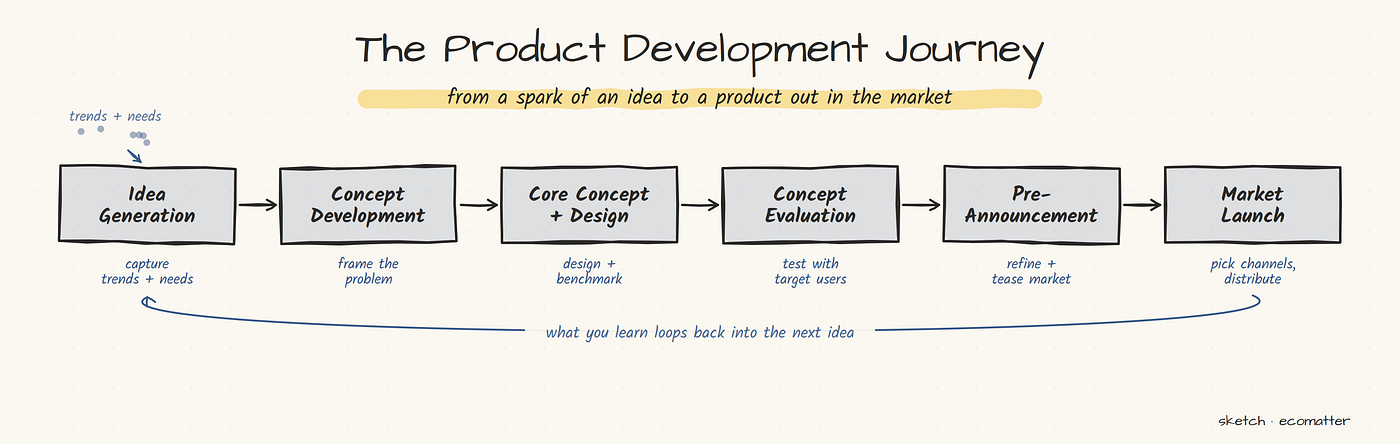
At EcoMatter.ai, we are building an AI-powered product development platform for founders who want to move from idea to validated product direction faster.
The goal is simple: Help solo founders and small businesses develop, test, and refine new product ideas in days instead of months.
EcoMatter.ai guides founders through a structured process inspired by proven product development and Design Sprint methods.
The aim is not to remove the founder from the process. The aim is to give the founder a better process. Instead of staring at a blank page, the founder can work through structured process, AI-supported research, ideation, prototyping, and validation planning while ensuring what they build is sustainable for people and planet.
That is what we are building with EcoMatter.ai because we believe the world need more founders who do good for planet and society.
If you are a solo founder, maker, or small business owner working on a new product idea, join the EcoMatter.ai waiting list and be part of the early community.
Email: awais.munawar@ecomatter.ai\
Robert McKim (father of design thinking) wrote that the ultimate purpose of design is to promote the wellbeing of living creatures, humans in particular, and to gratify their basic needs.
That may be why the process feels joyful.
Not because every stage is easy.
But because, at its best, design thinking lets us turn uncertainty into care, and care into something real.
메타데이터
- post_id
- 7a519b26d2ec
- slug
- can-ai-recreate-the-joy-of-a-design-thinking-workshop-for-solo-founders-7a519b26d2ec
- url
- https://medium.com/@awais.munawar/can-ai-recreate-the-joy-of-a-design-thinking-workshop-for-solo-founders-7a519b26d2ec
- canonical_url
- https://medium.com/@awais.munawar/can-ai-recreate-the-joy-of-a-design-thinking-workshop-for-solo-founders-7a519b26d2ec
- author_url
- https://medium.com/@awais.munawar
- status
- ok
- fetched_at
- 2026-06-16 19:09:56