Why Do We Need AI Design in Dentistry When We Already Have CAD/CAM Systems?
In recent years, digital technology has revolutionized dentistry, with CAD/CAM (Computer-Aided Design/Computer-Aided Manufacturing) systems…
Why Do We Need AI Design in Dentistry When We Already Have CAD/CAM Systems?
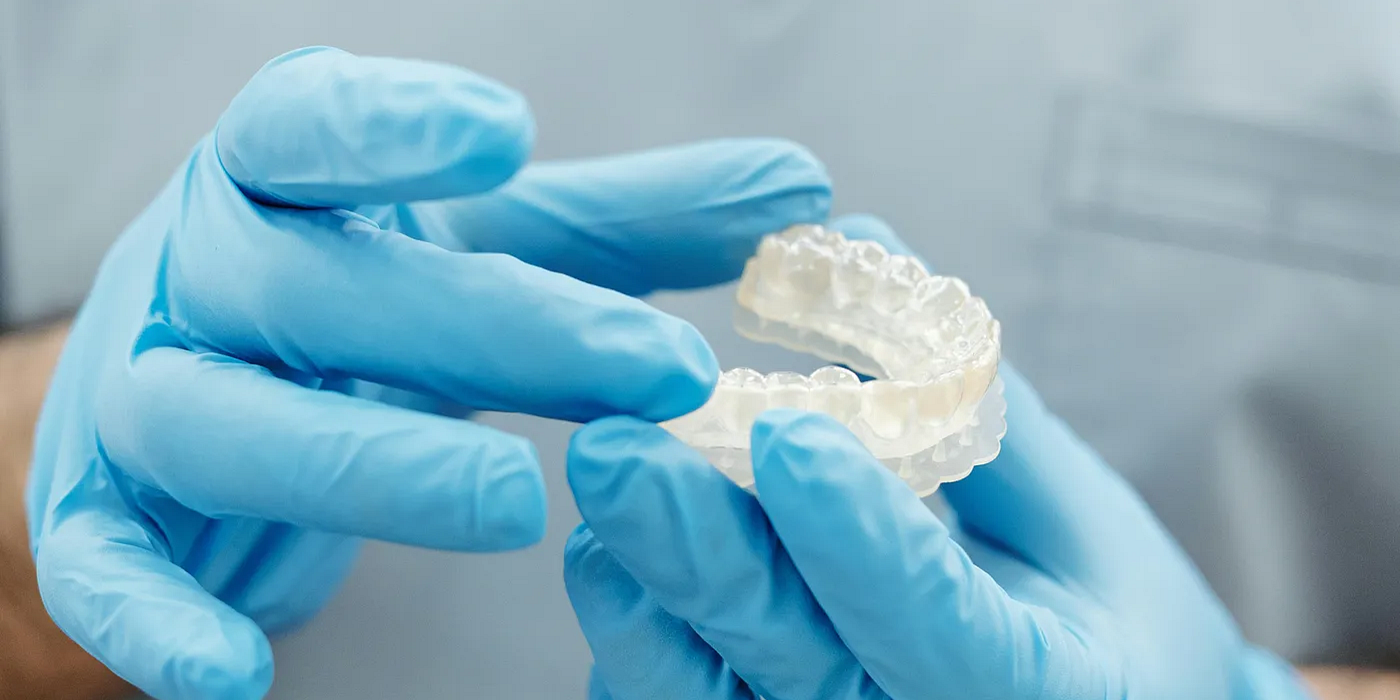
In recent years, digital technology has revolutionized dentistry, with CAD/CAM (Computer-Aided Design/Computer-Aided Manufacturing) systems leading the way in the design and fabrication of dental restorations. These systems have greatly improved precision, efficiency, and patient experience by allowing dental professionals to create accurate and consistent restorations.
However, as artificial intelligence (AI) continues to advance, the question arises: why is AI design necessary when CAD/CAM systems are already effective? This essay explores how AI enhances CAD/CAM technology, offering even more personalized, accurate, and efficient dental solutions.
CAD/CAM Systems in Dentistry
CAD/CAM systems, originally developed for industrial manufacturing in the 1960s, have become integral to modern dentistry since their adaptation in the mid-1980s. Initially used for precise industrial manufacturing, these technologies were later adapted for dentistry.
Compared to the traditional process of creating something from nothing, CAD provides an initial model that makes crown production faster, allowing adjustments with just a few clicks of the mouse. This significantly reduces the time needed for adjustment and processing, thereby enhancing the efficiency of dental restoration fabrication.
Additionally, CAD can digitize the expertise of master technicians, allowing precise adjustments such as the path of insertion and material minimal thickness through simple input values. This significantly reduces human error, ensuring that ideal angles and thicknesses are achieved with greater accuracy.
The Emergence of AI Design in Dentistry
AI is no stranger to the current generation. Originating from mid-20th-century computer science with the goal of mimicking human learning, AI has continuously proven its ability to drive rapid advancements, as seen in applications like ChatGPT, which seamlessly assists human tasks. Consequently, people have started integrating AI into various fields.
It also happens to dentistry. AI, to be more specific, Generative Adversarial Network (GAN) has shown its power in successfully generating crowns. You might be wondering, what exactly GAN is, and how it seemingly creates a crown out of thin air. In fact, by extensive datasets from CAD systems, GAN is able to offer more customized designs, either in simple cases or in complex situations where manual design may be less efficient.
The extensive adoption of intraoral scanners has catalyzed the emergence of AI-driven design. A study in the International Dental Journal found that 78.8% of participants reported daily use of IOS, meaning digital workflows have become standard infrastructure. This not only provides AI design with more clinically relevant training data but also encourages a trend toward greater automation of entire workflows. The ability of AI to reduce learning curves and enhance consistency will accelerate the transition in this generation compared to the previous one.
By analyzing large amounts of data from databases, we already see the potential of AI to quickly estimate the optimal shape of a crown and handle multiple tasks simultaneously, taking efficiency to another level.
Comparing CAD and AI-Design
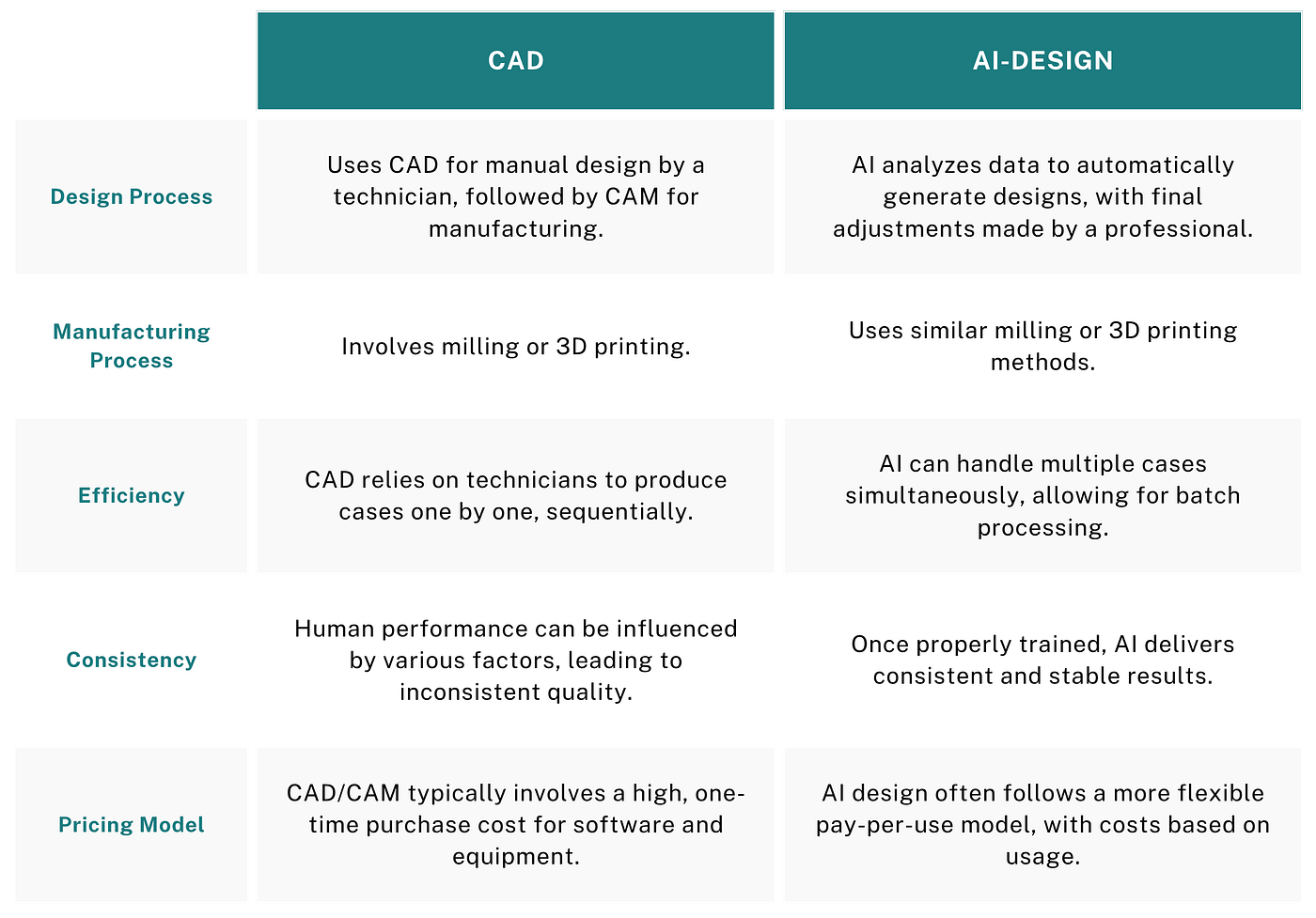
A comparison of CAD and AI-design reveals that while CAD excels in precision and reliability, AI offers significant advantages in terms of speed, personalization, and data-driven accuracy.
We’ve prepared a clear and concise comparison chart for you, highlighting the differences between CAD and AI design.
Conclusion
As AI continues to mature, it holds the potential to revolutionize the field of dentistry, gradually augmenting traditional CAD/CAM systems. While CAD/CAM has been a cornerstone of digital dentistry, offering precision and efficiency, AI brings a new dimension of adaptability and consistency. With its ability to learn from vast amounts of data, AI can generate highly customized dental solutions, streamline workflows, and handle multiple cases simultaneously.
As times change, the field of dentistry continually embraces new technologies, all aimed at providing better collaboration and higher-quality care for patients, dentists, and technicians alike. As AI technologies evolve, they may eventually surpass CAD/CAM systems, becoming the new standard in dental care, where efficiency, personalization, and innovation drive the future of dentistry.
메타데이터
- post_id
- 7a6200468684
- slug
- why-do-we-need-ai-design-in-dentistry-when-we-already-have-cad-cam-systems-7a6200468684
- url
- https://medium.com/dentscape-ai/why-do-we-need-ai-design-in-dentistry-when-we-already-have-cad-cam-systems-7a6200468684
- canonical_url
- https://medium.com/dentscape-ai/why-do-we-need-ai-design-in-dentistry-when-we-already-have-cad-cam-systems-7a6200468684
- author_url
- https://medium.com/@dentscape
- status
- ok
- fetched_at
- 2026-06-20 20:29:01