“God Does Not Play Dice” — What Einstein Actually Meant
Einstein accepted the mathematics, but not the story.
“God Does Not Play Dice” — What Einstein Actually Meant
Einstein accepted the mathematics, but not the story.
Albert Einstein’s most famous quote about quantum mechanics is also one of the most misunderstood.
“God does not play dice with the universe.”
It is often presented as the complaint of an old physicist who simply could not accept the strangeness of quantum mechanics. According to the popular story, Einstein disliked randomness, failed to grasp the new physics, and was eventually proven wrong by experiments.
The truth is far more interesting, and far more relevant today.
Einstein did not reject quantum mechanics. He rejected a specific interpretation of it.
And his objection was not about probability. It was about locality, physical reality, and what a theory should explain.
Photo by Ruben Sukatendel on Unsplash
Einstein accepted the mathematics — but not the story
Einstein fully accepted:
- The Schrödinger equation
- The predictive success of quantum mechanics
- The statistical accuracy of the wave function
What he rejected was the claim that the wave function is a complete description of reality.
In the Copenhagen interpretation, the wave function is not just a calculation tool. It is treated as the final word on what exists. Measurement outcomes are fundamentally random, and physical properties do not exist until they are observed.
Einstein found this deeply unsatisfactory.
Not because it was weird, but because it removed physics from spacetime.
The real problem: Nonlocality
Einstein’s central concern was locality.
In relativity, locality means something very precise:
Physical influences cannot propagate faster than light.
Standard quantum mechanics, when taken literally, seems to violate this. When two particles are entangled, a measurement on one appears to instantaneously affect the other, no matter how far apart they are.
Einstein famously called this “spooky action at a distance.”
He did not believe nature actually worked that way.
To him, this was a sign that quantum mechanics was incomplete, not incorrect.
“God does not play dice” — properly understood
When Einstein said that God does not play dice, he was not denying uncertainty as a practical matter.
He was saying this:
Nature itself follows lawful, local principles, even if our current theory describes them only statistically.
Randomness, for Einstein, reflected incomplete knowledge, not fundamental chaos.
He believed there must be deeper physical structure beneath the wave function, something real, local, and dynamical.
Photo by Riho Kroll on Unsplash
A vacuum with structure, not a void
Modern physics often treats the vacuum as either:
- Empty geometry (general relativity), or
- A sea of abstract fluctuations (quantum field theory)
But what if the vacuum itself has physical structure?
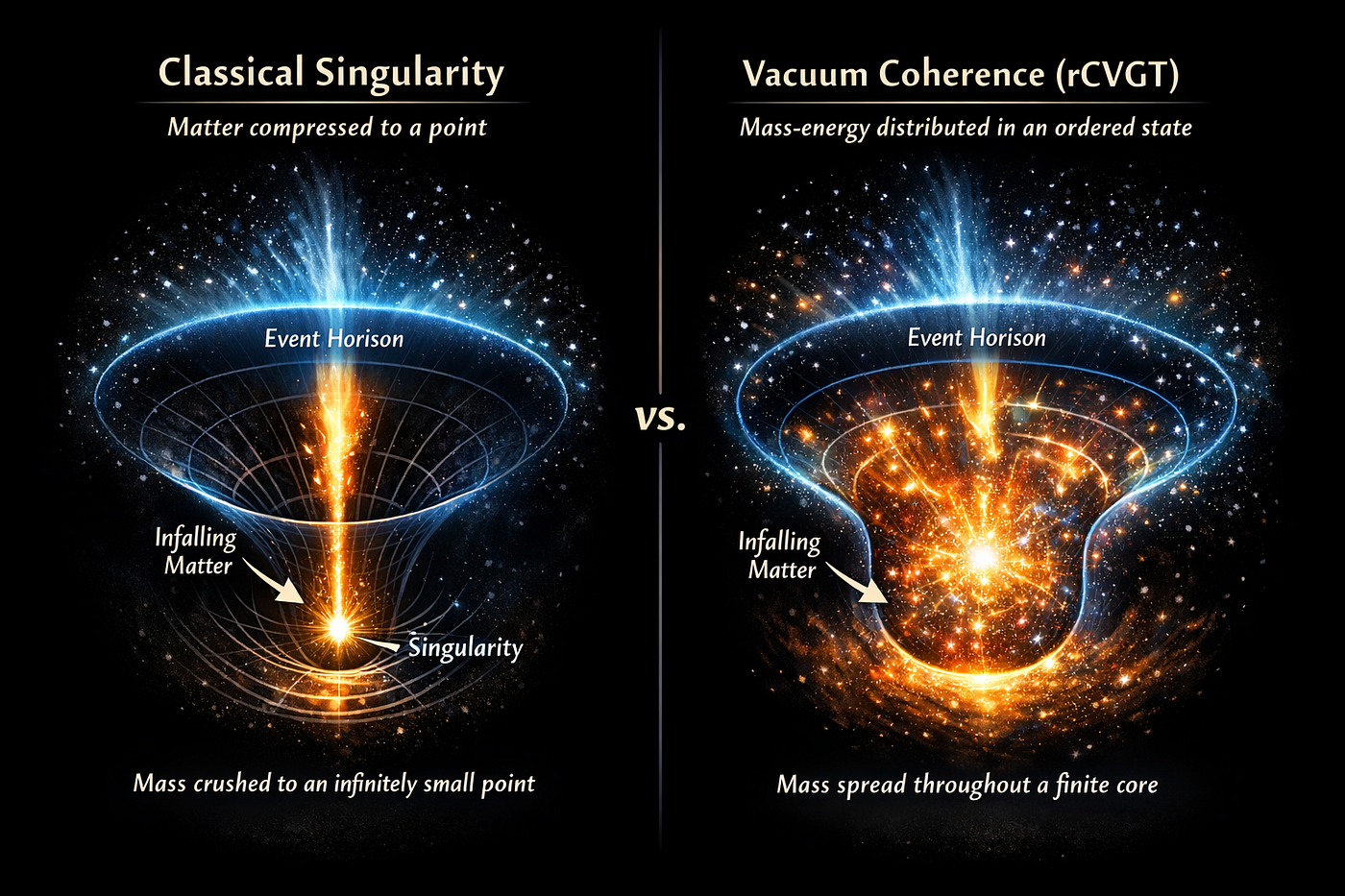
If the vacuum can store coherence, correlations, and time structure, as described in rCVGT, then many quantum “mysteries” change character:
- Entanglement becomes shared vacuum coherence
- Collapse becomes physical decoherence of that structure
- Correlations appear instant without transmitting signals
Nothing needs to travel faster than light. Locality is preserved. Relativity remains intact.
This kind of picture is remarkably close to what Einstein was hoping for, even if he never had the tools to formulate it explicitly.
Was Einstein wrong?
Experiments violating Bell inequalities are often presented as proof that Einstein lost the debate.
But Bell’s theorem does not say:
“Nature is nonlocal.”
It says:
“Certain combinations of assumptions cannot all be true at once.”
One of those assumptions is that the vacuum is physically trivial.
If correlations are stored in an extended physical medium, as the vacuum itself, then Bell violations do not require superluminal influence or conspiratorial determinism.
Einstein’s core intuition survives:
- No faster-than-light signals
- No instantaneous physical influence
- No need to abandon spacetime causality
What Einstein was really asking for
Einstein was not asking for classical physics to return.
He was asking for acomplete theory grounded in physical spacetime, with local dynamics and clear ontological meaning.
In modern language, we might say:
The wave function should emerge from deeper physics, not replace it.
That is not reactionary. It is profoundly forward-looking.
Dice, order, and unfinished physics
“God does not play dice” was never about theology.
It was about intellectual honesty.
Einstein believed that when a theory explains what we observe but not what exists, it is unfinished. Quantum mechanics, for all its success, still leaves unanswered questions about reality, locality, and time.
Nearly a century later, those questions remain open.
And that means Einstein’s objection was not the end of a debate, it was an invitation to continue it.
메타데이터
- post_id
- 7a70902e4ac9
- slug
- god-does-not-play-dice-what-einstein-actually-meant-7a70902e4ac9
- url
- https://medium.com/the-idea-of-reality/god-does-not-play-dice-what-einstein-actually-meant-7a70902e4ac9
- canonical_url
- https://medium.com/the-idea-of-reality/god-does-not-play-dice-what-einstein-actually-meant-7a70902e4ac9
- author_url
- https://medium.com/@steen_m_n
- status
- ok
- fetched_at
- 2026-07-11 19:40:18