Denominator Fallacy: Seeing Beyond the Surface of Data
Why counts without context distort comparison and reasoning
Denominator Fallacy: Seeing Beyond the Surface of Data
Why counts without context distort comparison and reasoning
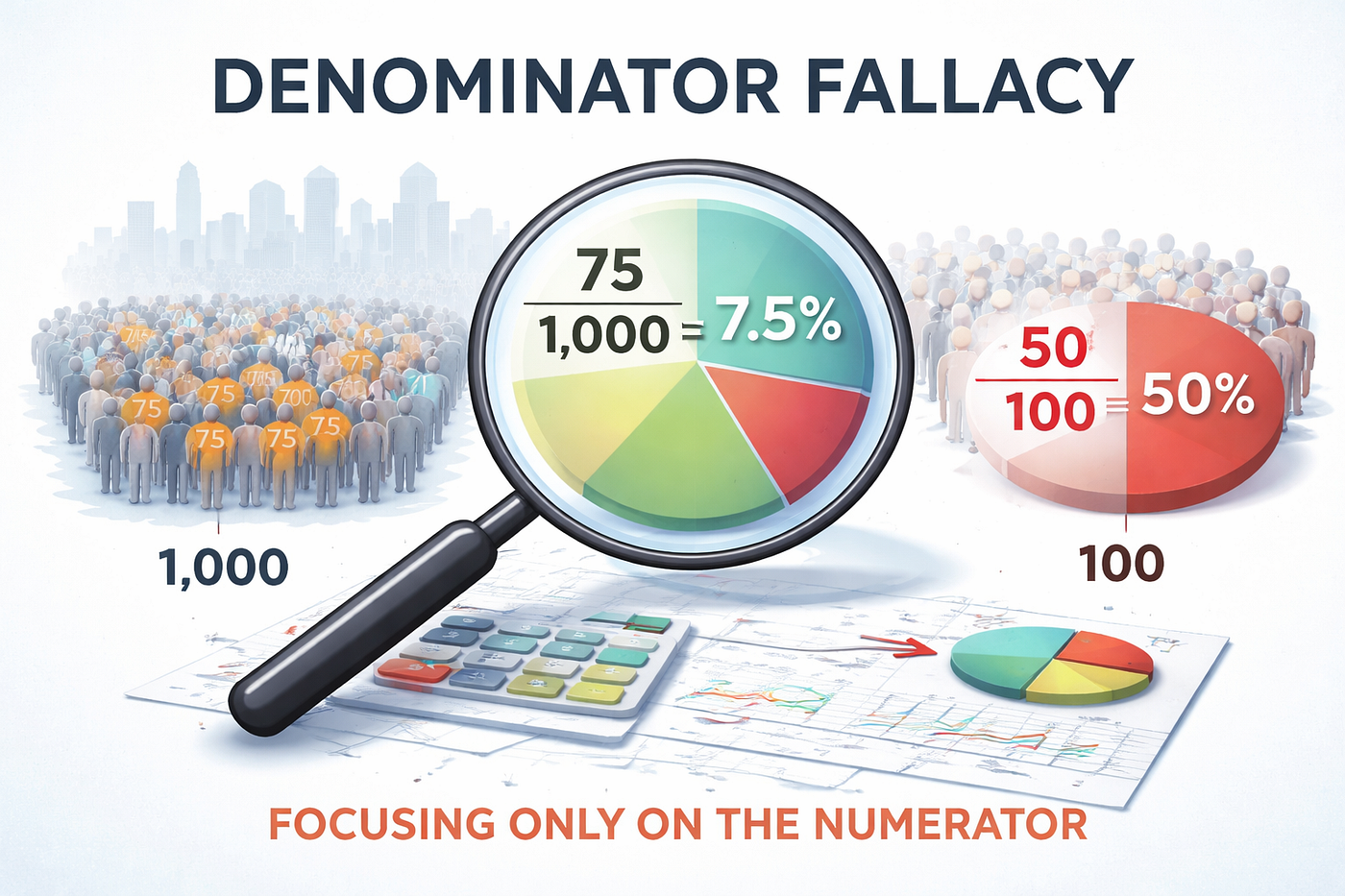
Image created using ChatGPT
Numbers carry an aura of authority. They appear precise, objective, and immune to bias. Yet numbers can mislead when they are presented without context. One of the most subtle and pervasive ways this happens is through the denominator fallacy. This fallacy occurs when attention is given to absolute numbers while ignoring the total population or base from which those numbers arise. In doing so, it distorts understanding and leads to flawed conclusions.
Understanding the Structure of a Ratio
At its core, the denominator fallacy is a misunderstanding of ratios. Any meaningful comparison between quantities often requires two components. The numerator represents the count of interest. The denominator represents the total number of possible cases or the size of the group being considered.
A number without its denominator is incomplete. It tells us what happened, but not how often it happens relative to opportunity or scale. Without that context, comparisons become misleading.
For instance, knowing that one city has more recorded crimes than another tells us very little unless we also know the population sizes. The denominator transforms raw counts into rates, and rates are what allow meaningful comparison.
Why the Fallacy Persists
The denominator fallacy persists because human cognition is naturally drawn to concrete numbers rather than abstract proportions. Absolute values feel more tangible. A large number evokes a stronger emotional response than a small one, even if the larger number comes from a much larger population.
There is also a cognitive shortcut at work. Evaluating proportions requires an extra step of reasoning. It demands division, comparison, and sometimes statistical literacy. In contrast, raw numbers are immediate and easy to grasp. This preference for simplicity often leads people to overlook the denominator entirely.
Media and communication practices further amplify the problem. Headlines and summaries often highlight striking figures without providing the necessary context. As a result, audiences form impressions based on incomplete information.
Illustrative Examples
Consider a hospital that reports a higher number of patient deaths than another hospital. Without context, it may seem less effective. However, if the first hospital treats a significantly larger number of critically ill patients, its death rate may actually be lower. The denominator, which in this case is the total number of patients treated, changes the interpretation entirely.
In education, a school that produces a higher number of top-performing students may appear superior. Yet if that school has a much larger student body, its proportion of high achievers may be lower than that of a smaller institution.
Even in business, companies often highlight total sales figures. A company with higher sales may seem more successful, but if its customer base is vastly larger, its efficiency or conversion rate may be weaker than that of a smaller competitor.
Consequences of Misinterpretation
The denominator fallacy is not merely an academic concern. It has real consequences. In public policy, it can lead to misallocation of resources when decisions are based on absolute counts rather than rates. In healthcare, it can distort perceptions of risk and effectiveness, influencing both policy and patient choices.
In everyday life, it affects how people interpret information about safety, performance, and success. Decisions based on incomplete comparisons can lead to poor judgments, whether one is choosing a product, evaluating a service, or forming opinions about social issues.
The Discipline of Contextual Thinking
Avoiding the denominator fallacy requires a deliberate shift in thinking. It begins with a simple question that should accompany any numerical claim: out of how many?
This question forces attention toward the denominator and encourages a move from counts to rates. It also promotes a habit of seeking comparable measures. Two quantities can only be meaningfully compared if they are normalised against similar bases.
Statistical literacy plays an important role here. Understanding concepts such as proportions, percentages, and rates equips individuals to interpret information more accurately. However, the greater skill is not mathematical but conceptual. It is the ability to recognise when context is missing and to seek it actively.
In conclusion, the denominator fallacy reveals a fundamental truth about numbers. They do not speak for themselves. Their meaning depends on context, and without that context, they can mislead as easily as they inform.
In a world increasingly driven by data, the ability to interpret numbers critically is essential. Recognising the role of the denominator is a small but powerful step toward clearer thinking. It transforms raw figures into meaningful insights and guards against conclusions that are persuasive but ultimately flawed.
To understand a number fully is to see not only what it counts, but also what it stands in relation to. Only then does it begin to tell the truth.
As always, feel free to reach out with any questions or comments. Happy musing!
Originally published at https://avinashi.substack.com.
메타데이터
- post_id
- 7a9bf32461c0
- slug
- denominator-fallacy-seeing-beyond-the-surface-of-data-7a9bf32461c0
- url
- https://medium.com/@bharath_keshav/denominator-fallacy-seeing-beyond-the-surface-of-data-7a9bf32461c0
- canonical_url
- https://medium.com/@bharath_keshav/denominator-fallacy-seeing-beyond-the-surface-of-data-7a9bf32461c0
- author_url
- https://medium.com/@bharath_keshav
- status
- ok
- fetched_at
- 2026-07-11 12:15:36