Reshaping Human Lineage: Your Grandchildren Might Be Designed in a Lab
The quiet revolution in human reproduction is already here — and it’s reshaping everything from family planning to the meaning of…
Reshaping Human Lineage: Your Grandchildren Might Be Designed in a Lab
The quiet revolution in human reproduction is already here — and it’s reshaping everything from family planning to the meaning of parenthood itself.
[embed]
In July 2024, Pavel Durov — the billionaire founder of Telegram — casually announced on his platform that he has fathered over 100 children.
Not through traditional means. Through sperm donation across 12 countries.
He plans to “open-source” his DNA so his biological children can find each other. He’s offered to fund IVF treatments for women under 37 who want to use his stored genetic material. All 100+ children will be included equally in his $15 billion estate.
This isn’t science fiction. This is a press release.
And Durov isn’t alone. A growing cohort of billionaires, technologists, and “pronatalist” advocates are treating human reproduction less like a biological process and more like a scalable engineering problem. They’re using technologies that are already available — embryo screening, commercial surrogacy, genetic testing — and pushing them to their logical extremes.
The question isn’t whether these technologies will change how humans reproduce. They already are. The question is whether you understand what’s coming — and whether you’re preparing your family for it.
The $200 Billion Industry You’ve Never Heard Of
Let’s start with a number that should get your attention: $201 billion.
That’s the projected size of the global surrogacy market by 2034. Today, it’s around $25 billion. That’s 8x growth in a decade — a 25% annual growth rate that rivals the hottest tech sectors.
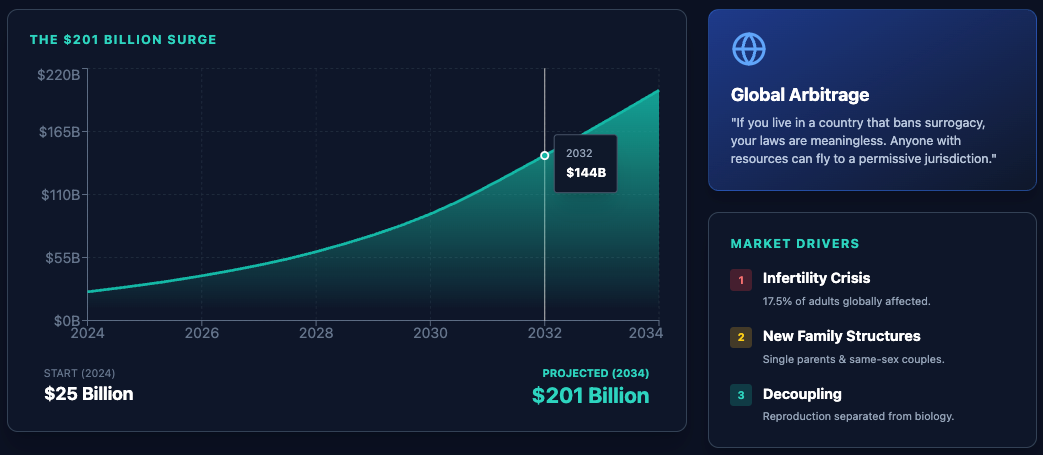
- 2024: $25 billion
- 2028: $60 billion
- 2034: $201 billion Use teal gradient coloring. Add a callout bubble: “8x Growth in 10 Years” and “25% Annual Growth Rate.” The visual should convey exponential acceleration.
Why the explosion?
Three converging forces:
1. Infertility is rising. The World Health Organization reports that 17.5% of adults globally now experience infertility. Delayed childbearing, environmental factors, and lifestyle changes have created a generation struggling to conceive naturally.
2. Family structures are diversifying. Same-sex couples, single parents by choice, and older parents are all growing demographics who often need assisted reproduction.
3. The technology works. IVF success rates have improved dramatically. Surrogacy legal frameworks have stabilized in key jurisdictions. The infrastructure exists.
But here’s what most people miss: surrogacy isn’t just about helping people have babies. It’s about decoupling reproduction from the biological constraints of the human body.
In the old world, a woman could carry one pregnancy per year. In the new world, with sufficient capital, you can have as many children as you can afford — simultaneously, across multiple surrogates, in multiple countries.
Durov’s 100+ children aren’t an anomaly. They’re a proof of concept.
The Tiered Global Market (And Why It Matters for You)
The surrogacy market has stratified into three tiers — and understanding them reveals how reproductive technology creates winners and losers.

Tier 1: The United States ($150,000–$250,000)
California is the “gold standard.” Pre-birth parentage orders mean your name goes on the birth certificate before the baby is born. The child gets U.S. citizenship. Medical care is world-class. Legal certainty is near-absolute.
The catch? It costs as much as a house.
Tier 2: Emerging Hubs ($40,000–$80,000)
Countries like Georgia (the country, not the state), Colombia, and parts of Mexico offer lower costs with reasonable legal frameworks. The trade-off is less certainty — laws can change, courts are less predictable, and infrastructure varies.
Tier 3: Grey Markets (Variable)
Unregulated jurisdictions where surrogacy happens in legal vacuums. Cambodia, Thailand (pre-2015), and others have served this market. Costs are lowest, but risks are highest — including sudden crackdowns that can leave intended parents stranded.

The insight here is crucial: If you live in a country that bans surrogacy (France, Germany, Italy, most of Europe), your domestic laws are essentially meaningless. Anyone with sufficient resources can simply fly to a permissive jurisdiction.
This is called regulatory arbitrage — and it means the future of reproduction will be determined not by the most restrictive ethical consensus, but by the most permissive jurisdiction available.
National bioethics laws are becoming obsolete for anyone who can afford a plane ticket.
The $100 Million Genome Is Now a $200 Genome
Here’s the technology curve that changes everything.
In 2001, sequencing a single human genome cost $100 million and took 13 years (the Human Genome Project).
By 2007, it was $1 million.
By 2014, it was $1,000.
Today? Under $200. Some companies are pushing toward $100.

This isn’t just Moore’s Law (the principle that computing power doubles every 18 months). Genomics has outpaced Moore’s Law by orders of magnitude. It’s one of the most dramatic cost collapses in technological history.
Why does this matter for reproduction?
Because cheap sequencing enables something called Preimplantation Genetic Testing for Polygenic Traits (PGT-P) — and it’s already being used by prospective parents today.
Here’s how it works:

- A couple does IVF and creates, say, 10 embryos.
- Each embryo is biopsied and sequenced.
- A computer calculates “Polygenic Risk Scores” for each embryo — predicting the likelihood of various diseases, but also traits like height and educational attainment.
- The parents choose which embryo to implant.
This isn’t hypothetical. Companies like Genomic Prediction are offering this service right now. The Collins couple — prominent pronatalist advocates with children named “Titan Invictus” and “Industry Americus” — have publicly discussed using PGT-P for their third, fourth, and fifth children.
The uncomfortable truth: When you screen against low educational attainment, you’re screening for higher intelligence. The line between “avoiding disease” and “selecting for enhancement” is rhetorical, not technical.

Current estimates suggest selecting the “best” embryo from 10 could yield about 3 IQ points of expected advantage. That sounds modest — until you realize that a 3-point population shift significantly changes the proportion of individuals at the extremes of the distribution.
And 3 points is just the beginning.
Two Fathers, One Baby: The Breakthrough That Changes Everything
In March 2023, a Japanese scientist named Katsuhiko Hayashi published a paper in Nature that should have been front-page news everywhere.
He created functional eggs from male mouse cells.

Here’s the process: Take skin cells from a male mouse (XY chromosomes). Reprogram them into stem cells. During culture, some cells spontaneously lose the Y chromosome and become XX. Differentiate those cells into eggs. Fertilize with sperm from another male.
Result: Live, healthy, fertile mice with two biological fathers.
Out of 630 embryos, 7 resulted in live births. A low success rate — but proof of concept.
This technology is called In Vitro Gametogenesis (IVG), and it solves the biggest limitation of current embryo selection: the number of embryos.
With traditional IVF, you might get 10–15 embryos. Selecting the “best” of 10 gives you modest gains.
But what if you could create 1,000 embryos? 10,000?
With IVG, you could theoretically create unlimited eggs from skin cells — no ovarian stimulation, no age-related decline, no biological clock. You could screen vast numbers of embryos and select true outliers.
The math gets wild: selecting the best of 10 embryos might gain you 3 IQ points. Selecting the best of 1,000 could theoretically yield 18+ points — potentially the difference between average and exceptional.
Leading bioethicists estimate human clinical applications of IVG are 10–15 years away. Your children or grandchildren may face these choices.
The Brain-Computer Interface Is No Longer Science Fiction
While these technologies work on the biological substrate (better genes, better bodies), a parallel track is working on the mind directly.
Neuralink — Elon Musk’s brain-computer interface company — received FDA approval for human trials in May 2023. The first human implant happened in January 2024.

As of mid-2025, 9 patients have received Neuralink implants. Here’s what they can do:
- Noland Arbaugh (first patient, quadriplegic): Plays chess, browses the web, learns languages, and plays video games like Civilization VI — all using only his thoughts.
- Alex (second patient): Uses the implant for gaming and 3D CAD design.
- Brad (ALS patient): Narrated and edited a YouTube video using brain signals. An AI system restored his voice.
The current generation of Neuralink is therapeutic — helping paralyzed patients regain function. But the roadmap is clear: Musk has explicitly stated the goal is “symbiosis with artificial intelligence.”
Imagine a future where your thoughts can directly query the internet. Where your memory is cloud-backed. Where cognitive processing is augmented by AI in real-time.
This isn’t 2100. The foundational technology is being implanted in humans today.
The Digital Afterlife Is Already Here
There’s one more piece of this puzzle that most people miss entirely.
You may never upload your consciousness to a computer. The physics are daunting — a biological brain runs on about 20 watts; simulating equivalent complexity in silicon would require roughly 20 megawatts, a million-fold energy gap.
But you don’t need to upload your consciousness to achieve a kind of immortality.

Companies like HereAfter AI, StoryFile, and others are already creating AI avatars of the deceased — trained on a person’s texts, emails, voice recordings, and video. These aren’t perfect reproductions of consciousness, but they’re good enough to fool the grieving.
Wealth management firms are developing “AI legacy planning” services. Your grandchildren may grow up having conversations with digital versions of grandparents who died before they were born.
We’re entering an era of “Sociological Immortality” — the deceased remain active participants in the lives of the living. The “Turing Test” for the afterlife isn’t about reproducing the soul; it’s about effectively mimicking the persona.
The Uncomfortable Future: Three Phases of Genetic Stratification
Let’s be honest about where this is heading.
These technologies are expensive. PGT-P adds $3,000–$5,000 to an IVF cycle. US surrogacy costs $150,000–$250,000. IVG, when it arrives, will initially cost far more.
If access remains unequal, we’re looking at a phased emergence of genetic stratification — a modern “Gattaca” scenario:

Phase 1: Optimization (2025–2035)
Wealthy families use PGT-P and premium surrogacy. Advantages are modest and overlap with environmental factors. The differences are visible mainly in aggregate statistics.
Phase 2: Divergence (2035–2050)
IVG enables selection from thousands of embryos. Cognitive and health advantages become measurable at the individual level. The gap between “selected” and “natural” children becomes socially visible.
Phase 3: Speciation? (2050+)
If iterative embryo selection or germline editing becomes available, the gap could become permanent — a genetic caste system encoded in DNA.
This is the nightmare scenario: a world where the “lottery of birth” is replaced by the “investment strategy of birth.” Meritocracy collapses when some children start life with engineered cognitive advantages.
The Probability Matrix: What’s Actually Likely?
Based on validated technology trajectories, here’s a realistic assessment of what may happen in your lifetime:

High Probability (>80%):
- PGT-P becomes standard care for IVF patients
- AI avatars of deceased become culturally normal
- Major legislation on genetic discrimination
Medium Probability (40–60%):
- Clinical IVG produces human births by 2040
- Brain-computer interfaces offer cognitive augmentation (not just restoration)
- Visible divergence between “selected” and “natural” populations
Low Probability (<20%):
- Whole brain emulation / consciousness upload (energy physics are brutal)
- Global ban on enhancement (geopolitical competition prevents coordination)
What Should You Actually Do?
If you’ve read this far, you’re probably wondering: “Okay, but what does this mean for me?”
Here’s a practical framework:

1. Financial Preparation
Start thinking about reproductive health as a financial planning category — like college savings or retirement.
- IVF costs: $15,000–$30,000 per cycle
- Egg freezing: $10,000–$15,000 plus annual storage
- PGT-P: Additional $3,000–$5,000
- US surrogacy: $150,000–$250,000
If you have daughters, consider funding egg freezing in their late 20s. It may be the highest-ROI gift you can give.
2. Education
Your children need genomics literacy. They don’t need to be scientists, but they need to understand enough to evaluate claims, resist manipulation, and make informed decisions.
They also need ethical reasoning frameworks. The bioethical dilemmas ahead are unprecedented. Teach them to think carefully about trade-offs, unintended consequences, and competing values.
3. Normalize the Conversation
Remove the stigma around assisted reproduction. IVF, surrogacy, and genetic screening are not moral failings or last resorts — they’re increasingly standard tools for family formation.
The families of 2050 may look very different: genetic donors across countries, gestational surrogates, same-sex parents with genetically related children, digital avatars of deceased relatives participating in family life.
Prepare your children for a world where “normal” family structures are radically diverse.
4. Civic Engagement
These technologies will be shaped by policy. Engage with regulatory processes. Support frameworks that balance access with safety. Advocate for equitable access so these technologies don’t become tools for entrenching inequality.
The worst outcome isn’t that these technologies exist. It’s that they exist only for the wealthy.
The Question You Can’t Avoid

The code is open. The question is whether you will read it, understand it, and help shape how it is written.”
We are entering what I call the Era of Directed Evolution.
For four billion years, life on Earth has been shaped by natural selection — random mutation filtered by environmental pressure. For the first time in history, a species has developed the capacity to intelligently design its successors.
This will not arrive as a dramatic singularity. It will be a “Slow Transhumanism” — a gradual, expensive, and bureaucratic transformation arriving via fertility clinics, estate planners, and regulatory filings.
In your lifetime, the definition of “parent” will expand beyond genetics. The definition of “birth” will decouple from the body. The definition of “death” will blur with digital persistence.
The most profound risk isn’t that technology destroys humanity — it’s that it divides humanity. That the genetic lottery is replaced by the genetic investment portfolio. That inequality becomes encoded in DNA.
Pavel Durov’s 100+ children are not an aberration. They’re a preview.
The code is being written. The question is whether you’ll read it, understand it, and help shape how it’s applied.
This essay draws on independently validated research from peer-reviewed journals (Nature, National Academy of Medicine), market research (Global Market Insights, Precedence Research, NHGRI cost tracking data), and primary sources including interviews, regulatory filings, and official company announcements.
메타데이터
- post_id
- 7aa9fa8e8d3b
- slug
- reshaping-human-lineage-your-grandchildren-might-be-designed-in-a-lab-7aa9fa8e8d3b
- url
- https://medium.com/@nayokow/reshaping-human-lineage-your-grandchildren-might-be-designed-in-a-lab-7aa9fa8e8d3b
- canonical_url
- https://medium.com/@nayokow/reshaping-human-lineage-your-grandchildren-might-be-designed-in-a-lab-7aa9fa8e8d3b
- author_url
- https://medium.com/@nayokow
- status
- ok
- fetched_at
- 2026-06-15 20:49:13