Why ‘It Depends’ Is the Most Brilliant Answer in Management
TeTra — Giving vocabulary to ‘It Depends’
Why ‘It Depends’ Is the Most Brilliant Answer in Management
TeTra — Giving vocabulary to ‘It Depends’
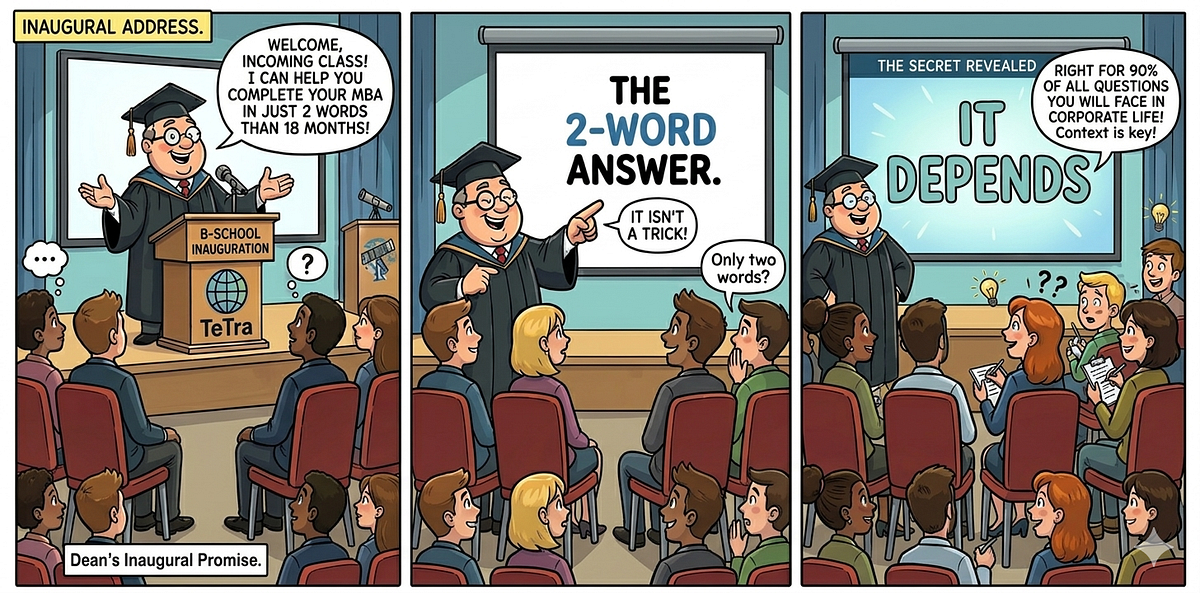
Image Credit : Gemini
Someone has just finished presenting a slick slide deck about how Netflix transformed its culture, how Amazon scales decision-making, or how Spotify organizes teams. The examples are compelling. The room is energized. Then comes the inevitable question: “Can we pull this off?”
A seasoned advisor or leader at the end of the table pauses, reflects, and delivers the ultimate anti-climax: “Well… it depends.”
Cue the collective sigh. Few phrases trigger eye-rolls faster in business. It sounds evasive. Noncommittal. Like someone is dodging the question instead of answering it.
Let’s cut to the chase: sometimes that’s exactly what’s happening.
We’ve all seen people use “it depends” as a professional escape hatch. It’s a convenient way to avoid taking a position, making a recommendation, or risking being wrong. Sometimes it’s just uncertainty dressed up in corporate language.
But I’ve noticed something over the years: the best strategists often say “it depends” more than anyone else.
Not because they know less. Because they see more.
When an advisor or leader uses that phrase correctly, they are intuitively running the problem through a framework we call **TeTra (Telescopic TransCreation). They are refusing to let the organization commit the dangerous sin of mimicry** — the act of copying visible practices while remaining completely blind to invisible conditions.
When translated through the TeTra framework, “it depends” is actually a shorthand for two rigorous diagnostic steps.
Image Credit : Gemini
1. Deconstructing the “It” (The Source Lens)
When you ask if a famous framework, methodology, or operating model works, the strategist’s brain immediately flies to the originating context of that model. They are training a Source Lens on the idea to separate the essence from the noise.
When they say “It depends,” they are privately parsing the six fixed dimensions of the source:
- Core Problem & Intent: What specific fire was this framework originally designed to put out? Are you fighting that same fire, or just admiring their fire trucks?
- Underlying Philosophy & “Why”: What is the foundational belief system that makes this structure make sense?
- Context & Conditions: What unique, invisible ecosystem allowed this to flourish? Did it work because they had zero technical debt, a flat culture, and limitless capital?
- Essential vs. Accidental Features: What part of this model is the actual engine, and what part is just a corporate paint job?
- Dependencies & Prerequisites: What must be true before this model can even function?
- Maturity Path: How long did it take them to grow into this, and what messy intermediate stages did they survive?
You cannot adopt a solution until you ruthlessly deconstruct why it worked somewhere else. “It” is never a plug-and-play machine; it is a living product of its birthplace.
2. Auditing the “Depends” (The Adopter Lens)
The second half of the phrase shifts focus entirely to your organization. The advisor turns an Adopter Lens toward your current reality to measure the gap between the model’s prerequisites and your actual capabilities.
They are evaluating your internal ecosystem across its six fixed dimensions:
- Strategic Intent Alignment: Does this model actually serve your long-term business goals, or is it just a shiny distraction?
- Cultural Alignment: Does your organizational culture reward the behaviors this new framework demands?
- System Readiness: Is your infrastructure, funding model, and architecture stable enough to absorb this shock?
- TransCreation Capacity: Do you have the leadership willpower to reshape this idea to fit your reality, or are you just looking for a checklist to blindly follow?
- Capabilities & Talent: Do your people have the specific skills required to run this engine, or are you putting rocket fuel in a lawnmower?
- Leadership & Governance: Is leadership ready to govern a new way of working, or will they default to old command-and-control habits when under pressure?
From Mimicry to TransCreation
The tragedy of modern management is that organizations routinely copy visible outcomes while ignoring invisible conditions. When the replication fails, we blame execution. But the failure wasn’t in the execution; it was in the translation.
[Mimicry]          Copying visible practices blindly
       ↓
[Understanding]    Analyzing the Source Lens (Why it worked there)
       ↓
[Translation]      Analyzing the Adopter Lens (What we have here)
       ↓
[TransCreation]    Preserving the core intent while altering the form
“It depends” is the precise friction point where mimicry dies and TransCreation begins. TransCreation means understanding the underlying intent and value of an idea so deeply that you can preserve its essence while completely redesigning its expression — its structure, vocabulary, and practices — for your specific context.
The “It Depends” Litmus Test
How do you tell the difference between someone who is hedging and someone who is practicing TeTra? It’s all in their very next sentence.
- The Cop-Out: “It depends…” followed by vague generalizations, circular logic, or an immediate attempt to stall without providing any clear structural criteria.
- The TeTra Practitioner: “It depends…” followed immediately by an articulation of the specific variables: “It depends on whether our core problem is X or Y, and whether our system readiness can support prerequisite Z.”
The next time a colleague, consultant, or internal advisor tells you “it depends,” don’t push for a binary yes or no. Don’t settle for the eye-roll. Lean into the dependency. Ask them: “Depends on what, exactly?”
Then, pull out the TeTra lenses and start mapping the answers.
We are finally on social media.. Come say hi…
Subscribe and follow our official social handles on **Instagram | X | Facebook**.
Feel free to mention / tag us on these social platforms whenever you want to promote or collaborate on your content. We love watching you grow with this community.
This story published on “**Pen With Paper” — a fresh space where writers bring their thoughts, stories, and ideas to life. Want to share your voice? Join our community, and together, “We Elevate Your Stories”**
메타데이터
- post_id
- 7ac38d83f49c
- slug
- why-it-depends-is-the-most-brilliant-answer-in-management-7ac38d83f49c
- url
- https://medium.com/pen-with-paper/why-it-depends-is-the-most-brilliant-answer-in-management-7ac38d83f49c
- canonical_url
- https://medium.com/pen-with-paper/why-it-depends-is-the-most-brilliant-answer-in-management-7ac38d83f49c
- author_url
- https://medium.com/@jayramjoshi
- status
- ok
- fetched_at
- 2026-07-09 20:10:33