⚛️Post Quantum Cryptography How to Prepare for Q Day
TLDR:Q Day threatens global encryption. Learn the quantum computing timeline, post quantum cryptography standards, and how to prepare your…
⚛️Post Quantum Cryptography How to Prepare for Q Day
TLDR:Q Day threatens global encryption. Learn the quantum computing timeline, post quantum cryptography standards, and how to prepare your organization today.
The Window Before the Reset
You know how some problems seem so far away that you don’t need to think about them? That is how most people think about quantum computers. They know the word. They know it is something about breaking encryption. But it feels like a problem for the next generation, or for people in labs with too much time.
It is not. The timeline just got shorter.
The Threat
There is a term for the moment when quantum computers become powerful enough to break the encryption we all rely on. People call it Q-day. It sounds like a movie. But it is a real thing, and the most recent research suggests it will arrive sooner than anyone thought.
To understand why, you have to understand how encryption works today. It relies on a trick. You take two enormous prime numbers and multiply them together. That product becomes the basis of a key. Going forward is easy. Any computer can do it. But going backward, taking that product and finding the original primes, is impossibly hard. Not impossible in theory. Impossible in practice. With today’s computers, it would take thousands of years. So the encryption is safe.
Quantum computers break this trick. They use something called a qubit. A normal bit is either a 1 or a 0. A qubit can be both at the same time. It exists in a state of superposition.
- Classical bit: Either 1 or 0.
- Qubit: 1 and 0 simultaneously (superposition).
Imagine flipping a coin. A normal computer sees it land on heads or tails. A quantum computer works with the coin while it is still spinning in the air, when it is both heads and tails simultaneously.
This lets quantum algorithms explore many possibilities at once. Instead of trying one key after another for thousands of years, they can test all the possibilities in parallel. When the qubits finally settle, the result reflects a computation that would take a classical computer longer than the age of the universe.
That is the threat. Encryption works today because it is computationally unreachable. Quantum computing makes it reachable.
The Timeline
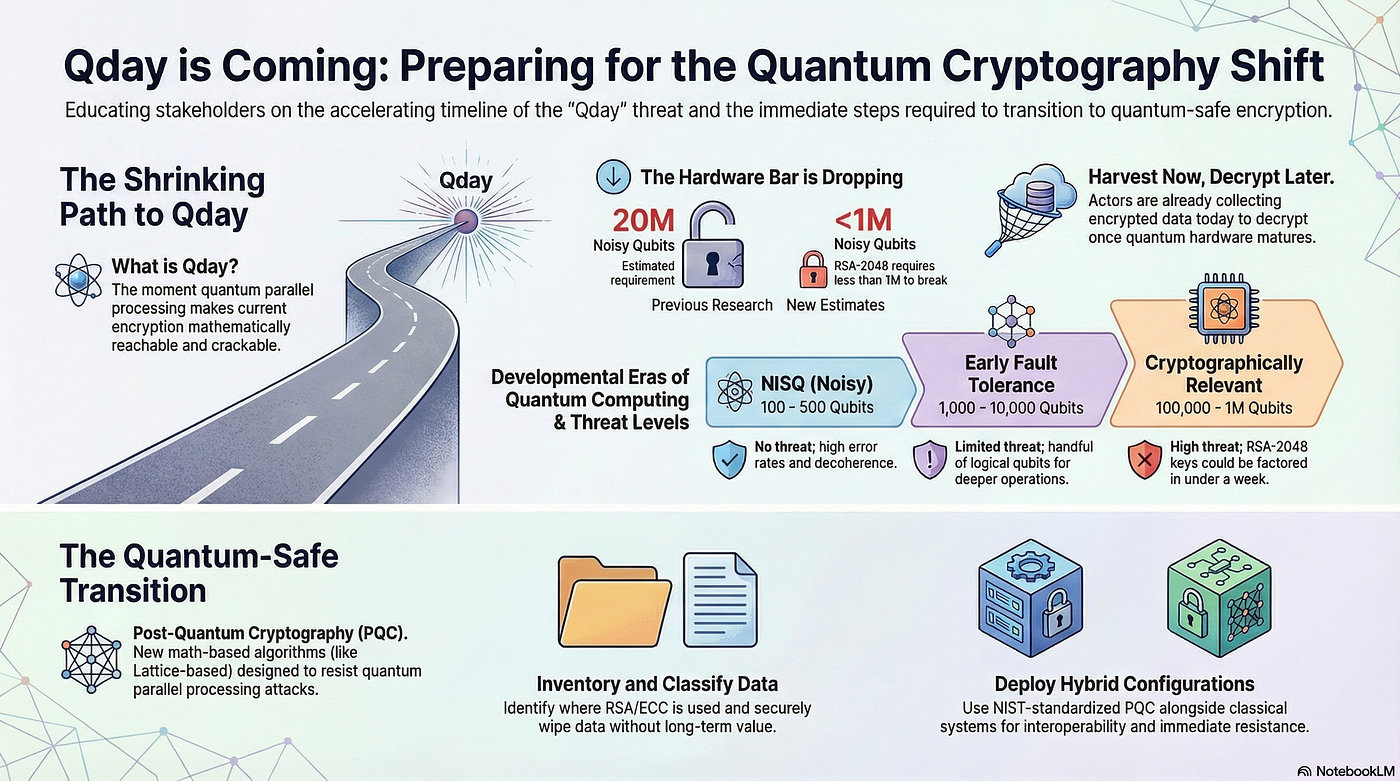
So how close are we? For a while, the estimates were comforting. You would need a machine with 20 million qubits to break RSA 2048, which is a common encryption standard. That felt far away. It was something to worry about in 30 years.
Then in 2025, Google’s quantum AI team published a paper. They recalculated. Their conclusion was that you could factor a 2048-bit RSA key in less than a week with a machine that had fewer than a million qubits. That is a dramatic shift. The bar is much lower than anyone thought.
To understand where we are now, it helps to think of quantum development in stages.
NISQ Era (Noisy Intermediate-Scale Quantum)
- Qubit range: 100 to 500 qubits.
- Status: Where we are now. Google’s Willow chip lives here.
- Limitation: Qubits are sensitive. A vibration, a temperature change, a stray electromagnetic wave can knock them out of their quantum state. This is called decoherence. Machines cannot maintain coherence long enough to do real cryptographic damage.
Early Fault Tolerance
- Qubit range: 1,000 to 10,000 qubits.
- Status: The next stage.
- Capability: Basic error correction. Deeper operations become possible, but still restrained.
Cryptographically Relevant Zone
- Qubit range: 100,000 to 1 million qubits.
- Status: Where the new Google paper says RSA 2048 falls.
- Capability: Surface code error correction. A machine in this range could factor a 2048-bit RSA key in less than a week.
Full Fault Tolerance
- Qubit range: 20 million qubits and above.
- Status: One to three decades out by most estimates.
- Note: This was the old threshold. The new research shows we do not need to wait this long.
The Harvest Now, Decrypt Later Problem
You might think you have time because these machines do not exist yet. But here is the problem: data lasts.
Any encrypted traffic sent today can be captured and stored. If an attacker cannot decrypt it now, they can wait until they have a quantum computer that can. This is called harvest now, decrypt later.
It is not theoretical. Nation states and well-resourced actors are already doing it. They are collecting encrypted data with the expectation that they will be able to read it in the future.
So the question is not just when Q-day arrives. The question is what data you are transmitting today that you want to remain secret for the next ten or twenty years.
What to Do Now
You cannot stop using encryption. So you have to switch to encryption that quantum computers cannot break. This is called post-quantum cryptography (PQC).
The new algorithms do not rely on factorization or discrete logarithms. They use different math that does not become easy to solve just because you apply quantum algorithms to it.
- Lattice-based constructions
- Multivariate quadratic equations
- Code-based cryptography
The difficulty remains high even for quantum hardware.
Steps to Take
1. Take Inventory
You need to know where your encryption is. Map out where RSA and ECC are used in your systems. Look at storage, key management, archives, and data in motion.
2. Classify and Delete
Most data does not need to survive for a decade. If data has no regulatory requirement or long-term business need, do not rely on post-quantum cryptography to protect it. Securely wipe it.
3. Migrate to Post-Quantum Schemes
For data that remains, and for new data, use post-quantum algorithms. NIST has already standardized key building blocks for:
- Key establishment
- Digital signatures
4. Use Hybrid Mode
You do not have to switch overnight. Most vendors now support hybrid configurations that work with classical systems while providing quantum resistance. You can test, pilot, and gradually deploy.
5. Secure Data in Motion
Transient traffic is vulnerable to harvest now, decrypt later. Look for technologies that have PQC embedded in their encryption stack for:
- TLS sessions
- IPsec tunnels
- API traffic
The Reset
The thing to understand about Q-day is that it will not arrive as a single day. There will not be an announcement. It will happen gradually.
First there will be lab demonstrations. Then commercial demonstrations. By the time it is public knowledge, nation states will likely have been exploiting it for years.
When it does arrive, the effect will be a reset. All the secrets protected by RSA and ECC will become readable overnight. Everything that was captured and stored will be exposed. From that point forward, only systems that are quantum safe will be trusted.
That is the window we are in now. It is the time before the reset. And the window is smaller than it was yesterday.
The good news is that the solutions exist. They are standardized. They are being deployed. The work is not speculative. It is just migration. It is the kind of work that organizations know how to do. They just have to start.
If you are responsible for data that needs to stay secret for the next ten years, you should be looking at this now. Not because it is interesting. But because the encryption you are using today may not be encryption for much longer. It is just a delay. And the delay is running out.
Further Reading:
🐍The LiteLLM PyPI Supply Chain Attack What You Need to Know
What is Moltbook? The Social Network for Ai Agents
🦞(Clawdbot) MoltBot OpenClaw Local System Architecture
Agent Skills Vs MCP Vs Prompts Vs Projects Vs Subagents :A Comparative Analysis
⌨️ What is LLM Prompt Engineering?
📈 Prompt Engineering Made Simple with the RISEN Framework
💡 What is Prompt Engineering ?:: RAG, CoT, ReAct & DSP Explained
🔗What is Model Context Protocol? (MCP) Architecture Overview
How DRIFT Stops Prompt Injection Attacks in LLM Agents
Implementing Secure by Design Principles in AI System Development
How to Build an Enterprise AI Compliance Program
🕵️How to Monitor AI Models in Production
⚙️AWS Well-Architected Best Practices
Building Cloud Agnostic Resilience After AWS Outage
Building Secure AI Agents with Data Governance
Part 1: Building AI Data Governance
**Part 2: Building The HR Agent**
Part 3: Evaluating and Deploying the HR Analytics Agent
How to Build a Secure Enterprise Sovereign AI Factory with Open-Source.
Build AI Customer Support Agents with PydanticAI
⚙️LangChain vs. LangGraph: A Comparative Analysis
🔗What is Model Context Protocol? (MCP) Architecture Overview
🚀DeepSeek R1 Explained: Chain of Thought, Reinforcement Learning, and Model Distillation
💻What is Ollama: Running Large Language Models Locally
Model Context Protocol (MCP) vs. APIs: The New Standard for AI Integration
🧠Understanding LLM Context Windows: Tokens, Attention, and Challenges
How DRIFT Stops Prompt Injection Attacks in LLM Agents
Frequently Asked Questions (FAQ)
1. What is Q-Day in simple terms?
Q-Day (Quantum Day) is the hypothetical future date when a quantum computer is built that is powerful enough to break the public-key cryptography (like RSA and ECC) that secures the internet, banking, government communications, and digital identities.
2. How close are we to Q-Day?
Estimates have shifted. While early projections suggested Q-Day was 20–30 years away, recent research (including a 2025 Google Quantum AI paper) suggests that factoring a 2048-bit RSA key may require fewer than 1 million physical qubits, rather than the previously estimated 20 million. Given the rapid pace of investment, many experts believe the cryptographically relevant window opens between 2030 and 2040.
3. Will my encrypted data be safe until then?
Not necessarily. The primary threat today is “Harvest Now, Decrypt Later.” Adversaries (including nation-states) are already intercepting and storing vast amounts of encrypted data. Even if it takes 10–15 years to build the quantum computer, once it exists, they can go back and decrypt all that historical data.
4. What is “Harvest Now, Decrypt Later”?
It is a strategy where attackers collect encrypted data today, knowing they cannot break it yet, but storing it for future decryption using a quantum computer. This makes long-lived data (like medical records, trade secrets, and personal data) vulnerable even if it is encrypted with today’s strongest algorithms.
5. How do quantum computers break encryption?
Modern encryption (RSA, ECC) relies on difficult math problems, like factoring large numbers or solving discrete logarithms. Quantum computers use algorithms like Shor’s Algorithm to solve these problems exponentially faster than classical computers, effectively collapsing the “brute force infeasibility” that keeps our data safe today.
6. What is Post-Quantum Cryptography (PQC)?
PQC refers to new mathematical algorithms designed to resist attacks from both classical and quantum computers. Instead of relying on factoring or discrete logs, PQC uses complex structures like lattices, multivariate equations, and error-correcting codes. The U.S. National Institute of Standards and Technology (NIST) has standardized several PQC algorithms, including CRYSTALS-Kyber (encryption) and CRYSTALS-Dilithium (signatures).
7. Is PQC the same as Quantum Key Distribution (QKD)?
No. PQC is mathematical cryptography that runs on classical computers. QKD is a physical method that uses quantum mechanics to distribute keys over fiber optics. Most security experts advocate for PQC as the practical, scalable solution for the internet, as QKD requires specialized hardware and has significant infrastructure limitations.
8. What should organizations do to prepare today?
Organizations should focus on three main actions:
- Inventory: Find where RSA and ECC are used (certificates, code signing, VPNs, backups, hardware).
- Enable Hybrid Mode: Deploy hybrid TLS and VPN solutions that use both classical and PQC algorithms together. This provides security today and quantum-resistance for the future.
- Data Hygiene: Aggressively purge data that does not have a long-term regulatory or business requirement. The safest data is data that doesn’t exist.
9. What is “hybrid mode” and why is it important?
Hybrid mode means using two encryption algorithms simultaneously (e.g., traditional ECC plus a PQC algorithm like Kyber) to generate a single session key. If one algorithm turns out to have a vulnerability, the other still protects the data. It allows organizations to transition to quantum-safe security without risking disruption or relying on unproven single algorithms.
10. Will my current devices (laptops, phones, IoT) survive Q-Day?
It depends. Devices that cannot be updated (e.g., IoT sensors, some medical devices, automotive control units) and have a long operational life are at high risk. If they rely on hard-coded RSA or ECC keys that cannot be replaced, they will become insecure when Q-Day arrives. Crypto-agility — the ability to update cryptographic algorithms — is now a critical requirement for new hardware and software procurement.
11. Does Q-Day affect symmetric encryption (like AES)?
Yes, but less severely. A quantum computer using Grover’s Algorithm can speed up brute-force attacks on symmetric keys. To maintain the same level of security, the key size for symmetric encryption (like AES) needs to double (e.g., moving from AES-128 to AES-256). AES-256 is considered quantum-resistant.
12. When will Q-Day actually happen?
There will not be a single “switch flip.” Q-Day will be a gradual realization. It will likely occur when:
- A major research lab or nation-state demonstrates the successful factorization of a cryptographically relevant key (e.g., 2048-bit RSA).
- Intelligence agencies confirm that state actors have already been using the capability in the wild. At that moment, global trust in classical public-key infrastructure (PKI) will effectively reset overnight.
13. I’m a small business. Should I worry about this?
Yes, indirectly. Even if you are not a direct target, your supply chain is. If a cloud provider, SaaS vendor, or financial institution you rely on is compromised due to a quantum attack, your data is exposed. You should prioritize asking your critical vendors about their PQC roadmaps and ensure your own data retention policies minimize the amount of sensitive data stored long-term.
메타데이터
- post_id
- 7ae71caebcc2
- slug
- ️post-quantum-cryptography-how-to-prepare-for-q-day-7ae71caebcc2
- url
- https://medium.com/@tahirbalarabe2/%EF%B8%8Fpost-quantum-cryptography-how-to-prepare-for-q-day-7ae71caebcc2
- canonical_url
- https://medium.com/@tahirbalarabe2/%EF%B8%8Fpost-quantum-cryptography-how-to-prepare-for-q-day-7ae71caebcc2
- author_url
- https://medium.com/@tahirbalarabe2
- status
- ok
- fetched_at
- 2026-06-18 00:10:23