Review: ‘The Getaway’ — Excellent, Muscular Steve McQueen Thriller
Sam Peckinpah’s 1972 adaptation of Jim Thompson’s novel is a taut, tense and superbly made thriller
Review: ‘The Getaway’ — Excellent, Muscular Steve McQueen Thriller
Sam Peckinpah’s 1972 adaptation of Jim Thompson’s novel is a taut, tense and superbly made thriller
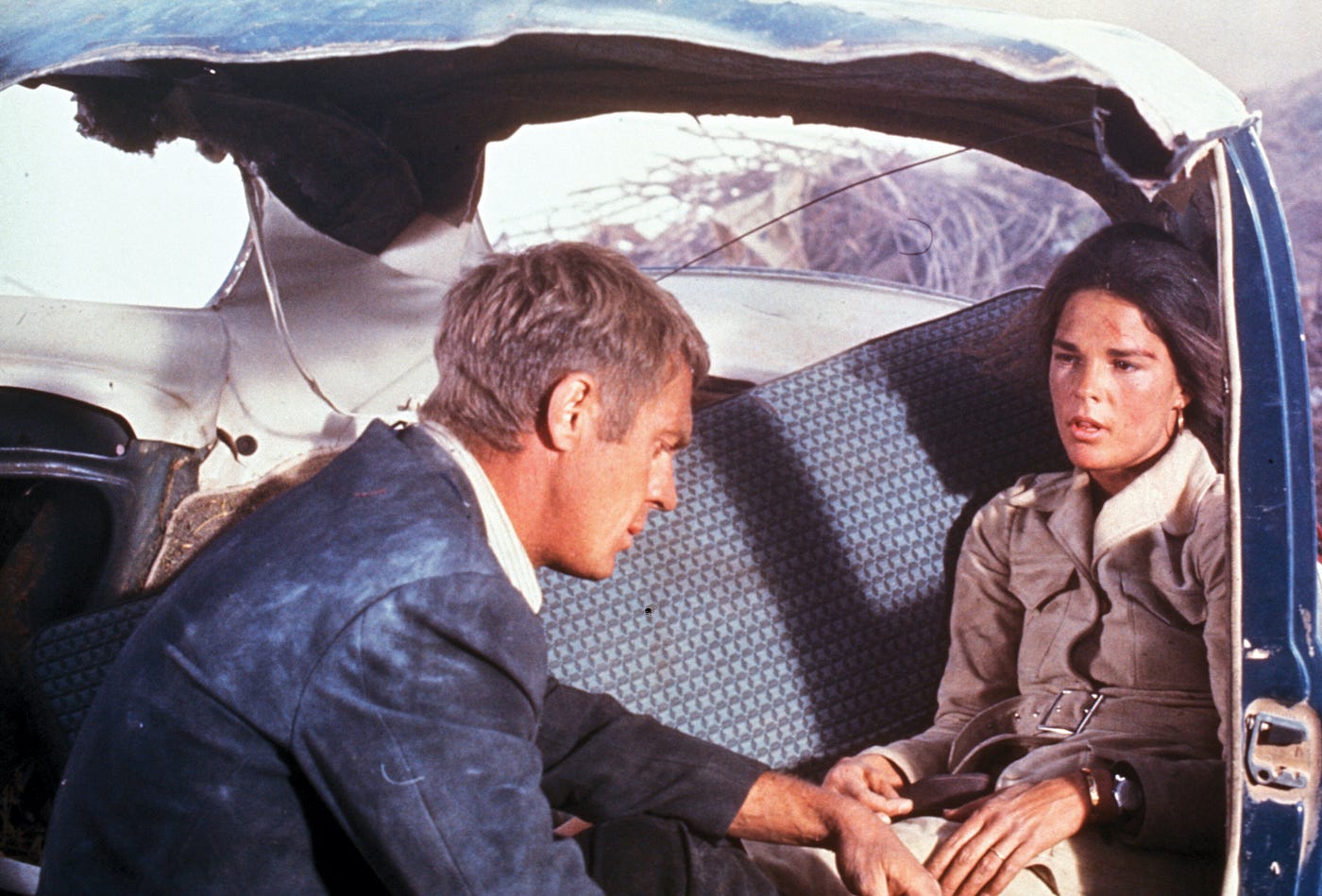
Still from The Getaway, via Warner Bros./Foster-Brower Productions/First Artists/Solar Productions/National General Pictures/Tatiana Films
There are a couple of throwaway mentions of the well-known American gangster John Dillinger early on in The Getaway, the 1972 thriller directed by Sam Peckinpah and starring Steve McQueen, which appear to be inconsequential but which in their own way end up summarising the film as a whole quite neatly. Adapted from a Jim Thompson novel by screenwriter Walter Hill — who would soon become a very talented and recognised director in his own right (beginning his career in 1975 with Hard Times before progressing towards a gathering of cult hits including The Driver, The Warriors, 48 Hrs and more) — The Getaway was the second film moving in a remarkable new direction from its director as he left behind the western (briefly) and began investigating some particularly ugly aspects of modern society instead. This began with the memorably caustic and nasty Straw Dogs, a film still infamous for some of its most violent sequences, and continued into this film, an extremely entertaining and sometimes shockingly well made crime thriller starring two of the biggest stars of their time.
Those two stars are Steve McQueen and Ali MacGraw, who even began a controversial affair on the very set of this film. Offscreen antics aside, the two play a married couple in the film whose lives have been brutally disrupted by a four year prison stint being served by McQueen’s ‘Doc’ McCoy for armed robbery. An immersive and atmospheric opening sequence shows the early signs of promise from the incredible editing of Robert L. Wolfe and the eccentric but terrific score by Quincy Jones (whose oddball gatherings of sounds and musical eccentricity on many film scores is reminiscent of Ennio Morricone’s equally strange but effective work), as Doc becomes increasingly frustrated with prison life (with Wolfe pushing and pulling McQueen’s character through time by hopping back-and-forth repeatedly between different sequences). The sound design this opening is also terrific, using the harsh mechanical sounds of various industrial prison machinery to create a tense and uneasy atmosphere very quickly. When Doc has a visit from MacGraw’s Carol, he tells her nothing more than to go to Jack Beynon in order for Beynon to pull some political strings and have Doc released as soon as possible.
Not only does Carol have to sleep with Beynon in order to secure Doc’s release, Doc is also subsequently forced into another heist after regaining his freedom. He and a crew selected by Beynon are to take around $500,000 from a small time bank which is only a lucrative job because of a business association with an oil company. And, seeing as this heist occurs in the opening act rather than at the end of the film, the audience knows as soon as things start to unfold that something has to go wrong… and it does. Rudy Butler (Al Lettieri), one of Beynon’s selected men, starts to double cross his colleagues after the money has been taken from the bank and gets away with it until it is just Rudy, Doc and Carol left. Doc, always wearing a facade of stoicism which does well to cover his persistent paranoia, just beats Rudy to the punch when the latter pulls a gun on him, shooting Rudy multiple times before taking all of the money and leaving with Carol. Some further backstabbing causes even more trouble, forcing Doc and Carol to go on the run before they can even discover that Rudy is in fact still alive having worn a bulletproof vest during his attack on Doc.
Still from The Getaway, via Warner Bros./Foster-Brower Productions/First Artists/Solar Productions/National General Pictures/Tatiana Films
The rest of the film is a very smoothly produced and engaging crime thriller, a non-stop two hour chase sequence that is beautifully paced and superbly put together. There are elements of the film’s formal qualities that are rigourous and mechanical, from the cinematography of Lucien Ballard to the occasionally overwhelming sound design and even the tightened structure of the screenplay, but what makes The Getaway so enticing is that it matches these muscular, slick qualities with a more unkempt look at the gangster film, often far from the romance of other gangster films of the time. Ironically, there’s an easy case to make that The Getaway is ultimately quite a romantic film in the end, but that romance is found in a more grounded, gritty and realistic world than the majority of on-screen romances in similar films of the time (which is perhaps why the chemistry between the stars soon translated into reality — it wasn’t such a large leap to make emotionally).
Those unkempt qualities are visible, not only in the more rugged formal aspects — the editing of Robert L. Wolfe and Quincy Jones’ score as previously mentioned, both consistently effective but unpredictable and emotionally engaging — but also in the shocking violence of the film which is much in line with many of Peckinpah’s other films whether that be numerous moments in Straw Dogs or the equally infamous The Wild Bunch. Director Paul Schrader quite rightly pointed out in an essay he penned on Peckinpah during his time as a film critic that the director likes to utilise ‘violence to excite and then [he] applies even more violence to comment on the excitement’, creating an uneasy feeling where the viewer is intended to be seduced by the violence at first but ultimately left shocked by it, in a state where they end up ‘evaluating what [they] had previously revelled in’.
This idea certainly applies to numerous sequences in The Getaway. The violence of the film is gnarly and often surprisingly blunt, at first in a way that strikes as almost humorous and dry but which has a kind of after-shock that lingers with the viewer. This is especially true of the climactic hotel shootout, a genuinely stunning sequence which finally fully lets go of the pent-up tension that the film has been accumulating for the previous 120 minutes with all-out, horrific violence — violence that begins, again, seductively cool but which soon becomes unsettling and disturbing because of the editing and the sound design in particular. As Doc guns down a number of criminals, Peckinpah’s focus repeatedly shifts away from the action very briefly and highlights the mixture of fear and exhilaration being felt by the civilians in the hotel who are caught up in the crossfire. At other times, Wolfe’s editing will either cut away from violence just at the right time to leave the impacts of certain hits up to the viewer’s imagination or will instead show in slow motion the brutality caused by McQueen’s booming shotgun, the nasty, bloody deaths usually skimmed over in action cinema suddenly feeling much more real and stark. This also applies to a number of sequences with Rudy as he kidnaps a vet and his wife Fran, forcing them to drive him cross country and look after his one actual bullet wound in pursuit of Doc and the $500,000. At first, there is a quirky humour to be found in scenes when Rudy ends up sleeping with a very willing Fran and even engages more than once in some quite gross food play with the woman, but all of this dark and almost absurd comedy is sharply contrasted by another strong feeling of unease which settles whenever the camera looks over to Fran’s husband, tied up and sadistically forced to watch as this criminal sleeps with his wife in front of him.

Still from The Getaway, via Warner Bros./Foster-Brower Productions/First Artists/Solar Productions/National General Pictures/Tatiana Films
It’s interesting that Peckinpah is bold enough to place such sequences of violence (which are still shocking today to a certain degree, never mind back in 1972) alongside some still raw but surprisingly romantic sequences between McQueen and MacGraw’s characters, whether they be the quiet, sensual moments shared between the two shortly after Doc gets out of prison or the more amusing dialogue shared between the two after they unintentionally find themselves spending a full night in the back of a dustbin truck barely avoiding being squashed to death by the trash compactor. But what’s more interesting is that Peckinpah not only puts these contrasting sequences closely to one another, he also manages to find a certain poetic logic between them as though one could never exist without the other. Just as some look with nostalgia back to the gangsters of the 1930s — including the name-dropped Dillinger — there is a certain whimsy and sweetness to the lasting connection between Doc and Carol, a suggestion that the love between these two characters is enough to allow them to pull through the ugly, threatening world they find themselves in. It’s a strange but somewhat comforting sentiment to find in such a violent film, and one even more surprising to find in a work by the usually ruthless Sam Peckinpah.
For more from me on film, see the following list:
[embed]Film Edit descriptionreecebeckett2002.medium.com
To support my writing, you can donate using Ko-fi.
메타데이터
- post_id
- 7aee2b2d23b7
- slug
- review-the-getaway-excellent-muscular-steve-mcqueen-thriller-7aee2b2d23b7
- url
- https://medium.com/counterarts/review-the-getaway-excellent-muscular-steve-mcqueen-thriller-7aee2b2d23b7
- canonical_url
- https://medium.com/counterarts/review-the-getaway-excellent-muscular-steve-mcqueen-thriller-7aee2b2d23b7
- author_url
- https://medium.com/@reecebeckett2002
- status
- ok
- fetched_at
- 2026-06-26 06:47:43