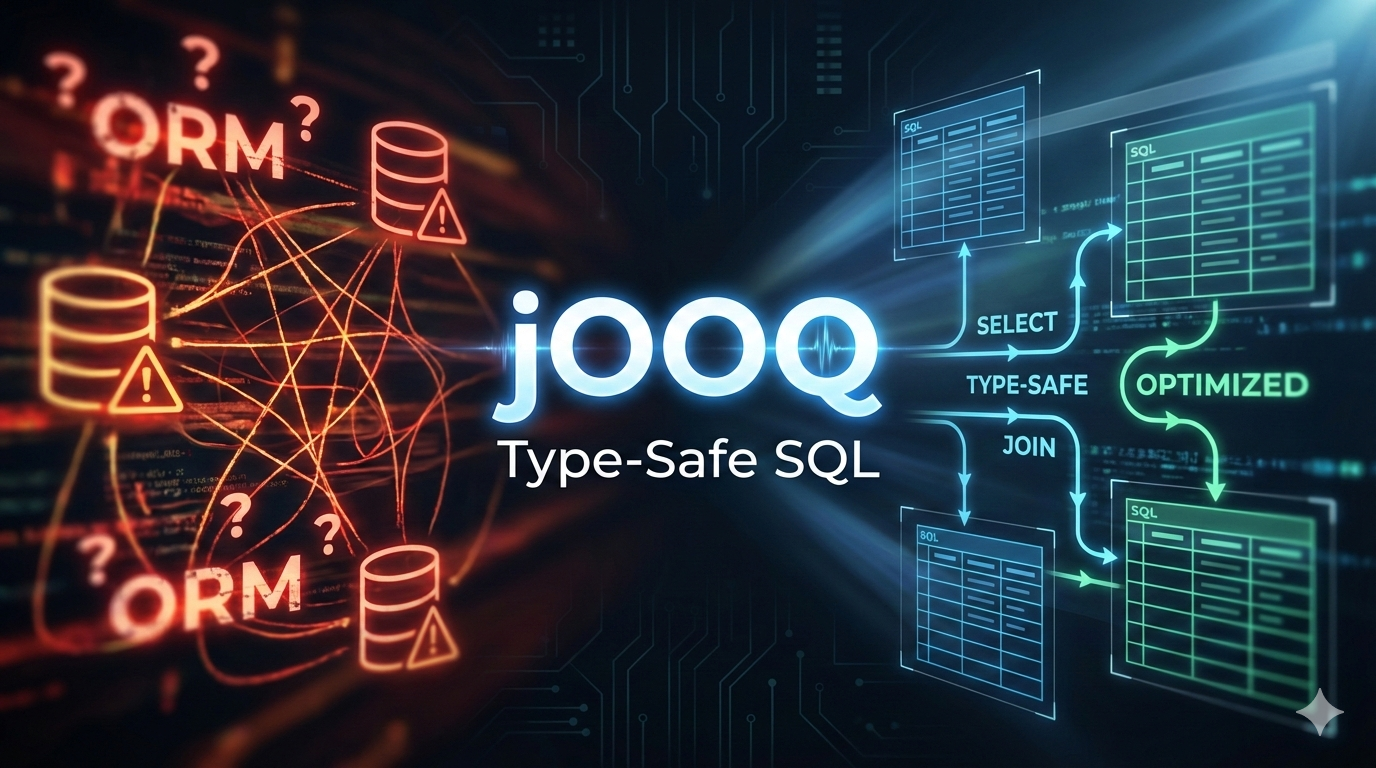
jOOQ in Production: Type-Safe SQL Without ORM Surprises
Why SQL-first persistence with jOOQ delivers predictable performance, safer schema evolution, and fewer production incidents than…
jOOQ in Production: Type-Safe SQL Without ORM Surprises
Why SQL-first persistence with jOOQ delivers predictable performance, safer schema evolution, and fewer production incidents than traditional ORMs
This article explores how jOOQ is used in production systems to achieve type-safe SQL, predictable query plans, and better performance than Hibernate.
Most production systems don’t fail because developers don’t know frameworks. They fail because abstractions slowly drift away from reality.
In the early phase of a Java project, Hibernate and JPA feel empowering. You model entities, write repository methods, and ship features fast. SQL feels like a solved problem — something the ORM will handle for you. But as data grows, traffic increases, and queries become more complex, many teams discover a painful truth in production:
- Latency spikes appear without obvious code changes
- Simple-looking repository calls generate complex SQL
- Indexes stop being used after refactors
- Performance issues surface only under real traffic
🌟 Open Access Version ✨ Knowledge wants to be free. 📚 Enjoy the full read — free & unrestricted
Real Production Incident
In a high-scale payments system processing millions of rows per day, a minor refactor introduced this line inside a request handler:
order.getCustomer().getEmail();That single access triggered a lazy load inside a loop, resulting in thousands of extra queries per request. The code looked harmless. The SQL impact was invisible until production dashboards lit up.
This is not a Hibernate bug. It is a loss of SQL visibility.
jOOQ was created for teams that reached this stage — where predictability, performance, and control matter more than abstraction comfort.
What jOOQ Really Is (and Why That Matters)
jOOQ is not an ORM. It does not attempt to map tables to object graphs. Instead, it generates Java classes that represent your database schema and lets you write SQL in a fluent, type-safe way.
Production Example: Explicit SQL Ownership
// jOOQ-based repository
public List<OrderSummary> fetchPaidOrders(long customerId) {
    return dsl.select(ORDERS.ID, ORDERS.AMOUNT, ORDERS.CREATED_AT)
              .from(ORDERS)
              .where(ORDERS.CUSTOMER_ID.eq(customerId))
              .and(ORDERS.STATUS.eq("PAID"))
              .orderBy(ORDERS.CREATED_AT.desc())
              .fetchInto(OrderSummary.class);
}
Here, every column, filter, and sort is visible and intentional. There are no hidden joins or fetch strategies. In production, this means the SQL you review during development is the SQL that executes under load.
Type-Safe SQL: Turning Runtime Failures into Compiler Errors
Schema drift is one of the most common sources of production bugs in database-driven systems.
Hibernate Runtime Failure
@Entity
@Table(name = "orders")
public class Order {
    @Column(name = "total_amount")
    private BigDecimal totalAmount;
}
After a schema change:
ALTER TABLE orders RENAME COLUMN total_amount TO amount;The application still compiles and deploys. The failure happens only when that field is accessed in production.
jOOQ Compile-Time Safety
// Generated jOOQ schema
public class Orders {
    public static final TableField<Record, BigDecimal> AMOUNT =
        DSL.field("amount", BigDecimal.class);
}
After regeneration, any reference to the old column immediately fails compilation. This shifts error detection from production to CI pipelines.
Production impact: fewer hotfixes, safer deployments, and faster feedback loops.
Query Plan Predictability: Why Production Systems Depend on It
Databases do not execute Java code. They execute query execution plans. In production, query plan stability is often more important than raw query speed.
Hibernate Surprise in Production
Order order = entityManager.find(Order.class, id);
order.getItems().size();
This changes the generated SQL from a simple primary key lookup into a join-heavy query.
Generated SQL (simplified)
SELECT o.*, i.*
FROM orders o
LEFT JOIN order_items i ON o.id = i.order_id
WHERE o.id = ?;
PostgreSQL EXPLAIN ANALYZE
Nested Loop  (cost=0.86..12435.22 rows=500 width=256)
  -> Index Scan using orders_pkey on orders o
  -> Seq Scan on order_items i
A sequential scan appears because the join cardinality exploded.
jOOQ Predictable Execution
dsl.select(ORDERS.ID, ORDERS.AMOUNT)
   .from(ORDERS)
   .where(ORDERS.ID.eq(orderId))
   .fetchOne();
SQL
SELECT id, amount FROM orders WHERE id = ?;PostgreSQL EXPLAIN ANALYZE
Index Scan using orders_pkey on orders (cost=0.29..8.31 rows=1 width=32)Production impact: stable plans, predictable latency, and confidence during traffic spikes.
Schema Evolution Without Fear
Schema changes are inevitable in long-lived systems.
ORM-Based Risk
With Hibernate, mismatches between entity mappings and the actual schema may only surface during specific code paths.
jOOQ + Flyway in Production
-- Flyway migration
ALTER TABLE orders ADD COLUMN discount NUMERIC;
// After jOOQ regeneration
ORDERS.DISCOUNT // immediately available and type-safeIf the column is missing or misconfigured, compilation fails. This makes schema evolution a build-time concern, not a runtime risk.
Performance Comparison: jOOQ vs Hibernate in Real Systems
This is not about micro-benchmarks. It’s about understanding where overhead comes from in production.
Hibernate Execution Characteristics
List<Order> orders = orderRepository.findByStatus("PAID");Behind the scenes:
- Entity hydration for every row
- Dirty checking snapshots
- Persistence context memory growth
MySQL EXPLAIN
Using where; Using temporary; Using filesortjOOQ Execution Characteristics
dsl.select(ORDERS.ID, ORDERS.AMOUNT)
   .from(ORDERS)
   .where(ORDERS.STATUS.eq("PAID"))
   .fetch();
MySQL EXPLAIN
Using index condition; Using whereResult in production: lower heap usage, fewer GC pauses, and faster response times for read-heavy APIs.
Complex Queries: Where jOOQ Shines
Advanced SQL is often unavoidable.
Production Reporting Query
dsl.select(
        ORDERS.CUSTOMER_ID,
        ORDERS.AMOUNT.sum().as("total_spent")
    )
   .from(ORDERS)
   .groupBy(ORDERS.CUSTOMER_ID)
   .having(ORDERS.AMOUNT.sum().gt(BigDecimal.valueOf(10000)))
   .fetch();
Implementing this cleanly with Hibernate usually requires native queries and manual mapping.
jOOQ advantage: advanced SQL with full type safety.
Hybrid Architecture: Hibernate for Writes, jOOQ for Reads
Many mature systems don’t choose between Hibernate and jOOQ — they use both.
Why This Works in Production
- Writes benefit from Hibernate’s entity lifecycle and cascading
- Reads benefit from jOOQ’s performance and SQL control
Production Architecture Example
Command Side (Writes)  -> Hibernate / JPA
Query Side (Reads)    -> jOOQ
Write Path (Hibernate)
@Transactional
public void createOrder(CreateOrderCommand cmd) {
    Order order = new Order(cmd);
    entityManager.persist(order);
}
Read Path (jOOQ)
public OrderView fetchOrder(long orderId) {
    return dsl.select(ORDERS.ID, ORDERS.AMOUNT, ORDERS.STATUS)
              .from(ORDERS)
              .where(ORDERS.ID.eq(orderId))
              .fetchOneInto(OrderView.class);
}
This pattern dramatically reduces read latency while keeping write logic simple and safe.
Debugging, Monitoring, and 2 AM Incidents
In real production incidents, clarity beats abstraction.
jOOQ logs exact SQL with bind values:
jooq.execute.logging=trueHibernate logs often show multiple generated queries that are hard to correlate with application code.
When You Should Not Use jOOQ
jOOQ is not ideal for:
- Simple CRUD-only applications
- Teams unfamiliar with SQL
- Rapid prototypes where performance is irrelevant
It excels when database behavior must be explicit and predictable.
Final Verdict
Most teams don’t abandon ORMs because they dislike them. They move away because production realities demand transparency.
jOOQ does not fight SQL. It respects it.
By making queries explicit, schemas type-safe, and execution plans predictable, jOOQ shifts failure detection from runtime to compile time and from production to CI.
For modern systems where:
- Data volume grows continuously
- Performance issues are expensive
- Debugging time matters
jOOQ is not just a persistence library — it’s a production engineering decision.
If your team has ever asked, “Why did this query suddenly become slow?”, jOOQ might already be the answer.
메타데이터
- post_id
- 7b1b9ca80e7e
- slug
- jooq-in-production-type-safe-sql-without-orm-surprises-7b1b9ca80e7e
- url
- https://medium.com/javarevisited/jooq-in-production-type-safe-sql-without-orm-surprises-7b1b9ca80e7e
- canonical_url
- https://medium.com/javarevisited/jooq-in-production-type-safe-sql-without-orm-surprises-7b1b9ca80e7e
- author_url
- https://medium.com/@pat.vishad
- status
- ok
- fetched_at
- 2026-07-13 06:23:13