What Is a Rotating Proxy vs. Static Proxy? Full Comparison — 2026
If you’ve spent any time researching proxies, you’ve likely come across two terms that keep showing up: rotating proxies and static…
What Is a Rotating Proxy vs. Static Proxy? Full Comparison — 2026

If you’ve spent any time researching proxies, you’ve likely come across two terms that keep showing up: rotating proxies and static proxies. They sound simple enough — but the differences between them matter a lot when you’re choosing infrastructure for business-critical operations.
In this guide, we’ll explain what a rotating proxy is, how it’s different from a static one, and which to choose for your specific use case.
What is a rotating proxy?
A rotating proxy is a type of proxy server that automatically assigns a new IP address from a pool of available IP addresses with each new connection. Unlike a static proxy — which uses a single, fixed IP for all your traffic — a rotating proxy dynamically cycles through a large number of addresses. This means each request, or batch of requests, appears to originate from a completely different device or location. Sometimes, a rotating proxy is referred to as a proxy rotator, though they’re not quite the same — one is a proxy type, another one is a tool.
The core purpose of this rotation is to distribute your web requests across many IPs, making it significantly harder for websites to:
- Detect automated activity
- Enforce blocks
- Track behavior patterns over time
What is a static proxy?
A static proxy is a proxy server that assigns you a single, fixed IP address that remains the same across all your requests. Unlike a rotating proxy, which cycles through a pool of IPs, a static proxy maintains one consistent identity throughout your session — making your traffic appear as a regular, returning user rather than an automated source.
Static proxies are typically datacenter-based, though static residential options exist for cases where a more trusted IP is needed. They’re a natural fit for tasks that require session continuity — such as managing accounts, handling logins, or any workflow where appearing as a consistent user matters more than staying anonymous at scale.
It’s also worth noting that if you already have static proxies, standalone proxy rotator tools exist that can add rotation on top of your existing setup — without needing to switch providers.
Proxy rotator use cases
Rotating proxies are valuable for any operation that requires anonymity, high request volume, or access across different locations. Here are some of the most common use cases:
- AI agent operations: AI agents and automated pipelines often need to interact with the web at scale — whether scraping training data, performing research, or executing multi-step tasks across different sites. Rotating proxies allow these agents to operate continuously without getting blocked, making them a key piece of infrastructure for teams building and deploying AI-driven data workflows.
- SEO and AI search monitoring: As AI-powered search experiences reshape how results are displayed, SEO teams need visibility into how their content appears across both traditional and AI-generated search features. Rotating proxies allow them to query search engines at scale, from multiple locations, without triggering rate limits, improving their SEO and AI search performance.
- Price monitoring: E-commerce businesses use rotating proxies to track competitor pricing and product availability across multiple platforms. By switching IPs, they can collect large volumes of data without triggering anti-bot measures — fueling their pricing monitoring based on accurate, up-to-date information.
Types of rotating proxies
Rotating proxy servers aren’t all built the same — each type comes with its own characteristics, advantages, and ideal use cases. Here are the main ones used in the market today:
- Rotating residential proxies. Rotating residential proxies use IP addresses assigned by ISPs to real, physical home internet connections. Because requests are routed through IPs of genuine rotating residential proxies, your traffic appears as legitimate user activity, offering high anonymity and significantly reducing the chances of being blocked. Rotating residential proxies are the go-to choice for tasks that require a high level of trust, such as market research or ad verification.
- Rotating datacenter proxies. Unlike residential proxies, datacenter proxies aren’t affiliated with ISPs. These IPs are assigned by third-party cloud service providers and originate from data centers rather than real home connections. Rotating datacenter proxies tend to be faster and more cost-effective, but websites can more easily identify them as non-residential traffic. They’re well-suited for high-speed tasks where the target sites have less aggressive anti-bot measures in place.
- Rotating mobile proxies. Mobile rotating proxies use IP addresses from real mobile devices — such as phones or tablets — mimicking authentic mobile user behavior. Because of their dynamic nature and the high level of trust mobile IPs carry, they’re particularly difficult for anti-bot systems to detect and block. They’re especially useful for accessing mobile-specific content or targeting sites with very aggressive anti-proxy measures.
How to set up rotating proxies
Setting up rotating proxies can sound complicated at first, but the process is usually straightforward, especially when you’re working with a reliable provider and clear documentation. Below are basic cURL, Python, and Java code samples to help you get started — for the sake of this tutorial, we’ll be using Oxylabs rotating residential proxies, but you’re free to look into other providers (Decodo, Webshare, ScrapingBee, etc.)
cURL
curl -x pr.oxylabs.io:7777 -U "customer-USERNAME:PASSWORD" https://ip.oxylabs.io/locationPython
import requests

username = "customer-USER"
password = "PASS"
proxy = "pr.oxylabs.io:7777"

proxies = {
  'http': f'http://{username}:{password}@{proxy}',
  'https': f'http://{username}:{password}@{proxy}'
}

response = requests.request(
    'GET',
    'https://ip.oxylabs.io/location',
    proxies=proxies,
)

print(response.text)
Java
package example;

import org.apache.http.HttpHost;
import org.apache.http.client.fluent.*;

public class Main {
  public static void main(String[] args) throws Exception {

    String username = "customer-USER";
    String password = "PASS";
    String proxyHost = "pr.oxylabs.io";
    int proxyPort = 7777;

    HttpHost entry = new HttpHost(proxyHost, proxyPort);
    String query = Executor.newInstance()
        .auth(entry, username, password)
        .execute(Request.Get("https://ip.oxylabs.io/location")
        .viaProxy(entry))
        .returnContent()
        .asString();
    System.out.println(query);
  }
}
Rotating vs. static proxies: a comparison
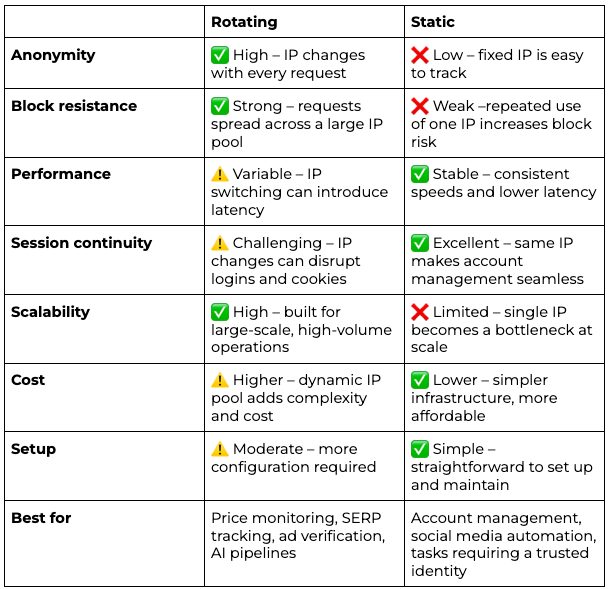
Rotating and static proxies each come with their own trade-offs — here’s a breakdown of where each one excels and where it falls short.
Rotating proxy pros
- Enhanced anonymity: Constantly switching IPs makes it difficult for websites to trace activity back to a single source.
- Bypass of IP blocks: Distributing requests across a large IP pool helps avoid the blocking that most modern websites have in place.
- Geo-restricted content: Rotating proxies provide IPs from different locations, giving you access to content that may be unavailable in your region.
- Scalability: Minimizing blocks and maintaining consistent access makes it easier to run large-scale operations without interruption.
Rotating proxy cons
- Higher cost: Residential or mobile rotating proxies tend to cost more, reflecting the complexity of managing a large, dynamic IP pool.
- Setup complexity: Integration can require more technical expertise, though premium providers often offset this with automatic rotation and management tools.
- Inconsistent performance: Constantly changing IPs can occasionally cause variations in connection speed or latency.
Static proxy pros
- Consistent identity: A fixed IP makes you appear as a regular, returning user — useful for platforms that flag frequent IP changes.
- Better performance: Static proxies offer more stable speeds and lower latency without cycling through different routes.
- Easier session management: The same IP across a session simplifies logins, cookies, and any continuity-dependent activity.
- Cost-effective: For lighter operations that don’t require scale or anonymity, static proxies are the more affordable option.
Static proxy cons
- Higher block risk: Repeatedly using a single IP makes it easier for websites to detect and block your activity at higher volumes.
- Limited scalability: A fixed IP becomes a bottleneck quickly, making static proxies a poor fit for large-scale data collection.
- No anonymity rotation: Since your IP never changes, your activity is easier to track and attribute to a single source over time.
Final word — which one to choose?
In today’s article, we’ve discovered what is a rotating proxy and, in opposition, what a static one is.
Rotating and static proxies solve different problems, and the right choice comes down to what your operations actually demand. If you’re running high-volume data collection, scraping across multiple targets, or need to stay under the radar at scale, rotating proxies — and rotating residential proxies in particular — are the stronger fit. If your work requires a consistent identity, stable sessions, or a more cost-effective setup for lighter tasks, static proxies are the better option.
Of course, rotating and static proxies are not the only proxy types — they can also be categorized into SOCKS vs. HTTP Proxies, transparent proxies, distorting proxies, reverse vs. forward proxies, and many more.
메타데이터
- post_id
- 7b1e74359d2c
- slug
- what-is-a-rotating-proxy-vs-static-proxy-7b1e74359d2c
- url
- https://medium.com/behind-the-firewall/what-is-a-rotating-proxy-vs-static-proxy-7b1e74359d2c
- canonical_url
- https://medium.com/behind-the-firewall/what-is-a-rotating-proxy-vs-static-proxy-7b1e74359d2c
- author_url
- https://medium.com/@lambert.watts.809
- status
- ok
- fetched_at
- 2026-06-14 11:28:49