Chronograph Watch Style: Office to Ocean in One Watch
I wore one dive chronograph for 30 days across every dress code I own. Here’s what worked, what didn’t, and the specs that quietly decide…
Chronograph Watch Style: Office to Ocean in One Watch
I wore one dive chronograph for 30 days across every dress code I own. Here’s what worked, what didn’t, and the specs that quietly decide whether a watch can cover your whole life.
Dive watches. Built with purpose.
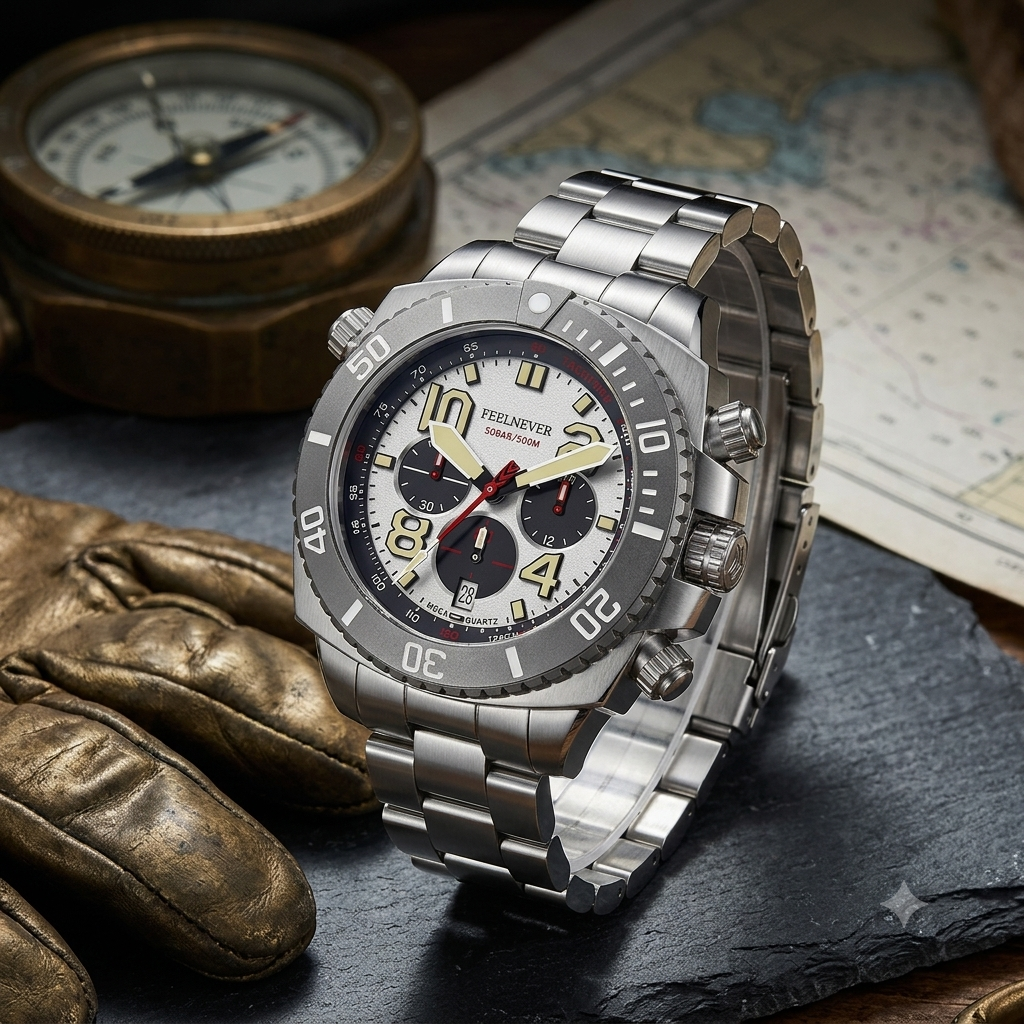
Most watch collections are built on a quiet anxiety: the fear of wearing the wrong watch to the wrong place. So we buy a desk watch, a weekend watch, a water watch — and rotate them like uniforms for lives most of us don’t actually lead in separate compartments.
The alternative theory is the one-watch life: a single piece that moves from a client meeting to a swim without a wardrobe stop. It sounds like marketing until you test it, so I did — 30 days, the AbyssForce 500M meca-quartz chronograph, every situation my calendar produced: office weeks, a wedding reception, gym sessions, two beach days, one storm hike. No backup watch allowed.
The verdict is genuinely useful, because it’s not “yes.” It’s yes, with rules — and the rules turn out to be specs, not styling tricks. Here’s the plan:
- See the 30-day diary across dress codes
- Learn the design math that lets a dive chronograph cross over
- Get the occasion-by-occasion styling rules, honest exclusions included
- Run the one-watch test on anything you’re considering
The 30-Day Diary
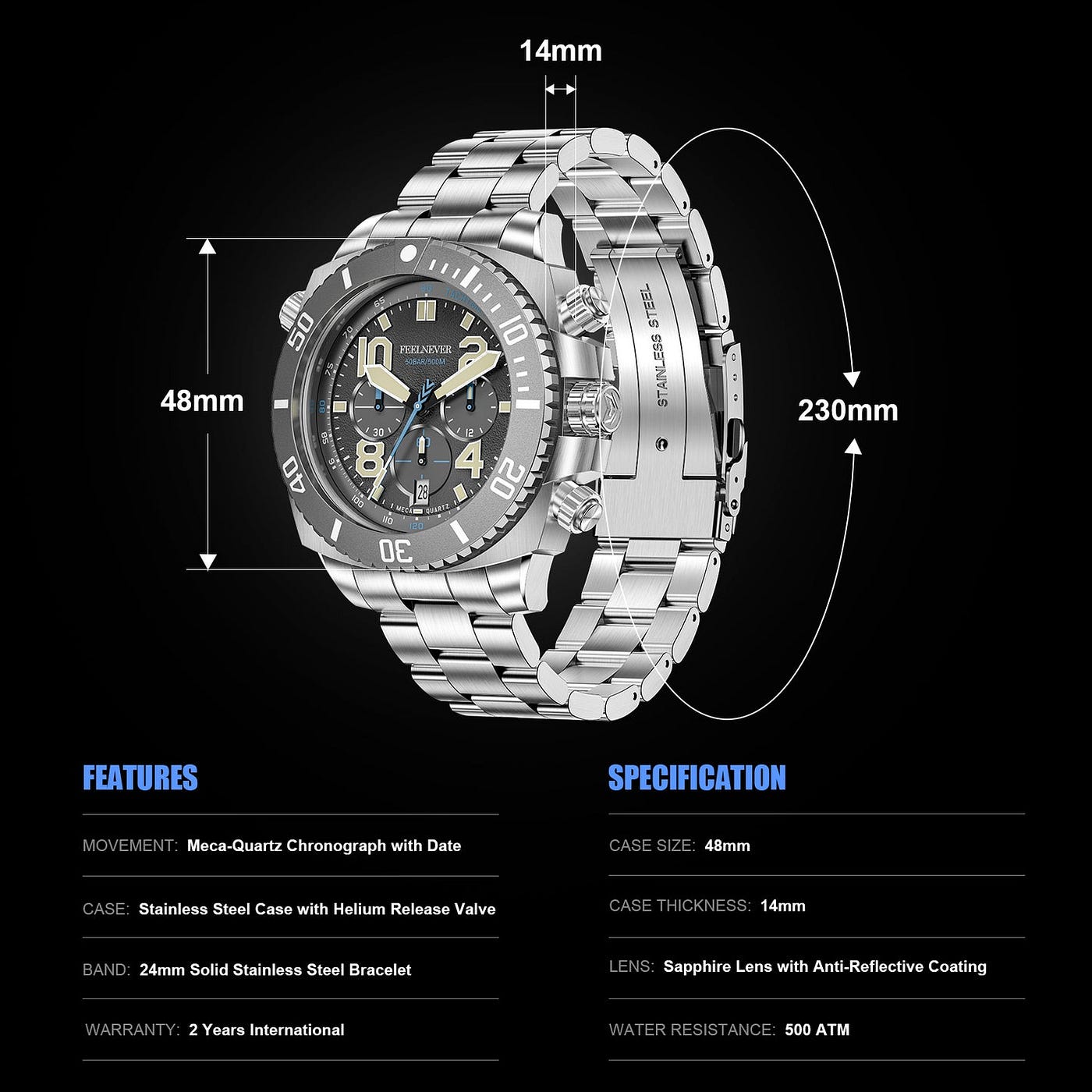
The office (days 1–9). The doubt was size: 48mm across a conference table sounds loud. The reality was thickness — at 14mm, the case slides under a business shirt cuff instead of pinning it open, and that single clearance is the difference between “wearing a dive watch to work” and “wearing a watch to work.” The dark dial and steel case read neutral across a desk; the sub-dials scan as instrumentation, not decoration. Nobody commented, which was the point.
Evenings and one wedding reception (days 10–16). Sleeves down, bracelet snug, the chronograph passed everywhere short of black tie. A tool watch with a clean, legible dial reads as intentional — a choice, not a leftover from the gym. The anti-reflective sapphire mattered more than expected in restaurant lighting: no glare flash across the table when the wrist moves.
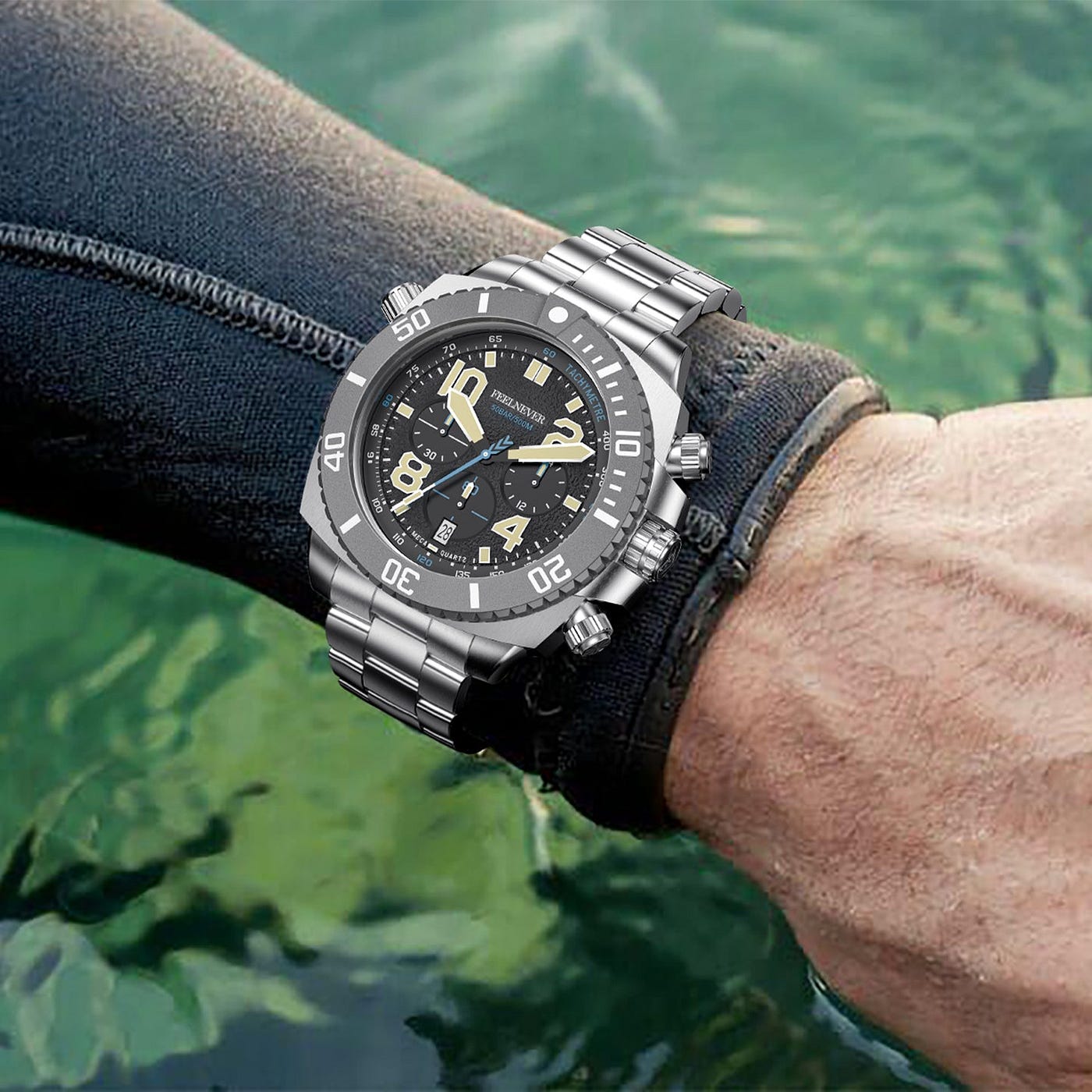
The water (days 17–30). Beach, pool, a hike that turned into weather. This is where the experiment stops being about style: pushers locked, crown down, and the watch simply came along — 500M/50BAR of margin means a swim is a rounding error. Everyone else’s watch was in a shoe on the sand. That contrast, more than any outfit, is what “office-to-ocean” actually looks like.
The Design Math Behind the Crossover
A watch crosses dress codes on four specs, and it’s worth naming them because they generalize to anything you shop:
- Thickness under 15mm. Cuff clearance is the hard gate for office wear. The AbyssForce’s 14mm — lean for a 500M chronograph — is the spec doing the most styling work.
- A legible, low-noise dial. Dark base, high-contrast hands, no novelty colors. Neutral dials borrow formality from whatever’s around them.
- Steel and sapphire. 316L and anti-reflective sapphire look correct at a desk and survive a reef. Materials are the wardrobe.
- A rating that ends the question. 50BAR with screw-down pushers means water plans never require watch plans.
Miss any one of the four and the watch develops a “wrong room” — the place you hesitate to wear it. Hesitation is what a second watch is really for.
The Styling Rules, Occasion by Occasion
Business and business casual: bracelet, sized snug, sleeve down. Let the watch appear when you reach for something; a dive chronograph discovered reads better than one displayed.
Smart casual and evenings: this is the sweet spot — open collar, knit, or blazer, where a purposeful tool watch outdresses a timid one.
Weekends and travel: the watch’s home turf. This is also where the chronograph earns its keep — parking meters, boarding windows, grill timing. Complications you use beat complications you explain.
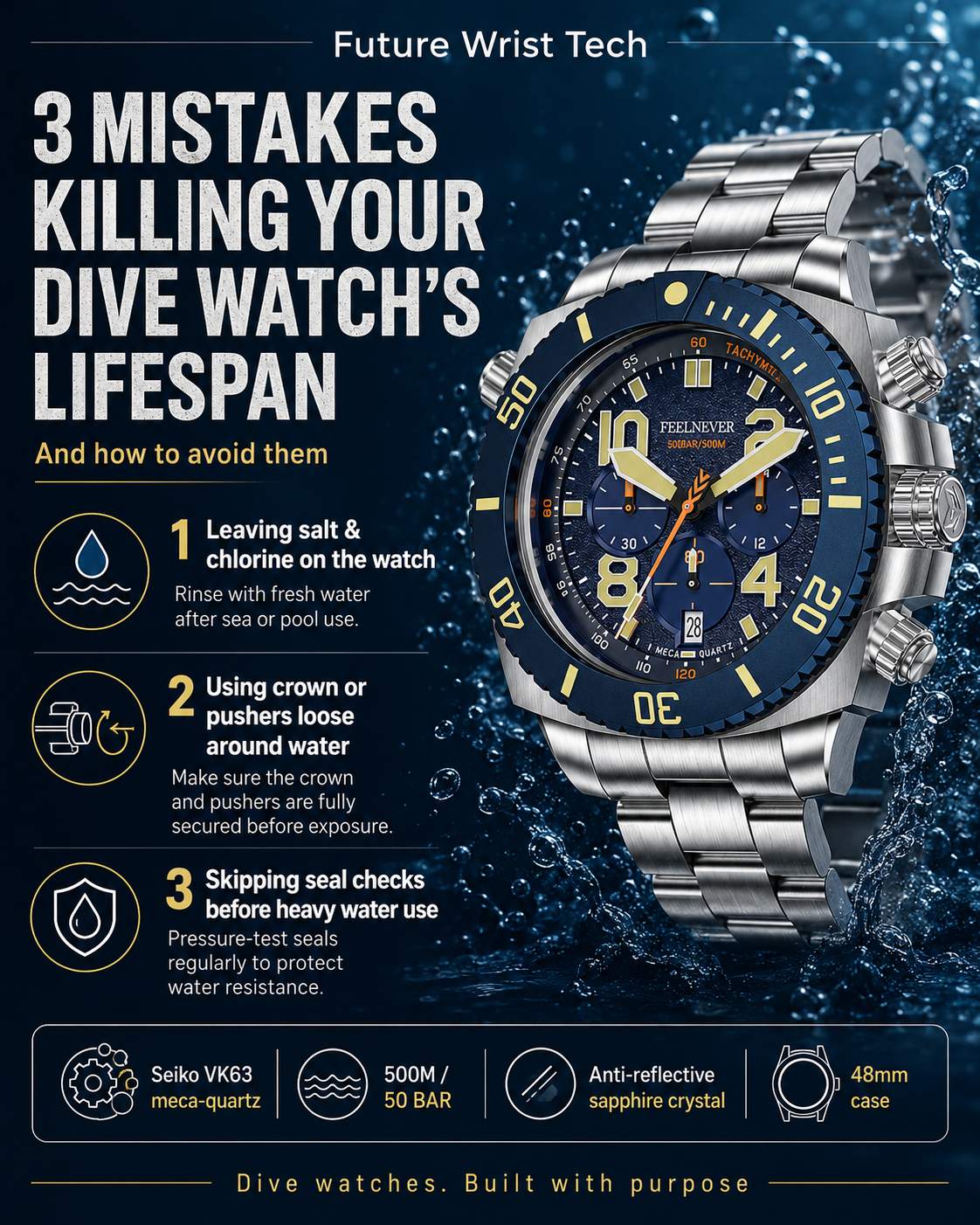
Actual water: lock the pushers, screw the crown, go. Rinse after salt. The styling rule here is that there isn’t one.
The honest exclusion — black tie: a 48mm tool watch at a tuxedo event is a statement, and you should only make statements on purpose. If your calendar is regularly formal, that’s the one gap this watch won’t close.
Strap Strategy: One Watch, Three Personalities
If there’s a cheat code in the one-watch life, it’s the strap drawer. Same case, three registers:
The steel bracelet is the default and the most formal option this watch owns — it’s what carried the office weeks and the wedding reception. Keep it sized snug; a loose bracelet reads careless at a desk and feels twice its 270 grams everywhere else.
Rubber is the summer and water setting. It sheds salt and sunscreen, drops meaningful weight off the wrist, and visually casualizes the whole watch in one swap. If your July is mostly pools and travel, this is the July configuration.
What to skip: leather. On a watch that’s genuinely going in the water, leather is a contradiction — it styles beautifully and dies wet. If you want the leather look for a dry season, treat it as occasional wardrobe, not daily equipment.
A quick-change spring bar setup makes the swap a 30-second decision instead of a toolkit project, which is the difference between a strap strategy you use and one you own.
The One-Watch Test
Considering any watch for the whole-life role? Score it in sixty seconds:
- Under 15mm thick? If not, the office door is already closing.
- Dial neutral enough for a desk, legible enough for a pool? Both, not either.
- Rating and seals good enough that water never changes your plans? In BAR, with the penetrations locked.
- One honest exclusion or fewer? Every watch has a wrong room. One is livable; three means you’re rebuilding the watch box you were escaping.
The AbyssForce passes at three and a half — black tie being the half — which, over 30 days, translated to exactly zero mornings spent choosing a watch.
Key Takeaways
- One watch can cover office-to-ocean, but the crossover is a spec sheet: thickness, dial, materials, rating
- 14mm is the number doing the styling work — cuff clearance decides office credibility more than diameter does
- Neutral, legible dials borrow formality; the same watch reads corporate at a desk and capable at a reef
- Water should never require a wardrobe decision — that’s what the rating and screw-down pushers are for
- Every watch has one wrong room; know yours (here: black tie) and the anxiety disappears
Thirty days later, the two-watch life looks like what it always was: a solution to picking the wrong specs the first time. For the complete occasion-by-occasion rulebook — including the situations we didn’t hit in 30 days — our guide on when to wear a dive watch covers seven rules for every occasion: futurewristtech.com/blogs/news/when-to-wear-a-dive-watch-7-rules-for-every-occasion
And to run the one-watch test against the full AbyssForce 500M sheet — 48mm x 14mm, VK63 meca-quartz, 50BAR, screw-down pushers, anti-reflective sapphire — click link in bio
메타데이터
- post_id
- 7b4bf0152a35
- slug
- chronograph-watch-style-office-to-ocean-in-one-watch-7b4bf0152a35
- url
- https://medium.com/@futurewristtech123/chronograph-watch-style-office-to-ocean-in-one-watch-7b4bf0152a35
- canonical_url
- https://medium.com/@futurewristtech123/chronograph-watch-style-office-to-ocean-in-one-watch-7b4bf0152a35
- author_url
- https://medium.com/@futurewristtech123
- status
- ok
- fetched_at
- 2026-07-16 19:47:57