Why Most Law Firm Websites Fail to Convert Google Visitors |And What Actually Fixes It
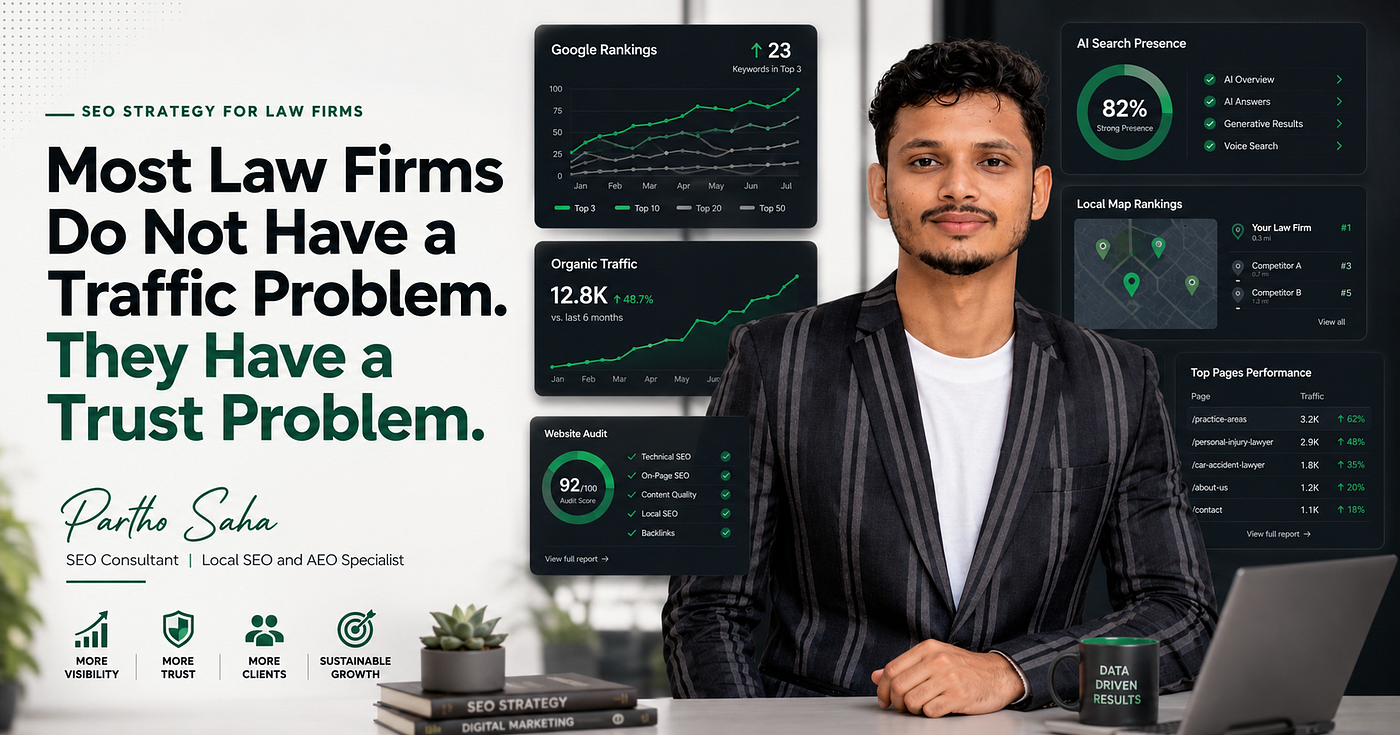
Most law firm websites don’t have a traffic problem. They have a persuasion problem.
Why Most Law Firm Websites Fail to Convert Google Visitors |And What Actually Fixes It

Most law firm websites don’t have a traffic problem. They have a persuasion problem.
They rank on Google. They get clicks. They even get decent impressions. Yet the phone doesn’t ring, the contact forms stay empty, and potential clients quietly leave within seconds. If that sounds familiar, it’s not bad luck, it’s structural failure.
I’ve seen this pattern repeat across small boutique firms, mid-sized practices, and even high-budget legal brands that clearly invested in SEO. The gap is almost always the same: marketing brings people in, but the website doesn’t know how to turn those people into clients.
And here’s the uncomfortable truth most agencies won’t say out loud: legal websites are often built like digital brochures, not conversion systems. They’re designed to “look professional,” not to influence decisions.
This article breaks down exactly why law firm websites fail to convert Google visitors and what needs to change if you actually want cases, not just clicks.
Why law firm websites fail to convert Google visitors is that they prioritize appearance over persuasion, treating the site like a static brochure instead of a decision-making tool. Google visitors arrive with urgency and comparison intent, but most law firm pages fail to guide them, reassure them, or remove friction, causing rapid exits instead of consultations.
Let’s be direct: most legal websites are built to impress other lawyers, not to convert stressed-out people searching for help at 11 PM.
A Google visitor is not casually browsing. They’re usually dealing with something urgent injury, criminal charges, family disputes, financial pressure. Yet they land on pages filled with abstract messaging like “trusted advocates since 1998” and generic stock imagery.
There’s a mismatch between emotional urgency and informational blandness. That mismatch kills conversions.
Instead of answering “Can you solve my exact problem?” The site talks about itself. Instead of reducing uncertainty, it increases cognitive load. Visitors are forced to search for relevance instead of being guided toward it.
If your homepage doesn’t immediately answer three things what you do, who you help, and what happens next you’re already losing most of your traffic.
The biggest conversion gap comes from mismatch between search intent and website messaging because law firm pages often target broad keywords but fail to align content with what users actually want at that moment. Google users are looking for specific answers, reassurance, and next steps, not general firm descriptions or legal history.
A person searching “car accident lawyer near me” is not in research mode. They are in decision mode.
But most law firm landing pages respond like academic essays. They explain practice areas in vague language, bury key information below long introductions, and delay the answer users came for.
This creates instant friction. The visitor thinks: “Am I in the right place?” If that question isn’t answered within 5–10 seconds, they leave.
Strong conversion-focused pages mirror intent. They match the exact language of the search query. They immediately confirm its relevance with phrases like “If you’ve been injured in a car accident, here’s how we can help today.”
The goal is not to educate broadly, it’s to confirm relevance quickly and reduce doubt.
Firms that fail here are essentially paying for clicks that their own messaging actively rejects.
Poor user experience and lack of trust signals destroy conversions because legal decisions require high confidence, and slow, cluttered, or outdated websites create doubt about professionalism. If a site loads slowly, looks dated, or is hard to navigate on mobile, users assume the firm is equally outdated or unresponsive and leave immediately.
Speed matters more than most lawyers realize.
A 2–3 second delay is enough to lose a potential client who is already anxious and comparing options. And yet many law firm websites are overloaded with heavy images, outdated plugins, and unoptimized scripts.
Then comes mobile experience. Most legal traffic now comes from mobile devices, but many sites still feel like desktop pages squeezed onto a smaller screen. Tiny text, hard-to-tap buttons, and buried contact options make conversion unnecessarily difficult.
Trust is also visual. Visitors subconsciously judge credibility based on layout quality. If the design feels outdated, they assume the legal service will be too.
Add missing essentials like visible phone numbers, clear office locations, and fast-access consultation buttons, and you create a credibility gap that never gets closed.
In legal services, uncertainty kills action. UX either reduces uncertainty or amplifies it. Most sites accidentally do the latter.
Weak content strategy and SEO mismatch reduce conversions because ranking pages often attract traffic with general informational keywords rather than high-intent service queries. When content is written for search engines instead of real client concerns, it attracts visitors who are not ready to convert or fail to guide qualified users toward contact actions.
A lot of firms think SEO success equals business success. It doesn’t.
You can rank for “what to do after a car accident” and still not get clients. Why? Because informational traffic is early-stage. Those users are looking for answers, not lawyers.
Meanwhile, your service pages, the ones that should convert are often underdeveloped. Thin content. Weak headlines. No emotional alignment. No clarity on outcomes.
There’s also a content disconnect: blogs bring in curiosity traffic, but service pages are not built to capture or transition that attention.
The result is a leaking funnel. Traffic enters at the top, wanders around, and exits without ever being guided toward a decision.
Good legal content strategy does two things:
- Attracts the right intent
- Funnels that intent toward a clear conversion path
If your content doesn’t lead somewhere, it’s just noise.
Missing conversion architecture is the silent reason law firm websites fail because even when visitors are interested, they are not guided toward action through clear calls-to-action, structured funnels, or strategically placed contact opportunities. Without frictionless pathways like click-to-call buttons or simplified forms, potential clients drop off before engaging.
Most law firm websites treat contact forms like an afterthought.
You’ll often find a single “Contact Us” page buried in the navigation. Sometimes a form with 10+ fields. Sometimes no phone number is visible until the footer.
That’s not a funnel; that’s a barrier.
High-converting websites make action obvious and effortless. Every key page should have multiple conversion points: sticky call buttons, short forms, and clear consultation prompts.
And psychology matters. A visitor doesn’t want to “submit a request.” They want reassurance: “Talk to a lawyer today,” “Get a free case review,” or “See if you have a claim.”
The difference is subtle but powerful. One feels like paperwork. The other feels like help.
If users have to think about how to contact you, you’ve already lost them.
Lack of trust and credibility signals prevent conversions because legal services require high emotional assurance, and visitors look for proof through reviews, case results, recognitions, and transparent attorney profiles before committing to contact. Without visible social proof and humanization, even well-designed sites fail to overcome skepticism.
People don’t hire law firms they hire certainty.
And certainty comes from proof.
Most law firm websites underuse testimonials, case outcomes, and attorney credibility signals. Or worse, they bury them on separate pages nobody visits.
Visitors want reassurance in the moment of doubt, not hidden behind navigation menus.
Strong trust signals include:
- Visible client reviews near CTAs
- Real attorney photos (not stock imagery)
- Clear case experience summaries
- Recognitions and affiliations (used sparingly, not as decoration)
But there’s another layer: human presence.
A faceless firm feels risky. People want to know who will actually handle their case. If your website doesn’t show real humans with real authority, it creates psychological distance.
In legal services, distance equals hesitation. And hesitation kills conversion.
How to fix law firm website conversion problems is by rebuilding the site as a decision system rather than a digital brochure, focusing on intent alignment, speed, trust signals, and frictionless conversion pathways. Successful redesigns prioritize user psychology first, then design, then SEO structure, ensuring every page guides visitors toward a single clear action.
Fixing this isn’t about adding more pages or rewriting a blog.
It’s about restructuring the entire flow.
Start with intent mapping. Identify what users are thinking when they land on each page. Then redesign the page to answer that thought immediately.
Next, simplify everything. Reduce navigation overload. Remove unnecessary sections. Increase clarity above aesthetics.
Then rebuild conversion paths:
- Add visible call buttons everywhere
- Shorten forms aggressively
- Reframe CTAs around outcomes, not actions
Finally, reinforce trust continuously, not occasionally. Every scroll should reduce doubt, not introduce it.
The best law firm websites don’t feel like websites. They feel like guided conversations that end in one natural step: “Call now.”
If your site doesn’t do that, it’s not performing, it’s just existing.
The real problem isn’t traffic it’s trust under pressure
Law firm websites don’t fail because people aren’t interested. They fail because interest isn’t being converted into confidence.
Google brings you people who already need help. Your website decides whether they believe you are the right help.
If that bridge is weak, if messaging is vague, speed is poor, trust is thin, or action is unclear then no amount of SEO will save it.
Fixing conversion is not a cosmetic task. It’s a structural one. And firms that understand that shift stop chasing more traffic and start turning existing traffic into real cases.
메타데이터
- post_id
- 7b55cd9d62c0
- slug
- why-most-law-firm-websites-fail-to-convert-google-visitors-and-what-actually-fixes-it-7b55cd9d62c0
- url
- https://medium.com/@parthosaha-seo/why-most-law-firm-websites-fail-to-convert-google-visitors-and-what-actually-fixes-it-7b55cd9d62c0
- canonical_url
- https://medium.com/@parthosaha-seo/why-most-law-firm-websites-fail-to-convert-google-visitors-and-what-actually-fixes-it-7b55cd9d62c0
- author_url
- https://medium.com/@parthosaha-seo
- status
- ok
- fetched_at
- 2026-08-12 18:19:41