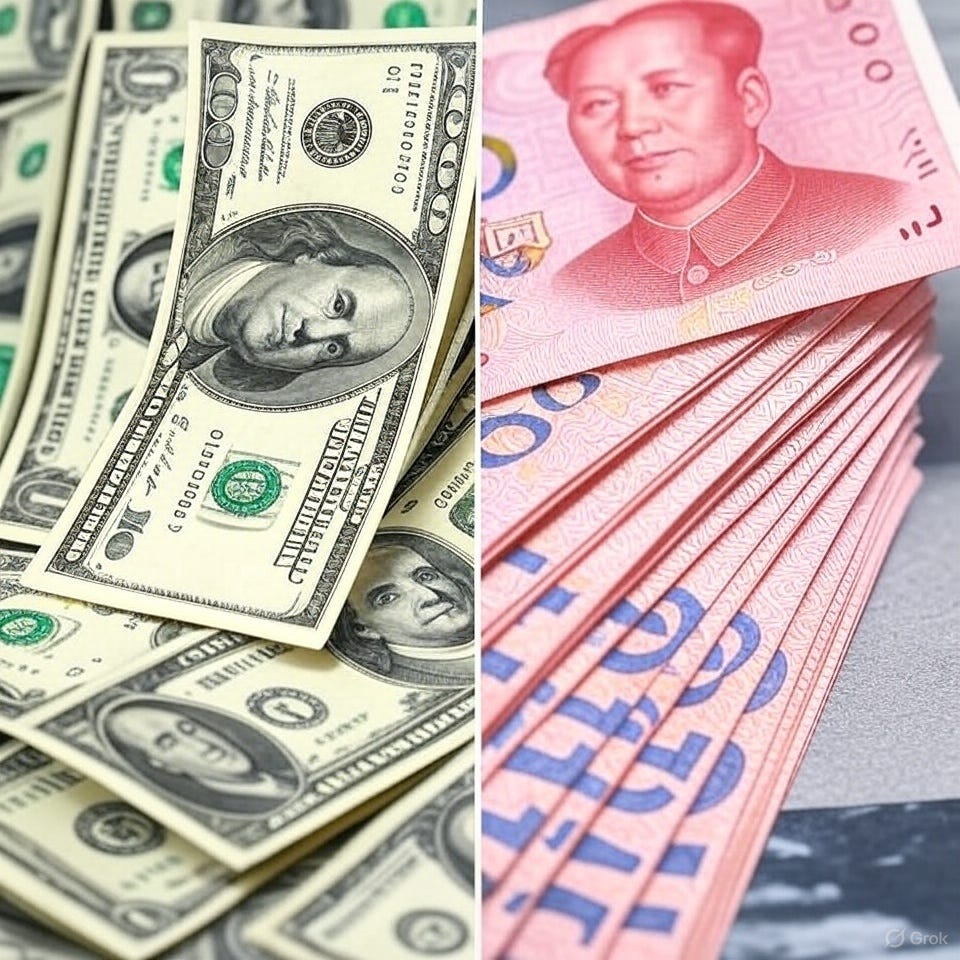
China’s Central Bank Is Rewriting Its Reserve Portfolio
Twenty months and counting
China’s Central Bank Is Rewriting Its Reserve Portfolio
Twenty months and counting
China’s central bank added 480,000 troy ounces of gold in June 2026, pushing its total holdings to 75.44 million troy ounces, or 2,346 tonnes, according to data published by the State Administration of Foreign Exchange. That brought the People’s Bank of China’s consecutive buying streak to twenty months, running without interruption from November 2024 through June 2026.
The June purchase sits comfortably within the monthly pattern SAFE has reported throughout this period. There is nothing exceptional about the June number on its own. What is exceptional is the length of the run. Twenty consecutive months of additions is the longest sustained buying streak the PBOC has recorded since 2015, and the cumulative weight now positions China as one of the largest official holders of gold anywhere in the world.
The month those purchases were accumulating, China’s foreign exchange reserves fell to $3.4163 trillion, down $26 billion from the May figure of $3.4423 trillion, missing the consensus forecast of $3.44 trillion. Currency market observers attributed part of the decline to U.S. dollar index movements affecting the valuation of non-dollar assets held within the reserve pool. But the direction of travel is what matters more than the monthly arithmetic.
Photo by Jingming Pan on Unsplash
The composition shift inside the headline number
The apparent contradiction between a falling reserve total and rising gold holdings resolves the moment you look at the portfolio rather than the aggregate. Even as total foreign exchange reserves dropped $26 billion in June, China’s gold allocation kept expanding. The two facts are not in tension. They describe a deliberate reweighting: gold is going up, and the overall pool is shrinking, which means gold’s share of the portfolio is rising faster than the tonnage figures alone would suggest.
Gold still accounts for less than 10% of China’s officially reported reserve portfolio, according to the World Gold Council. Estimates from different sources and reporting periods place the figure somewhere between 6.5% and 9.6%, depending on when the calculation was made and which valuation methodology was applied. That range reflects how quickly the composition is shifting rather than any fundamental disagreement about the underlying data. Either way, the number sits well below the gold allocation typical of the largest Western reserve holders, which means China has substantial room to continue reweighting before gold becomes a dominant share of the portfolio.
Speculation about unreported or strategically concealed Chinese gold holdings circulates regularly in commodity markets. Those estimates, which run from 5,000 to 30,000 tonnes in some analyst scenarios, are outside the scope of what SAFE officially reports. The figures cited here refer to officially reported reserves only. Whatever the actual total might be, the direction of official accumulation is not in doubt.
Why this is not a gold trade
Most coverage of the PBOC’s buying streak frames it as a bullish signal for gold prices. That framing misreads what China is doing. The purchases are not an expression of conviction about gold’s price trajectory. They are a capital defense move, structured to reduce the portion of China’s national savings that sits in assets a foreign government could freeze.
The logic became legible in February 2022, when the United States and its allies froze approximately $300 billion of Russian central bank reserves held in Western financial infrastructure, in response to the invasion of Ukraine. China watched a sovereign reserve pool, one built over decades, become inaccessible in a matter of days. For Beijing, the lesson was straightforward: dollar-denominated assets held in Western custodial systems carry a sanctions risk that gold held domestically does not.
Evidence suggests China is increasingly pursuing reserve diversification with that risk explicitly in mind, according to analysis from the Council on Foreign Relations and Foreign Policy. The People’s Bank of China has not issued explicit policy statements framing gold purchases as a sanctions defense. The motivation is inferred from the timing, the geopolitical context, and the internal logic of reserve restructuring. But the inference is a short one.
The broader strategy appears to involve three simultaneous tracks: accumulating gold as a reserve asset insulated from Western financial infrastructure, internationalizing the yuan through bilateral trade agreements and swap lines, and developing alternative payment networks that route transactions outside SWIFT. Gold is one component of that effort, not the whole of it.
Photo by Christian Lue on Unsplash
What the CFR critique actually says
The Council on Foreign Relations has published analysis characterizing China’s de-dollarization efforts as partially illusory, arguing that dollar assets are being shifted to less transparent entities rather than genuinely eliminated from China’s exposure. The CFR framing deserves a precise reading. The critique is not that de-dollarization is not happening. It is that dollars have not disappeared from China’s economic system. They have moved to entities that are harder to track. That is a different claim.
A partial reallocation of reserve composition is still a reallocation. If China’s central bank holds fewer dollars and more gold within its official reserve portfolio, the composition has changed regardless of what other dollar exposure exists elsewhere in the Chinese financial system. The CFR critique is a meaningful complication of the strongest versions of the de-dollarization narrative, particularly the version that imagines China replacing the dollar as the world’s reserve currency. Foreign Policy reported in June 2026 that China’s de-dollarization drive has hit structural limits, and CNBC noted that China does not need to dethrone the dollar to achieve its narrower strategic objectives.
That narrower objective, reducing the vulnerability of China’s sovereign reserves to Western financial pressure, does not require replacing the dollar globally. It requires reducing the fraction of reserves that Western governments could immobilize. Twenty months of gold purchases is a practical step toward that goal, not a declaration of dollar war.
The number that remains unanswered
The World Gold Council’s data on central bank gold reserves tracks official purchases across more than fifty countries, and its June 2026 survey found that more central banks signal plans to increase gold holdings than at any point in recent memory. China is the most visible buyer, but not the only one.
What the data does not answer is where China’s buying streak ends. The twenty-month run has proceeded at a pace of roughly 15 tonnes per month. At that rate, the PBOC would cross 2,500 tonnes sometime in the second half of 2027, assuming no acceleration. Gold would still represent less than 10% of officially reported reserves even then, given current reserve valuations. The structural argument for continued accumulation, reducing sanctions exposure, does not disappear at any particular tonnage threshold.
China’s total foreign exchange reserves stood at $3.4163 trillion at the end of June 2026, according to SAFE. The gold within that pool was worth considerably more per ounce than it was when the buying streak began in November 2024. Whether Beijing is content to let gold’s rising price do the portfolio reweighting work, or whether it will continue purchasing at the same monthly pace regardless of price, is the question that June’s numbers raised without resolving.
메타데이터
- post_id
- 7b7dd5ca7829
- slug
- chinas-central-bank-is-rewriting-its-reserve-portfolio-7b7dd5ca7829
- url
- https://medium.com/the-geopolitical-economist/chinas-central-bank-is-rewriting-its-reserve-portfolio-7b7dd5ca7829
- canonical_url
- https://medium.com/the-geopolitical-economist/chinas-central-bank-is-rewriting-its-reserve-portfolio-7b7dd5ca7829
- author_url
- https://medium.com/@flappo.business
- status
- ok
- fetched_at
- 2026-07-13 06:23:13