3i/ATLAS. Debunking the Comet’s typography
Things got spooky when a picture of Uluru slipped across my YouTube feed.
3i/ATLAS. Debunking the Comet’s typography
Things got spooky when a picture of Uluru slipped across my YouTube feed.

left: Uluru (Wiki commons) Right: 3i/ATLAS (amateur telescope. 9 Sept. 2025)
This geological wonder has some uncanny similarities with our interstellar visitor (3i/ATLAS) that could change the way that we relate to it? What you are about to read turns everything upside down!
We analyse the data.
Our analysis is based on amateur telescope data of the comet from late July 2025, when its distance from the sun gave greater visibility a chance. Many other telescopes were successfully capturing the comet with significant detail. However, not many researchers had the inclination to analyse their pickings, meaning that a lot of valuable detail gets discarded or is still there waiting to be analysed.
Researchers analysing space photography are at risk of ‘Pareidolia’. This is the general tendency to perceive meaningful connections, patterns, or images in random, vague, or ambiguous data.
Because the human brain is an aggressive pattern-recognition engine, when faced with gaps in visual information (such as noise in digital space images or low-resolution pixels), the brain struggles to process the uncertainty. This makes it possible to see an alien riding a hover board on mars.
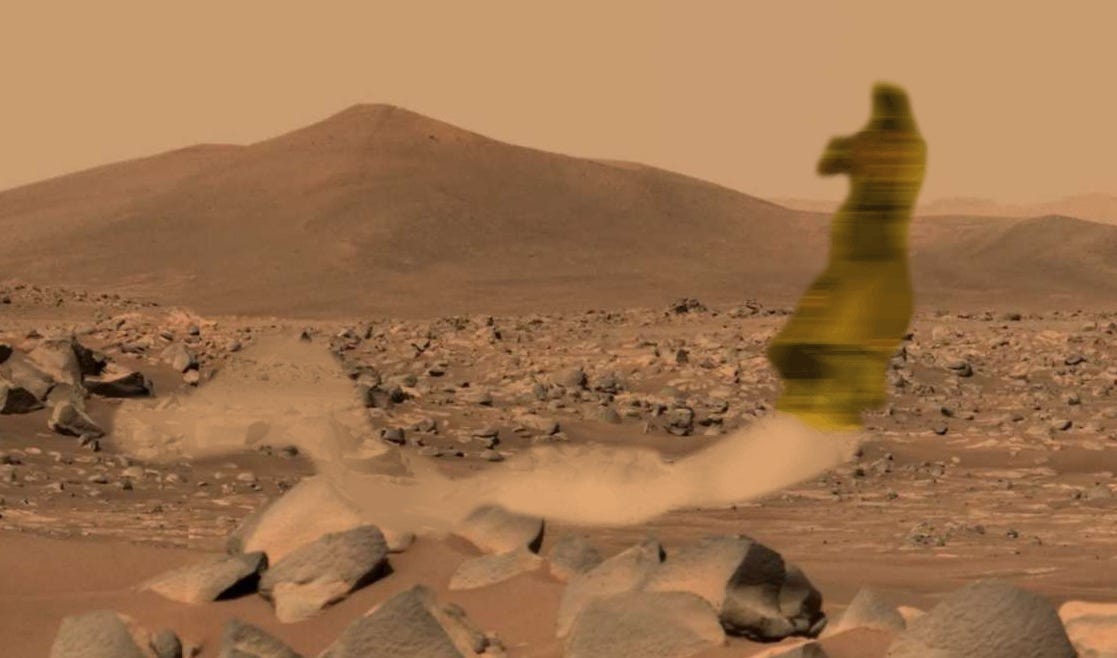
image credit: back ground image NASA (open source). Overlay: example of a Pareidolia effect.
Back to the 3i/ATLAS. The closer the comet came to the sun the bigger and denser its coma became. This is why no telescope captured any structural details apart from signs on the surface of the coma that indicated a structure of sorts rotating and spinning beneath.

hints of a structure covered by the Coma
One of the best images (in my opinion) of 3i we have to date is a top view. This to me is one such image that could evoke Pareidolia ‘paranoia’. However, my analysis shows that there is enough recognisable data to leave the condition aside.
We take a closer look.

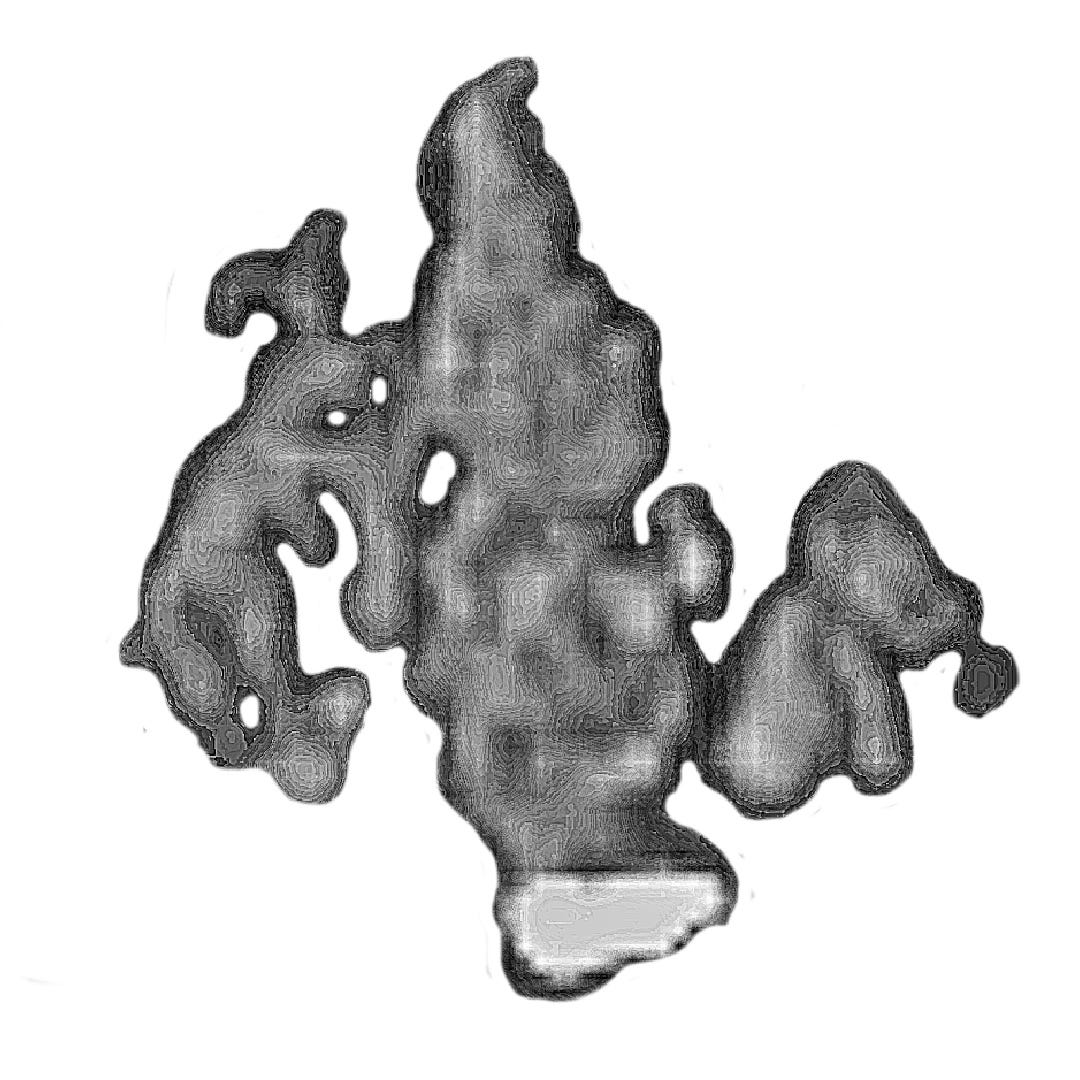
3i/ATALS. (late July 2025) Amateur Telescope (Ray’s Astrophotography/Texas). Forensic image analysis by AF Full Spectrum Forensics
When we analyse this image we get to see the contours that signal the layout of the comets structure and its significant landmarks like high points, deep wells, steep valleys, cliffs and gentle slopes. We also have access to data captured early in August 2025 that indicate the signal of a front view, a left side view and a right side view.

From this data we created a cross section of the comet. At the time, scientists were speculating that the object was more disc-like in its cross section than the standard comet shape and our analysis has shown this to be the case. The object is flatter than what it is high, however its disc-likeness is only seen in a cross section or the full front view. The layout of the land so to speak can be clearly seen in this top view where a series of four-sided geometric shapes placed together in a grid-like formation construct the overall signal shape of the object.
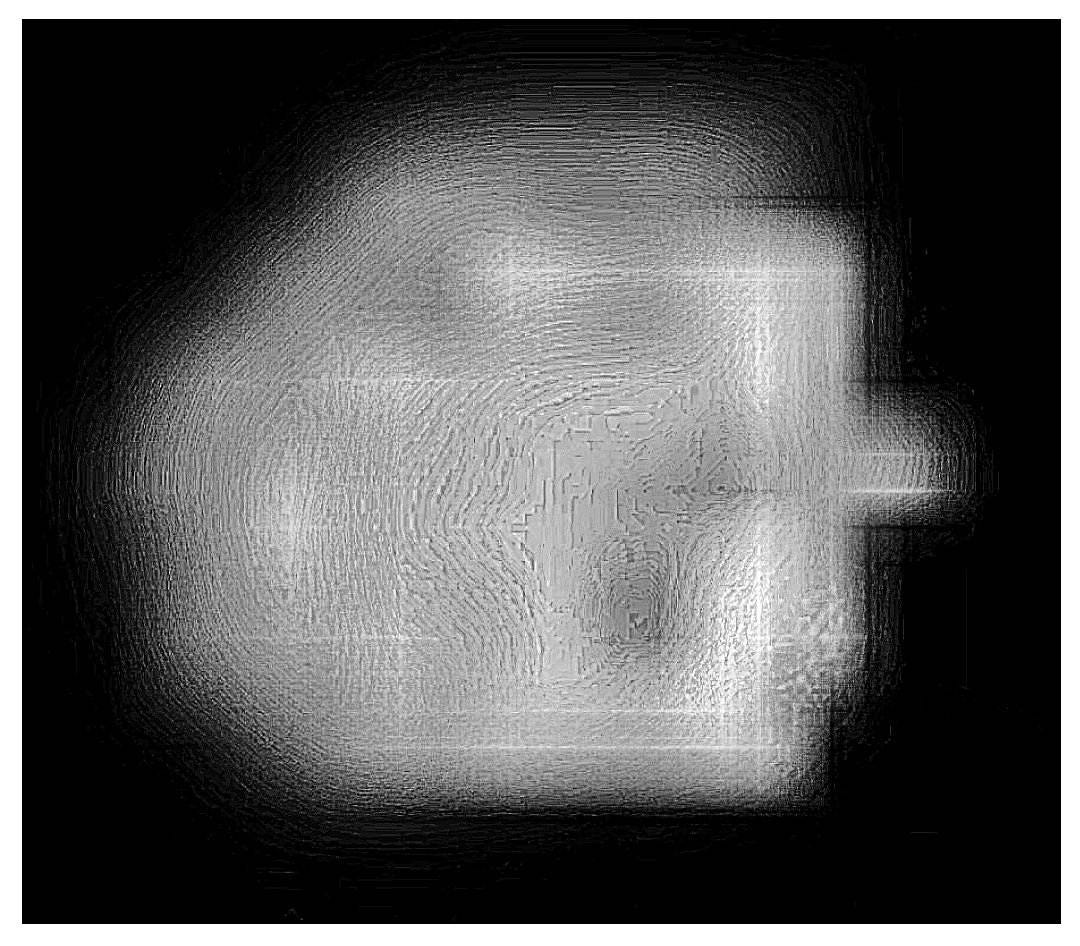
geometric grid-like pattern / formation

illustration: Front View
For this presentation, I would like to introduce Uluru into the story. This geological phenomena carries similarities with comet 3i. Uluru, an ‘inselberg’ or island mountain that formed around 550 million years ago in the centre of Australia. What I am about to tell you is important as it gives you an idea from where I am drawing parallels and it will help you to understand the possibilities of how 3i could be associated with first nation history.
We look at the term ‘Inselberg’/ island mountain. In the case of 3i we would call it a ‘sky island’. In both geological phenomena we see visual similarities in sediment formation. However seeing that 3i is estimated by scientists to be a couple of billion years old I doubt that it would be a sedimentary layering like Uluru, probably being more than likely a ‘stromatolite’ formation.

Uluru has a vertical formation while 3i has a horizontal formation. However, what is significant between the two is the reddish tint on Uluru that signifies the presence of iron oxide. (Please note that I am not drawing up similarities in chemical make up but rather in visual geological similarities).

Uluru. (image source: NASA)

Between 400 and 350 million years ago, a separate tectonic event called the Alice Springs Orogeny folded and buckled the Earth’s crust. The horizontal layers of the buried Mutitjulu Arkose were squeezed so fiercely that they fractured and flipped nearly 90 degrees vertically.
Over the last 300 million years, the sea receded and the surrounding landscape was subjected to continuous wind and water erosion. The softer, surrounding sedimentary layers wore away quickly. The vertical layers of the arkose sandstone being incredibly hard lacked structural joints or faults, making them highly resistant to erosion. This left Uluru standing proudly above the desert plains, with its bulk extending at least 2.5 to 6 kilometres underground.
At this point we deviate from the Uluru/ 3i/Atlas comparison and enter the chemistry and physical structure of the comet’s geology.

On 3i at the time that the image was captured in late July 2025, the colour of the comet was a reddish tint, the signal of a specific Chemistry: This red colour is driven by complex organic compounds called ‘tholins’. Tholins are not a single chemical, but a “soup” of carbon-rich, heavy organic molecules. The cause of this resulted over millions of years in interstellar space when cosmic rays bake methane and carbon dioxide ice on the comet’s surface. This radiation creates a dark, reddish crust. At this early stage, the comet’s coma was primarily composed of old, reflective organic dust.
We understand that the reddish tint on the surface of the comet at that point in time, was composed of methane and carbon dioxide. However, we don’t know if that chemistry resides below the surface or not. What is visible however, is the location of two distinct features that add a clue to this. These are the location of two deep pits. Their colour signals a gradation of red becoming darker as the pit deepens. The sides of the two pits hold the signal of sedimentary layers and give us a possible clue as to how what lurks in the depths of the comet.
Apart from these two pits, there are, as seen in a Hubble image from early August, the locations of fissures or caves across the surface of the comet that have been observed to emit gas. These have been recognised and are referred to by scientists as ‘gas jets’. The exact locations of these gas jets on the comet’s body have not been scientifically acknowledged. However, our analysis brings you these exact locations, thanks to Hubble telescope. It is an image containing enough data to keep Pareidolia at bay, however you need the help of the other view points in order to maintain your path of vision.
So we know that there are fissures, caves and open pits that signal entry points into the inside of the comet. I would speculate that the presence of these signifies an underground network of tunnels or caves that run the length and breadth of the comet.
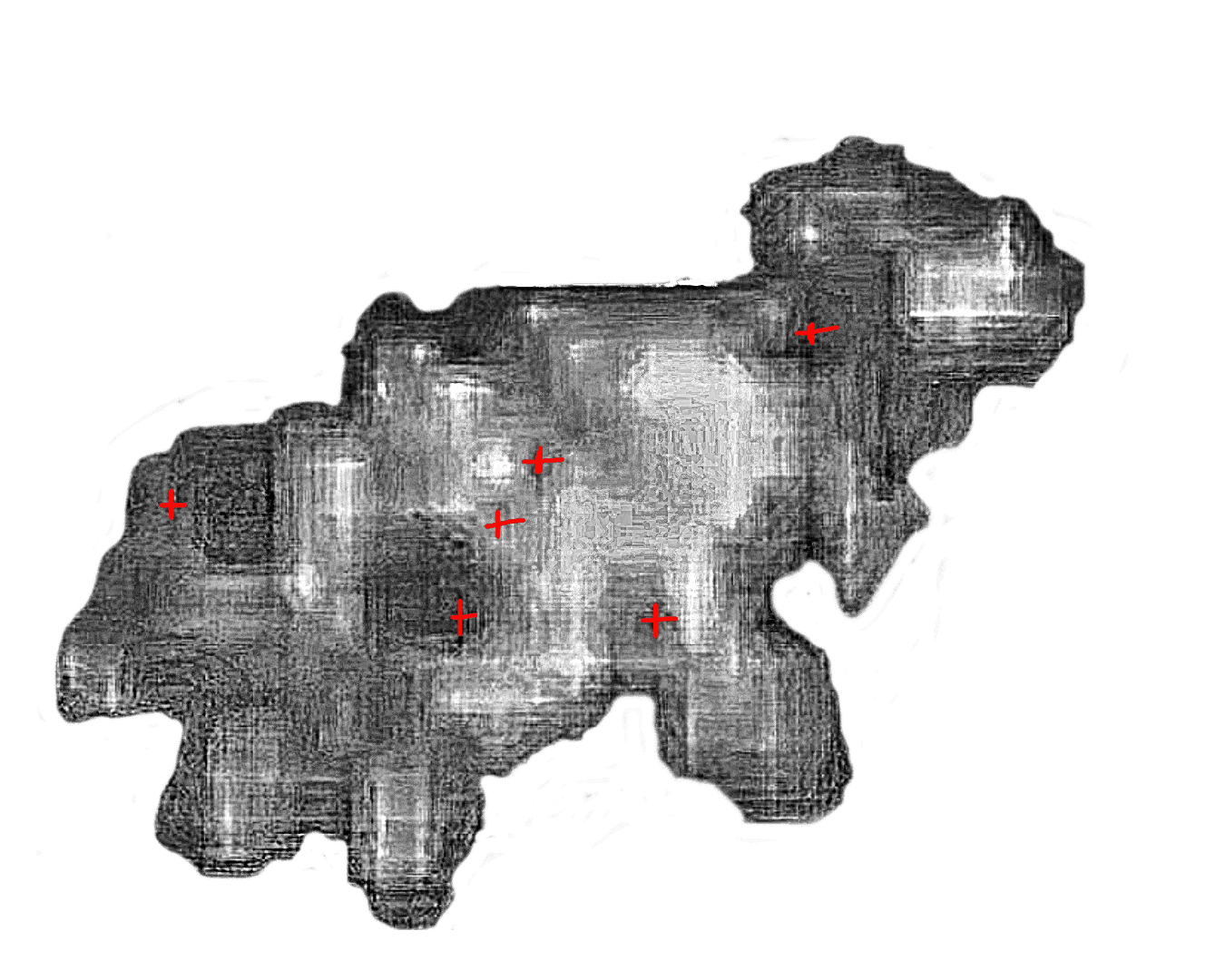
Gas Jet / Fissure locations. Image source: Hubble telescope
When we analyse the type of typography seen on the comet we see an association with a ‘Karst’ formation.
As a side note. On earth, Karst chemistry of dissolution is as follows: Associated features are caused by carbonic acid. Rain passing through Earth’s atmosphere picks up carbon dioxide which readily dissolves in the water. Once the rain reaches the ground, it may pass through soil that provides additional CO2 produced by soil respiration. Some of the dissolve carbon dioxide reacts with the water to form a weak carbonic acid solution, which dissolves calcium carbonate.
We know that scientists have detected carbon dioxide, hydrogen and oxygen in the comets coma. The chemistry of these are suggested contributors to the cave system of the 3i/ATLAS.
The varied colour distribution across the Karst-like terrain of comet 3I/ATLAS offers a fascinating glimpse into its volatile activity and surface composition.
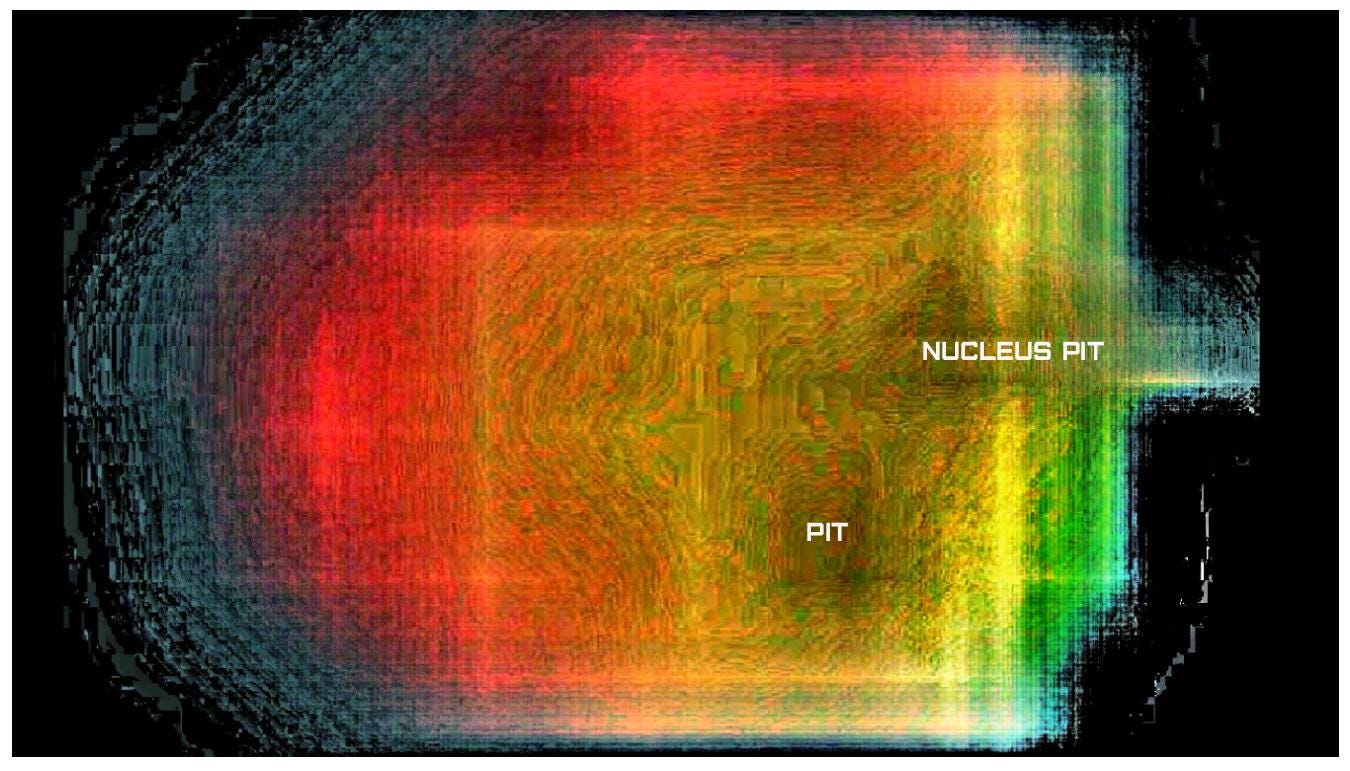
Here is a brief analysis of how these geological features correlate with the observed colour tints:
Depressions and Pits (Dark Yellow-Orange-Brown).
The darker yellow, orange, and brown hues concentrated within the pits, fissures, and deep valleys suggest the accumulation of heavier, complex organic molecules, often referred to as tholins.
- These compounds form when simple gases are exposed to solar ultraviolet radiation.
- Depressions act as natural cold traps where these less volatile, darker materials settle and remain protected from solar wind stripping.
High-Altitude Areas and Cliffs (Bright Red or Yellow)
The bright red and vibrant yellow tints on the elevated planes and cliff faces likely indicate freshly exposed surfaces or areas of active sublimation.
- The reddish tint is highly characteristic of pristine organic sub-surface material or iron-bearing silicates that have been suddenly exposed due to mass wasting or cliff collapses as the comet responds to thermal stress.
Contour Lines and Sedimentary Gradients (Green Accentuation)
The green tint tracing the sedimentary lines and contour gradients across the entire surface is a distinct signature of gas emissions, specifically diatomic carbon (C2 ) or cyanogen (CN).
- As volatile gasses vent from the interior along structural fault lines and bedding planes, they undergo fluorescence when excited by sunlight, creating a glowing green outline that accentuates the comet’s topography regardless of the underlying substrate colour.
This striking palette highlights a dynamic world where structural geology directly dictates chemical exposure and venting behaviour.
As the audience, let us know how you think these elements contribute toward functioning of the comet.
On the right side of the comet, we see another Karst feature where a near vertical cliff gives shape to a jagged surface across an area that is laid out in a circular formation. On the opposite side of this formation is the front pit where the nucleus is located. The slope that descends into the pit is gradual becoming increasingly steeper closer to the bottom.
This pit is where the nucleus is located and has access from the outer front side of the comet through what looks like the geological feature called a slot canyon.
As a conclusion we get to see how horizontal sedimentary layers within this Karst formation runs horizontally across the width and length of the comet.
Let me know in the comments if you see this layered effect happening here.
Now we analyse the two pits.
The nucleus pit and the one diagonally across from that. The back pit is substantially deeper and has a more distinct geometry and colouration to it while the nucleus pit has irregular deep vertical fissures that determine its jagged shape that comes across as triangular. It’s deepest point appears to be shaft-like, possibly plunging down as deep as the back pit.

I find the colouring in these pits significant as they could provide more clues about the comet.
To shift the surface reflectance of an interstellar object like 3i/ATLAS from a typical reddish tint to a deep, ultra-dark red verging on black, is often referred to as severe “space weathering” that can be driven by specific chemical pathways under prolonged irradiation:
Apart from the two pits, we see this happening in a mote-like formation that circumvents the base of three sides of the comet. It as interesting mote-like formation that is speculated to act as a container for gas. We can see here from the colour tint, how it could be possible that shifts in the absorption spectrum can occur completely across the visible range, absorbing almost all blue and green light, leaving a highly muted, dark red residue that borders on black as the material carbonises.
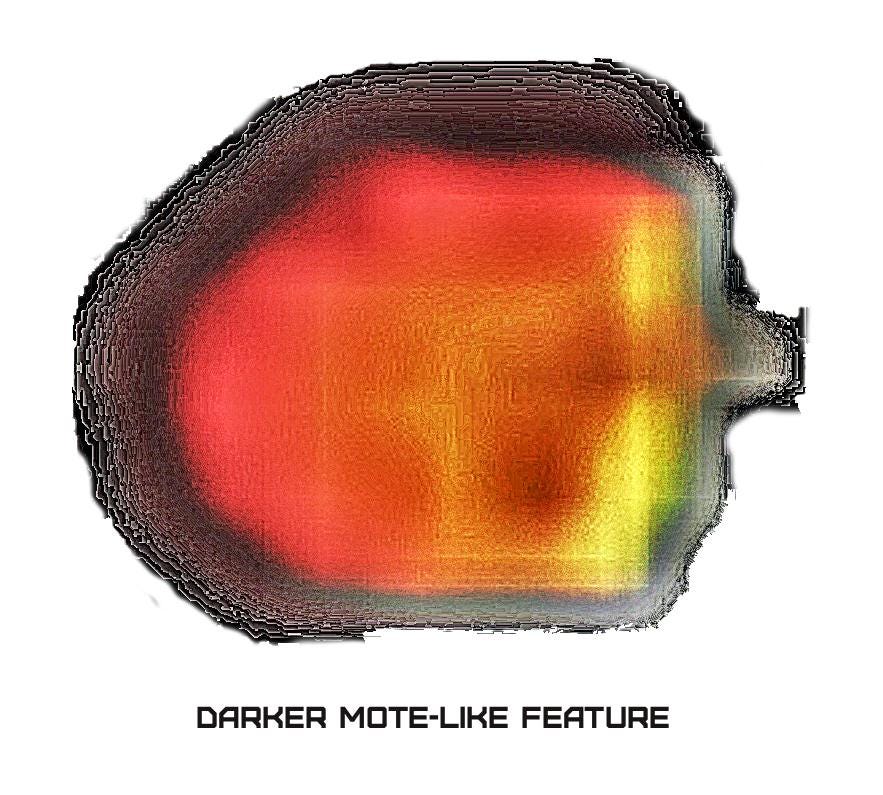
Let me know in the comments what role this mote-like structure could play.
We can note at this stage that we detected a gas cloud inside the gulley that traverses the two pits with a band-like shape. This cloud is notably different in formation from the gas covering the rest of the object. This feature could also act as a means of identification when the object is immersed in a dense gas cloud as seen in these images from mid September 2025 onward. However, the most obvious function would be something to do with the cooling effect that a pit like this would serve given its colour and depth.
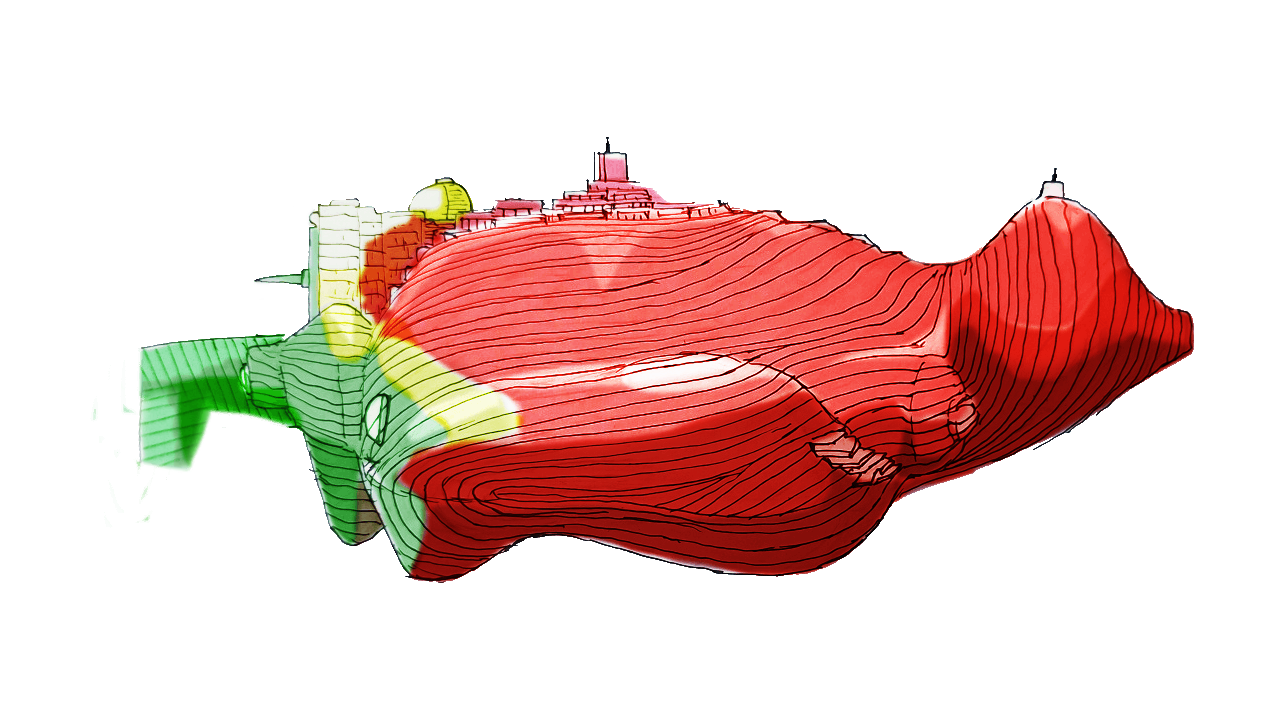
illustration: elevation study / right side
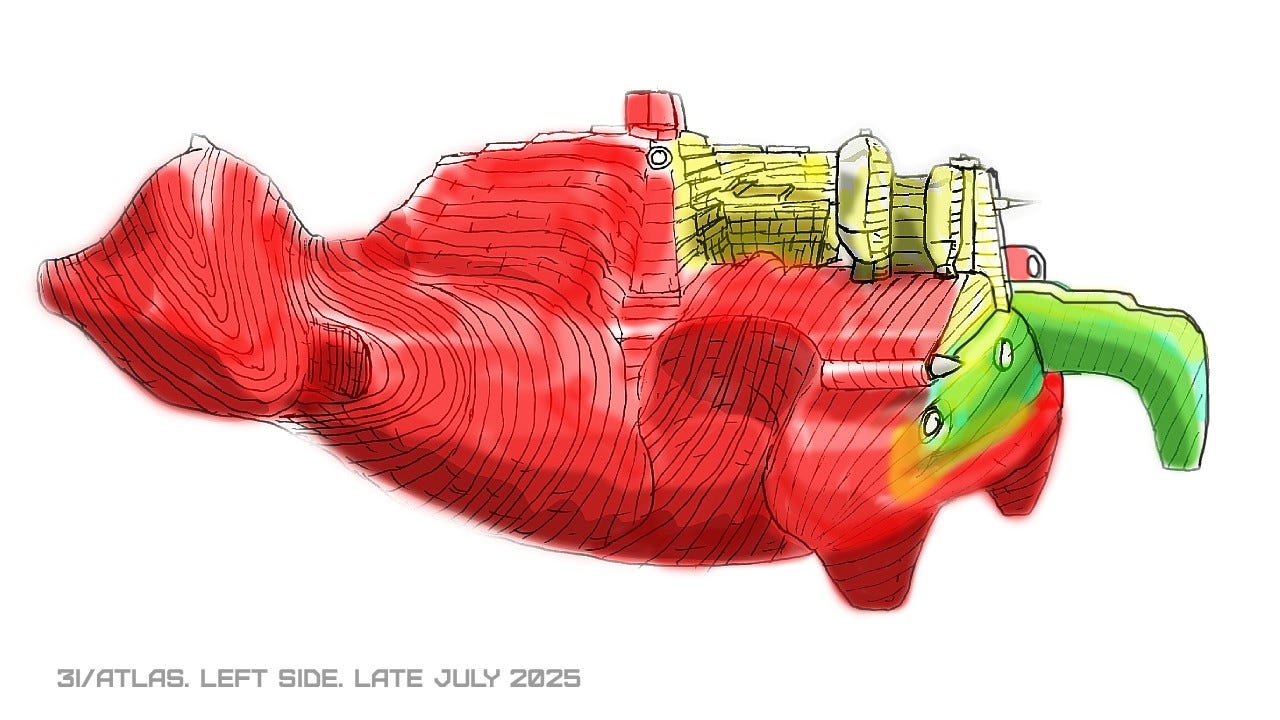
illustration: elevation study / left side
To conclude: We get an idea from what has been discussed here, that this comet has in fact got a typographical layout of a specific geology enmeshed in a disc-like formation and that shape plays a role in how the gas that it emits moves across its surface rendering the object to take on different shapes depending on the angel it is being observed from. We see that the nucleus resides within an open pit that exits the front of the comet through keyhole canyon. And finally, just when we can shrug all these formations off to natures way, we observe a long arm-like structure, a gangway of sorts, that protrudes at a 90 degree angle off the front of the comet and appears to curve downward to end at its tip on a ‘foot’. This gangway was detected in the Hubble LSGF shot from late December 2025 and it matches up with another front shot of the comet by an amateur telescope in early August 2025. We have observed the gas ejected from the nucleus jet being jettisoned across this extended gangway and out into space toward the sun, where it interacts with the sun’s plasma.
If we don’t readily see anything unusual within the typography of the comet, we do see it in this feature. We observe that the other six fissures dotted around the object, emit a gas that appears either act as jets for maintaining the object’s movement or to maintain the cover or skin surrounding the comet, or both while the nucleus ejects gas toward the sun.

Let me know if this analysis has been useful for you. Below is a link to the YouTube video that accompanies this story. If you are unable to watcj it then please consider just giving it a like as any interaction from viewers is a positive signal for the algorithm to make it available for more viewers. (Thank you in advance.)
All the above is contained in the video script with the exception of a few details that came later. There is always more to this mostly misunderstood anomaly that if anything requires much more analysis by science.
메타데이터
- post_id
- 7b842908ae32
- slug
- 3i-atlas-debunking-the-comets-typography-7b842908ae32
- url
- https://medium.com/@adekipades/3i-atlas-debunking-the-comets-typography-7b842908ae32
- canonical_url
- https://medium.com/@adekipades/3i-atlas-debunking-the-comets-typography-7b842908ae32
- author_url
- https://medium.com/@adekipades
- status
- ok
- fetched_at
- 2026-06-23 03:48:11