Ukraine has Created a ‘Digital Hell’ for Russian Forces
Precision in the age of algorithms: How autonomous swarm technology is reshaping the modern battlefield
Ukraine War
Ukraine has Created a ‘Digital Hell’ for Russian Forces
Precision in the age of algorithms: How autonomous swarm technology is reshaping the modern battlefield
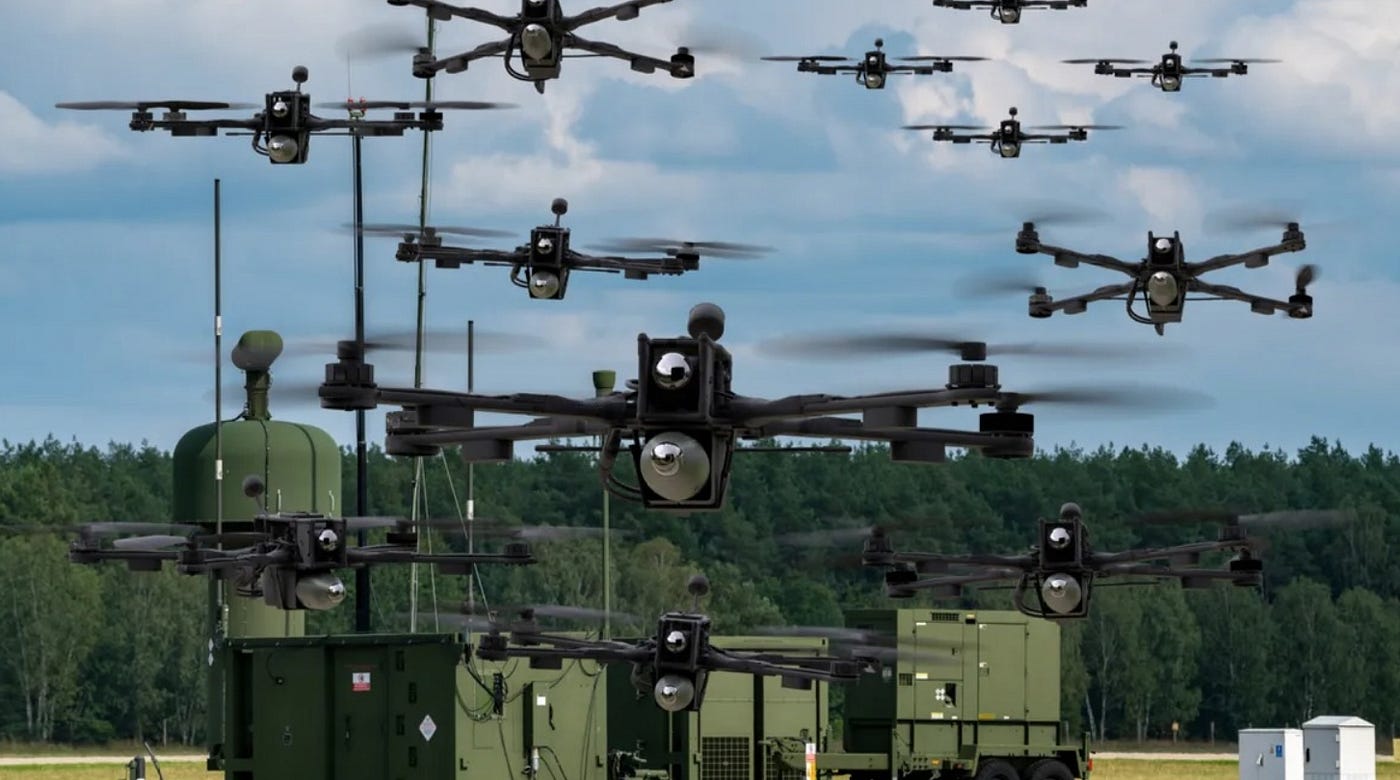
Illustrative drone swarm picture
The future is here (again) and it is terrifying Russian forces.
One Ukrainian soldier controls a swarm of drones. How is that for force multiplication?
Or fear multiplication?
Here’s the background. In September 2025 a Ukrainian startup company announced that it had secured $15 million of funding for developing drone swarming technology. The firm, Swarmer, specialises in AI-powered solutions that aim to increase drone autonomy and organize them into coordinated swarms.
Ukraine continues to forge ahead in redefining modern warfare, driven not only by the existential need to defeat Russia, but by the need to minimise losses of its prime young men and women on the front line.
And now it seems that Swarmer is further enabling those requirements as its abilities are now operational.
Some of the online chat about this technology is sensationalised, but the core details appear to be solid.
The integration of autonomous systems
The transformation of modern war through the integration of autonomous systems has reached a distinct milestone with the deployment of advanced swarm drone technology by the Armed Forces of Ukraine.
This development, which enables the coordination of multiple unmanned aerial vehicles by a single operator, marks a change in the conduct of military operations.
The capacity to process data and execute tactical decisions within seconds is a quantum departure from the traditional methods of command and control that have defined warfare for decades.
Algorithmic battlefield awareness
This system relies on the convergence of artificial intelligence and high-speed communication networks to create an integrated view of the battlefield.
It’s an AI-powered system that lets one operator control and coordinate multiple drones (often 3–8, with tests up to 25+ and ambitions for 100+ in a coordinated fleet). Drones can communicate, adapt, navigate in jammed environments, and handle tasks semi-autonomously.
The platform can identify, classify, and track targets without the need for manual input for every stage of the process.
This capability removes the latency that previously existed between the identification of a target and the execution of a strike.
While traditional military planning often required a significant number of personnel and an extended period for the gathering and analysis of intelligence, this system condenses the observe, orient, decide, act cycle to a duration that is measured in seconds.
It is essentially a cloud of semi-autonomous lethality floating over a battle sector.
Tactical implications of distributed sensors
The implications for tactical operations are substantial. The use of swarms allows for the distribution of sensors across a wide area, which provides a level of situational awareness that was previously difficult to achieve.
By networking these sensors in a mesh, the system creates a digital map of the combat environment, providing the operator with accurate targeting data.
This precision, which is described as being comparable to that of a platoon of snipers, enables the engagement of targets with high efficiency. The capacity to concentrate force at a specific point or to disperse assets to maintain surveillance over a large area provides commanders with a degree of flexibility that alters the traditional static nature of defensive lines.
This shift toward digital, automated warfare has consequences for the personnel involved in these engagements.
‘Digital hell’ — the term reportedly used by Russian troops to describe this environment highlights the psychological and physical impact of such capabilities. The switch from human-centric planning to algorithmically assisted execution creates a landscape where the speed of reaction exceeds human capacity.
When the Russians are faced with a system that can process threats and respond with precision almost immediately, the traditional methods of maneuvering and concealment become far less effective.
Future of military doctrine
The integration of such technology yet again raises questions regarding the future of military doctrine and the ethics of enabling autonomous AI.
The ability to achieve strategic outcomes through the use of small, distributed, and autonomous units suggests that the reliance on large, centralised platforms may decrease in favor of adaptable, networked sensor and control systems underpinned by AI.
This trend indicates that the control of the electromagnetic spectrum and the protection of data links will become the primary focus of defensive efforts.
Jamming-resistant fibre-optic drones have become so prevalent that the battlefield is strewn with the fibres, and birds have taken to using them for nests.
Image credit:https://www.facebook.com/oleg.mal.cenko.900831
As armies continue to incorporate these advances, the nature of the engagement changes, moving toward a model where intelligence, speed, and automation define the outcome.
However, I note the dependence on high speed communications networks, which are susceptible to jamming.
Nevertheless, the deployment of this technology by the Ukrainian military demonstrates the rapid evolution of tactical methods in response to the demands of a high-intensity conflict.
By automating the coordination of drone swarms, the armed forces have addressed the need for greater efficiency in target acquisition and engagement. The reduction in the number of personnel required to operate these systems allows for a more versatile use of human resources, shifting the role of the soldier from a direct participant in every phase of the strike to an overseer of complex, automated processes.
This force multiplication is not merely an incremental improvement in hardware; it is a fundamental change in the methodology of warfare.
And it is a fear-multiplier.
The ability to maintain a continuous, high-fidelity view of the battlefield while simultaneously executing strikes at scale provides an advantage that is difficult to counter with conventional means.
As this system continues to be refined and deployed, it is likely to influence how other nations approach the development of their own unmanned capabilities. The focus on integrating artificial intelligence into the tactical decision-making loop is now a central priority for defence planners globally.
The key to modern warfare is to out-innovate the enemy, and Ukraine leads the world in defence innovation.
[embed]
메타데이터
- post_id
- 7b89600a588a
- slug
- ukraine-has-created-a-digital-hell-for-russian-forces-7b89600a588a
- url
- https://medium.com/the-dock-on-the-bay/ukraine-has-created-a-digital-hell-for-russian-forces-7b89600a588a
- canonical_url
- https://medium.com/the-dock-on-the-bay/ukraine-has-created-a-digital-hell-for-russian-forces-7b89600a588a
- author_url
- https://medium.com/@james-marinero
- status
- ok
- fetched_at
- 2026-07-09 09:01:30