10 Cross-Rollup MEV Headaches Coming in 2026
A field guide to the nastiest execution, sequencing, and coordination problems teams will hit as rollups start talking to each other for…
10 Cross-Rollup MEV Headaches Coming in 2026
A field guide to the nastiest execution, sequencing, and coordination problems teams will hit as rollups start talking to each other for real.
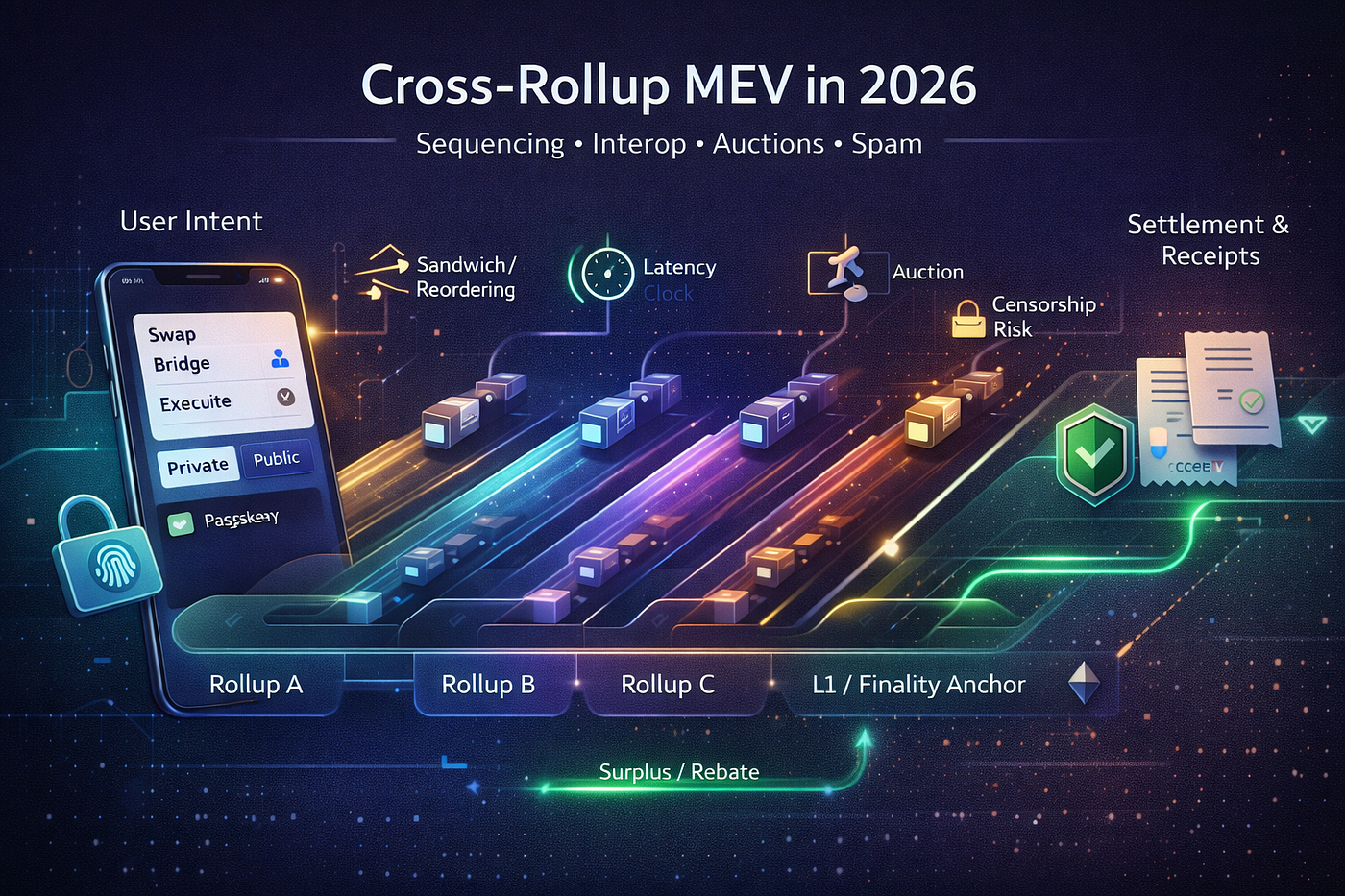
Top 10 cross-rollup MEV challenges teams will face in 2026 — shared sequencing, interop latency, atomicity, spam, auctions, censorship, and attribution.
Rollups were supposed to make Ethereum feel faster, cheaper, and — ideally — less stressful.
And they did… until you try to trade across two rollups in the same mental breath.
Suddenly you’re dealing with different sequencers, different finality clocks, different fee markets, different mempools, different “private orderflow” lanes. And MEV doesn’t politely stay inside one chain. It follows value.
If 2024–2025 was “MEV meets rollups,” then 2026 is where MEV goes cross-rollup — and teams realize the hard part isn’t building another L2. It’s coordinating them without turning users into the collateral damage.
Here are 10 cross-rollup MEV challenges teams will face in 2026, written like a punch list for builders who don’t want surprises.
1) Atomic cross-rollup execution will be the new battleground
Single-chain atomicity is already fragile. Cross-rollup atomicity is… aspirational.
Interoperability roadmaps (like the OP Stack “Superchain” vision) aim for trust-minimized cross-chain composability and low-latency reads across chains, but actually achieving “feels like one chain” behavior creates a massive MEV surface.
Why it’s a MEV magnet
If a trade requires steps on Rollup A and Rollup B, whoever can control ordering across both can:
- back-run your first step before your second lands
- reorder messages to force worse routing
- atomically arbitrage liquidity fragmentation
In 2026, “atomic” becomes a product feature — and an MEV strategy.
2) Shared sequencers will concentrate cross-domain MEV (unless designed carefully)
Cross-rollup MEV is often described as “the unsolved problem of shared sequencing,” because rollups typically order transactions independently with no unified mechanism.
Shared sequencer networks promise coordination (and sometimes better interop), but they also become a single marketplace for cross-domain MEV — a powerful chokepoint.
The 2026 failure mode
A “shared” sequencer that ends up effectively:
- permissioned
- vertically integrated with a builder/solver
- exclusive with a few wallets
…starts looking less like coordination infrastructure and more like a toll booth.
3) Based sequencing vs shared sequencing will create weird incentive wars
Based rollups shift sequencing back to Ethereum L1 proposers/validators; shared sequencing introduces a separate coordination layer. Each approach changes who gets paid, who can censor, and who captures MEV.
The 2026 tension
Teams will face awkward questions:
- Do we want Ethereum-wide ordering (based) or ecosystem-wide ordering (shared)?
- Who gets MEV revenue: L1 validators, rollup sequencers, or auction participants?
- Can users verify “best execution,” or are we just moving trust?
You’re not just picking architecture. You’re picking politics.
4) Cross-rollup preconfirmations will be gamed
Users love preconfirmations: “your transaction is basically in.”
But across rollups, preconfirmations can become a game of timing, signaling, and selective disclosure — especially when different systems have different finality and reorg risks.
What teams will wrestle with
- A preconfirm on Rollup A might be meaningless if Rollup B delays inclusion.
- Searchers can exploit the “soft promise” window to position across venues.
- Builders can preferentially preconfirm profitable flow.
Preconfirmations will need clear guarantees, slashing conditions, and composable rules — or they’ll become another MEV lever.
5) Interop messaging will introduce “message-order MEV”
Cross-rollup interop isn’t just “send message.” It’s “send message, prove, relay, execute, and order against other messages.”
If your cross-chain message arrives a block earlier or later, that timing is value.
Expect attacks like
- delaying a message to enable arbitrage elsewhere
- reordering message execution to front-run state changes
- “message stuffing” to crowd out competitors during high-value windows
In 2026, teams will treat messaging layers like execution venues — because that’s what they become.
6) Cross-rollup spam will keep fees high (and it’s already concentrated)
Here’s the uncomfortable data point: Flashbots researchers observed spam bots across multiple rollups consuming more than 50% of gas while paying less than 10% of fees, and noted high concentration (e.g., two searchers responsible for the majority of spam on Base in that timeframe).
Why this matters for cross-rollup MEV
Spam isn’t random. It’s often:
- probing for profitable opportunities
- saturating mempools to increase rivals’ costs
- creating noise to hide signals
2026 teams will need spam-aware fee markets, rate limits, or auction-based inclusion policies — or UX will degrade exactly when interop adoption spikes.
7) Private orderflow across rollups will fragment price discovery
Let’s be real: private execution reduces some toxic MEV. It also creates fragmented liquidity and hidden markets.
The SUAVE pitch is explicitly about enabling private, collaborative block building and creating foundations for cross-domain MEV preference expression.
The 2026 challenge
When different rollups and wallets use different private routes:
- “best price” becomes unprovable
- arbitrage becomes more profitable (because markets drift)
- users get inconsistent execution across identical trades
Teams will need credible disclosure: what’s private, who can bid, who gets surplus.
8) Cross-rollup auctions will trigger “PFOF-style” distrust
Order-flow auctions and solver markets can route surplus back to users. They can also quietly turn into “who pays the integrator most.”
You might be wondering: how will users know they’re not being sold out?
What will matter in 2026
- transparent surplus splits (user vs sequencer vs solver)
- audit trails: “why did this route win?”
- opt-outs and fallback paths
- open bidding access where possible
If auctions become opaque, regulators won’t be the only ones unhappy. Power users will route around you.
9) MEV attribution across rollups will be a nightmare (and teams will argue about it)
On one chain, you can at least attempt to measure MEV by analyzing ordering and outcomes.
Across rollups, value extraction can be distributed:
- profit on Rollup A
- hedge on Rollup B
- settlement on L1
- and the “loss” shows up as slippage in a wallet UI
The 2026 builder pain
Product and BD teams will fight over numbers:
- “Our chain has low MEV!”
- “No, it’s just happening elsewhere.”
- “Our sequencer isn’t extracting!”
- “No, it’s your preferred solver network.”
If you can’t attribute MEV, you can’t govern it.
10) Encryption and fairness tools will be real — but operationally brutal
Tech like encrypted mempools and delay encryption is often pitched as MEV mitigation in shared sequencing contexts.
The 2026 reality
Encryption helps, but it introduces operational complexity:
- key management and failure modes
- delayed execution hurting UX
- new griefing vectors (“reveal late,” “jam the reveal,” “selective decrypt”)
- harder debugging and monitoring
Teams will discover that “fair ordering” is not a toggle. It’s an operational discipline.
Architecture sketch: where cross-rollup MEV sneaks in
Wallet Intent
   |
   |  (private/public routing choice)
   v
Rollup A Sequencer -----> Messaging/Relay Layer -----> Rollup B Sequencer
   |                           |                          |
   | (ordering games)          | (message order MEV)      | (inclusion games)
   v                           v                          v
Auction/Solver Market -----> Builder/Proposer -----> Settlement + Receipts
          (surplus split)         (centralization)         (attribution)
If you’re building infra in 2026, you’re not “just scaling.” You’re designing who gets to see value first — and what they’re allowed to do with that advantage.
A tiny technical sample: cross-rollup intent constraints (toy)
Here’s a minimal pattern teams will lean on: encode constraints so solvers can’t “creatively interpret” what the user meant.
// Toy struct for a cross-rollup swap intent.
// In practice you'd include signatures, domains, replay protection,
// and a verification method in your settlement contract.

struct CrossRollupIntent {
    address user;
    uint256 amountIn;
    uint256 minAmountOut;
    uint64  deadline;
    uint32  srcDomain;   // rollup A
    uint32  dstDomain;   // rollup B
    bytes32 allowedSolverSet; // optional: hash of allowlist / policy
}

// Commentary:
// - minAmountOut + deadline reduce execution manipulation windows.
// - domain IDs make "where it should settle" explicit.
// - allowedSolverSet is a crude way to enforce policy until trust matures.
Not glamorous. But constraint design is where most “MEV safety” actually lives.
Conclusion: In 2026, MEV becomes a coordination problem
Cross-rollup MEV isn’t a single exploit to patch. It’s a systemic byproduct of interoperability, shared sequencing, auctions, and fragmented execution lanes.
The teams that win in 2026 will do three things relentlessly:
- Make incentives explicit (who bids, who earns, who sees what)
- Ship verifiable execution guarantees (not marketing)
- Treat coordination layers as critical infrastructure, not optional add-ons
If you’re building in this space, I’d love to hear it: which challenge feels most underestimated right now? Drop a comment, follow for more deep dives, and tell me what you want next — shared sequencers, based rollups, or cross-chain auction design.
메타데이터
- post_id
- 7b966fc8f3eb
- slug
- 10-cross-rollup-mev-headaches-coming-in-2026-7b966fc8f3eb
- url
- https://medium.com/@Modexa/10-cross-rollup-mev-headaches-coming-in-2026-7b966fc8f3eb
- canonical_url
- https://medium.com/@Modexa/10-cross-rollup-mev-headaches-coming-in-2026-7b966fc8f3eb
- author_url
- https://medium.com/@Modexa
- status
- ok
- fetched_at
- 2026-07-20 18:16:01