What is being discovered and studied in particle physics?
Particle physics is the branch of science that studies the smallest fundamental building blocks of matter and the forces that control them…
What is being discovered and studied in particle physics?

This comprehensive visualization shows the interactions of fundamental particles and forces at the Large Hadron Collider to explain the origin and structure of our universe.
Particle physics is the branch of science that studies the smallest fundamental building blocks of matter and the forces that control them. It investigates fundamental particles such as bosons, including quarks, leptons, and the Higgs boson, and their interactions. Researchers aim to understand matter, antimatter, and the origin of the universe using tools such as particle accelerators, detectors, and high-energy collisions. Current studies focus on the behavior of neutrinos, dark matter, quark-gluon plasma, and theories beyond the Standard Model. Particle physics not only advances our knowledge of the fundamental laws of the universe, but also drives technological advances in medicine, computer science, and material science.
Fundamental Particles
Fundamental particles are the basic building blocks of matter, which cannot be broken down into smaller components. Everything in the universe, from stars and planets to humans, is made up of them. Their main types are quarks, leptons, and bosons.
There are six types of quarks: up, down, charm, strange, top, and bottom. They combine in different ways to form protons, neutrons, and mesons, which make up the nuclei of atoms. Leptons include the familiar electrons, as well as the heavier muons and tau, and the nearly invisible neutrinos, which interact with matter very weakly.
Bosons are particles that carry forces. For example, photons carry the electromagnetic force, gluons carry the strong nuclear force, and the W and Z bosons carry the weak nuclear force. The Higgs boson gives mass to other particles through the Higgs field.
Antiparticles are mirror images of particles with opposite electrical charges. Studying them helps scientists understand why the universe is made up mostly of matter rather than antimatter.
By studying these particles, physicists try to explain the fundamental laws of nature, the behavior of matter at the microscopic level, and the origin of the universe. Modern experiments, including experiments at large particle accelerators, are continually revealing new properties, interactions, and possibly unknown particles beyond the Standard Model.
Fundamental forces
Fundamental forces are the fundamental interactions that govern the behavior of particles and matter in the universe. There are four known fundamental forces: the strong nuclear force, the electromagnetic force, the weak nuclear force, and gravity.
The strong nuclear force binds quarks together to form protons, neutrons, and atomic nuclei. It is the most powerful force, but it only acts over very short distances. The electromagnetic force governs the interactions between charged particles such as electrons and protons and is responsible for electricity, magnetism, and light.
The weak nuclear force is responsible for certain types of particle decay, such as beta decay in radioactive atoms. It plays an important role in nuclear reactions and the production of energy in stars. The W and Z bosons mediate this force.
Gravity is the weakest of the four, but it is effective on large scales and holds planets, stars, and galaxies together. Like the other three forces, it cannot be fully explained by quantum physics and has remained a major focus of research, along with theories of quantum gravity.
Studying these forces helps physicists understand how particles interact with each other, how matter is formed, and how the universe takes shape. Experiments in particle accelerators reveal how these forces behave at high energies, leading to the search for unified theories that can bring all four forces together in a single framework.
Current Research Topics
Particle physics is constantly evolving, and researchers are exploring phenomena that will deepen our understanding of the universe. The Higgs boson, discovered in 2012, is a major focus. Scientists study its mass, properties, and interactions to understand how particles acquire mass.
Neutrino physics is another active area. Neutrinos are nearly massless, elusive particles that can oscillate in different ways. Studying them helps answer questions about the matter-antimatter asymmetry and the evolution of the universe.
Researchers also study quark-gluon plasma, a state of matter that existed immediately after the Big Bang. These extremely intense conditions are recreated in high-energy collisions in accelerators, providing insights into the early universe.
A major goal is to understand dark matter and dark energy, which make up most of the universe but remain invisible. Scientists are searching for new particles that could explain these mysterious entities.
Theories beyond the Standard Model, such as supersymmetry or extra dimensions, are also being explored. This could reveal unknown particles and forces, expanding the boundaries of physics.
Studies of antimatter explore why matter dominates the universe, despite the fact that antimatter was also created during the Big Bang. Advanced experiments using particle accelerators, detectors, and simulations are constantly expanding the boundaries of knowledge, revealing the fundamental laws that govern matter, energy, and the universe.
Experimental Tools & Methods
Particle physics relies on advanced experimental tools and methods to study the smallest fundamental building blocks of matter and their interactions. The most important instruments are particle accelerators, which accelerate particles to near the speed of light and cause them to collide. These high-energy collisions can produce rare or short-lived particles, allowing scientists to study their properties and interactions. The Large Hadron Collider (LHC) is the most famous example, where discoveries such as the Higgs boson were made.
Detectors are another essential tool. They track the paths, energies, and types of particles produced in the collisions. Modern detectors use sensors, calorimeters, and layers of magnetic fields to record information with great precision.
Physicists use high-energy collisions to recreate conditions similar to the early universe, which helps them study phenomena such as the quark-gluon plasma. In addition, computer simulations model the behavior of particles, predict outcomes, and analyze vast amounts of experimental data.
Other methods include studies of cosmic rays, neutrino observatories, and experiments in underground laboratories to detect rare phenomena. Together, these tools enable scientists to test theoretical predictions, discover unknown particles, and study forces at the microscopic level, thereby increasing our understanding of the fundamental laws of the universe.
Applications of Particle Physics
Although particle physics studies the smallest components of matter, its discoveries have practical applications that affect everyday life and technology. One of the most direct applications is in the medical field. Technologies from particle physics are used in medical imaging, such as PET scans, and in cancer treatment, such as proton therapy, which precisely targets tumors without harming surrounding tissue.
In materials science, understanding particles and forces helps develop advanced materials, including semiconductors, superconductors, and nanomaterials. These materials are important for electronics, energy systems, and computer technology.
Particle physics also drives innovations in computing and data analysis. Experiments such as the Large Hadron Collider generate enormous amounts of data, which require advanced algorithms, artificial intelligence, and high-performance computing. These tools are often used in industries ranging from finance to climate modeling.
In addition, particle physics improves our understanding of the universe. Research on fundamental particles, dark matter, and forces contributes to cosmology and astrophysics, helping to explain how the universe was formed, why it is expanding, and how matter behaves under extremely hostile conditions.
Particle physics inspires new technologies and innovations, from particle detectors used in security scanning to advances in quantum computing. By probing the fundamental elements of nature, particle physics expands human knowledge and creates tools that improve technology, health, and society.
Future Directions
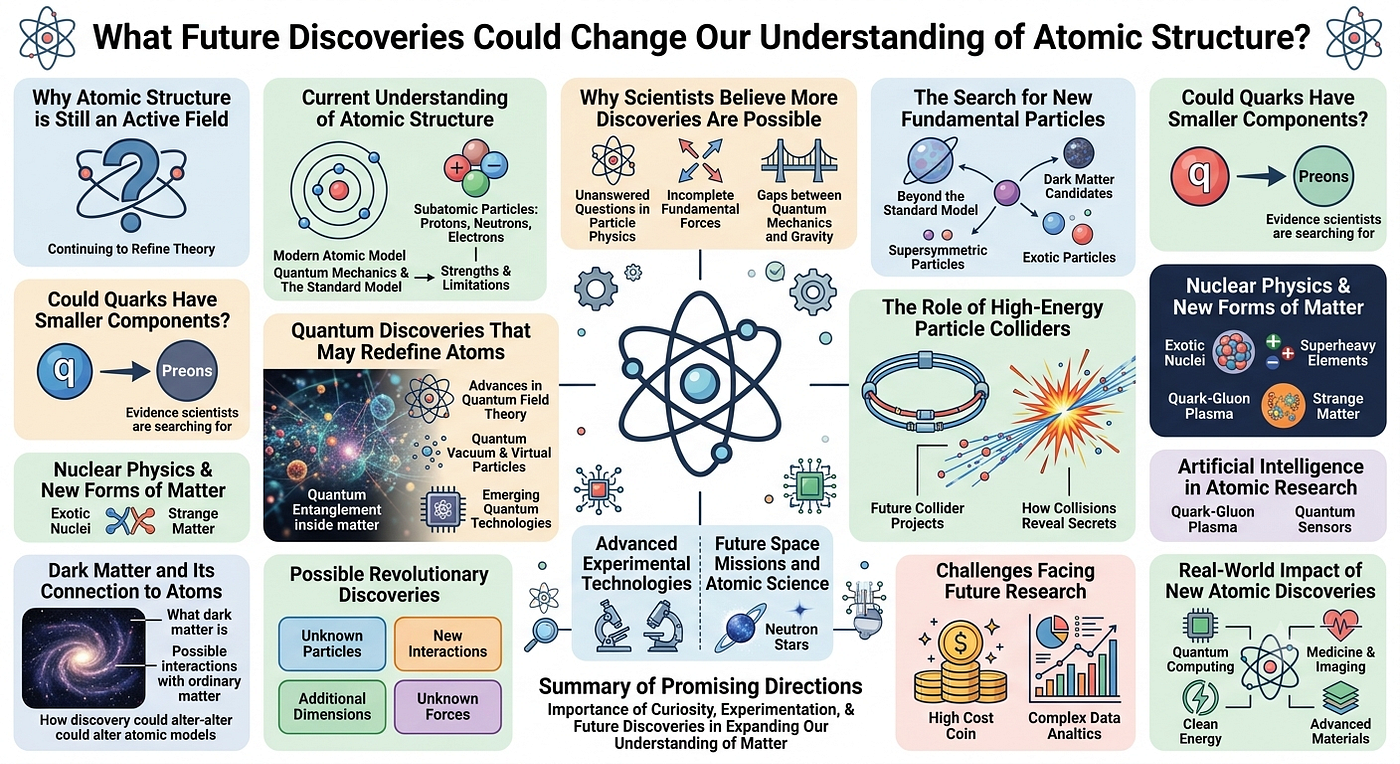
The future of particle physics is focused on exploring the unknown and expanding the boundaries of our knowledge of the fundamental components of the universe. A key direction is the development of the next generation of particle accelerators, which will achieve energies greater than those of the Large Hadron Collider. The goal of these accelerators is to discover new particles, test theories beyond the Standard Model, and study rare interactions that have so far eluded us.
Research is also progressing on dark matter and dark energy, which together make up most of the universe but remain largely mysterious. Physicists are designing sensitive detectors and experiments to directly observe these elusive components, which could revolutionize our understanding of cosmology.
Another focus is on the unification of the forces, which is attempting to unify the gravitational, electromagnetic, weak, and strong forces under a single theoretical framework. This includes exploring quantum gravity, string theory, and supersymmetry, which could reveal new dimensions or unknown particles.
In addition, particle physics will increasingly rely on quantum computing, artificial intelligence, and high-performance simulations to model complex phenomena and analyze huge datasets.
Future research will continue to bridge the gap between theory and experiment, providing deeper insights into the origins of matter, energy, and the universe. These efforts will not only answer fundamental questions, but will also drive technological innovations in medicine, computer science, and materials science, shaping both science and society.
Conclusion
Particle physics is the study of the smallest fundamental building blocks of matter and the forces that control them, unraveling the fundamental structure of the universe. By studying fundamental particles, forces, and their interactions, scientists unravel mysteries such as the behavior of neutrinos, dark matter, and antimatter. Advanced tools such as particle accelerators, detectors, and simulations allow for precise experiments, while these discoveries have practical applications in medicine, technology, and materials science. Future research aims to unify forces, discover unknown particles, and understand cosmic phenomena, thereby deepening our knowledge of the universe and inspiring new discoveries that benefit science and society.
Frequently Asked Questions (FAQs)
- What is particle physics?
Particle physics is the branch of science that studies the fundamental building blocks of matter and the forces that govern them. It studies the interactions between quarks, leptons, bosons, and antiparticles, as well as the strong, weak, electromagnetic, and gravitational forces. Scientists use particle accelerators and detectors to study collisions and rare events. Research in particle physics helps explain how matter behaves at the smallest scale, why the universe exists as it does, and provides technologies that bridge theory and practical applications in medicine, computer science, and materials science.
- What are fundamental particles?
Fundamental particles are the basic building blocks of matter that cannot be further divided. They include quarks (which make up protons and neutrons), leptons (such as electrons and neutrinos), and bosons (force carriers such as photons and the Higgs boson). Studying these particles helps scientists understand the interactions between matter, energy, and particles. Antiparticles, which are mirror images of particles, provide insight into the matter-antimatter imbalance in the universe. High-energy collision experiments reveal their properties, which guide theories like the Standard Model and the discovery of new physics beyond what we currently know.
- What are the fundamental forces?
The universe is governed by four fundamental forces: strong, weak, electromagnetic, and gravitational. The strong force binds quarks into protons and neutrons, while the weak force governs some radioactive decays. The electromagnetic force governs the interactions between charged particles, which produce electricity and light. Gravity, although the weakest, shapes planets, stars, and galaxies. Studying these forces helps physicists understand how particles interact with each other, how matter forms, and how the universe is shaped, and the experiments aim to unify them all under a single theory. Knowledge of the forces also drives new discoveries in technology, medicine, and astrophysics.
- How do particle accelerators work?
Particle accelerators are machines that accelerate particles to near the speed of light and cause them to collide. These high-energy collisions produce new or rare particles, which scientists study to understand fundamental physics. Detectors around the collision sites track the paths, energies, and types of particles. Accelerators recreate conditions similar to those in the early universe, making it possible to study quark-gluon plasma, neutrinos, and the Higgs boson. Data analysis and computer simulations help interpret the results. Accelerators are also used in medicine, imaging, and materials science, making them both research tools and practical technology enablers.
- What are the uses of particle physics?
Although particle physics focuses on the smallest particles, its applications are very broad. In medicine, techniques such as PET scans and proton therapy treat diseases and detect tumors. In technology, particle physics leads to advances in computing, data analysis, and materials science, including semiconductors and superconductors. Experiments also inspire innovations in security scanning and sensors. Beyond practical applications, particle physics helps explain the origin of the universe, dark matter, and the fundamental laws of physics, as well as driving new technologies and discoveries. Its research not only adds to scientific knowledge, but also contributes to healthcare, engineering, and everyday technology.
메타데이터
- post_id
- 7b96caef3118
- slug
- what-is-being-discovered-and-studied-in-particle-physics-7b96caef3118
- url
- https://medium.com/@sciencespectrum/what-is-being-discovered-and-studied-in-particle-physics-7b96caef3118
- canonical_url
- https://medium.com/@sciencespectrum/what-is-being-discovered-and-studied-in-particle-physics-7b96caef3118
- author_url
- https://medium.com/@sciencespectrum
- status
- ok
- fetched_at
- 2026-08-10 03:14:41