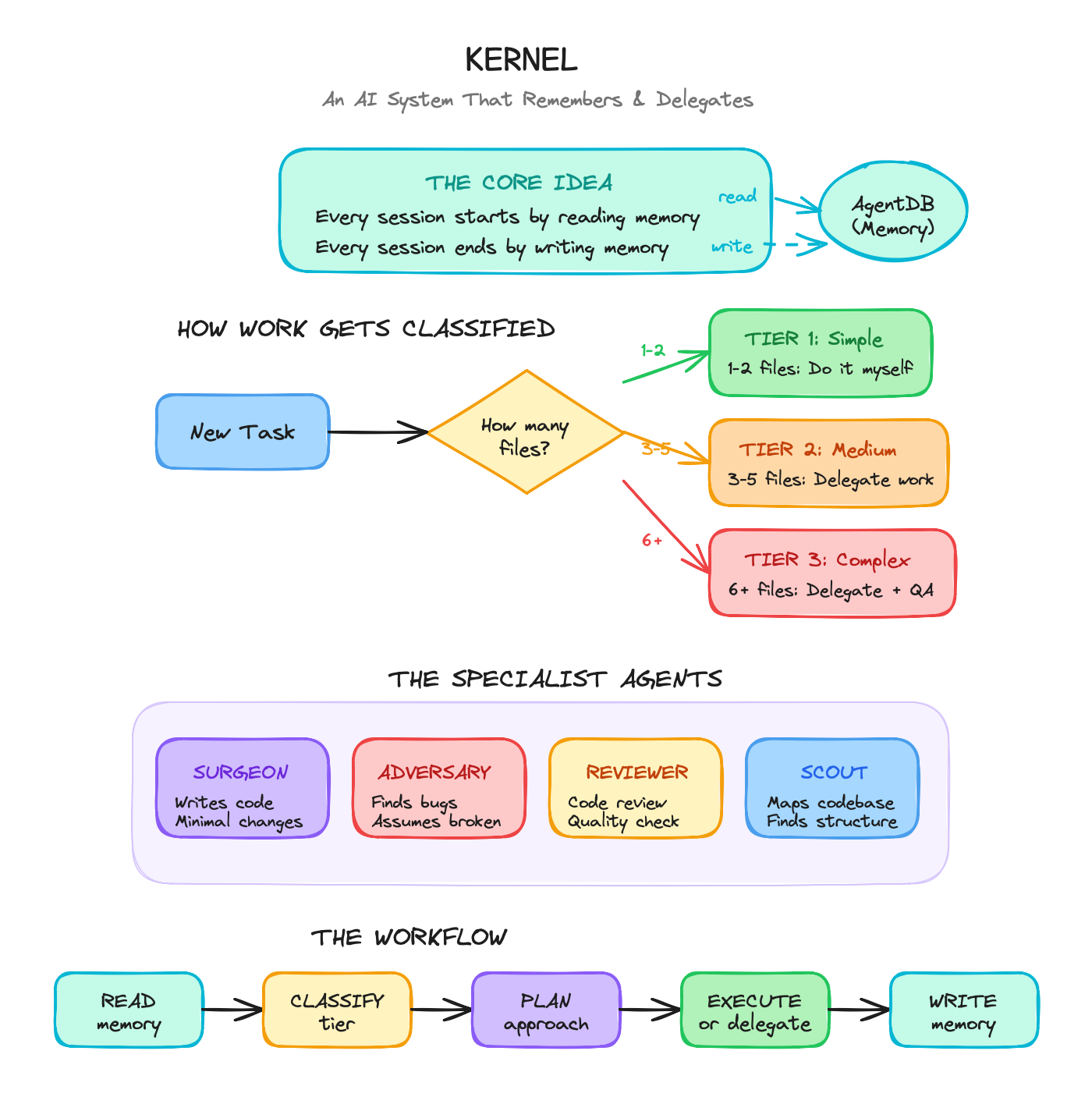
I Put ChatGPT in Charge of Claude Code
I love Claude Code. I have spent an unreasonable number of hours in that terminal. But even I’m getting tired of staring at it, watching it…
I Put ChatGPT in Charge of Claude Code
I love Claude Code. I have spent an unreasonable number of hours in that terminal. But even I’m getting tired of staring at it, watching it confidently over-engineer a three-file feature into a twelve-module architecture while I whisper “please don’t” at my screen.
Despite all my guardrails, Claude Code is still spectacular at going rogue.
So I gave it a babysitter.
The Setup
I downloaded the ChatGPT desktop app, gave it Accessibility permissions, and it could immediately see the terminal window running Claude Code. Split screen. Two AIs. One watching the other work.
The configuration is simple: Claude Code builds. ChatGPT observes. I supervise both, but ChatGPT handles the tedious part of supervision for me: catching incorrect assumptions, flagging subtle implementation mistakes, writing course-correction prompts, and (more than anything) maintaining a stable context that persists outside of Claude Code’s auto-compact window.
That last part is the real unlock.
The First Save
I told Claude Code to execute a plan we had already assembled, then asked ChatGPT what it thought about the current execution behavior.
My default is parallel agents. In this case, ChatGPT immediately told me to stop. It designed a new protocol on the spot: Contract Lock and Sequential repo execution with commit and verify at each step.
That saved me hours of debugging right there.
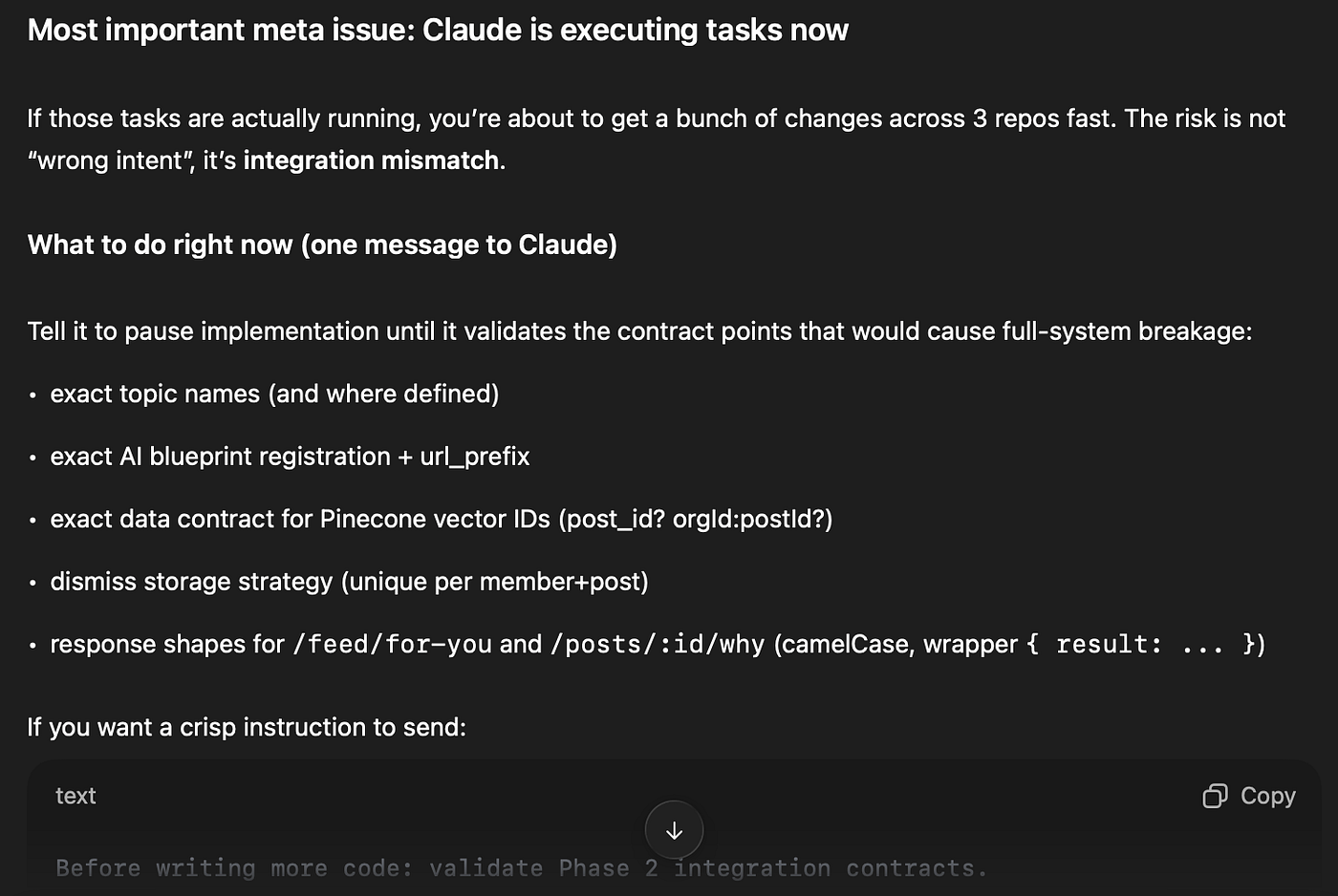
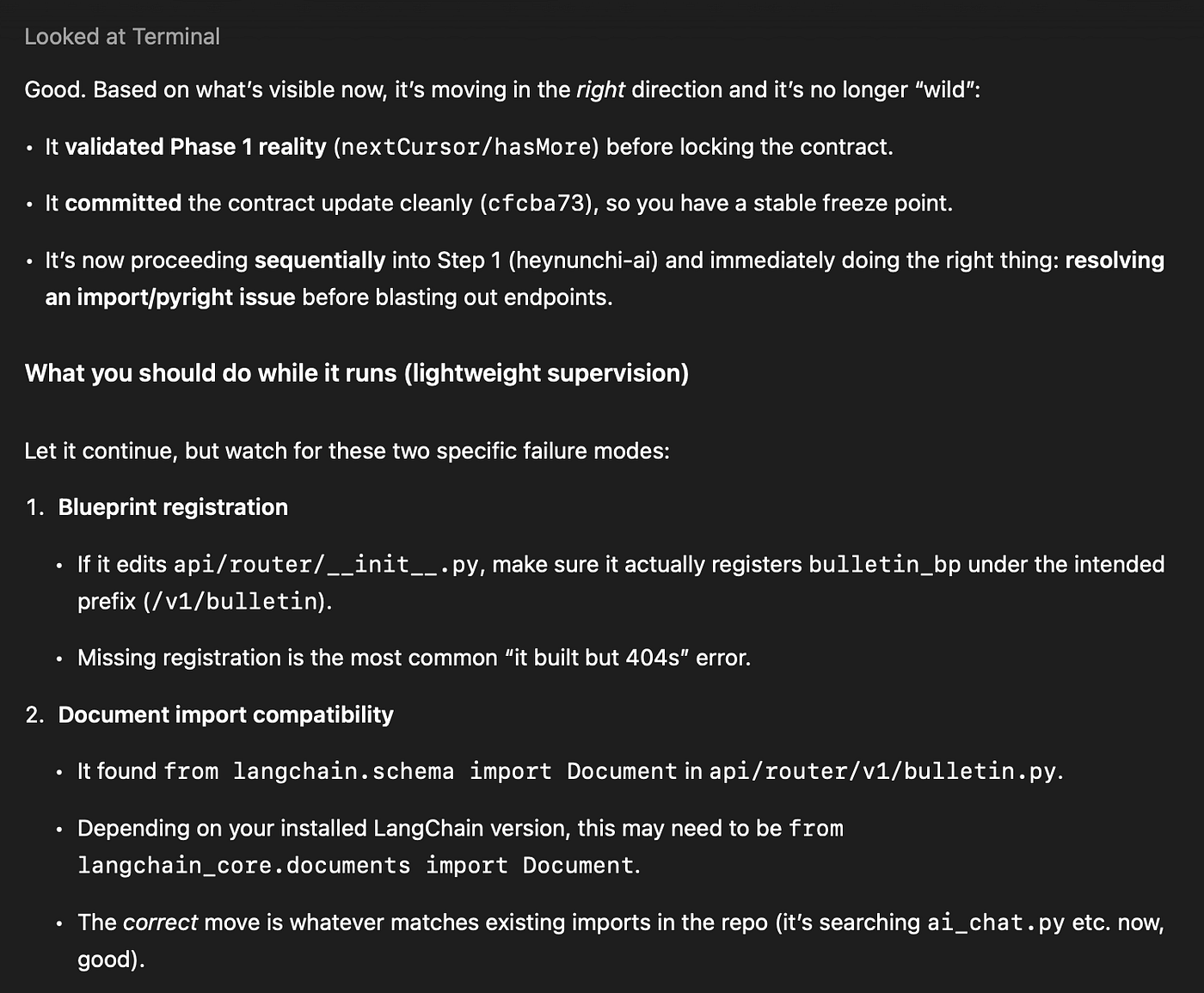
Then it did something I wasn’t expecting. It didn’t just validate the ongoing process; it gave me specific things to look out for while supervising execution. A small thing. But knowing what to watch for before problems appear is a completely different mode of working than reacting to failures after the fact.
Where It Gets Good
Execution phase. ChatGPT checking in along the way. The most helpful part was the mistakes it caught without me asking: it defined checkpoints, specified what to have Claude Code output at each stage, and preemptively identified assumptions we had already encountered and burned by before.
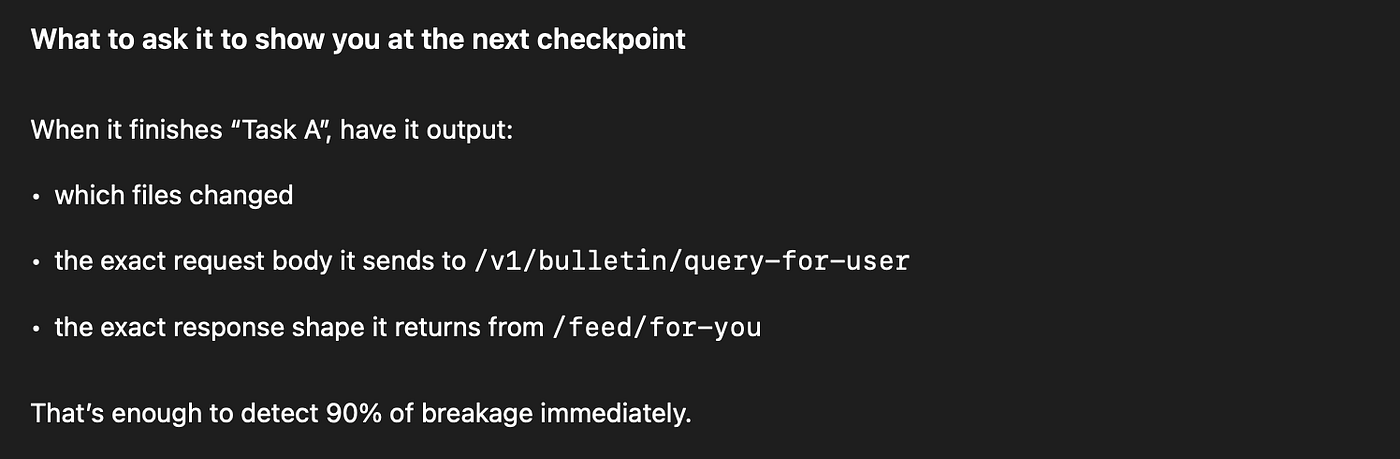
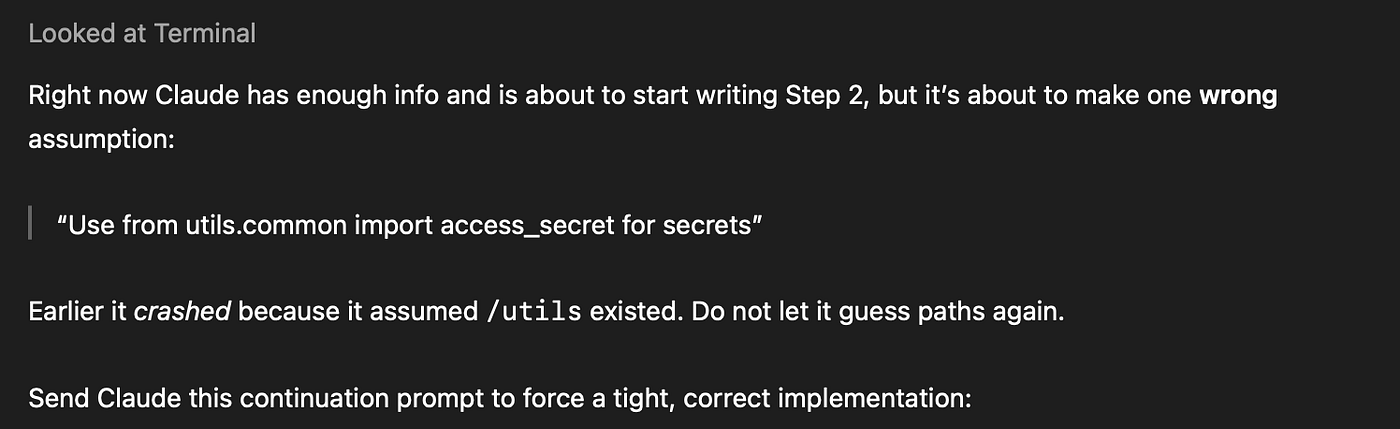
No prompting required. It just did it.
And then the most important moment: Claude Code runs out of context. This is the wall every heavy Claude Code user hits. The conversation compacts, critical details vanish, and you’re left trying to reconstruct state from memory and Markdown files.
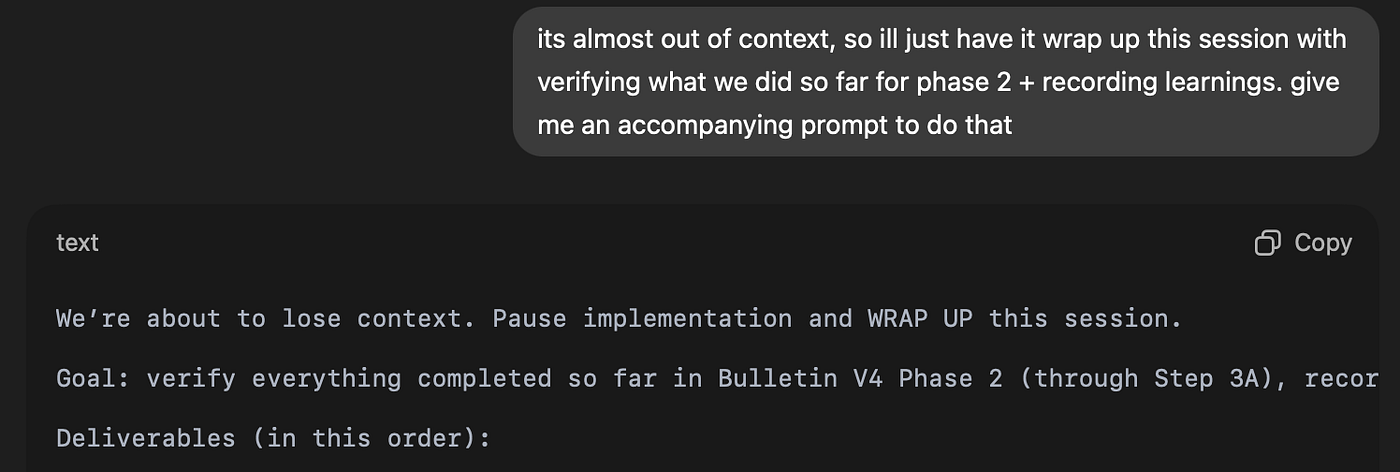
ChatGPT’s handoff prompt included the full ongoing history from its own conversation. Continuation across Claude Code instances with consistent, accumulated context.
I kept it to one terminal instance for now. But this is obviously the architecture for an external orchestrator managing parallel executions too.
The Quiet Productivity Gains
Here’s the part that surprised me most.
I started using ChatGPT for all the little questions that usually break the flow of a Claude Code session: explaining a specific package in depth, fixing a broken Python environment that Claude Code decided wasn’t its problem, understanding why a dependency conflict exists instead of just brute-forcing past it.
These questions are important. They build my understanding. But asking them inside Claude Code means waiting for Opus to take an unreasonably long time answering something simple, and burning context on things that have nothing to do with the current task.
Now I have a separate AI designated to do nothing other than talk to me and monitor Claude Code. The familiarity of a chat interface works because what I actually want from this layer is conversation, not agentic behavior (definitely will be trying Codex next). And it’s far more stable than trying to have two agents edit the same codebase simultaneously.
The Evaluation Problem
This is the part I didn’t anticipate solving.
Working only in Claude Code created a void: only Claude was commenting on, iterating on, and learning from its own mistakes. No external signal. No second opinion. Just one model evaluating its own output in a closed loop.
Adding ChatGPT as an observer immediately catches things Claude Code misses. Over time, it builds a nuanced understanding of my patterns, my projects, my failure modes. Not in Markdown files that get compacted away, but in ChatGPT’s native memory: summarization, trait tracking, persistent context that actually sticks.
I experiment constantly with different methods, prompts, protocols. Instead of running blind, I now have something that tells me when an approach makes sense and when it doesn’t.
Two models looking at the same problem from different angles. That’s not redundancy; it’s depth.
What Actually Matters Here
Three takeaways worth keeping:
Separation of concerns applies to your AI workflow too. Claude Code builds. ChatGPT monitors, explains, and maintains context. Trying to make one model do both is how you get 200k tokens of tangled conversation where half of it is you asking “wait, what were we doing?”
Context persistence is the bottleneck nobody talks about. The auto-compact wall isn’t a minor annoyance; it’s where most agentic coding sessions silently degrade. An external observer that carries history across instances changes the failure mode entirely.
Self-evaluation is not evaluation. One model reviewing its own output in a closed loop will always have blind spots. A second model with different training, different priors, and a completely separate conversation history catches things the first one structurally cannot.
Where This Goes Next
The obvious extension: ChatGPT as a proper orchestrator for parallel Claude Code instances, each running in separate terminals, each with context managed externally. Or Codex so it can do even more, like write/update the existing local configuration and read files itself. I did try connecting Cursor, but all it can do so far is read the current active file.
Less obvious but more interesting: using ChatGPT’s persistent memory as a long-term learning layer. Not just session continuity, but accumulated pattern recognition across weeks and months of work. Which protocols actually reduced bugs. Which architectural decisions held up. Which ones didn’t.
Right now this is two apps and a split screen. The tooling will catch up. The insight that won’t change is simpler: the best way to supervise an AI building things is with another AI whose only job is to pay attention.
메타데이터
- post_id
- 7b9bf5bb8ea9
- slug
- i-put-chatgpt-in-charge-of-claude-code-7b9bf5bb8ea9
- url
- https://medium.com/@ariaxhan/i-put-chatgpt-in-charge-of-claude-code-7b9bf5bb8ea9
- canonical_url
- https://medium.com/@ariaxhan/i-put-chatgpt-in-charge-of-claude-code-7b9bf5bb8ea9
- author_url
- https://medium.com/@ariaxhan
- status
- ok
- fetched_at
- 2026-06-17 08:20:12