Challenges of Temperature Measurement in Electromagnetic Environments
The sensor looked perfect on the bench. Then it moved beside a powerful field source and everything changed. The temperature drifted, the…
Challenges of Temperature Measurement in Electromagnetic Environments
The sensor looked perfect on the bench. Then it moved beside a powerful field source and everything changed. The temperature drifted, the control loop overcorrected, and the team started blaming the process when the real problem was the measurement itself.
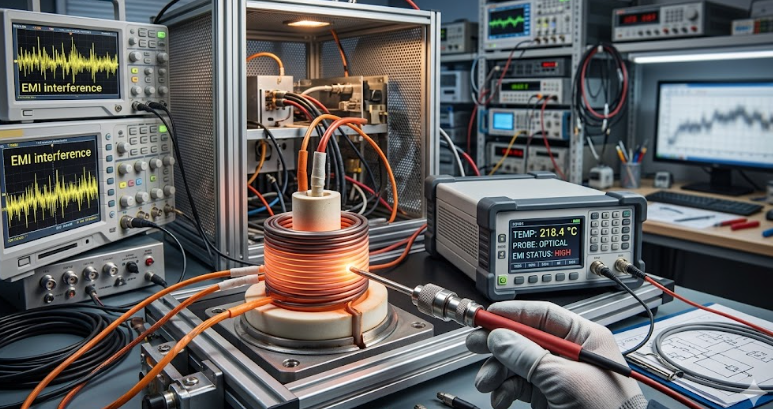
That is the central challenge of temperature measurement in electromagnetic environments. In places shaped by strong magnetic fields, radiofrequency energy, high voltage, or induction, a reading can become contaminated before it ever reaches the operator. What looks like a temperature problem is often a sensing problem first.
That distinction affects quality, process consistency, and safety. The FDA says it receives around 300 adverse event reports for MRI scanners and coils each year, and most reports describe heating or burns.
Key Takeaways
- In harsh field conditions, the sensor can be influenced by the environment it is supposed to observe.
- Traditional electrical sensors may fail because of induced voltage, self-heating, or grounding issues.
- The best choice depends on the field, the installation geometry, and the cost of a bad reading.
- Non-electrical sensing approaches deserve attention when shielding and filtering stop solving the problem.
Why does temperature measurement in electromagnetic environments fail so often?
In plain language, temperature measurement in electromagnetic environments becomes difficult whenever the sensing method depends on very small electrical signals. Thermocouples are useful and widely trusted, but they work by generating a tiny voltage from a temperature difference. That means outside disturbances can corrupt the result before it reaches the instrument.
The trouble is not always obvious. A sensor can tolerate heat, vibration, and demanding industrial use, yet still become vulnerable when strong electromagnetic energy enters the picture. In these settings, the reading may shift because voltage is induced into the wires, because the sensing element is heated by the field itself, or because common-mode voltage between grounds changes the signal the instrument sees.
What actually goes wrong with traditional electrical sensors?
Three failure modes appear repeatedly.
First, induced voltage. Changing electromagnetic fields can generate electrical potential in sensor wiring. When the measurement signal is already tiny, even a modest disturbance can bend the reading away from reality.
Second, sensor self-heating. In alternating fields, conductive materials can heat internally. A sensor may start reporting a temperature that partly reflects its own exposure to the field rather than the target. This is especially troublesome near motors, generators, induction systems, and RF equipment.
Third, grounding problems. When the sensor sits inside energized equipment or near multiple grounds, common-mode voltage can alter the measured signal. At that point, the issue is not calibration drift. It is the measurement architecture itself.
What should engineers compare before choosing a sensor?
A better decision starts with four questions:
- Is the environment electrically quiet or field-intense?
- Is contact measurement required, or would non-contact work?
- Is the target surface, material, or geometry friendly to the chosen method?
- What is the cost of a false reading?
That checklist changes the conversation. Instead of asking, “Which sensor do we usually use?” the team starts asking, “Which sensing principle is least likely to mislead us here?”
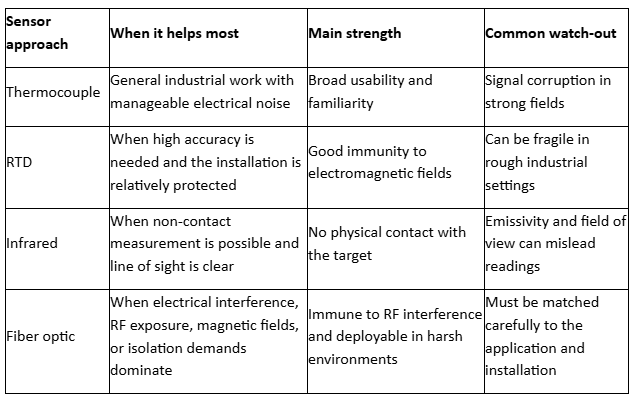
When should a team move beyond thermocouples?
Not every harsh environment requires a complete technology shift. But some do.
If the process itself creates strong electromagnetic energy, if metallic leads distort the field, or if confidence inside that field matters, then it is time to reassess the sensing principle. NIST work on RF-heated material noted that conventional thermocouple or thermistor probes often could not be used in those conditions because metallic leads created severe field distortions, intense heating, and large measurement artifacts. The same work described optical approaches developed because usual electrical methods struggled in those environments.
That is where photonic and fiber-based sensing becomes more than a niche option. NIST describes optical temperature sensor technology as electromagnetic-interference resistant, deployable in harsh environments, fast in response, and relevant to industrial process control, health, biotechnology, and food-related settings.
Stop Doing This. Start Doing That
Do this: define the field conditions before you pick the sensor. Not that: assume a sensor that survives heat will also survive electromagnetic exposure.
Do this: test the full measurement chain, including routing and grounding. Not that: validate the sensor only on a quiet bench and expect the same behavior in the live system.
Do this: consider non-contact or non-electrical methods when the environment punishes conductive probes. Not that: keep adding signal cleanup tools to a sensing method that is fundamentally mismatched to the application.
As Galileo Galilei put it, “Measure what is measurable, and make measurable what is not so.”
A familiar lab-to-line scenario
Imagine a development team working on a heated medical or industrial assembly. On the bench, a conventional probe looks acceptable. Once the product moves into an MRI-adjacent test setup, an RF chamber, or an induction-based process, the temperature trace becomes noisy, then oddly stable in the wrong places. The team checks the software, swaps the logger, and repeats the run. The result still feels off.
What changed was not the need to measure temperature. What changed was the physics around the measurement.
In that kind of scenario, the practical path is to reframe the job around the environment, not the habit. Decide whether contact is truly needed. Review whether the sensor material can be influenced by the field. Check whether the wiring path is acting like an antenna. Then choose the sensing method that adds the least measurement burden to the system.
This is also why application support matters. In harsh electromagnetic settings, probe placement, routing geometry, grounding, and target emissivity all matter. The right answer is rarely just “buy a sensor.” It is “build the right measurement approach.”
Conclusion
Harsh electromagnetic environments expose a truth many teams only learn after lost time and failed tests: temperature is not hard to measure until the environment starts talking back. Once fields, induced voltages, self-heating, and grounding conflicts enter the scene, the safest path is to match the sensing principle to the physics of the application. That is why temperature measurement in electromagnetic environments is as much a strategy decision as a hardware decision.
For organizations that need help evaluating fiber optic sensing, dielectric measurement, demonstrations, or application fit across MRI, RF, induction, research, food, and medical settings, **BioTemp4Life** is the perfect option.
FAQ
What makes a good temperature sensor for harsh electromagnetic environments?
One that resists interference, matches the installation geometry, and stays reliable under live field conditions.
What are the best practices before selecting a temperature sensor?
Map field intensity, grounding conditions, wire routing, contact needs, and the cost of a bad reading.
What trends are shaping temperature measurement in harsh environments?
More teams are considering non-electrical and photonic sensing when interference or isolation becomes central.
How to reduce false temperature readings near RF or induction equipment?
Review wire routing, grounding, and sensor placement first, then question whether the sensing principle itself should change.
When to hire an application specialist for temperature measurement?
When strong fields or unexplained drift make the measurement hard to trust.
What services are useful for complex temperature measurement problems?
Application review, demonstrations, setup guidance, and dielectric evaluation are often more useful than hardware alone.
메타데이터
- post_id
- 7bb39c8facb0
- slug
- challenges-of-temperature-measurement-in-electromagnetic-environments-7bb39c8facb0
- url
- https://medium.com/@kevin.johnsonnnn2024/challenges-of-temperature-measurement-in-electromagnetic-environments-7bb39c8facb0
- canonical_url
- https://medium.com/@kevin.johnsonnnn2024/challenges-of-temperature-measurement-in-electromagnetic-environments-7bb39c8facb0
- author_url
- https://medium.com/@kevin.johnsonnnn2024
- status
- ok
- fetched_at
- 2026-06-15 20:49:13