I Used to Write Spaghetti Code — Then I Found This Python Feature
I didn’t know it at the time, but I was writing code like someone frantically scribbling directions on a napkin. Every new task became…
I Used to Write Spaghetti Code — Then I Found This Python Feature
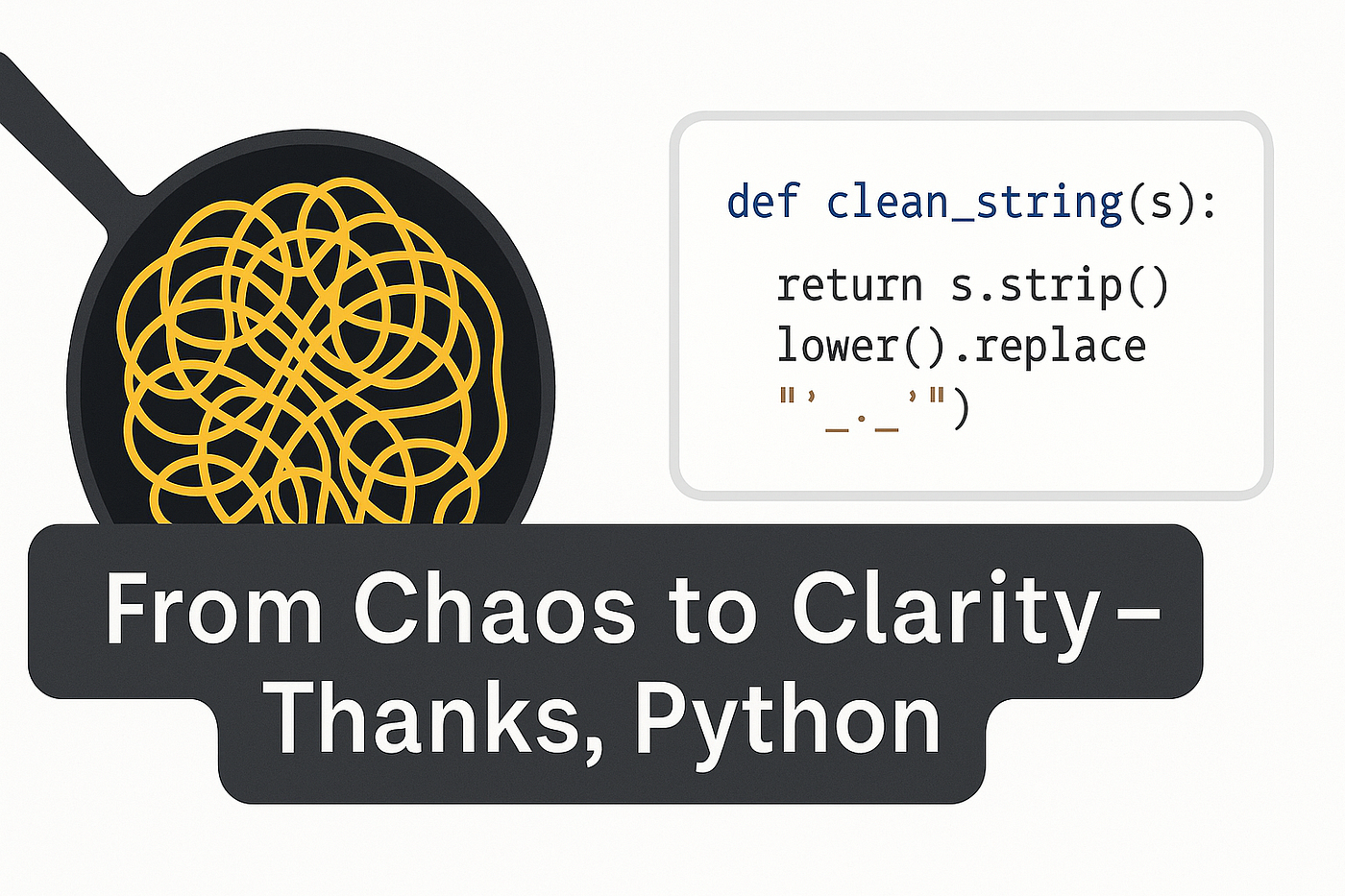
I didn’t know it at the time, but I was writing code like someone frantically scribbling directions on a napkin. Every new task became another clumsy “and then this happens…” bolted onto a growing pile of logic that barely held together.
It wasn’t scalable. It wasn’t maintainable. It certainly wasn’t elegant.
But it worked. And that’s all I cared about — until it didn’t.
Until I spent three hours fixing a bug in a file I couldn’t even read anymore. Until I was afraid to touch my own scripts. Until my confidence as a developer started quietly dissolving under the weight of my own code.
That was my life with spaghetti code.
And then Python handed me something small but life-altering: the ability — and encouragement — to think in functions.
Not in the “write a function to make it shorter” kind of way, but in a “this is how your brain should approach problems” kind of way.
And everything changed.
The Slow Burn of Spaghetti
If you’ve never heard the term spaghetti code, congratulations — you probably learned programming the right way.
But for the rest of us, it’s code that’s twisted, tangled, and interdependent in ways that make it fragile and almost unreadable. It’s like building a house out of noodles. Change one wall and the ceiling caves in.
In my early Python days, I wrote entire scripts with no real structure:
- 300 lines in one file.
- Repeated logic with copy-pasted variations.
- A single giant loop doing five different things.
- Global variables everywhere.
It started out innocently enough — a little automation here, a quick data clean-up there. But small scripts have a sneaky habit of growing into monsters. One feature turns into five. One exception becomes a dozen edge cases.
Before I knew it, I was drowning in my own logic, unable to trace what any part of the script actually did without rereading the whole thing.
The Moment of Realization
One night, frustrated and exhausted, I decided to try something different. Not out of wisdom, but desperation.
I took a chunk of repeated logic and pulled it into a small function. Nothing fancy — just a name and a return value. It looked like this:
pythondef clean_string(s):
return s.strip().lower().replace(" ", "_")It was just a few lines, but seeing it extracted gave me something I hadn’t felt in weeks: clarity.
Suddenly, I could describe what that part of my program did in plain English. Even better, I could reuse it. And tweak it. And test it on its own.
I felt like I had just discovered punctuation after writing run-on sentences my whole life.
The Philosophy Behind Python’s Simplicity
Python doesn’t force structure on you. That’s both its superpower and its trap.
If you want to write messy, all-in-one procedural code? It won’t stop you.
But Python also offers something subtler — a kind of whisper in its syntax that nudges you toward clarity. The def keyword isn’t just a tool; it’s an invitation.
An invitation to name your thoughts, modularize your logic, and write code that tells a story.
Python’s design is deeply human. It doesn’t just let you write instructions — it encourages you to write in sentences, each function a complete thought.
This shifted how I approached problems. I stopped thinking “How do I code this?” and started asking “What’s the responsibility of this piece?” or “Can I give this logic a name?”
Suddenly, every block of code became an opportunity for abstraction. I began to think like a craftsman, not a repairman. And my projects stopped feeling like patchwork.
Functions as Mental Architecture
Once I embraced functions, something else happened: I could breathe again.
No longer trapped in a wall of scrolling logic, I could zoom out and see the shape of my code — its layers, its rhythm, its logic.
Functions gave me:
🧠 Mental clarity
I could now reason about my code. Functions let me chunk ideas. They reduced cognitive load. I didn’t have to juggle everything in my head anymore.
🧪 Testability
I could run small pieces of logic in isolation. No more running the whole script just to see if one transformation worked.
🧩 Reusability
Functions turned my throwaway code into tools I could reuse, improve, and share across projects.
📖 Readability
Coming back to code after a week no longer felt like deciphering a forgotten language. With good function names, the code started to read like documentation.
The Real Lesson: Write Like You Think
I used to believe that writing clever, dense code was a sign of a good developer.
Now I know better.
Writing clear, simple, and well-structured code — that’s the true mark of mastery.
And Python, in its quiet elegance, helped me see that.
It taught me that the best code reads like a story: One where each function is a sentence, Each script is a chapter, And the whole program flows with intention.
Final Thoughts
I didn’t need to switch languages. I didn’t need a new framework. I just needed to respect the structure of my own logic.
And Python gave me the perfect tool to do that.
So if you’re stuck in spaghetti code — overwhelmed by your own creations, afraid to touch what you’ve written — start small. Take one chunk. Give it a name. Wrap it in a function.
It’s not just cleaner code.
It’s better thinking.
메타데이터
- post_id
- 7bb4d279c51e
- slug
- i-used-to-write-spaghetti-code-then-i-found-this-python-feature-7bb4d279c51e
- url
- https://medium.com/@hadiyolworld007/i-used-to-write-spaghetti-code-then-i-found-this-python-feature-7bb4d279c51e
- canonical_url
- https://medium.com/@hadiyolworld007/i-used-to-write-spaghetti-code-then-i-found-this-python-feature-7bb4d279c51e
- author_url
- https://medium.com/@hadiyolworld007
- status
- ok
- fetched_at
- 2026-06-09 15:37:30