Chandrayaan-3 Reveals A Highly Active Plasma Zone Near The Moon’s South Pole.
Scientists now say the region near the Moon’s south pole is far more electrically active than earlier studies suggested. Fresh data from…
Chandrayaan-3 Reveals A Highly Active Plasma Zone Near The Moon’s South Pole.
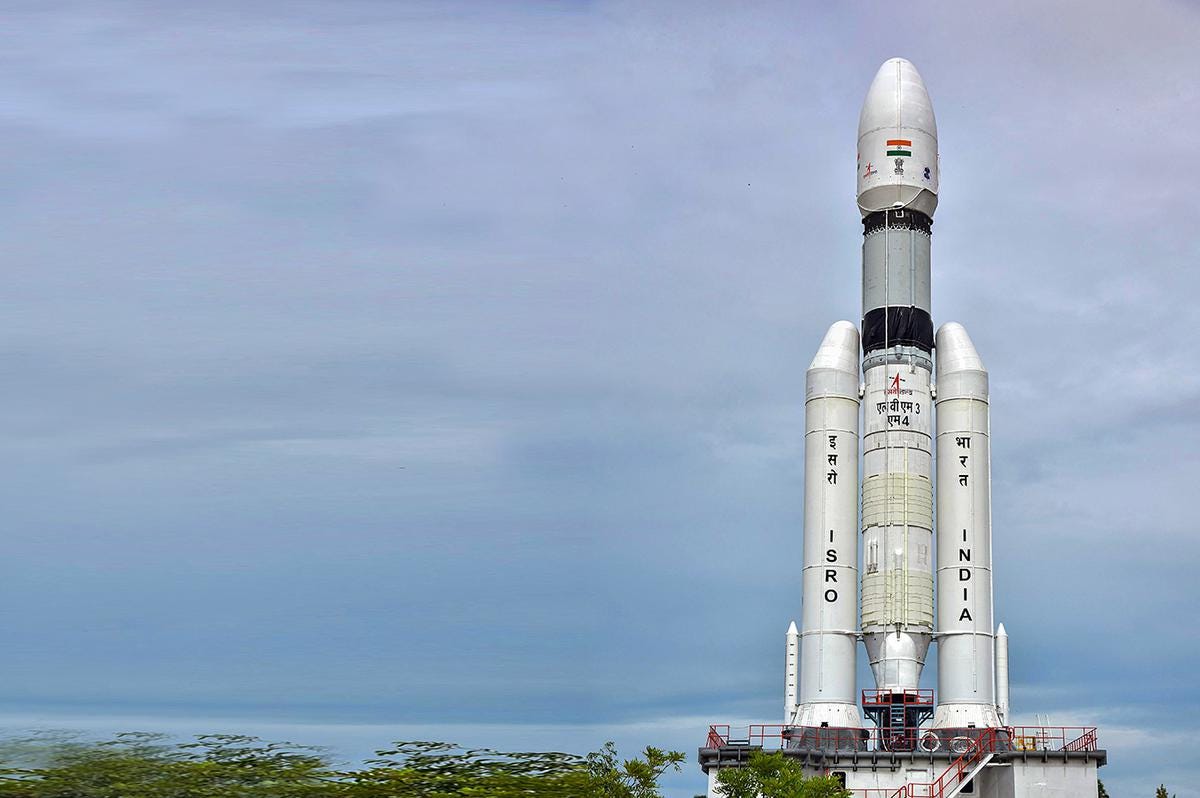
The RAMBHA-LP instrument offers the first ground truth of the Moon’s near-surface plasma at southern high latitudes.
Scientists now say the region near the Moon’s south pole is far more electrically active than earlier studies suggested. Fresh data from Chandrayaan-3’s lander, Vikram, shows that the plasma above the surface is both denser and more energetic than what remote observations had indicated.
Plasma, the fourth state of matter, is made of charged particles that respond strongly to electromagnetic forces. On the Moon, this thin layer — often called the lunar ionosphere — forms through several interacting processes. The solar wind hits the surface with a constant stream of electrons and ions. Sunlight knocks electrons out of surface atoms through the photoelectric effect. And when the Moon moves into Earth’s magnetotail for a few days each month, it collects additional charged particles. All of this creates a shifting, electrically active zone just above the ground.
Chandrayaan-3’s RAMBHA-LP instrument has delivered the first direct, low-altitude readings from this region. At Shiv Shakti Point (69.3° S, 32.3° E), it measured electron densities between 380 and 600 particles per cubic centimetre, far higher than earlier estimates based on remote-sensing methods such as radio occultation. The probe also found that electrons close to the surface carry high energies, with kinetic temperatures between 3,000 and 8,000 Kelvin, showing that the plasma is much more energised than previously thought.
The data also reveals that this plasma does not stay constant. It changes with the Moon’s position in its orbit. During daylight, when the Moon faces the Sun and is outside Earth’s magnetic influence, the solar wind and the thin exosphere drive most of the variation. But when the Moon enters the geomagnetic tail behind Earth, the plasma behaves differently as new streams of charged particles shape the region.
Insights from the mission hint that molecules such as carbon dioxide and water vapour may also influence the lunar ionosphere. The in-house Lunar Ionospheric Model suggests that molecular ions, not just elemental ones, play a real role in forming the charged layer above the surface.
These findings give researchers a clearer baseline for future missions, especially those heading to the Moon’s southern high latitudes. RAMBHA-LP was developed by the Space Physics Laboratory at the Vikram Sarabhai Space Centre in Thiruvananthapuram, marking another step forward in India’s space science work.
메타데이터
- post_id
- 7bc4c30409ea
- slug
- chandrayaan-3-reveals-a-highly-active-plasma-zone-near-the-moons-south-pole-7bc4c30409ea
- url
- https://medium.com/@tech__manas/chandrayaan-3-reveals-a-highly-active-plasma-zone-near-the-moons-south-pole-7bc4c30409ea
- canonical_url
- https://medium.com/@tech__manas/chandrayaan-3-reveals-a-highly-active-plasma-zone-near-the-moons-south-pole-7bc4c30409ea
- author_url
- https://medium.com/@tech__manas
- status
- ok
- fetched_at
- 2026-08-02 03:07:16