Horizontal Scaling in System Design: Why Every Engineer Should Learn It
A system that works perfectly for 1,000 users can become unusable when that number grows to 100,000. The application logic may remain…
Blog Thumbnail
Horizontal Scaling in System Design: Why Every Engineer Should Learn It
A system that works perfectly for 1,000 users can become unusable when that number grows to 100,000. The application logic may remain unchanged. The database queries may still be correct. Infrastructure, however, tells a different story.
This is one of the reasons horizontal scaling has become a fundamental concept in modern system design.
Whether you’re building a startup product, preparing for system design interviews, architecting enterprise platforms, or operating large-scale distributed systems, understanding horizontal scaling is no longer optional. Traffic spikes happen. User bases grow. Data accumulates. Systems that cannot scale eventually become bottlenecks.
The challenge isn’t building software that works today.
The challenge is building software that continues to work when demand increases by 10x, 100x, or even 1,000x.
This is where horizontal scaling enters the conversation.
What Is Horizontal Scaling?
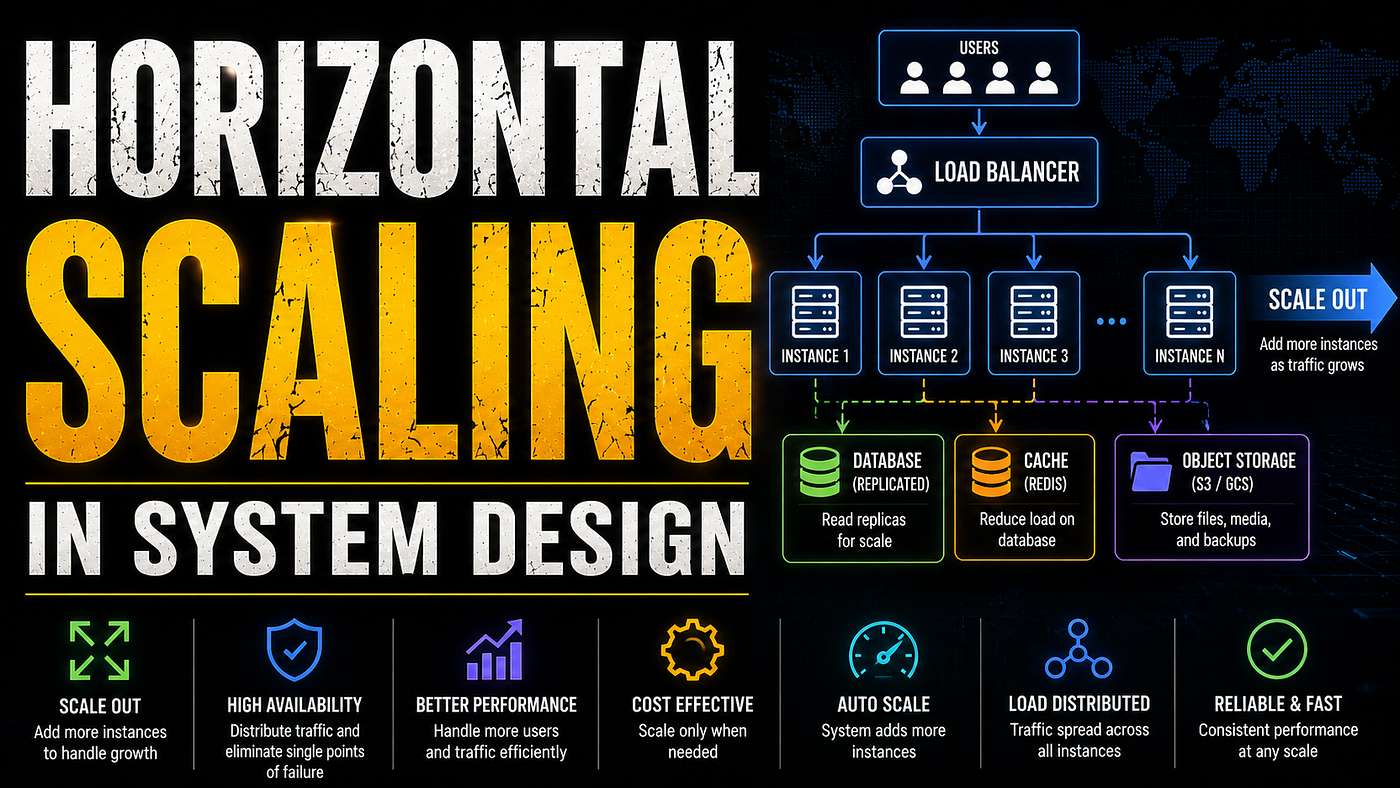
Horizontal scaling refers to increasing system capacity by adding more machines or instances instead of increasing the resources of a single machine.
Instead of upgrading one server from 16 GB RAM to 64 GB RAM, you add additional servers and distribute the workload among them.
Consider a simple example:
Before Scaling

        Users
          |
          v
     +----------+
     | Server A |
     +----------+
After horizontal scaling:
             Users
               |
               v
        +-------------+
        | Load Balancer|
        +-------------+
          /    |    \
         /     |     \
        v      v      v

   +------+ +------+ +------+
   | Srv1 | | Srv2 | | Srv3 |
   +------+ +------+ +------+
Instead of relying on a single machine, requests are distributed across multiple servers.
More machines.
More capacity.
Better fault tolerance.
Different challenges.
Horizontal Scaling vs Vertical Scaling
Before discussing implementation details, it’s important to understand the difference between horizontal and vertical scaling.
Vertical Scaling
Vertical scaling means adding more resources to an existing machine.
Examples:
- Upgrading CPU cores
- Increasing RAM
- Adding faster SSDs
- Improving network bandwidth
Server
  |
  +-- 8 GB RAM
  +-- 4 CPU

Becomes

Server
  |
  +-- 64 GB RAM
  +-- 32 CPU
Advantages:
- Simple implementation
- Minimal architecture changes
- Easier operational management
Disadvantages:
- Hardware limits exist
- Expensive at scale
- Creates a single point of failure
Horizontal Scaling
Horizontal scaling adds additional machines.
1 Server

Becomes

5 Servers

Becomes

50 Servers

Becomes

500 Servers
Advantages:
- Near unlimited growth potential
- Higher availability
- Better fault tolerance
- Reduced dependency on individual machines
Disadvantages:
- Increased complexity
- Distributed system challenges
- Network communication overhead
- Data consistency issues
Why Large Systems Prefer Horizontal Scaling
Companies operating at internet scale rarely depend on a single machine.
There is a practical reason.
A powerful server has limits.
Eventually you reach hardware ceilings.
You cannot keep upgrading forever.
Horizontal scaling removes this constraint by distributing traffic across many servers.
Consider a social media platform receiving:
10 Million Requests / DayHandling all traffic through a single machine introduces significant risks.
- Server crashes
- Hardware failures
- Maintenance downtime
- Resource exhaustion
With horizontally scaled infrastructure:
100 Servers

Each Handles

100,000 Requests / Day
The load becomes manageable.
Failure becomes survivable.
Growth becomes predictable.
The Role of Load Balancers
Horizontal scaling would be impossible without load balancing.
A load balancer acts as the entry point to the system.
Its responsibility is straightforward:
Receive incoming traffic and distribute requests among available servers.
Users
  |
  v

+--------------+
| LoadBalancer |
+--------------+
   |   |   |
   v   v   v
Server Server Server
  A      B      C
Popular load-balancing algorithms include:
Round Robin
Requests are distributed sequentially.
Req1 -> Server A
Req2 -> Server B
Req3 -> Server C
Req4 -> Server A
Least Connections
Traffic is routed to the server handling the fewest active connections.
Useful when request durations vary significantly.
Weighted Round Robin
Servers with greater capacity receive more traffic.
Server A Weight = 5
Server B Weight = 2
Server C Weight = 1
Server A handles a larger share of requests.
Stateless Services Make Scaling Easier
One of the first principles of scalable architecture is designing stateless services.
A stateless server does not store session information locally.
Bad approach:
User Login
   |
   v
Server A Stores Session
If future requests reach Server B:
User Request
   |
   v
Server B

Session Missing
The request fails.
A common solution involves moving session data to a shared storage layer.
          +-------+
          | Redis |
          +-------+
           /  |  \
          /   |   \
      Server Server Server
        A      B      C
Any server can process any request.
Scaling becomes significantly easier.
Database Scaling Challenges
Application servers scale relatively well.
Databases are different.
Adding more database servers introduces new complexities.
Data must remain synchronized.
Queries must remain correct.
Transactions must remain reliable.
This is where architects start making trade-offs.
Read Replicas
A common strategy is separating read and write operations.
           Primary DB
                 |
        ------------------
        |       |        |
        v       v        v
     Replica Replica Replica
Writes:
INSERT
UPDATE
DELETE
Go to the primary database.
Reads:
SELECTCan be distributed across replicas.
Benefits include:
- Increased read throughput
- Reduced primary database load
- Improved scalability
Database Sharding
Sometimes a single database can no longer store all data efficiently.
Sharding partitions data across multiple databases.
Example:
User ID 1-1M   -> Shard A
User ID 1M-2M  -> Shard B
User ID 2M-3M  -> Shard C
Instead of storing everything in one database, data is distributed.
Advantages:
- Increased storage capacity
- Improved throughput
- Better scalability
Challenges:
- Cross-shard joins
- Rebalancing shards
- Operational complexity
Caching and Horizontal Scaling
Adding servers alone does not solve every scaling problem.
Repeated database queries remain expensive.
Caching reduces unnecessary workload.
Example:
User Request
      |
      v
    Cache
      |
   Hit/Miss
      |
      v
   Database
Popular caching technologies include:
- Redis
- Memcached
Frequently accessed data can be served directly from cache.
Latency decreases.
Database load decreases.
Infrastructure costs often decrease as well.
Horizontal Scaling and Fault Tolerance
One overlooked advantage of horizontal scaling is resilience.
Imagine a system running on a single machine.
Machine Failure

System Down
Now consider:
Server A
Server B
Server C
Server D
Server E
If Server C fails:
Server A ✓
Server B ✓
Server C ✗
Server D ✓
Server E ✓
The application remains available.
Users may not even notice the failure.
This characteristic becomes increasingly important for systems requiring high availability.
Common Problems Introduced by Horizontal Scaling
Horizontal scaling solves many issues.
It also introduces new ones.
Engineers often underestimate this reality.
Distributed Transactions
A transaction spanning multiple services becomes difficult to coordinate.
Service A
Service B
Database C
What happens if one operation succeeds while another fails?
Maintaining consistency becomes challenging.
Network Latency
Communication between machines is slower than communication within a single machine.
Every remote call introduces:
- Latency
- Timeouts
- Retry logic
- Failure handling
Data Consistency
Multiple copies of data can drift apart.
Eventually consistent systems accept temporary inconsistencies.
Strongly consistent systems sacrifice performance for correctness.
Choosing between them depends on business requirements.
Operational Complexity
More servers create more operational responsibilities.
Monitoring.
Logging.
Alerting.
Security.
Deployment management.
Capacity planning.
Everything becomes larger in scope.
Real-World Examples
Most modern internet companies rely heavily on horizontal scaling.
Streaming platforms distribute traffic across thousands of servers.
E-commerce platforms scale during seasonal sales.
Ride-sharing applications process millions of concurrent location updates.
Cloud providers themselves are built around the assumption that machines will fail.
The architecture does not prevent failures.
It expects them.
Then continues operating regardless.
That distinction matters.
Design Principles for Effective Horizontal Scaling
Several principles consistently appear in scalable architectures:
Keep Services Stateless
Stateless services are easier to replicate.
Cache Aggressively
Reduce unnecessary database access.
Distribute Traffic Properly
Use reliable load balancing mechanisms.
Design for Failure
Assume machines will fail.
Build recovery mechanisms accordingly.
Scale Databases Carefully
Database scaling is often harder than application scaling.
Monitor Everything
Without observability, scaling problems become invisible until users notice them.
Final Thoughts
Horizontal scaling is not merely a technique for handling more traffic. It represents a different way of thinking about systems.
Instead of building bigger machines, engineers build architectures composed of many smaller machines working together.
That shift sounds simple.
In practice, it introduces an entirely new set of engineering challenges: distributed communication, consistency guarantees, fault tolerance, replication strategies, caching layers, and operational complexity.
Yet modern applications have little choice.
User growth demands it.
Data growth demands it.
Availability requirements demand it.
The systems powering today’s largest platforms were not built by continually upgrading a single server. They were built by embracing horizontal scaling and designing architectures capable of expanding far beyond the limits of any individual machine.
For anyone serious about system design, understanding horizontal scaling is one of the most valuable investments you can make. Many advanced concepts — load balancing, caching, database sharding, replication, distributed systems, and cloud-native architecture — begin from this single idea.
Add more machines.
Distribute the work.
Keep the system running.
메타데이터
- post_id
- 7bc5d19bcb4d
- slug
- horizontal-scaling-in-system-design-why-every-engineer-should-learn-it-7bc5d19bcb4d
- url
- https://medium.com/algomart/horizontal-scaling-in-system-design-why-every-engineer-should-learn-it-7bc5d19bcb4d
- canonical_url
- https://medium.com/algomart/horizontal-scaling-in-system-design-why-every-engineer-should-learn-it-7bc5d19bcb4d
- author_url
- https://medium.com/@yashjainio
- status
- ok
- fetched_at
- 2026-06-22 12:55:45