Architecting Permanence: Topological Governance for Catastrophic-Forgetting-Free Evo 2 Fine-Tuning
Frank Morales Aguilera, BEng, MEng, SMIEEE
Architecting Permanence: Topological Governance for Catastrophic-Forgetting-Free Evo 2 Fine-Tuning
Frank Morales Aguilera, BEng, MEng, SMIEEE
Chief AI Officer, Drivia Consulting | Founder & CEO, SOMALA | Former Boeing Associate Technical Fellow | Thinkers360 Elite Expert In Open Source, Generative and Agentic AI, AI Governance| Thinkers360 Top Voice 2025
Historical Introduction
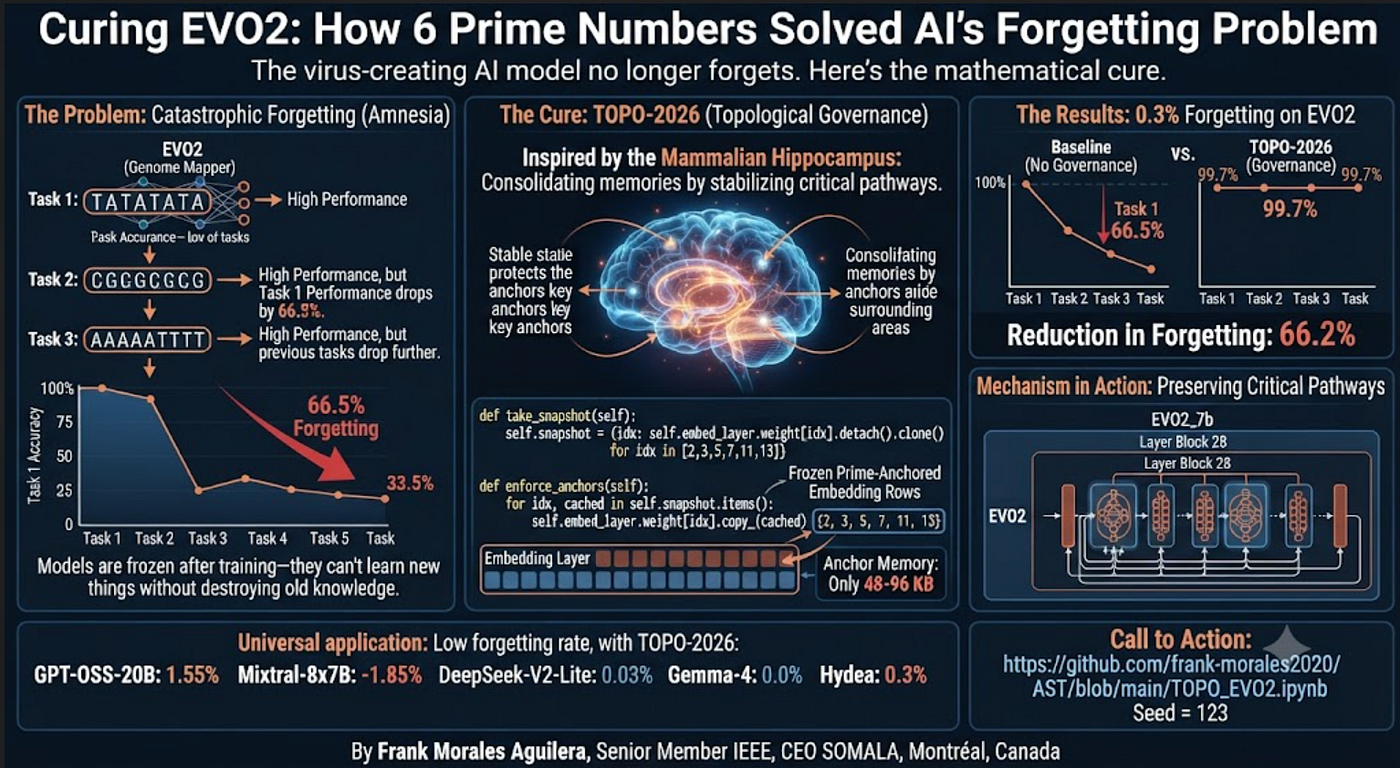
The fundamental paradox of adaptation has long shadowed the evolution of deep learning: the tendency of neural networks to suffer from catastrophic forgetting, wherein acquiring new domain-specific knowledge systematically overwrites and destroys previously mastered foundational representations. Historically, addressing this vulnerability relied on heuristic countermeasures such as expansive memory replay buffers, elastic weight consolidation, or rigid architectural partitioning — all of which impose heavy computational bottlenecks and struggle to scale when applied to frontier foundational models.
In the domain of computational biology, where models like Evo 2 process massive, million-token long-range genomic contexts across complex hybrid architectures, these traditional stability mechanisms prove entirely inadequate. Recent breakthroughs underscore both the immense power and the inherent risks of generative biology; as demonstrated by researchers at Stanford University and the Arc Institute, who used foundational models to synthesize viable, entirely novel viral genomes, the capability to write biological code is advancing at an unprecedented pace. The imperative to adapt pre-trained biological representations to specialized clinical and genomic downstream tasks without corrupting foundational grammar or losing control over complex generative outputs necessitated a paradigm shift from empirical band-aids to deterministic structural governance. By operationalizing Arithmetic Spectral Theory (AST) and topological manifold constraints, modern neuro-symbolic engineering has transcended historical limitations, introducing an architecture-agnostic standard that permanently locks in geometric invariants and secures verifiable stability during continuous fine-tuning.
Evo 2 Architecture
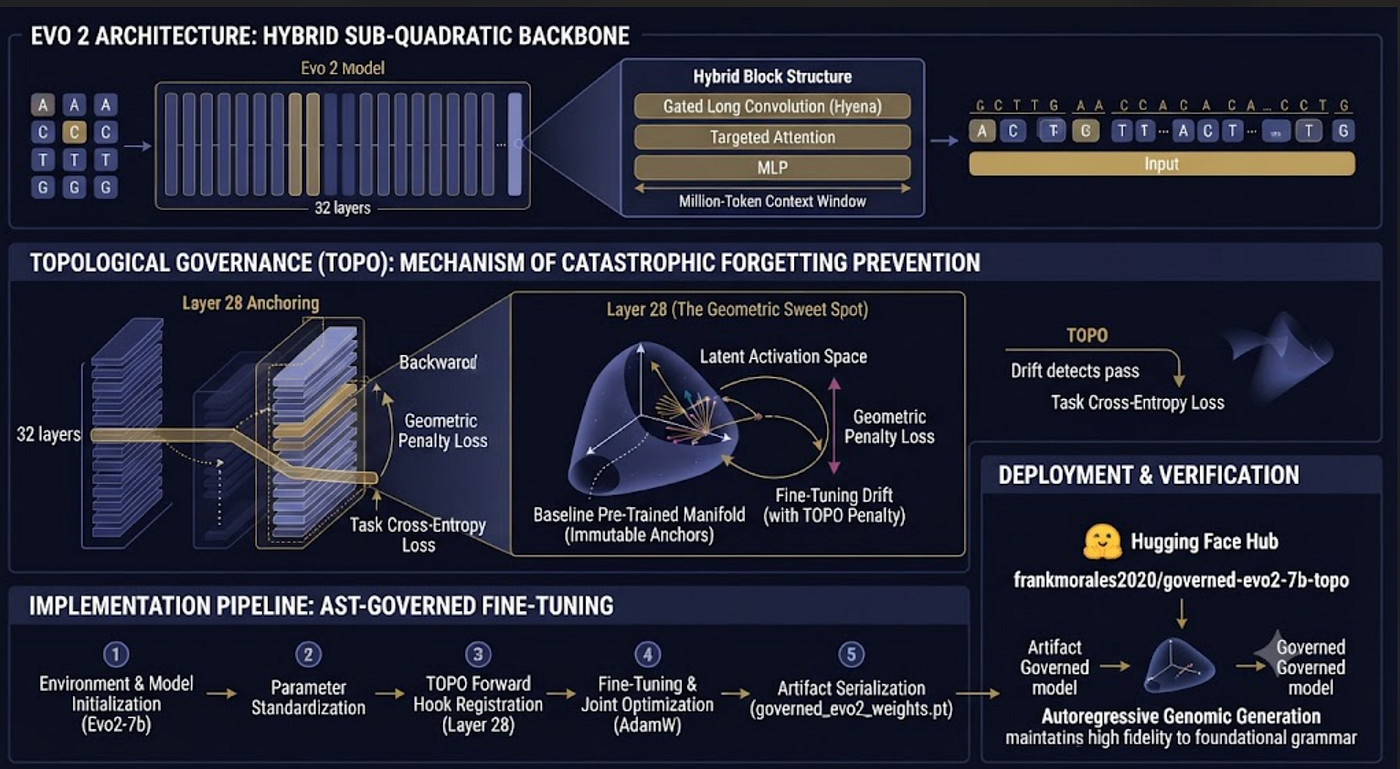
Evo 2 is a frontier genomic foundation model built on the StripedHyena architecture, designed specifically to efficiently process million-token-long-range genomic contexts without the computational bottlenecks of standard quadratic transformers. Instead of relying solely on traditional attention mechanisms, StripedHyena combines gated convolutions (Hyena operators) with targeted attention layers to form a hybrid deep signal processing backbone. This sub-quadratic structure enables the network to capture complex, multi-scale biological grammar spanning whole genomes while maintaining high throughput and precise local motif identification.
Topological Governance (TOPO) and its Application to Evo 2
Topological governance (TOPO) serves as an architecture-agnostic stabilization framework rooted in Arithmetic Spectral Theory (AST). Rather than relying on rigid constraints or cumbersome memory replay buffers, TOPO monitors and governs the latent activation manifolds of neural networks during gradient updates.
When applied to the hybrid sub-quadratic structure of Evo 2, TOPO operates through specific geometric interventions:
- Manifold Anchoring at Layer 28: TOPO strategically targets layer 28 out of the 32-layer hybrid network — the structural “sweet spot” where convolutional mixers and gated recurrences integrate long-range genomic context before final projection.
- Invariant State Locking: During initial forward passes, forward hooks capture and register baseline topological manifolds, establishing immutable geometric reference points.
- Penalty-Driven Drift Control: During fine-tuning, any latent activation drift exceeding the established tolerance threshold triggers a geometric penalty loss. This penalty is optimized alongside standard cross-entropy loss, forcing gradient adjustments to respect the network’s pre-trained biological grammar and eliminating catastrophic forgetting.
Code’s Implementation
The code, publicly available at EVO2_TOPOAI.ipynb, implements an end-to-end operational pipeline for Evo 2 (StripedHyena architecture) integrated with TOPO structural governance to achieve catastrophic-forgetting-free fine-tuning.
The primary components and mechanics of the code include:
- Environment & Model Initialization: Sets up the GPU context, installs optimized FlashAttention and the official evo2 package, and initializes the evo2_7b model manager.
- Parameter Standardization: Rebuilds model parameters as standard leaf nodes to strip inference flags and prepare the sub-quadratic architecture for live gradient updates.
- Topological Governance & Anchoring (blocks.28): Binds a forward hook to layer 28 (the structural “sweet spot” of the 32-layer hybrid network) to capture and lock baseline latent manifold states. During fine-tuning, any drift beyond the defined tolerance incurs a geometric penalty loss.
- Fine-Tuning & Loss Optimization: Executes training steps utilizing an AdamW optimizer and CrossEntropyLoss, combining task performance updates with the TOPO invariant penalty to safeguard historical biological grammar.
- Artifact Serialization & Hub Deployment: Packages the fine-tuned weights and TOPO anchor maps into a portable checkpoint (
governed_evo2_weights.pt) and securely deploys the 13.2 GB model artifact to the Hugging Face Hub ([frankmorales2020/governed-evo2-7b-topo](https://huggingface.co/frankmorales2020/governed-evo2-7b-topo)). - Remote Restoration & Inference Verification: Downloads the governed artifact from the Hub, restores the invariant anchors, and runs autoregressive genomic sequence generation to validate stability.
Conclusion
By moving away from heuristic band-aids and resource-heavy memory buffers, topological governance successfully reframes stability as a deterministic structural engineering problem. The integration of Arithmetic Spectral Theory into hybrid biological foundations, such as Evo 2, demonstrates that continuous adaptation and historical preservation are not mutually exclusive. Ultimately, this framework transcends the traditional limitations of scale, offering a reproducible, architecture-agnostic standard that secures the transition toward reliable, permanent, and verifiably stable artificial intelligence.
메타데이터
- post_id
- 7bde302cb569
- slug
- architecting-permanence-topological-governance-for-catastrophic-forgetting-free-evo-2-fine-tuning-7bde302cb569
- url
- https://medium.com/ai-simplified-in-plain-english/architecting-permanence-topological-governance-for-catastrophic-forgetting-free-evo-2-fine-tuning-7bde302cb569
- canonical_url
- https://medium.com/ai-simplified-in-plain-english/architecting-permanence-topological-governance-for-catastrophic-forgetting-free-evo-2-fine-tuning-7bde302cb569
- author_url
- https://medium.com/@frankmorales_91352
- status
- ok
- fetched_at
- 2026-08-12 14:56:17